

Heart Rate Zones
What Is Heart Rate Zone Training?
Heart rate zone training helps endurance athletes control workout intensity, build aerobic capacity, and balance easy, threshold, and high-intensity work.

Heart Rate Zone Training, in Plain Language
Heart rate zone training is a way to organize endurance workouts by effort. Instead of describing a run, ride, row, hike, or ski session as simply easy or hard, you train within heart-rate ranges that represent different levels of internal strain.
The purpose is not to chase a number every second. It is to make intensity visible. Useful zones help you keep easy days easy, place harder work deliberately, and review whether the training you completed matched the training you intended.
Researchers call the pattern across intensities training intensity distribution. Intensity can be measured with heart rate, blood lactate, respiratory gas exchange, power, pace, speed, or perceived exertion. A review by Stöggl and Sperlich explains that well-trained endurance athletes use several of these signals and that no single distribution is automatically best in every context (Frontiers in Physiology). Heart rate remains popular because it is accessible and continuous, but it is most useful when interpreted beside output and perceived effort.
How Heart Rate Zones Work
Heart rate is an internal load measure: it shows how your body responded to the pace, power, grade, temperature, fatigue, and recovery state of a workout. Pace and power are external load measures: they show the work you produced. A training-load consensus statement recommends considering both rather than treating one number as the whole workout (Bourdon et al.).
Zones turn a continuous response into practical ranges. Exercise physiologists often describe three broad intensity domains separated by two thresholds:
- Below the first lactate or ventilatory threshold: sustainable, low-intensity work.
- Between the first and second thresholds: moderate-to-heavy work that becomes progressively less sustainable.
- Above the second threshold: severe intensity, where fatigue develops quickly.
A 2023 systematic review describes ventilatory and blood-lactate thresholds as common anchors for prescribing endurance intensity, while also showing meaningful individual uncertainty when alternative threshold methods are compared (Kaufmann et al.). Consumer platforms commonly translate those physiological domains into three, five, or seven named zones.
This is why the same label can mean different things across devices. One app may calculate Zone 2 from maximum heart rate, another from heart-rate reserve, and a coach may anchor it to the first ventilatory threshold. Compare the actual beats-per-minute boundaries before assuming two systems describe the same effort.
The Five Heart Rate Zones
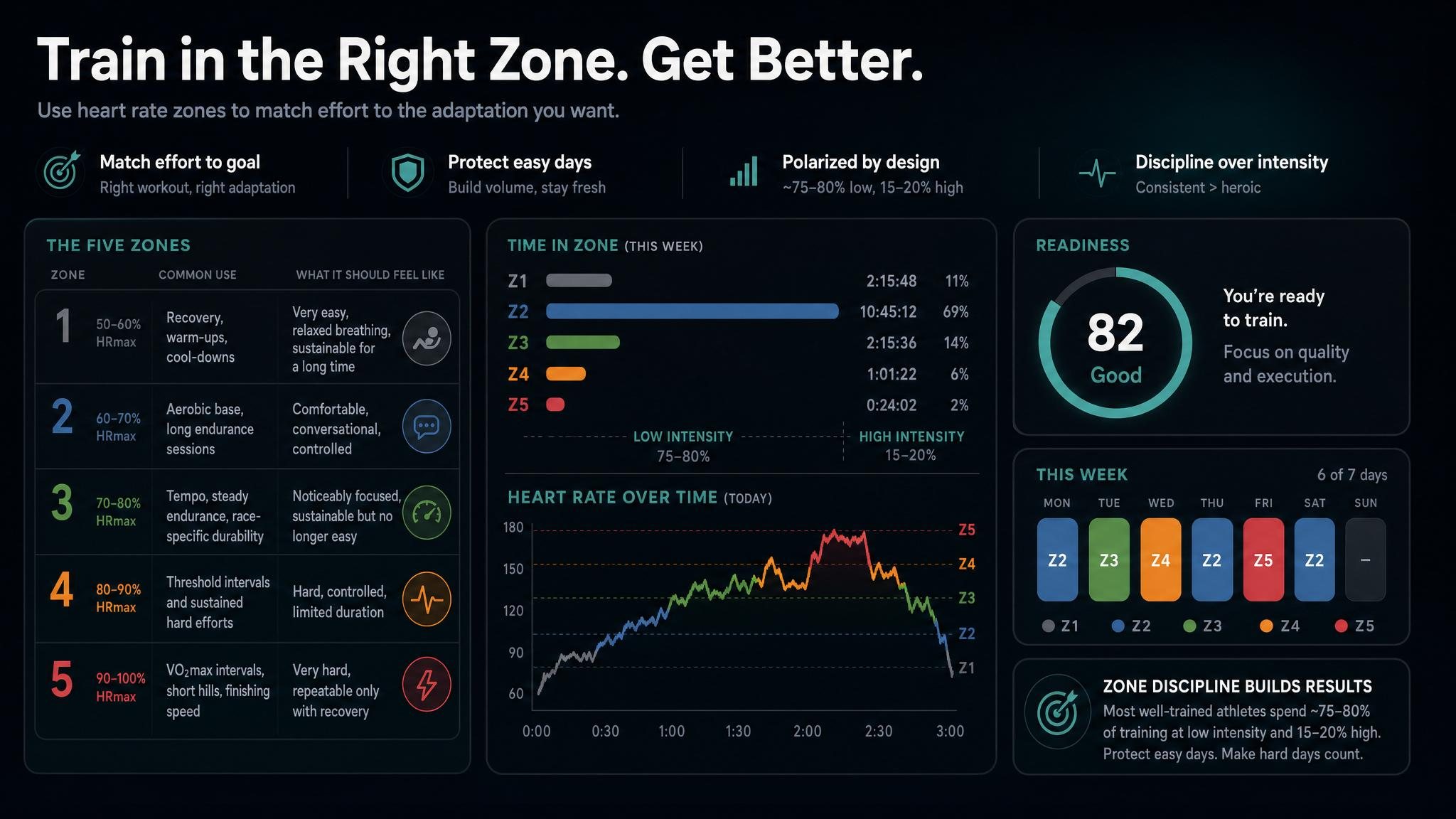
A five-zone model is easy to use and detailed enough for most endurance training.
| Zone | Main purpose | Typical feel |
|---|---|---|
| Zone 1 | Recovery, warm-ups, cool-downs | Very easy; relaxed breathing |
| Zone 2 | Aerobic base and long endurance work | Comfortable and conversational |
| Zone 3 | Tempo and steady, moderate work | Focused; sustainable but not easy |
| Zone 4 | Threshold intervals and sustained hard work | Hard but controlled |
| Zone 5 | VO2max intervals, short hills, finishing speed | Very hard; requires recovery |
These labels are not magic switches. Adaptation happens across a continuum, and a brief move across a boundary does not transform the workout. The zones are useful because they give workout intent and post-workout analysis a shared language.
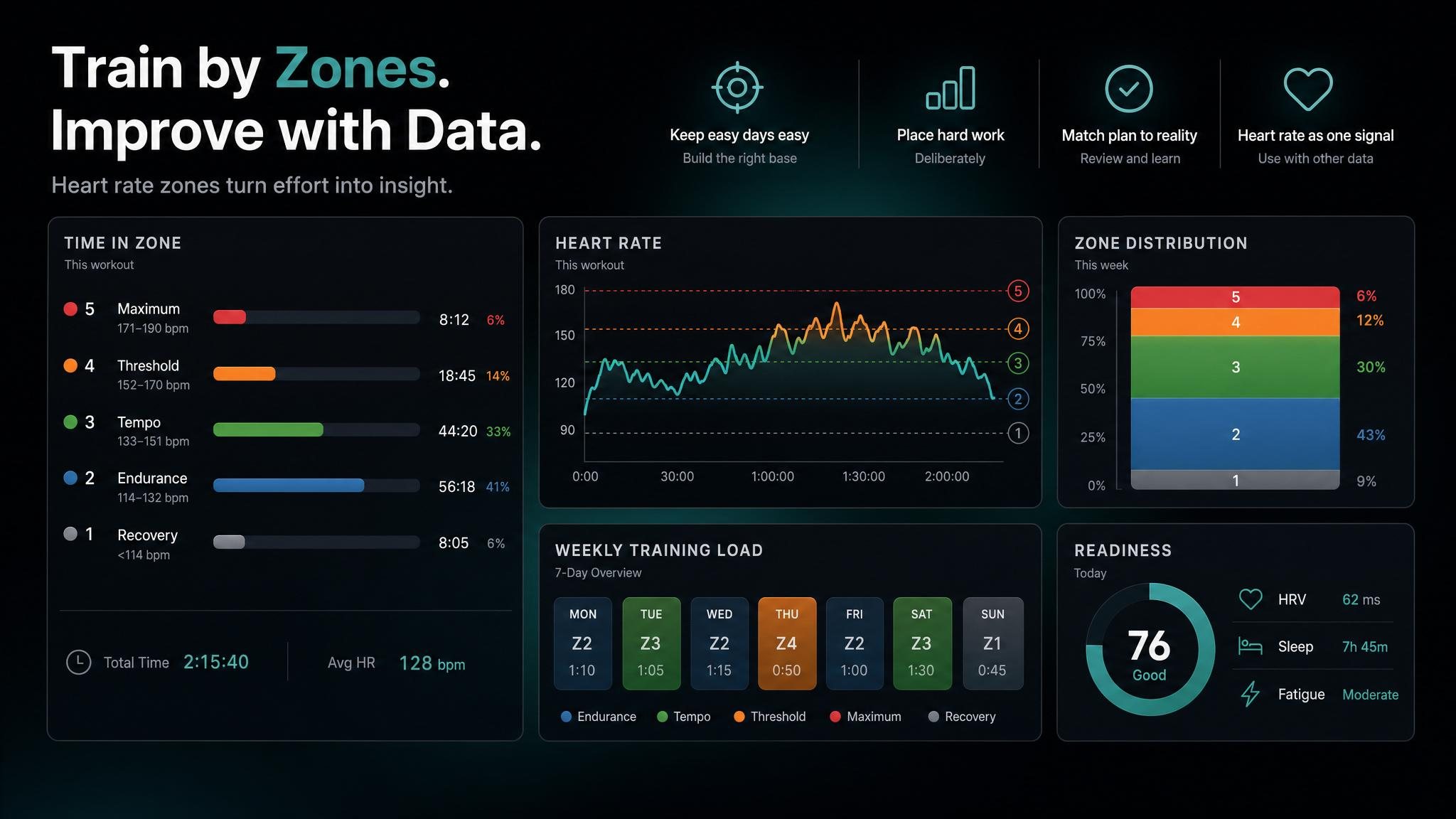
For a deeper explanation of the boundaries, read what the five heart rate zones mean.
Why Endurance Athletes Use Zones
Heart rate zones solve four practical problems.
First, they make easy training honest. A pace that feels comfortable for 30 minutes can still be too costly when repeated day after day. A heart-rate range provides a guardrail for aerobic work, especially during high-volume blocks or in conditions that make pace misleading.
Second, zones separate workout purposes. Recovery, aerobic endurance, tempo, threshold, and VO2max sessions should not all collapse into the same moderate intensity. A planned target makes the difference clear before the workout begins.
Third, zones improve review. Time in zone can show whether a long run stayed mostly aerobic, whether a threshold session reached its target, and whether heat or fatigue made a familiar pace more internally demanding.
Fourth, zones make trends comparable. When your calculation method remains stable, you can compare weeks and spot accidental moderate intensity, increasing drift, or changes in the heart-rate cost of familiar output.
Many trained endurance athletes accumulate most of their volume below the first threshold, with smaller amounts of moderate and high-intensity work. However, that observation is not a command to copy an exact 80/20 split. A 2025 individual-participant network meta-analysis found no overall difference between polarized and pyramidal programs for VO2max or time-trial performance; the response appeared to vary with performance level (Rosenblat et al.). Zones help you observe and control intensity—they do not prescribe one universal distribution.
How to Calculate Useful Zones
The strongest zone setup uses a recent lab or field test that estimates your first and second thresholds. Those boundaries are individual and directly related to the physiological domains the zones are meant to describe.
If threshold testing is unavailable, common alternatives are:
- Measured maximum heart rate. Zones are percentages of the highest credible heart rate reached in a suitable maximal test or competition.
- Heart-rate reserve. The Karvonen-style method uses both maximum and resting heart rate, which adjusts the range for the individual resting value.
- Age-predicted maximum heart rate. This is convenient but should be treated as a starting estimate, not a personal measurement.
Tanaka, Monahan, and Seals proposed the widely used 208 − 0.7 × age equation after analyzing laboratory data, but individual error remains large enough to shift practical zone boundaries (Journal of the American College of Cardiology01054-8)). Research in recreational marathon runners also found that age-based equations can misclassify individuals even when group averages look reasonable (Nikolaidis et al.).
Use this priority order:
- Recent, credible threshold values.
- A measured maximum heart rate or heart-rate reserve.
- An age estimate, checked against breathing, perceived effort, and repeatable workouts.
The heart-rate-zone calculator compares common methods. The guide to calculating heart rate zones explains why their results differ.
Do not change the method every week. Stable settings make comparisons meaningful. Update them when a better test, a major fitness change, medication, illness, or repeated workout evidence shows the current boundaries no longer fit.
Match the Zone to the Workout
A zone target should answer a training question. It should not become a score to maximize.
| Workout purpose | Primary signal | What to review afterward |
|---|---|---|
| Recovery | Mostly Zone 1 | Did it reduce stiffness without adding fatigue? |
| Easy endurance | Mostly Zone 2 | Was breathing conversational; did heart rate drift? |
| Tempo | Controlled Zone 3 | Was the moderate work deliberate? |
| Threshold | Repeatable Zone 4 blocks | Did pace or power stay controlled across intervals? |
| Short intervals | Pace, power, and RPE first | Did quality stay high despite heart-rate lag? |
A short interval can be successful with little recorded Zone 5 time because heart rate responds after the work begins. A hilly long run can include short Zone 3 excursions without becoming a tempo session. Interpret the color through the workout’s planned purpose, sequence, terrain, and perceived effort.
For specific sessions, see threshold workouts explained and VO2max intervals explained.
Cross-Check Heart Rate With How the Workout Felt
Heart rate can rise at the same pace because of heat, dehydration, altitude, fatigue, illness, caffeine, or stress. It can also be wrong because of poor sensor contact. That is why zone training should include a reality check.
The talk test is a useful field signal. At moderate intensity, most people can talk but not sing; during vigorous activity, only a few words are comfortable (CDC). Perceived exertion adds another compact record of the internal cost.
If the watch reports Zone 2 while breathing is labored and speech is broken, do not force the session harder to satisfy the display. Check the boundaries, conditions, fatigue, and sensor. If heart rate looks unusually high but pace and perceived effort are normal, inspect the file for spikes or dropouts before changing the plan.
Wrist optical sensors are useful but imperfect. In a validation study across several consumer devices, heart-rate error varied by device, activity, and participant even though heart-rate estimates were generally better than energy-expenditure estimates (Shcherbina et al.). Use a well-fitted watch for steady training and consider a chest strap when accurate interval response matters.
Use Zones Differently for Running and Cycling
The same athlete may not have identical heart-rate boundaries in every sport. Body position, active muscle mass, cooling, terrain, and sport-specific fitness change the relationship between heart rate and output.
Runners can use heart rate as a guardrail on easy and long runs, then combine it with pace, grade, and RPE for faster work. The heart-rate-zone guide for runners includes example weeks and explains how to handle hills and heat.
Cyclists should read heart rate beside power when power is available. Watts show external work; heart rate shows its internal cost. The heart-rate-zone guide for cyclists covers field testing and indoor riding, while power zones versus heart-rate zones explains common mismatches.
Review the Workout, Not Only the Average
Average heart rate can hide intervals, pauses, hills, warm-up, recovery, cooldown, and late drift. Review a session in this order:
- Name the intended purpose.
- Check total time and percentage in each zone.
- Find where zone changes happened on the timeline.
- Compare heart rate with pace, power, elevation, weather, and perceived effort.
- Add context such as sleep, soreness, stress, fueling, hydration, and sensor quality.
- Make one proportionate decision for the next workout.
The complete post-workout heart-rate-zone analysis guide walks through that process. For steady sessions, also learn what heart-rate drift means. One unusual file may deserve only a note; a repeating pattern deserves an adjustment.
A Four-Week Starting Process
Week 1: establish a baseline
Choose one zone method and record the boundaries. Complete normal workouts without chasing the display. Note whether easy breathing and Zone 2 broadly agree.
Week 2: protect easy training
Use Zone 2 as a guardrail on one or two steady sessions. Slow down early when heat or hills raise heart rate. Learn what controlled aerobic work feels like rather than forcing an exact percentage.
Week 3: separate easy and hard days
Keep easy sessions genuinely easy and add one planned quality session appropriate to your current training. Use pace, power, or RPE beside heart rate when intensity changes quickly.
Week 4: review the pattern
Compare the four weeks. Look for repeatable easy volume, accidental Zone 3, late drift, unusually high heart rate at familiar output, and whether hard work stayed controlled. Make one change—or keep the settings unchanged if they fit.
Common Mistakes
- Treating boundaries as physiological walls. The body responds on a continuum, and field measurements contain uncertainty.
- Using an age formula as a personal test. It estimates a population average, not your exact maximum.
- Chasing the target every second. Heart rate lags and responds to terrain, heat, and fatigue.
- Ignoring pace, power, and effort. Heart rate describes internal cost, not the whole workout.
- Changing zones after one odd session. Fix obvious sensor issues and look for repeated mismatches first.
- Letting every easy day become moderate. Repeated accidental Zone 3 work can compromise the separation between easy and hard training.
How Zone Training Log Fits
Zone Training Log turns workout data from Apple Health and Health Connect into zone summaries that can be compared with effort, notes, and longer-term patterns. It does not make every training decision for you. It keeps the evidence visible so you can decide whether each workout matched its purpose.
Apple Watch users can start with how Apple calculates heart-rate zones and when they are accurate, then follow the workflow for turning Apple Watch data into a training log. To connect individual sessions to a longer view, use the weekly endurance review habit.
Frequently Asked Questions
What zone should most endurance training use?
Many endurance plans place a large share of training below the first threshold, commonly overlapping with easy Zone 1 and Zone 2 work. The correct share depends on experience, sport, training phase, available time, and the zone system. Use the purpose of the week instead of forcing every athlete into one percentage.
Is Zone 2 the same on every watch and app?
No. Platforms may calculate zones from maximum heart rate, heart-rate reserve, threshold heart rate, or a proprietary model. Compare the beats-per-minute boundaries before assuming two Zone 2 labels mean the same intensity.
Should I slow down as soon as I cross a boundary?
Not always. Brief changes from hills, heat, or measurement noise may not change the workout. Look at duration, breathing, RPE, terrain, and whether heart rate stays elevated. On a strict recovery day, slowing early is often useful; on a rolling long run, short excursions can be normal.
Can I train by zones without a chest strap?
Yes. Wrist sensors can be useful for steady work and trends. A chest strap becomes more valuable when readings are jumpy, conditions are cold, movement is irregular, or precise interval data matters.
What if heart rate and perceived effort disagree?
Treat the disagreement as information. Check the sensor, weather, terrain, fatigue, illness, caffeine, hydration, and fueling. If effort is high while output is poor, do not push harder merely to reach a target. Record the mismatch and look for repetition.
Conclusion
Heart rate zone training gives endurance athletes a repeatable language for intensity. Set credible ranges, match each zone to a workout purpose, cross-check the display with pace, power, breathing, and perceived effort, and review patterns across weeks rather than judging isolated files.
The value is not the color itself. The value is making easy training, hard training, recovery, and progression easier to see and easier to adjust.

Our editorial approach & AI disclosure
We use AI to help research, organize, and draft some articles. Every article is reviewed by a human editor and aims to reflect current evidence-based training practices and scientific literature.
Read our editorial policy