


Threshold Workouts Explained
Threshold workouts are hard-steady sessions that build the ability to hold strong aerobic output without turning every hard day into a race. Learn what they are, how they should feel, and how to use them.
Jun 18, 202610 min read

Introduction
Threshold workouts are controlled hard-steady sessions. They sit above easy aerobic training and below all-out intervals. The goal is to spend time near the intensity where breathing, lactate production, and muscular fatigue begin to rise faster, while still staying controlled enough to repeat the work.
For runners, that might mean cruise intervals such as 4 x 8 minutes at threshold effort. For cyclists, it might mean 3 x 12 minutes near threshold power. The exact format can change, but the purpose stays the same: build the ability to hold strong aerobic output without turning the workout into a race.
Threshold training is useful because endurance performance depends on more than maximum aerobic capacity. Reviews of endurance training describe lactate threshold, VO2 max, and economy as major performance-related variables, and threshold can improve with training (Jones and Carter, 2000). The practical value is simple: if you can move your hard-steady boundary upward, race pace or race power can feel more sustainable.
The risk is that threshold feels productive enough to overuse. It is not easy training. It is also not a weekly test of toughness. Done well, it is repeatable pressure. Done poorly, it becomes a hidden race effort that steals recovery from the rest of the week.
Choose the right threshold resource
Use this workout guide when you need session formats, intensity control, and progression. For the physiology, testing methods, and threshold-zone definition, start with What Is Lactate Threshold?. To turn a tested value into training bands, use the lactate-threshold calculator.
What Is A Threshold Workout?
A threshold workout is training near the hard-steady boundary often associated with lactate threshold, ventilatory threshold, critical power, functional threshold power, or field-test threshold pace. Those terms are related, but they are not perfectly interchangeable. A review of lactate threshold concepts found that different threshold definitions and testing methods can identify different points on the same physiological curve (Faude, Kindermann, and Meyer, 2009).
That is why threshold should be treated as a range, not a magic number. In practice, threshold work is the effort where you are clearly working, breathing is deep, and conversation is limited to short phrases. You can hold the effort for meaningful blocks, but you cannot ignore it.
The session should feel hard enough to demand focus and easy enough that pace, power, form, and breathing remain stable. If the first repetition already feels like a time trial, you are probably above threshold. If you can chat comfortably, you are probably below it.
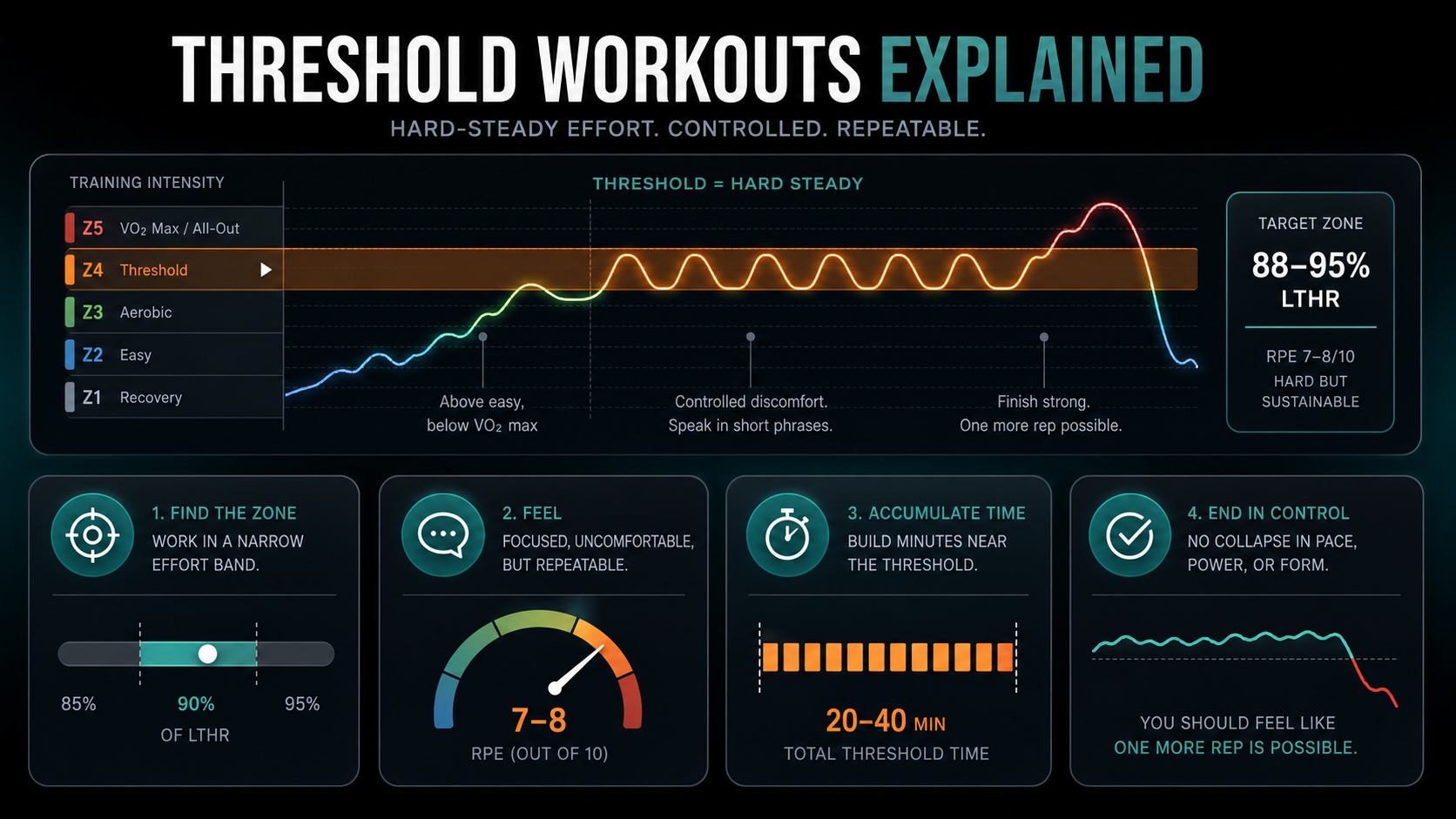
The infographic uses a common threshold-planning idea: a narrow high-aerobic band close to a tested threshold anchor. It is not a lab definition. Your actual threshold range depends on the test, sport, training status, fatigue, heat, terrain, and device accuracy.
Why Threshold Workouts Work
Threshold workouts work because they give the aerobic system a strong but manageable stimulus. You spend enough time near a meaningful performance boundary to challenge oxygen delivery, carbohydrate use, lactate handling, and muscular endurance. You also avoid the extreme fatigue cost of repeated maximal efforts.
Interval training in general is a potent stimulus. MacInnis and Gibala reviewed interval-training adaptations and described improvements in aerobic capacity and skeletal-muscle oxidative adaptations from interval methods, while also noting that the interaction between intensity, duration, and frequency still needs careful interpretation (MacInnis and Gibala, 2017). That matters for threshold work: the workout is not just "hard." The dose and recovery shape the adaptation.
Threshold also fits well with endurance goals because it is specific to sustained performance. A 5K runner, half-marathon runner, marathoner, time-trial cyclist, gravel rider, and triathlete all need the ability to hold discomfort without repeatedly spiking above control. Threshold work trains that skill.
But threshold does not replace easy volume. Seiler's review of endurance training distribution described a pattern among successful endurance athletes in which most training is low intensity, with a smaller share devoted to high-intensity work (Seiler, 2010). For everyday athletes, the takeaway is not to chase an exact ratio. It is to keep threshold as one ingredient inside a mostly aerobic week.
How Threshold Should Feel
Threshold should feel like controlled discomfort. Your breathing is strong but rhythmic. You can speak a short phrase, not a full conversation. You are focused, but not panicked. The workout asks for discipline more than aggression.
For running, threshold pace often feels like a pace you could race for roughly 45-70 minutes when fresh, though this estimate varies by athlete and event. For cycling, threshold power is often tied to a field-test or model-based anchor such as FTP or critical power, but the workout still needs an effort check. A number can be correct on paper and wrong on a hot, tired, windy day.
Use three questions during the session:
- Can I hold this effort without bargaining with myself?
- Is my pace or power stable rather than fading?
- Could I complete one more controlled repetition if I had to?
If the answer to all three is yes, the intensity is probably close. If the answer is no in the first half of the workout, back off. Threshold is not meant to prove how long you can suffer above threshold.
Common Threshold Workout Formats
Threshold workouts can be continuous or broken into intervals. Continuous tempo work is simple, but it is easy to overcook because there is no reset. Cruise intervals and broken threshold sessions make the effort easier to control because short recoveries keep the session repeatable.
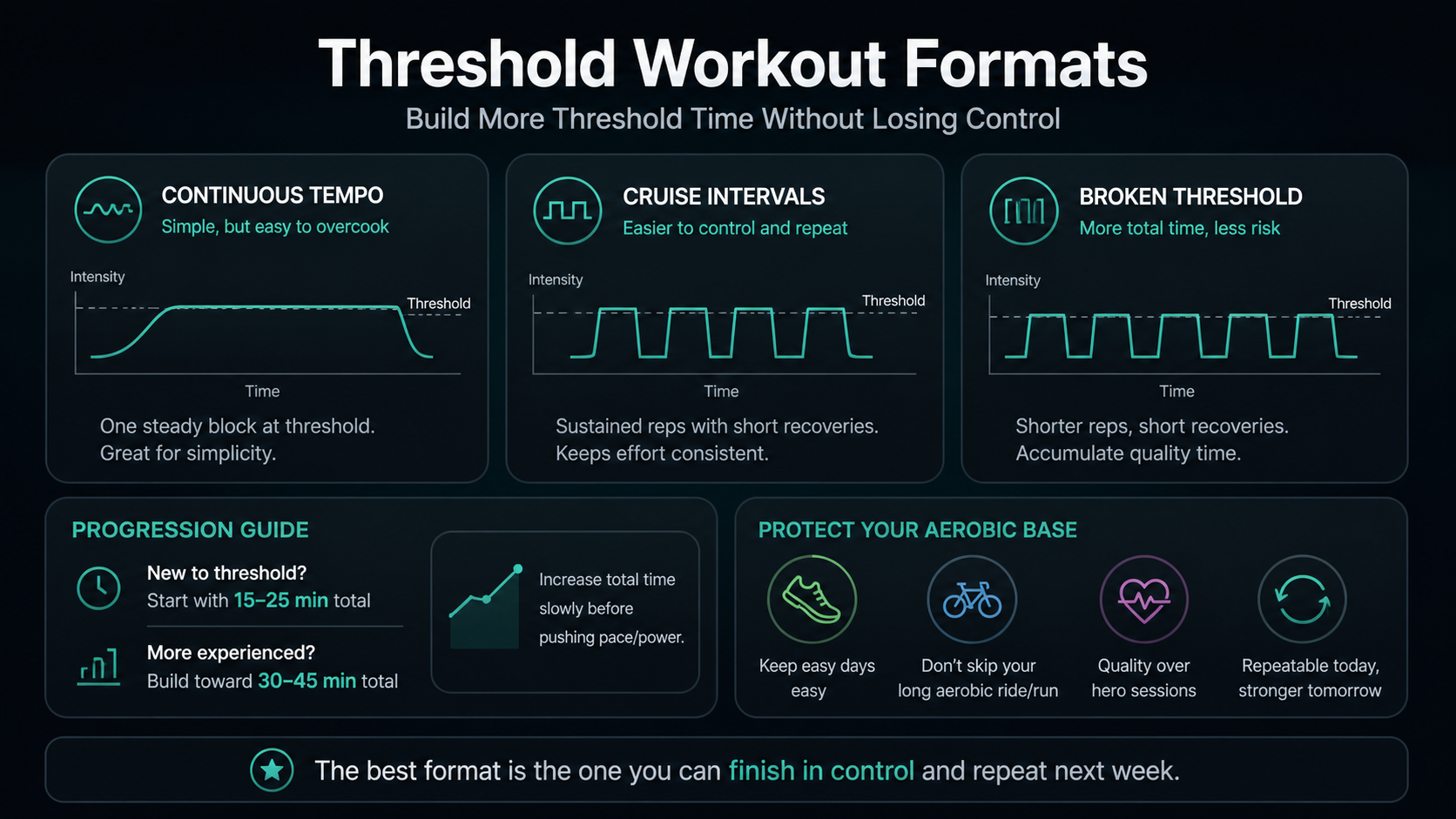
Continuous threshold is one steady block. A runner might do 20 minutes at threshold effort after a warm-up. A cyclist might do 25-30 minutes near threshold power. This format is useful when the athlete is experienced and honest with effort.
Cruise intervals break the work into moderate chunks with short recoveries. Examples include 4 x 6 minutes, 3 x 8 minutes, or 5 x 5 minutes at threshold. The recoveries are easy and short enough that the workout stays aerobic, not fully reset.
Broken threshold uses shorter repeats to collect more total time with less risk of drifting too hard. A runner might do 8 x 3 minutes with 60-90 seconds easy. A cyclist might do 4 x 8 minutes with 2-3 minutes easy. This is often the best entry point for athletes new to threshold work.
Billat's review of interval training for middle- and long-distance running emphasized that interval work is shaped by the combination of intensity, duration, and recovery rather than by intensity alone (Billat, 2001). That is the key to threshold design. The interval format should help you stay near threshold, not lure you above it.
How To Set Threshold Intensity
The best threshold target is the one you can apply consistently. You can use heart rate, pace, power, perceived effort, or a combination.
Heart rate is useful because it reflects internal load. If your threshold heart rate is known from a field test, lab test, or coach assessment, threshold intervals may sit near that anchor after heart rate catches up. The weakness is lag. Heart rate rises slowly during short reps and drifts upward with heat, dehydration, fatigue, and long duration.
Pace is useful for running on flat, repeatable terrain. It gives immediate feedback and keeps the workout concrete. The weakness is context. Hills, wind, trails, heat, and fatigue can make the same pace mean a very different effort.
Power is useful for cycling because it responds quickly to output. It works well for structured intervals and indoor training. The weakness is that power does not tell you how your body is responding internally. A threshold power target may be too hard on a bad recovery day.
Perceived effort is the necessary final check. Threshold should feel like 7-8 out of 10 for most athletes: hard, focused, sustainable, and controlled. Buchheit and Laursen's HIIT programming review highlights how interval intensity, work duration, recovery duration, recovery intensity, repetitions, series, and frequency all interact (Buchheit and Laursen, 2013). That complexity is why one target number is never enough.
How Often To Do Threshold Workouts
Most recreational and developing endurance athletes should start with one threshold workout per week. That is enough to create a signal while leaving room for easy training, long aerobic work, strength training, and recovery.
Two threshold workouts per week can work for some athletes during specific blocks, but it is easy to turn the whole week too moderate. If you add a second quality day, make sure it has a different purpose or a lower cost. For example, one threshold day and one relaxed speed day is usually easier to absorb than two demanding threshold sessions.
Laursen reviewed high-intensity and high-volume training for intense endurance events and reported that short blocks of high-intensity intervals can improve performance in trained athletes, while also warning that high-volume training remains important (Laursen, 2010). In plain training terms: intensity helps, but it works best when the base is still protected.
Place threshold away from your hardest long session when possible. A simple pattern is:
- Monday: easy or rest
- Tuesday: threshold workout
- Wednesday: easy
- Thursday: easy or relaxed speed
- Friday: easy or rest
- Saturday: long easy session
- Sunday: recovery
The exact days can change. The principle is stable: threshold needs easy training around it.
Example Threshold Workouts
Use these as templates, not prescriptions. Warm up well before each session and cool down easily afterward.
For runners new to threshold:
- 3 x 5 minutes at controlled threshold with 2 minutes easy jog.
- 6 x 3 minutes at threshold with 90 seconds easy jog.
- 15-20 minutes continuous only if you can hold back.
For experienced runners:
- 4 x 8 minutes at threshold with 2 minutes easy jog.
- 3 x 10 minutes at threshold with 2-3 minutes easy jog.
- 5-6 x 1 kilometer at threshold effort with short easy recoveries.
For cyclists new to threshold:
- 3 x 6 minutes near threshold power with 3 minutes easy.
- 4 x 5 minutes near threshold with 2-3 minutes easy.
- 2 x 10 minutes controlled if indoor pacing is stable.
For experienced cyclists:
- 3 x 12 minutes near threshold with 4 minutes easy.
- 2 x 20 minutes controlled, not maximal.
- 4 x 10 minutes with short easy recoveries.
The best workout is the one you can finish with stable mechanics and repeat next week. If the final rep collapses, reduce either intensity or total time before adding more.
How To Progress Threshold Training
Progress threshold by increasing total controlled time before increasing intensity. If 3 x 6 minutes feels smooth, move to 3 x 7 or 4 x 6 before trying to go faster. If 2 x 10 minutes is manageable, repeat it once or twice before moving to 2 x 12 or 3 x 8.
A simple four-week progression:
- Week 1: 18 minutes total threshold, such as 3 x 6 minutes.
- Week 2: Repeat the same workout with better control.
- Week 3: Add a small amount, such as 3 x 7 minutes.
- Week 4: Hold steady or reduce the dose.
This works because threshold adaptation is not earned by one heroic workout. It is earned by repeatable pressure over weeks. Midgley, McNaughton, and Jones reviewed training recommendations for long-distance runners and framed performance improvement around multiple physiological determinants, not one single session type (Midgley, McNaughton, and Jones, 2007). Threshold is one useful lever, but it is not the whole machine.
Common Mistakes
The first mistake is running or riding threshold too hard. Many athletes turn threshold into VO2 max work because the target feels important. If recovery needs become unusually high, or easy days feel worse for several days, the workout probably exceeded its purpose.
The second mistake is using stale threshold numbers. A field-test result from six months ago may not match current fitness. Retest after a training block, a meaningful race, or repeated evidence that workouts are too easy or too hard.
The third mistake is skipping recovery because threshold is "not that hard." Threshold is still quality work. It creates enough strain to deserve easy training before and after.
The fourth mistake is adding too much total time. Newer athletes often do better with 15-25 minutes of threshold work. Experienced athletes may build toward 30-45 minutes, but only if easy days and the long aerobic session remain intact.
The fifth mistake is copying another athlete's workout. A cyclist with years of threshold work may handle 2 x 20 minutes easily. A runner returning from injury may need 6 x 3 minutes. The format should match the athlete, not the other way around.
Conclusion
Threshold workouts are hard-steady sessions that help runners and cyclists build sustainable output. They should feel focused, uncomfortable, and repeatable. They should not feel like a race from the first minute.
Use threshold as a controlled tool: choose a reliable intensity anchor, start with a manageable amount of total time, keep recoveries easy, and progress slowly. Most athletes should begin with one threshold day per week and protect the easy training around it.
If you finish in control and can repeat the workout next week, the session did its job. That is the simplest test of good threshold training.
Continue Your Threshold Training Plan
Use what lactate threshold means to choose a credible intensity anchor, then compare threshold work with VO2 max intervals. After the session, review pace or power, heart rate, interval consistency, and perceived effort with the post-workout zone analysis workflow.