


VO2 Max Intervals Explained
VO2 max intervals are hard repeats designed to spend time near the top of your aerobic system. Learn how they work, how they should feel, and how runners and cyclists can use them.
Jun 18, 202613 min read

Introduction
VO2 max intervals are hard, controlled repeats designed to spend time near the top of your aerobic system. They are harder than threshold workouts, shorter than steady tempo work, and more repeatable than all-out sprinting. The point is not to make one rep heroic. The point is to create several high-quality bouts where oxygen demand is very high and form still holds together.
For runners, VO2 max intervals might look like 5 x 3 minutes at a strong 3K-5K effort with easy jogging between reps. For cyclists, they might look like 4 x 4 minutes above threshold power with easy spinning between reps. Shorter formats such as 30 seconds hard, 30 seconds easy can also work, but only if the hard segments stay controlled enough to accumulate useful work.
The name can make the workout sound more exact than it really is. VO2 max is a lab-measured rate of oxygen use, usually expressed relative to body mass. A watch or bike computer may estimate it, but interval workouts are still programmed with practical anchors: pace, power, heart rate response, breathing, terrain, and perceived effort.
Used well, VO2 max intervals can improve high-end aerobic capacity and performance. Reviews of endurance training and interval training describe VO2 max as one important endurance determinant, while also emphasizing that training response depends on intensity, duration, frequency, and the athlete's background (Bassett and Howley, 2000; MacInnis and Gibala, 2017). Used poorly, VO2 max intervals become repeated time trials that create more fatigue than fitness.
The practical goal is simple: finish every repetition hard, stable, and repeatable.
What Are VO2 Max Intervals?
VO2 max intervals are repeated hard efforts that push oxygen uptake toward its upper limit. They usually sit above lactate threshold and below pure sprint intensity. Breathing is heavy, talking is not realistic, and the final part of each repetition takes focus. But the workout should still have structure.
That distinction matters. A true sprint is limited by neuromuscular power and short-term anaerobic energy. A threshold workout is a hard-steady aerobic session that can be held for longer. VO2 max intervals live between those worlds: hard enough to drive oxygen demand very high, long or repeated enough for the aerobic system to respond, and controlled enough that you can complete several reps.
Heart rate often lags behind the actual effort. If you start a 3-minute running rep or cycling rep, pace or power rises immediately, but heart rate may take 60-120 seconds to catch up. That is why the first minute of a VO2 max interval may not show Zone 5 on your watch even when the effort is right. The workout is still doing its job if the later part of the rep and later reps show the expected breathing, pressure, and heart rate response.
Researchers have long argued that effective interval training is shaped by more than intensity alone. Midgley, McNaughton, and Wilkinson reviewed training intensity for improving maximal oxygen uptake in distance runners and framed the problem around how close the athlete trains to the intensity that elicits VO2 max, how long that intensity can be sustained, and how the session is repeated (Midgley, McNaughton, and Wilkinson, 2006). In plain language: the workout has to be hard enough, but it also has to last long enough and repeat well enough to matter.
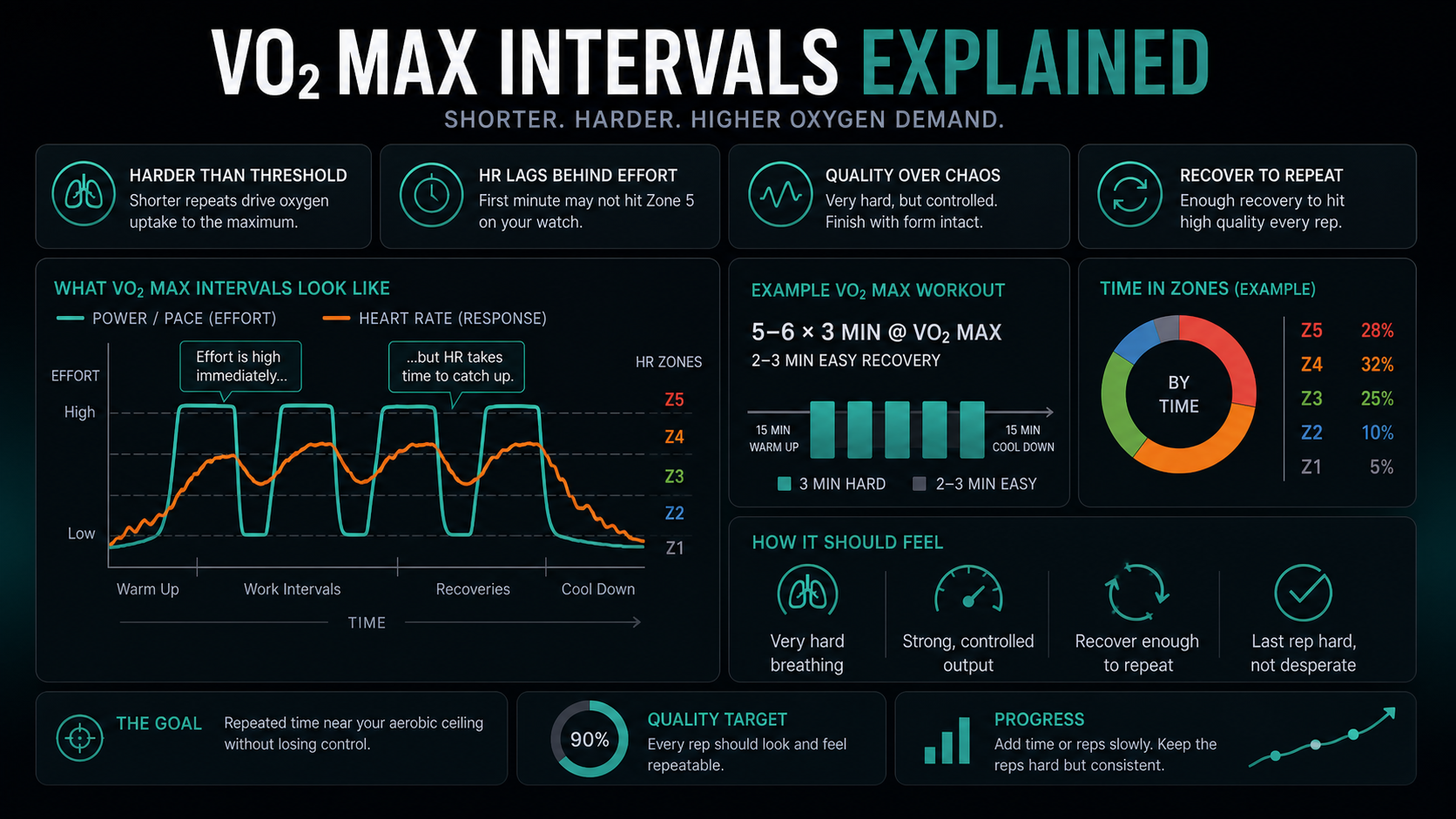
Think of VO2 max intervals as time near your aerobic ceiling, not time spent chasing maximum pain. If the first rep is a personal record and the last rep is a collapse, the session probably missed the target.
Why VO2 Max Intervals Work
VO2 max intervals work because they create a strong aerobic stimulus in a compressed amount of time. During the hard repetitions, oxygen demand rises quickly. The cardiovascular system has to deliver more oxygen, working muscles have to use it, and the athlete has to tolerate high breathing and muscular pressure without losing control.
The exact adaptations depend on the athlete and the training block. Interval training research describes changes that can include improvements in maximal oxygen uptake, muscle oxidative capacity, mitochondrial signaling, buffering, and high-intensity endurance performance (MacInnis and Gibala, 2017). That does not mean every athlete gets the same result from the same workout. A newer athlete, a well-trained runner, and a cyclist deep in a race season may all need different doses.
Laursen and Jenkins reviewed the scientific basis for high-intensity interval training and emphasized that successful interval programming depends on work intensity, work duration, relief intensity, relief duration, number of repetitions, number of sets, and training frequency (Laursen and Jenkins, 2002). This is why copying a hard session from a faster athlete can be misleading. The visible workout is only one part of the system. The training history, easy volume, recovery, and current fatigue decide whether that workout is productive.
For most endurance athletes, VO2 max intervals are useful because they train a zone that is hard to reach with easy volume or threshold work alone. Easy aerobic training builds the base. Threshold improves hard-steady control. VO2 max intervals ask the upper aerobic system to work near its ceiling.
The best results usually come when those pieces support each other. If VO2 max work replaces too much easy training, the athlete may get tired but not more durable. If VO2 max work is never included, the athlete may have a solid base but lack high-end aerobic pressure for shorter races, climbs, surges, and hard group efforts.
How VO2 Max Intervals Should Feel
VO2 max intervals should feel very hard, but not reckless. A useful effort cue is 8-9 out of 10. You are breathing hard. You are not chatting. You may be counting down the final minute of the rep. But you are still in charge of your mechanics.
For runners, that means posture stays tall, cadence does not turn frantic, and the stride stays strong rather than strained. For cyclists, cadence and torque should stay intentional rather than turning into a desperate stomp. A hard finish is fine. A form breakdown in the first half of the workout is a sign to back off.
The first repetition should not feel easy, but it should feel repeatable. If a workout calls for 5 x 3 minutes, rep one should feel like the beginning of a set, not a race finish. The middle reps should be uncomfortable but steady. The final rep can be the hardest, but it should still look like the earlier reps.
Heart rate is useful after it catches up. During longer intervals, such as 3-5 minutes, heart rate may climb into a high zone by the second half of each rep, especially after the first two repetitions. During short intervals, such as 30/30s, heart rate may stay high across the whole set even though each hard segment is brief. In both cases, pace, power, and perceived effort usually guide the early part better than heart rate alone.
The simplest field test during the workout is this: could you complete one more controlled repetition if required? If the answer is yes, the session is probably targeted well. If the answer is no halfway through, the workout is too hard for that day.
Common VO2 Max Interval Formats
VO2 max intervals can be built many ways. The right format depends on training history, sport, terrain, and what kind of fatigue you can absorb.
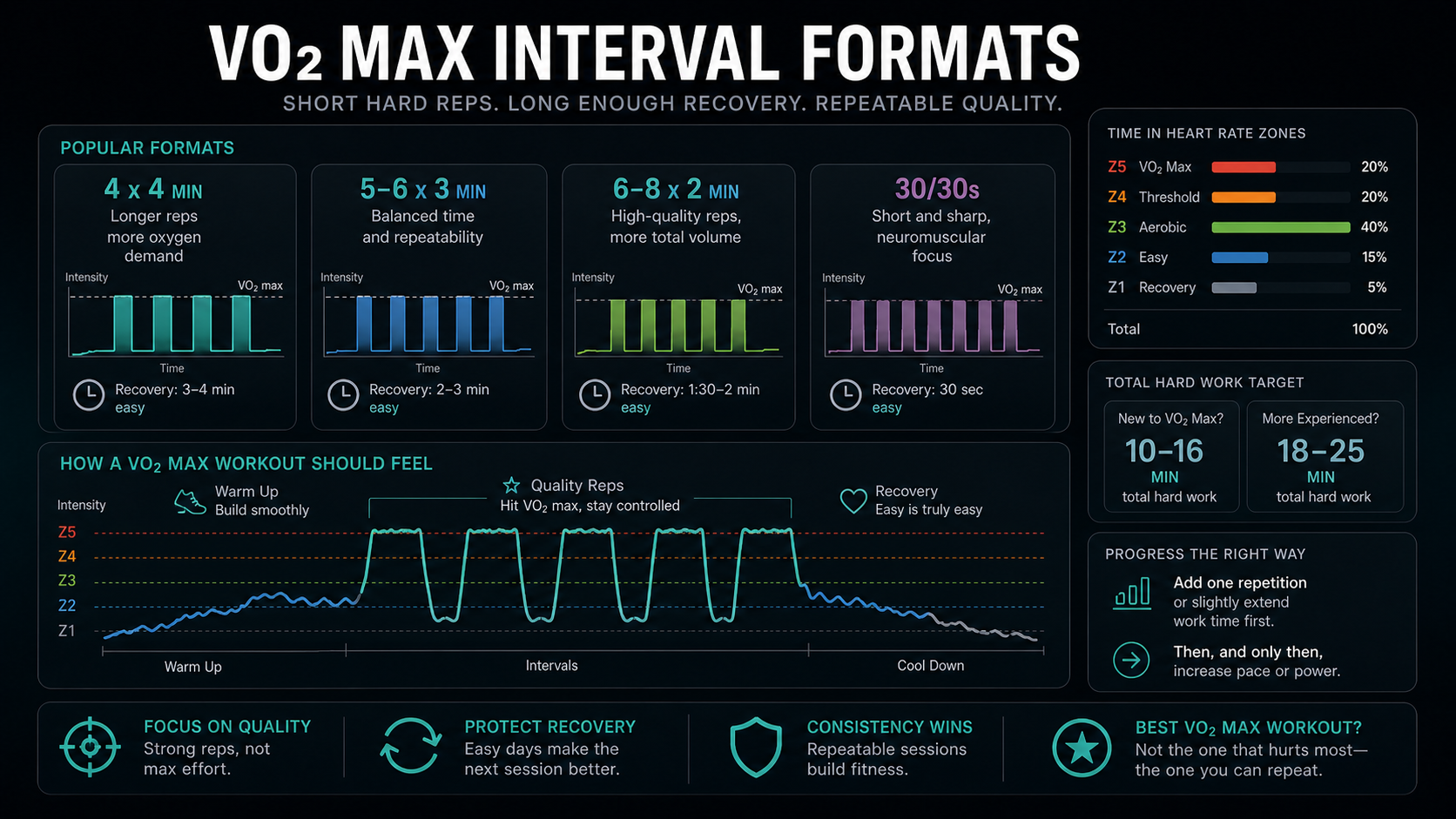
The classic 4 x 4 minute format is popular because each repetition is long enough for oxygen uptake and heart rate to rise, while the total hard work stays manageable. It works well for runners on a track, road, or steady hill, and for cyclists indoors or on a climb. Recovery is often 3-4 minutes easy.
The 5-6 x 3 minute format is a balanced option for many athletes. It gives enough time for the aerobic system to respond without making each rep feel endless. Recovery is usually 2-3 minutes easy. This can be one of the most practical formats for runners preparing for 5K-10K races and cyclists who want high-end aerobic work without a huge recovery cost.
The 6-8 x 2 minute format is shorter and a little sharper. It may suit newer athletes, runners returning to speed, hill sessions, or cyclists building toward longer VO2 max work. Recovery is often 90 seconds to 2 minutes easy. Because the reps are short, avoid sprinting the first 20 seconds.
Short intervals such as 30 seconds hard, 30 seconds easy can also create a strong oxygen uptake response across a set. They are useful when you want high work density with less time spent grinding through long reps. The risk is that athletes turn the hard segments into sprints. For endurance development, the hard portions should be fast and strong, not maximal.
Seiler and colleagues compared several aerobic interval formats in trained recreational cyclists and found that accumulated work duration and intensity interacted. In that study, a 4 x 8 minute format produced larger improvements in several performance markers than shorter, harder 4 x 4 minute work, despite being performed at a lower intensity (Seiler et al., 2013). The practical lesson is not that one format is always best. It is that total quality work matters, and the hardest possible interval is not automatically the most effective one.
How To Set VO2 Max Intensity
The best intensity target is the one you can execute consistently. Most athletes should combine an external target with an internal check.
For runners, VO2 max intervals often fall near 3K-5K race effort, depending on rep length and recovery. Shorter reps may be closer to 3K effort. Longer reps may need to be closer to 5K effort. If you do not race often, use effort: very hard breathing, stable form, and a pace you can repeat without major fade.
For cyclists, VO2 max intervals are often programmed above threshold power. Many athletes use a range around 110-120 percent of functional threshold power for 2-5 minute reps, but that is only a planning range. Some riders need less to get the right response. Some well-trained riders can handle more for short reps. The right target is the highest controlled power you can repeat for the whole session.
For heart rate, use it as a response marker rather than a steering wheel in the first minute. In 4-minute reps, heart rate should usually climb high by the second half, especially after the first repetition. In 2-minute reps, it may lag too much to be useful rep by rep. In 30/30s, heart rate may stay elevated across the set but not tell you whether each hard segment is paced well.
For perceived effort, aim for "hard but repeatable." The first half of the workout should feel controlled. The second half should require concentration. The final rep should be difficult but not desperate.
Buchheit and Laursen's review on high-intensity interval training programming highlights how variables such as interval intensity, interval duration, recovery duration, recovery intensity, repetitions, sets, and scheduling interact to change the training stimulus (Buchheit and Laursen, 2013). That is why one intensity number cannot define the whole session.
How Often To Do VO2 Max Intervals
Most runners and cyclists should start with one VO2 max workout per week during a focused block. That is enough to create a strong signal while leaving room for easy aerobic training, long sessions, threshold work, strength, and recovery.
Two VO2 max sessions per week can work for some athletes in short blocks, but it is a high-cost choice. It also leaves less room for other important work. If you add a second quality day, avoid stacking two maximal-style sessions close together. A common pattern is one VO2 max day and one lower-cost threshold, tempo, or long aerobic session.
Training distribution research in endurance athletes often shows a large share of training performed at low intensity, with a smaller share devoted to higher intensity work (Seiler, 2010). Recreational athletes do not need to copy an elite distribution exactly, but the principle is useful: hard work works better when easy work stays easy.
A simple week might look like this:
- Monday: rest or very easy
- Tuesday: VO2 max intervals
- Wednesday: easy aerobic training
- Thursday: easy or short relaxed strides
- Friday: easy or rest
- Saturday: long easy run or ride
- Sunday: recovery aerobic training
For athletes already doing threshold work, be careful about adding VO2 max on top of it. The problem is rarely one hard session. The problem is the total load of hard and moderate work across the week.
Example VO2 Max Workouts
Use these workouts as templates, not prescriptions. Warm up for 10-20 minutes first, include a few short relaxed pickups if appropriate, and cool down easily afterward.
For runners new to VO2 max intervals:
- 6 x 2 minutes hard with 2 minutes easy jog.
- 8 x 90 seconds uphill with an easy jog down.
- 10 x 30 seconds hard, 30 seconds easy, done as one controlled set.
For experienced runners:
- 5 x 3 minutes at 3K-5K effort with 2-3 minutes easy jog.
- 4 x 4 minutes strong with 3 minutes easy jog.
- 6 x 3 minutes on a steady hill or flat path with 2 minutes easy.
For cyclists new to VO2 max intervals:
- 6 x 2 minutes above threshold with 2 minutes easy spin.
- 5 x 3 minutes strong with 3 minutes easy spin.
- 2 sets of 8 x 30 seconds hard, 30 seconds easy, with 5 minutes easy between sets.
For experienced cyclists:
- 4 x 4 minutes above threshold with 4 minutes easy spin.
- 5-6 x 3 minutes at high but repeatable power with 3 minutes easy.
- 3 sets of 6 x 40 seconds hard, 20 seconds easy, with 5 minutes easy between sets.
The best version is the one you can complete with stable output. If power fades by 15 percent, pace falls apart, or mechanics break down, reduce the target or shorten the workout next time.
How To Progress VO2 Max Training
Progress VO2 max work slowly. The workout is already intense, so small changes matter.
Start by increasing total quality time before increasing intensity. If 5 x 2 minutes feels smooth, move to 6 x 2 minutes or 5 x 2:30 before going faster. If 4 x 3 minutes is repeatable, try 5 x 3 minutes before chasing a harder pace or power target.
A practical progression for many athletes is:
- Week 1: 10-12 minutes total hard work, such as 5-6 x 2 minutes.
- Week 2: 12-15 minutes total hard work, such as 5 x 3 minutes.
- Week 3: 16-20 minutes total hard work, such as 4 x 4 or 6 x 3 minutes.
- Week 4: reduce the dose or return to threshold/easy aerobic focus.
More experienced athletes may build toward 20-25 minutes of total VO2 max work in a session, but only if quality stays high and the surrounding week remains manageable. Newer athletes often do better with 10-16 minutes.
Do not progress every variable at once. Add one repetition, extend the repetitions, or shorten recovery slightly. Avoid increasing pace, adding reps, and cutting recovery in the same session. That turns a targeted workout into a test.
Common Mistakes
The first mistake is sprinting the first repetition. VO2 max intervals are not a contest to see how fast you can start. A better session usually begins a little restrained and finishes strong.
The second mistake is using heart rate as the only target. Heart rate lags during short hard efforts, so athletes often push too hard early while waiting for the watch to show the "right" zone. Use pace, power, breathing, and repeatability first. Use heart rate to confirm the response later.
The third mistake is doing too many hard sessions in one week. VO2 max intervals create real strain. They need easy training around them. If every day becomes medium-hard, the workout loses its purpose and recovery gets squeezed.
The fourth mistake is treating every group workout as VO2 max training. Group energy can be useful, but it often turns controlled reps into races. If the goal is VO2 max development, the workout should match the session design, not the fastest person in the group.
The fifth mistake is progressing while fatigue is already high. If sleep is poor, resting heart rate is elevated, easy pace feels wrong, or motivation is unusually low, it may be better to reduce the workout or move it. A slightly underdone VO2 max session is usually better than a forced one that ruins the next three days.
Conclusion
VO2 max intervals are hard repeatable efforts that train the upper end of aerobic fitness. They should feel very hard, but controlled. The goal is high oxygen demand, stable mechanics, and enough recovery to repeat quality reps.
Start with a manageable format such as 6 x 2 minutes, 5 x 3 minutes, or 4 x 4 minutes. Use pace or power to guide the early part, heart rate to confirm the response later, and perceived effort to keep the workout honest. Keep easy days easy, progress total quality time slowly, and avoid turning every rep into a race.
If you finish the final repetition tired but still in control, the workout probably landed where it should.