

Pace, Power & RPE
Power Zones vs Heart Rate Zones for Cyclists
Power zones show cycling output in watts. Heart rate zones show internal response. Learn when to trust each metric, how to compare them, and how to use both for better cycling training.
Introduction
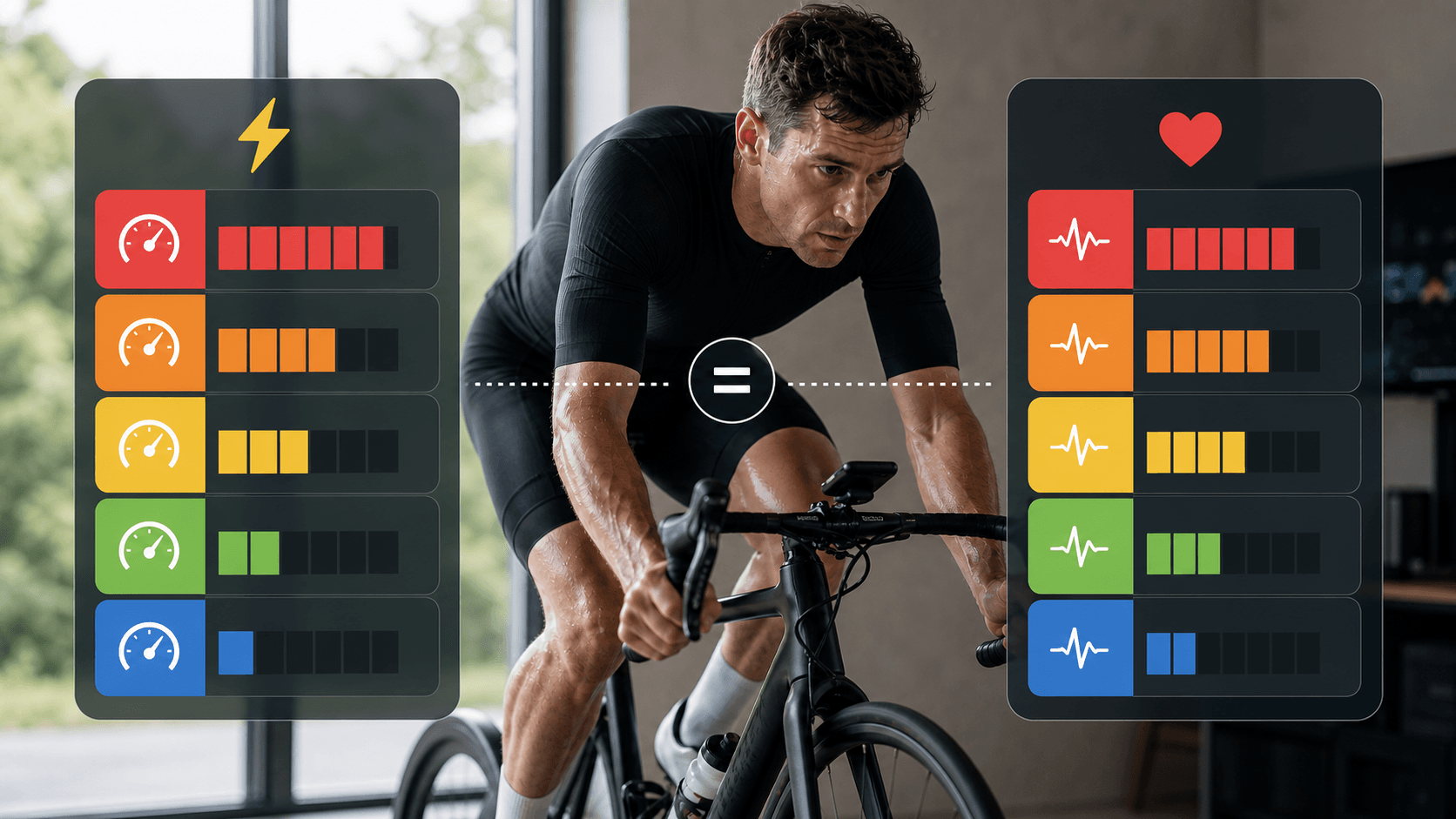
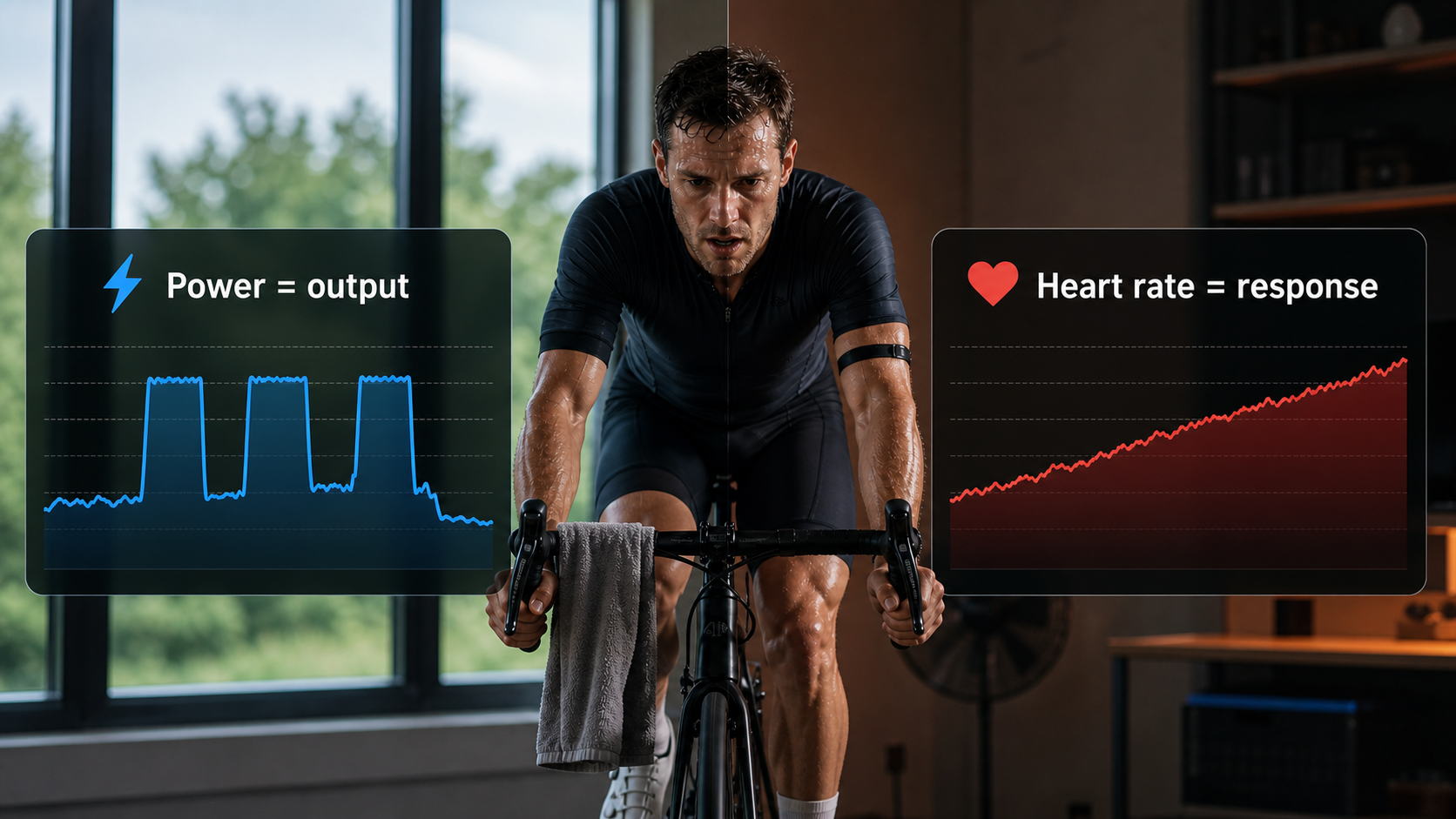
Power zones and heart rate zones are two of the most useful ways to organize cycling training, but they do not measure the same thing. Power zones measure output: the watts you put into the pedals. Heart rate zones measure internal response: how costly that output is for your body on that day, in those conditions, with that level of fatigue. If you need the heart-rate side first, the guide to heart-rate-zone training for cyclists covers zone setup, workout use, and review.
That distinction sounds simple, but it changes how you should interpret almost every ride. If you do a 3-minute interval, power tells you immediately whether you are riding at the target intensity. Heart rate may still be catching up when the interval is nearly over. If you do a 3-hour endurance ride, heart rate may be more revealing than power alone because it shows whether the same output is becoming more expensive as heat, dehydration, fuel status, and fatigue accumulate.
The best answer is not "train by power" or "train by heart rate." The best answer is to use power and heart rate together, with each metric doing the job it is good at.
This is also how many sport scientists describe the relationship between external and internal training load. External load is the work performed. Internal load is the physiological response to that work. Bourdon and colleagues summarize why monitoring both is useful: the same external session can create different internal stress depending on the athlete and the context (International Journal of Sports Physiology and Performance).
For cyclists, power is one of the cleanest external-load signals available. Heart rate is one of the most accessible internal-load signals. Together they answer a better question than either one alone: "Did the work match the plan, and how did my body handle it?"
This guide explains how power zones and heart rate zones differ, when each is more useful, what to do when they disagree, and how to use the comparison tool in this article to interpret one ride, lap, climb, or interval.
The Short Answer
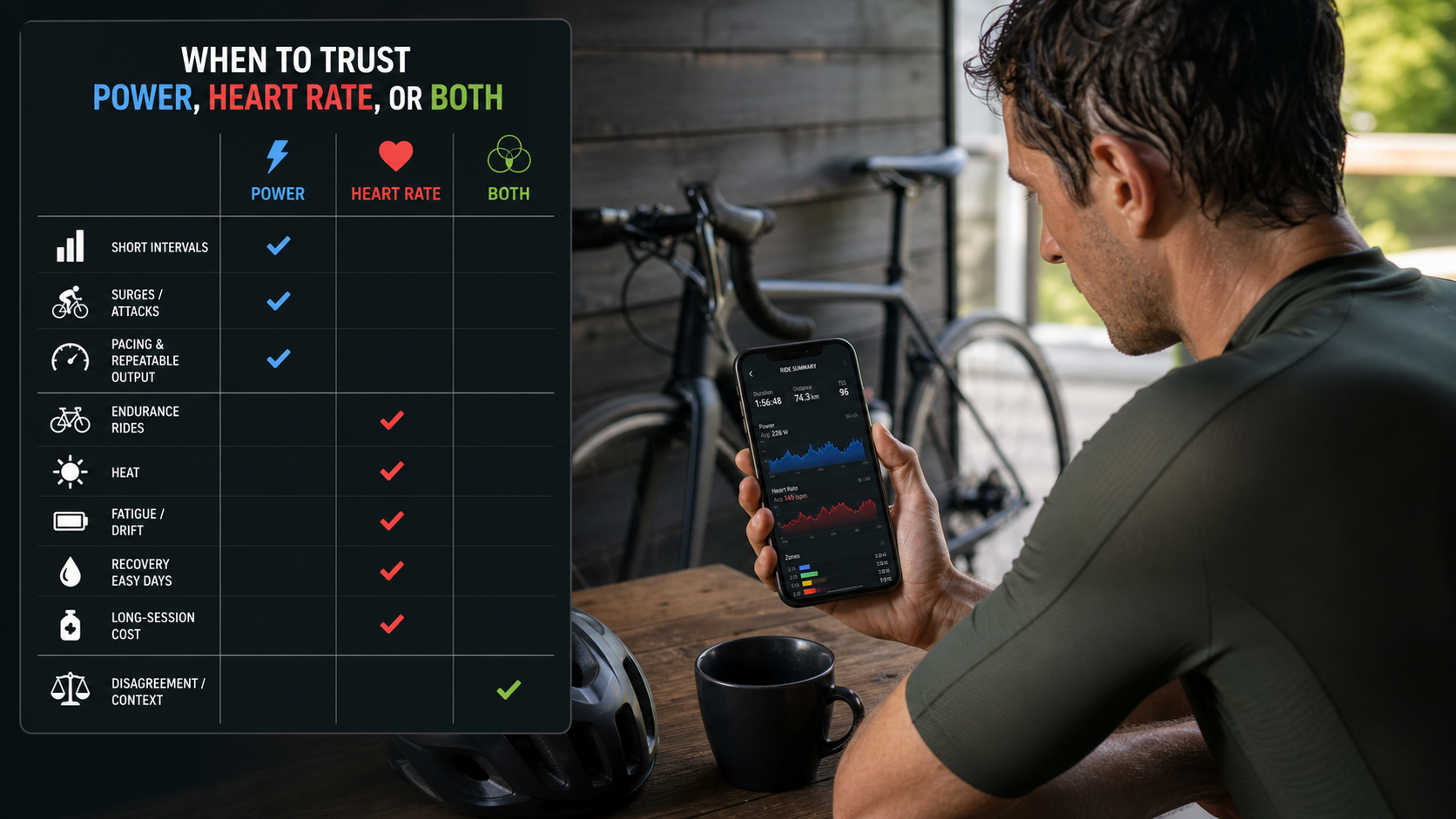
Power zones are usually better for pacing, intervals, short efforts, climbs, time trials, and repeatable output targets. Heart rate zones are usually better for understanding internal cost, endurance intensity, heat stress, fatigue, recovery, and cardiac drift. If you have both metrics, you should not force them to compete. Use power to control the work. Use heart rate to judge the response.
Power answers:
| Question | Example |
|---|---|
| How much work am I doing right now? | "Am I riding this interval at 300 watts?" |
| Did I pace the effort evenly? | "Did I start the climb too hard?" |
| Was the workout completed at the planned output? | "Were the 4 x 8 minute intervals actually at threshold power?" |
| How does today's output compare with previous rides? | "Can I hold the same watts at lower perceived strain?" |
Heart rate answers:
| Question | Example |
|---|---|
| How hard is my body working to support this output? | "Why is my endurance pace 10 beats higher today?" |
| Is the ride staying easy enough? | "Is this Zone 2 ride drifting into Zone 3?" |
| Am I seeing heat, dehydration, or fatigue? | "Why is heart rate climbing at the same power?" |
| Did the week create more internal stress than planned? | "Was a low-wattage recovery week still stressful?" |
The practical rule is this:
Use power first for control. Use heart rate second for context.
That does not mean heart rate is secondary in importance. It means the timing is different. During a short interval, power gives the cleaner real-time command. After the ride, heart rate helps you understand whether that command was easy, normal, unusually expensive, or unsustainable.
What Power Zones Measure
Power is mechanical output. In cycling, it is usually measured in watts by a power meter at the crank, pedal, hub, or smart trainer. A watt is a rate of work. If you ride at 250 watts, you are producing 250 joules of work per second at the measurement point.
Power is valuable because it reacts immediately. Press harder and the number rises. Ease off and it falls. That makes it excellent for pacing and interval control. A cyclist doing a 30-second surge, a 3-minute VO2 max interval, or a 20-minute threshold effort does not need to wait for heart rate to stabilize before knowing whether the effort is on target.
Most cycling power zones are built around FTP, or functional threshold power. FTP is commonly used as a practical anchor for the highest power a cyclist can sustain for a long, hard effort, though exact test protocols and definitions vary. Coaches and platforms then divide training into bands such as recovery, endurance, tempo, threshold, and VO2 max.
A practical five-zone power model might look like this:
| Zone | Power focus | Typical cycling use |
|---|---|---|
| Zone 1 | Recovery | Easy spinning, warmups, cooldowns, recovery rides |
| Zone 2 | Endurance | Aerobic base rides, long steady rides, durable volume |
| Zone 3 | Tempo | Steady pressure, climbs, group rides, controlled moderate work |
| Zone 4 | Threshold | Hard sustainable intervals and time-trial style efforts |
| Zone 5 | VO2 max and above | Short hard repeats, attacks, surges, steep efforts |
The exact percentages differ by system. Some cyclists use a seven-zone model. Some coaches separate sweet spot, anaerobic capacity, and neuromuscular sprint work. Those details can be useful, especially for advanced plans, but the core principle stays the same: power zones organize external output.
Power has limitations. It does not tell you whether the effort is easy or hard for your body today. It does not know whether the room is hot, whether you slept badly, whether you are dehydrated, whether your legs are stale, or whether you are coming down with something. A power meter can say "200 watts" on two different days while the physiological cost is completely different.
Power also depends on accurate equipment. A poorly zeroed power meter, a smart trainer with calibration problems, drivetrain losses, or mismatched devices can make comparisons messy. Power is precise when the measurement system is reliable, but it is not magic.
What Heart Rate Zones Measure
Heart rate is an internal response. It reflects how fast the heart is beating to support the work you are doing. During exercise, heart rate is influenced by intensity, duration, hydration, heat, cooling, altitude, caffeine, stress, fatigue, sleep, illness, medication, and individual physiology.
Heart rate zones divide that response into ranges. Some systems use maximum heart rate. Some use heart-rate reserve. Many cycling-specific systems use lactate threshold heart rate, often abbreviated LTHR, because threshold heart rate can map better to sustainable performance intensity than a broad age estimate.
A practical five-zone threshold-style heart-rate model might look like this:
| Zone | Heart-rate focus | Typical cycling use |
|---|---|---|
| Zone 1 | Recovery response | Very easy riding and warmups |
| Zone 2 | Endurance response | Comfortable aerobic work and long rides |
| Zone 3 | Tempo response | Controlled moderate work |
| Zone 4 | Threshold response | Hard sustainable work near threshold |
| Zone 5 | Very hard response | High internal stress from hard efforts |
Heart rate is valuable because it shows internal cost. If you normally ride endurance at 185 watts and 135 bpm, but today the same 185 watts produces 150 bpm, that is information. It may be heat. It may be fatigue. It may be poor sleep, dehydration, low carbohydrate availability, illness, or accumulated training load. Power says the output is normal. Heart rate says the cost is not normal.
Achten and Jeukendrup's review describes heart-rate monitoring as useful for exercise prescription and training control, while also emphasizing the need to interpret it with context because heart rate is affected by several physiological and environmental variables (Sports Medicine).
Heart rate has limitations too. It lags behind changes in effort. It may not show the full stress of short efforts. It can drift upward during long rides. It can be wrong if the sensor is poor, the strap is dry, the wrist optical signal is noisy, or the device locks onto cadence. It is very useful, but it is not a direct measure of cycling output.
Why Cyclists Should Use Both
Power and heart rate are strongest when they are paired. Each metric covers a weakness in the other.
Power gives you immediate control. Heart rate gives you physiological interpretation. Power is usually more stable across short intervals. Heart rate can reveal when a normal power target is creating abnormal strain. Power is excellent for pacing a climb. Heart rate can warn you that the climb is becoming too costly for the rest of the ride.
This is especially important because endurance training is not just a collection of isolated workouts. It is a repeated process of applying stress, recovering from it, and adapting. A session that looks identical by external load may not create the same internal load twice. That is why training logs are more useful when they preserve both output and response.
Here is a simple example:
| Ride | Power | Heart rate | Interpretation |
|---|---|---|---|
| Endurance ride in cool weather | 190 W | 138 bpm | Normal aerobic cost |
| Same route in heat | 190 W | 151 bpm | Same output, higher internal strain |
| Same route after a hard week | 190 W | 149 bpm | Possible fatigue or incomplete recovery |
| Same route after fitness gain | 190 W | 132 bpm | Same output, lower internal cost |
The power number is unchanged. The training meaning is not.
This is also why cyclists should avoid judging every ride by a single metric. If you use only power, you may miss signs that the body is struggling. If you use only heart rate, you may misjudge short intervals, surges, and pacing because heart rate does not respond quickly enough.
The goal is not to create a complicated dashboard. The goal is to ask a better question after each ride: "For the power I produced, was the heart-rate response expected?"
Use The Power vs Heart Rate Zone Comparison Tool
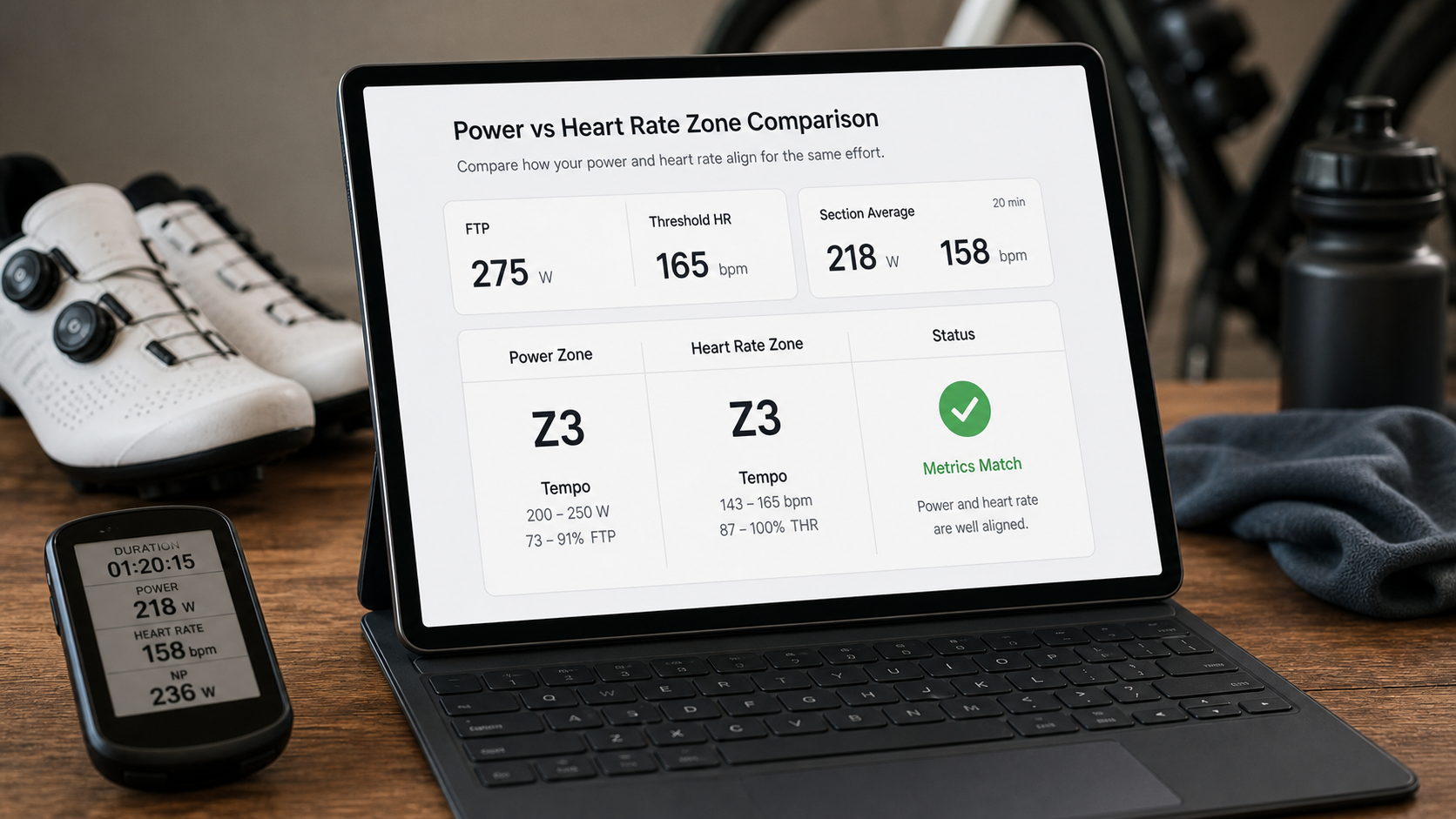
Use the tool below when power and heart rate seem to tell different stories. Enter your current FTP, cycling threshold heart rate, and one average power and heart rate from the same ride section. That section can be a full ride, a lap, a long climb, a steady endurance block, or an interval.
The tool builds side-by-side cycling zones from FTP and cycling threshold heart rate. Then it compares the selected effort and returns three useful pieces of information:
| Readout | What it means |
|---|---|
| Power zone | The external output zone for the selected watts |
| Heart-rate zone | The internal-response zone for the selected heart rate |
| Zone gap | Whether the two signals match or one is leading the other |
You can also open the standalone Power vs Heart Rate Zone Comparison tool when you want to compare a ride outside this article.
Treat the result as a training interpretation tool, not as a lab test. If your coach uses different zone boundaries, or if you have lab-tested zones, keep using those anchors. The value here is not that every cyclist must use the same percentages. The value is that the tool forces a clean comparison between output and response for the same effort.
How To Interpret The Three Main Readouts
The most useful part of the comparison is not the exact label. It is the relationship between the two labels.
If power and heart rate are in the same zone, the ride is internally and externally aligned. That usually means the output and physiological response are telling a similar story. A Zone 2 power ride with Zone 2 heart rate is probably a normal endurance ride. A Zone 4 interval with Zone 4 heart rate is probably a sustained threshold-style effort.
Alignment is useful, but it is not automatic proof that the ride was perfect. You still need to consider duration, purpose, terrain, cadence, fueling, heat, and perceived effort. A 20-minute aligned threshold interval and a 2-hour ride that gradually becomes aligned in Zone 4 are very different training events.
If power is higher than heart rate, output is leading response. This often happens early in intervals, during short surges, during sprints, or when heart rate has not had time to catch up. It can also happen in cool conditions, when you are fresh, or when you have improved fitness and can produce a given power at a lower internal cost.
For example, a 3-minute interval might sit in Zone 5 by power but only Zone 3 or Zone 4 by heart rate for much of the effort. That does not mean the interval was easy. It means heart rate lagged behind the external work. For short intervals, power is usually the better control metric.
If heart rate is higher than power, internal response is leading output. This can happen late in long rides, in heat, indoors with poor airflow, after poor sleep, during dehydration, when under-fueled, during illness, or after accumulated fatigue. It can also happen if your FTP is set too high, your threshold heart rate is set too low, or the heart-rate sensor is reading incorrectly.
For example, a steady endurance ride might sit in Zone 2 by power but Zone 3 by heart rate after 90 minutes. That may be cardiac drift. It may be heat. It may be a sign that the planned endurance day is becoming more costly than intended. The correct response depends on the ride purpose.
Why Heart Rate Drifts At The Same Power
One of the most common reasons power and heart rate disagree is cardiac drift. During prolonged exercise, heart rate can rise even when power stays stable. The ride may start at 180 watts and 135 bpm, then end at 180 watts and 150 bpm. The output did not change, but the internal cost increased.
Coyle and Gonzalez-Alonso reviewed cardiovascular drift and described how heart rate can rise during prolonged exercise, especially when heat stress and dehydration increase cardiovascular strain (Exercise and Sport Sciences Reviews).
For cyclists, drift is especially visible because power can remain steady while heart rate gradually climbs. You may see it during:
| Situation | Typical pattern |
|---|---|
| Long endurance ride | Power stays stable, heart rate rises late |
| Indoor trainer session | Heart rate climbs because cooling is poor |
| Hot-weather ride | Heart rate is high from the start or rises faster |
| Under-fueled long ride | Heart rate and perceived effort rise while power feels harder |
| Fatigue day | Heart rate is unusually high for normal endurance power |
The American College of Sports Medicine position stand on exercise and fluid replacement describes how fluid deficits and heat stress can increase physiological strain during exercise (Medicine & Science in Sports & Exercise). That matters for cyclists because airflow, clothing, indoor trainer setup, and drinking opportunities can change heart-rate response at the same watts.
Drift is not always a problem. Some drift is normal during long rides. The question is whether the drift matches the workout purpose. A long endurance ride may tolerate a small late rise. A recovery spin probably should not become a Zone 3 internal-load session. A race simulation may intentionally include sustained stress, but then you should plan recovery afterward.
Power vs Heart Rate By Workout Type
Different workouts need different metric priorities. The table below is a practical starting point.
| Workout type | Primary control | Secondary context | Why |
|---|---|---|---|
| Recovery ride | Heart rate and feel | Power | The goal is low internal stress, not output |
| Zone 2 endurance ride | Heart rate, power, and feel together | Drift over time | Output should stay sustainable and internal cost should remain controlled |
| Tempo ride | Power | Heart rate | Power helps hold steady pressure; heart rate shows accumulated cost |
| Sweet spot or threshold intervals | Power | Heart rate trend | Power controls the target; heart rate shows whether the effort is normal |
| VO2 max intervals | Power and perceived effort | Heart rate after the first reps | Heart rate lags and may not stabilize during short repeats |
| Sprint or attack work | Power and execution | Heart rate later | Heart rate is too slow for real-time sprint control |
| Long climb | Power | Heart rate ceiling | Power prevents surging; heart rate warns when the climb is getting too expensive |
| Indoor trainer endurance | Heart rate and cooling | Power | Poor airflow can raise heart rate at normal watts |
| Group ride | Power spikes and heart rate cost | Perceived effort | Surges may create more stress than average power suggests |
For recovery rides, heart rate deserves more attention than power. The purpose is to keep stress low. If your heart rate climbs into a moderate zone at very low watts, that may be a sign to ride easier, shorten the session, improve cooling, or take the day off.
For endurance rides, use both. Power can keep you from soft-pedaling too much or surging too hard. Heart rate can keep the ride honest. If the ride is meant to be aerobic base work, you usually want both output and internal response to stay controlled.
For tempo and threshold intervals, use power as the main target. Heart rate is still useful, but it should not override the first minutes of the interval. If you chase heart rate too early, you may overshoot power badly. Review heart rate afterward to see whether the response was normal.
For VO2 max intervals and sprints, heart rate is mostly a review metric. It can show that the session created high internal stress, but it is usually too slow to guide second-by-second execution.
When Power Should Lead The Decision
Power should usually lead when the workout requires exact output. That includes intervals, pacing targets, structured trainer sessions, time trials, climbs, and repeated efforts.
Short intervals are the clearest example. Heart rate is delayed. If a workout asks for 6 x 3 minutes at high intensity, the first minute of each interval may show a heart rate that looks too low. If you keep increasing power until heart rate reaches the target, you will probably start too hard. Power is the cleaner guide.
Power should also lead during rolling terrain when the goal is even pacing. Speed is distorted by wind, grade, and surface. Heart rate is distorted by lag and drift. Power lets you smooth the effort. On a climb, it can keep you from going 30 percent too hard in the first five minutes. In a time trial, it can keep early enthusiasm from ruining the final third.
Power is also useful when tracking progress across similar conditions. If you can hold the same heart rate at higher power, or the same power at lower heart rate, that can indicate improved fitness, better durability, better cooling, better fueling, or simply a better day. The interpretation still needs context, but power gives the output side of the comparison.
Use power first when:
| Situation | Reason |
|---|---|
| Intervals shorter than about 8 minutes | Heart rate may lag too much |
| Sprint and attack work | Heart rate cannot guide the effort in time |
| Pacing a climb or time trial | Power prevents surging |
| Smart trainer workouts | Power makes targets repeatable |
| Comparing output over time | Watts show work independent of speed |
The mistake is using power as if it explains the whole ride. A perfect power file can still be too stressful if the heart-rate response is unusually high and the athlete is not recovering.
When Heart Rate Should Lead The Decision
Heart rate should lead when the workout's main purpose is controlling internal stress. Recovery rides, easy endurance rides, heat adaptation, long aerobic sessions, and fatigue-management days all require attention to heart rate.
A recovery ride is not a low-power competition. If your legs feel heavy, sleep was poor, and heart rate is higher than normal, the right response may be to ride very easily or stop early. A low wattage number does not guarantee recovery if the internal response is high.
Heart rate should also lead when environmental conditions change. Indoors, many cyclists underestimate how much cooling matters. A fan, open window, and lower room temperature can produce a very different heart-rate response at the same trainer power. Outdoors, summer heat, humidity, direct sun, altitude, and clothing can all raise heart rate.
Heart rate is valuable on long rides because it reveals durability. A cyclist who can hold Zone 2 power for two hours with stable heart rate is not the same as a cyclist whose heart rate drifts sharply after 45 minutes. Both may have the same FTP. Their aerobic durability and fueling needs may differ.
Use heart rate first when:
| Situation | Reason |
|---|---|
| Recovery rides | The goal is low internal load |
| Easy endurance days | Heart rate prevents accidental moderate work |
| Heat or indoor training | Internal strain can rise at normal power |
| Long rides | Drift reveals durability and fueling issues |
| Fatigue checks | High heart rate at easy power can be a warning |
| Return from illness | Internal response matters more than forcing old power targets |
Heart rate should not be used in isolation either. If heart rate is unusually low during a hard workout, it might mean freshness, fatigue, poor sensor contact, accumulated stress, or simply a delayed response. Always compare it with power, perceived effort, and the ride purpose.
What To Do When They Disagree
Power and heart rate will disagree often. That is not a failure. It is the point of comparing them.
Start by identifying the direction of the mismatch.
If power is higher than heart rate, ask whether the effort was short, early, cool, or fresh. A high-power interval with lower heart rate is often normal if the interval is short. A long threshold interval with unusually low heart rate may mean you are fitter than before, the power target is too low, or the heart-rate sensor is under-reading.
If heart rate is higher than power, ask whether the ride was hot, long, under-fueled, stressful, or late in a hard training block. Also ask whether the sensor looks plausible. Sudden spikes, impossible drops, or heart rate matching cadence may point to measurement noise.
Then compare the mismatch with the workout purpose.
| Mismatch | If the ride was easy | If the ride was hard |
|---|---|---|
| Power higher than heart rate | You may be riding harder than heart rate shows early on | Often normal for short intervals |
| Heart rate higher than power | Back off, shorten, cool, drink, or treat as fatigue signal | Could be expected during late race-specific work, but recovery cost is higher |
| Both high | The ride was hard internally and externally | Make sure it was planned |
| Both low | Easy ride or under-target session | Check whether the workout stimulus was enough |
Finally, look for repeat patterns. One ride can be noisy. A trend is more useful. If every endurance ride is Zone 2 by power and Zone 3 by heart rate, something deserves attention. It may be wrong zones, too much accumulated fatigue, hot conditions, poor fueling, or an FTP that is no longer realistic for the duration you are attempting.
Foster's work on session rating of perceived exertion is a useful reminder that subjective strain can also help monitor training load (Journal of Strength and Conditioning Research). If power, heart rate, and perceived effort all say the ride was harder than planned, trust the pattern.
How To Set Good Inputs For The Tool
The comparison tool is only as useful as the inputs. Use bike-specific anchors whenever possible.
For FTP, use a recent cycling value from a test, coach assessment, race effort, model estimate, or well-calibrated training platform. Do not use a number you wish were true. If FTP is set too high, endurance power may look lower than it really is, and the tool may understate the power zone. If FTP is set too low, ordinary riding may look too intense.
For cycling threshold heart rate, use a bike-specific threshold heart rate when available. Do not blindly copy running threshold heart rate. Running and cycling can produce different heart-rate responses because posture, muscle recruitment, eccentric loading, cooling, and local muscular fatigue differ. Some athletes can reach higher heart rates running than cycling. Others have bike-specific adaptations that change the relationship.
If you do not know threshold heart rate, use the best practical estimate you have, then refine it with repeated observations. A steady hard field effort, coach-guided test, race segment, or lab assessment can be useful. Avoid building serious decisions from a single noisy ride.
Be cautious with age-predicted maximum heart rate. Tanaka, Monahan, and Seals proposed a revised age-predicted maximum-heart-rate equation, but age formulas are still population estimates rather than individual tests (Journal of the American College of Cardiology). They can be useful as a fallback, not as the final word for training zones.
For comparison power and heart rate, use the same section. Do not compare normalized power from a full ride with average heart rate from one climb. Use matching data: lap average power and lap average heart rate, interval average power and interval average heart rate, or full-ride average power and full-ride average heart rate.
For short intervals, average heart rate may lag behind the true effort. That is fine, but interpret the result accordingly. For long endurance blocks, the average can hide drift, so it may be useful to compare the first half and second half separately.
Common Cycling Scenarios
Zone 2 Power, Zone 3 Heart Rate
This is one of the most common mismatches. It means the power target looks aerobic, but heart rate says the internal response is more moderate.
First, check context. Is it hot? Are you indoors? Did you sleep badly? Is the ride long enough for drift? Did you drink and fuel? Did you do hard work yesterday? Are you using a wrist sensor that might be noisy?
If the ride was supposed to be easy, reduce power, improve cooling, drink, fuel, or shorten the ride. If this happens every time, revisit FTP, threshold heart rate, and your easy-zone boundaries. If the ride was a long endurance challenge or race-specific session, the mismatch may be expected, but the recovery cost is still higher than a clean Zone 2 ride.
Zone 4 Power, Zone 2 Heart Rate
This often happens early in hard intervals or during short efforts. The power demand is high, but heart rate has not caught up. Do not chase the heart-rate number by pushing even harder in the first minute. Use power, cadence, and perceived effort to execute the interval, then review heart-rate response after the set.
If a long threshold interval stays Zone 2 by heart rate the whole time, something is off. The power target may be too low, threshold heart rate may be set too high, the sensor may be wrong, or the interval may not have been as hard as planned.
Same Power, Higher Heart Rate Than Usual
This is a classic internal-load signal. It can mean heat, dehydration, fatigue, stress, poor sleep, under-fueling, illness, altitude, or accumulating training load.
One day is not enough to diagnose a problem. But if the same power keeps producing higher heart rate across several rides, treat it as a warning. Review training load, recovery, nutrition, hydration, temperature, and sleep. If you feel unwell, do not force old power targets.
Same Heart Rate, Higher Power Than Usual
This can be a positive sign. It may indicate better fitness, better cooling, better pacing, better fueling, lower fatigue, or a favorable route. Compare like with like before celebrating too much. A cool flat ride and a hot hilly ride are not equivalent. But over repeated similar sessions, more power at the same heart rate can be a useful progress marker.
Group Ride Looks Easy By Average Power
Average power can hide surges. A group ride may show modest average watts but include repeated spikes above threshold. Heart rate may stay elevated because the ride is stochastic. Normalized power, lap review, time in zones, and perceived effort help here. If the training plan called for easy endurance, a surge-heavy group ride may not be easy even if average power looks reasonable.
How To Use The Comparison In A Weekly Training Review
The most useful place for power-heart-rate comparison is not during every second of the ride. It is in a weekly review. A single ride can be distorted by weather, route, sensor noise, or life stress. A week shows patterns.
In Zone Training Log, review your rides by zone and ask:
| Weekly question | Why it matters |
|---|---|
| Did easy rides stay easy by both power and heart rate? | Prevents accidental moderate training |
| Did hard rides hit the planned power? | Confirms the external stimulus happened |
| Did heart rate respond normally to hard sessions? | Flags fatigue, heat, or under-recovery |
| Did long rides show excessive drift? | Reveals durability, cooling, and fueling needs |
| Did total Zone 3 time creep up? | Helps catch intensity distribution drift |
Intensity distribution matters because endurance athletes often benefit from keeping a large share of training relatively easy while placing harder work deliberately. Seiler's review of endurance intensity distribution discusses the common pattern of substantial low-intensity volume with smaller amounts of high-intensity work in successful endurance training (International Journal of Sports Physiology and Performance).
Cycling-specific evidence also supports being intentional with intensity. Neal and colleagues compared polarized and threshold-heavy training in trained cyclists and reported performance benefits from polarized training over the study period (International Journal of Sports Physiology and Performance). That does not mean every cyclist must follow one exact distribution, but it does reinforce the practical point: if easy rides keep turning into moderate internal-load sessions, the week changes.
A weekly review should not punish you for one messy ride. It should help you answer:
| Pattern | Possible decision |
|---|---|
| Easy rides aligned in Zone 1 or Zone 2 | Keep building volume |
| Easy power but elevated heart rate | Reduce load, improve cooling, fuel better, or adjust zones |
| Hard power targets missed with high heart rate | Recovery may be insufficient |
| Hard power targets hit with normal heart rate | Training stimulus likely matched plan |
| Long ride drift improving over time | Aerobic durability may be improving |
This is where the comparison tool becomes more than a calculator. Use it on representative ride sections, then put the result into context with the whole week.
Mistakes Cyclists Make With Power And Heart Rate
The first mistake is treating power as the only truth. Power is precise, but it is only the output side of the story. If every endurance ride requires unusually high heart rate, the body is telling you something. Ignoring that signal can turn a good plan into accumulated fatigue.
The second mistake is treating heart rate as a real-time throttle for every workout. Heart rate is too slow for short intervals and surges. If you wait for heart rate to reach Zone 5 before counting a VO2 max interval, you may misread the session. Use power and perceived effort for execution, then use heart rate for review.
The third mistake is comparing mismatched data. Do not compare full-ride average power with peak heart rate. Do not compare normalized power with average heart rate from a different segment. Do not compare a cool morning endurance ride with a hot indoor trainer session as if conditions were identical.
The fourth mistake is using stale zones. FTP changes. Threshold heart rate can shift. Device estimates can be wrong. Age formulas can be very wrong for individuals. If the tool repeatedly gives results that do not match reality, revisit the inputs before changing the training plan.
The fifth mistake is ignoring perceived effort. Power and heart rate are useful because they are measurable, but the athlete still matters. If power is low, heart rate is high, and the ride feels terrible, that pattern deserves attention. If power is high, heart rate is normal, and the ride feels controlled, that is different.
The sixth mistake is assuming every disagreement is bad. A mismatch is often useful. Power higher than heart rate can be normal during short intervals. Heart rate higher than power can be normal late in a hot long ride. The question is not whether the numbers always match. The question is whether the mismatch is explainable, planned, and recoverable.
Practical Rules For Cyclists
Use these rules when you need a fast decision:
| Situation | Best first metric | Practical action |
|---|---|---|
| Short interval | Power | Hit the target watts and review heart rate later |
| Sprint or attack | Power and execution | Do not wait for heart rate |
| Recovery ride | Heart rate and feel | Keep internal load low |
| Long endurance ride | Both | Watch drift and fuel early |
| Hot ride | Heart rate | Reduce power expectations if internal strain rises |
| Indoor trainer | Heart rate and cooling | Add airflow before judging fitness |
| Time trial or climb | Power | Pace steadily and watch heart rate ceiling |
| Fatigue day | Heart rate and feel | Let power be lower if the body is not ready |
And use these review questions after the ride:
| Question | Why it helps |
|---|---|
| Was the power zone what I planned? | Confirms external execution |
| Was the heart-rate zone what I expected? | Confirms internal response |
| Did heart rate drift at steady power? | Reveals heat, fueling, fatigue, or durability |
| Did perceived effort match the data? | Catches sensor errors and subjective strain |
| Did this ride fit the week? | Prevents accidental intensity creep |
The best cyclists do not worship one metric. They know what each metric is good for.
Conclusion
Power zones and heart rate zones are not rivals. They are two views of the same ride.
Power zones show what you did at the pedals. Heart rate zones show how your body responded. Power is usually better for pacing, intervals, climbs, trainer targets, and repeatable output. Heart rate is usually better for internal load, recovery, heat, drift, fatigue, and the cost of long rides.
When they match, the ride is easier to interpret. When they disagree, the disagreement is often the most useful part of the data. Power higher than heart rate may simply mean the effort was short or heart rate lagged. Heart rate higher than power may reveal heat, dehydration, fatigue, poor cooling, under-fueling, illness, or an endurance ride that is no longer as easy as planned.
Use the comparison tool to check one ride section at a time. Then use Zone Training Log to zoom out and ask whether the week matched the plan. That is where power and heart rate become more than numbers: they become a feedback system for training decisions.

Our editorial approach & AI disclosure
We use AI to help research, organize, and draft some articles. Every article is reviewed by a human editor and aims to reflect current evidence-based training practices and scientific literature.
Read our editorial policy