

Heart Rate Zones
Heart Rate Zone Training for Runners
A runner-focused guide to heart-rate zone training: how zones work, how to set them, how to use them for easy runs, long runs, tempo work, intervals, and weekly planning.

Introduction
Heart rate zone training for runners means using heart-rate ranges to control training intensity. Instead of judging every run by pace, you use your heart rate to see how hard your body is working. The goal is simple: keep easy runs easy, place hard work deliberately, and review the week so your training has a clear purpose.
For runners, this is useful because pace does not tell the whole story. A 9:00 mile on flat pavement, a 9:00 mile uphill, and a 9:00 mile in heat can create very different stress. Heart rate is an internal load signal. It reflects your body's response to the work, while pace, distance, elevation, and power describe the external work you performed. Training-load researchers treat that distinction between internal and external load as central to athlete monitoring (Bourdon et al.). On variable terrain, the practical application is explained in why trail pace breaks but heart-rate zones still work.
Heart-rate zones are not magic, and they are not medical advice. They are estimates that help you organize effort. The best runners use zones with breathing, perceived effort, pace, terrain, workout purpose, and recovery status. The point is not to obey the watch blindly. The point is to make better training decisions.
Zone Training Log is built around that idea. It turns Apple Health and Health Connect workouts into a running log organized by heart-rate zones, notes, tags, effort, planned workouts, summaries, and trends. For runners who want to train by zones without spreadsheets, the workflow is: record the run, review time in zones, add context, and adjust the week.
What Heart Rate Zones Mean For Runners
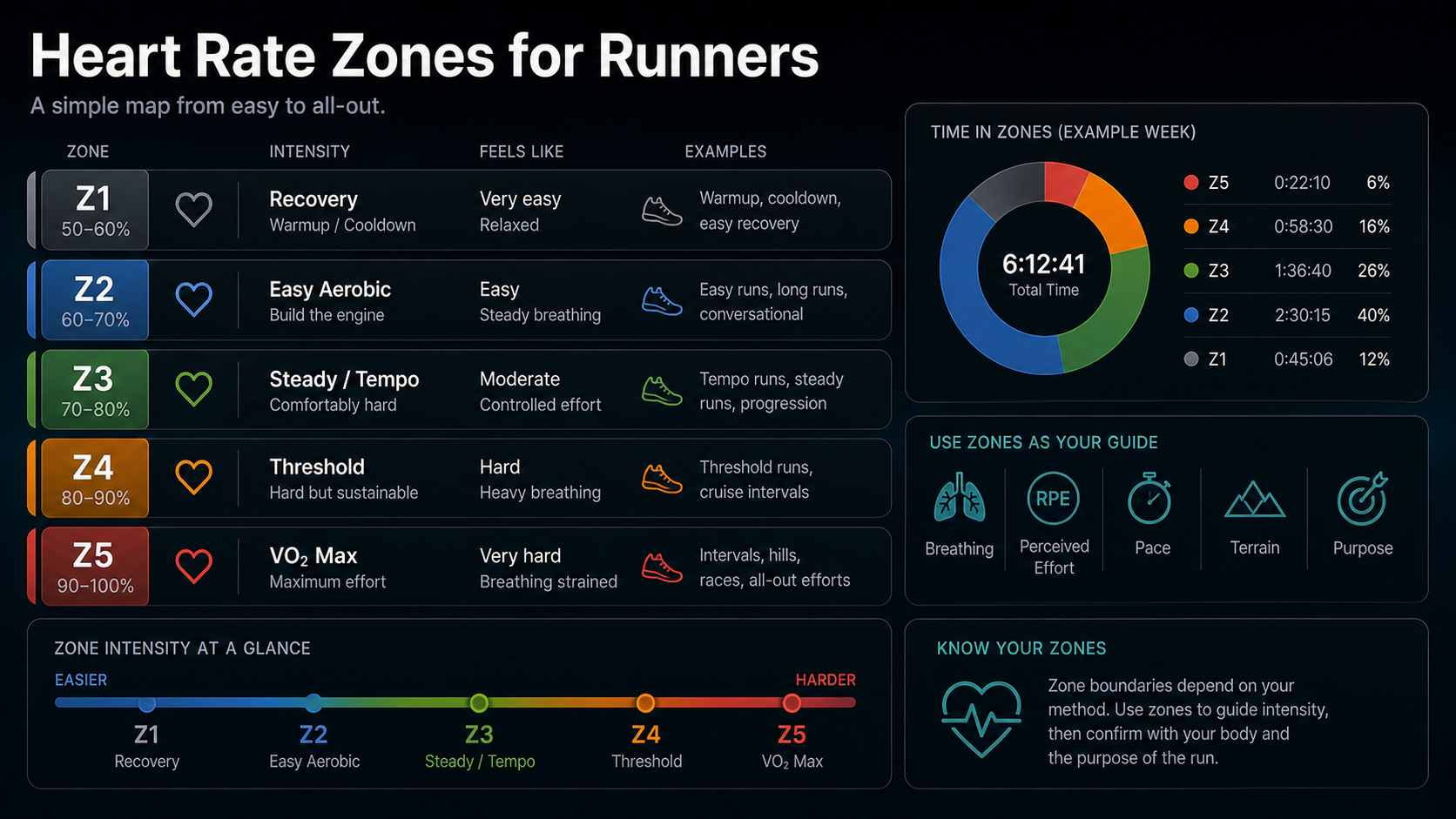
Heart-rate zones divide your heart-rate range into intensity bands. Most runners see five zones, although the exact boundaries and names vary between apps, watches, coaches, and lab protocols.
A simple five-zone running model looks like this:
| Zone | Common running feel | Typical purpose |
|---|---|---|
| Zone 1 | Very easy, relaxed | Recovery, warmup, cooldown |
| Zone 2 | Easy, conversational | Aerobic base, easy runs, long runs |
| Zone 3 | Steady, controlled | Tempo-like running, progression, moderate work |
| Zone 4 | Hard but sustainable | Threshold runs, cruise intervals |
| Zone 5 | Very hard | VO2 max intervals, hills, racing surges |
The exact percentages depend on the method. Some systems base zones on maximum heart rate. Others use heart-rate reserve, lactate-threshold heart rate, ventilatory thresholds, or manual boundaries. That is why one app's Zone 3 may not mean the same thing as another app's Zone 3.
Use the labels as a map, not a universal language. The important question is not "What color did the app show?" It is "Did this run create the intensity I intended?"
Why Runners Use Heart Rate Zones
Runners use heart-rate zones because they solve a common problem: pace can make easy days too hard and hard days too vague.
On easy days, many runners drift into moderate effort because the pace feels familiar. Heart rate exposes that drift. If the plan says easy but your heart rate spends half the run in a steady Zone 3, the workout may be more stressful than intended.
On long runs, heart rate shows whether the effort stays controlled as fatigue builds. A pace that feels easy at mile 2 may produce a higher heart rate by mile 12. That rise can be normal, but it changes the cost of the run.
On harder workouts, heart rate helps you understand the overall load. It is less precise for short sprints because heart rate lags behind pace and muscular effort, but it is useful for threshold work, longer intervals, and post-workout review.
Heart-rate monitoring has both applications and limitations. Achten and Jeukendrup reviewed heart-rate monitoring in sport and described it as useful for exercise prescription and training monitoring, while emphasizing that interpretation depends on conditions and individual response (Sports Medicine). That is exactly how runners should use zones: as context, not as a single-command system.
Set Zones Before You Trust The Colors
Zone training only works if the zone boundaries are close enough. If your zones are wrong, an accurate heart-rate reading can still lead to the wrong training decision.
Many runners start with age-based maximum heart-rate estimates. These are convenient, but they are population estimates. Tanaka, Monahan, and Seals proposed the often-cited 208 minus 0.7 times age equation, but individual variation remains large enough that age formulas should be treated as starting points rather than personal truth (Journal of the American College of Cardiology01054-8)).
There are several ways to set running zones:
Maximum heart rate method: Zones are percentages of your estimated or tested maximum heart rate. This is simple, but it can be inaccurate if max heart rate is estimated poorly.
Heart-rate reserve method: Zones use the range between resting heart rate and maximum heart rate. This adds resting heart rate, which may better reflect individual differences, but it still depends on a credible max.
Threshold-based method: Zones are based on a lactate-threshold or field-test estimate. This can be useful for trained runners, but the test needs to be appropriate, repeatable, and updated when fitness changes.
Manual method: You edit zones based on known training response, lab testing, coaching input, or repeated field evidence.
Whichever method you choose, cross-check it with breathing and perceived effort. The CDC's talk-test guidance is a simple practical check: at moderate intensity, you can talk but not sing; at vigorous intensity, speaking more than a few words becomes difficult (CDC). If your watch says easy Zone 2 while you cannot speak comfortably, check the zone setup, sensor data, terrain, and conditions.
Zone Training Log supports custom heart-rate zones, including methods based on maximum heart rate, heart-rate reserve, age, and manual thresholds. The value is not just setting zones once. It is keeping the training log consistent as your zones improve.
Use Zones Differently For Each Run Type
Heart-rate zone training becomes useful when each run has a job. The same zone chart can be good or bad depending on the workout purpose.
Recovery Runs
Recovery runs should reduce stress, not add hidden load. Most of the run should sit in Zone 1 or low Zone 2, depending on your system. If a recovery run spends long periods in Zone 3, it probably is not recovery.
That does not mean recovery runs must be painfully slow. It means the run should leave you better prepared for the next meaningful session. If that requires slowing down, using run-walk, choosing flat terrain, or shortening the run, the zone chart is doing its job.
Easy Runs
Easy runs are where many runners get the most value from zones. These runs should usually feel conversational, controlled, and repeatable. Zone 2 is often the target, but some runners will spend part of easy running in Zone 1 or low Zone 3 depending on zone model, terrain, and fitness.
The mistake is turning every easy run into moderate work. Easy running is how runners build durable volume without making every session a race. If your easy days keep drifting above the intended zone, use a heart-rate ceiling for the first 20 minutes and let pace be whatever it needs to be.
Long Runs
Long runs are not automatically hard runs. For many runners, the best long run is mostly easy Zone 2 with controlled late drift. Some plans include progression long runs or race-specific blocks, but those should be intentional.
Heart rate is especially useful because fatigue changes the cost of a long run. If pace stays the same while heart rate rises steadily, the run is becoming more internally expensive. Cardiovascular drift during prolonged exercise is a known pattern, especially with heat stress or dehydration (Coyle and Gonzalez-Alonso).
Drift is not always failure. A mild rise late in a long run can be normal. The question is whether it matches the plan. A supposed easy long run that spends the last half in Zone 3 may need an easier start, better fueling, more hydration, a shorter route, or a lower weekly load.
Tempo Runs And Threshold Runs
Tempo and threshold work should feel controlled-hard, not all-out. Depending on your zone model, these workouts often land around Zone 3 to Zone 4. The goal is sustained quality, not a workout that becomes a race.
Heart rate is useful here because it shows whether the effort stabilized. If the workout is meant to be threshold but heart rate climbs into the highest zones and pace falls apart, the session may be too hard. If the workout feels easy and never reaches the intended range, the target may be too light or the zones may be too high.
Intervals And Hills
Short intervals are harder to judge by heart rate because heart rate responds with a delay. During a 30-second hill repeat, your legs may be working at high intensity before heart rate reaches Zone 5. Then heart rate may keep rising during recovery.
For short intervals, use pace, power, grade, repetition quality, recovery, and RPE first. Use heart rate to understand the total session load and whether recoveries were adequate.
For longer intervals, such as 3 to 8 minutes, heart rate becomes more useful because it has time to rise. You can compare reps: did heart rate climb higher at the same pace, did recovery drop off, and did effort become unsustainable?
Build A Runner's Week Around Zones
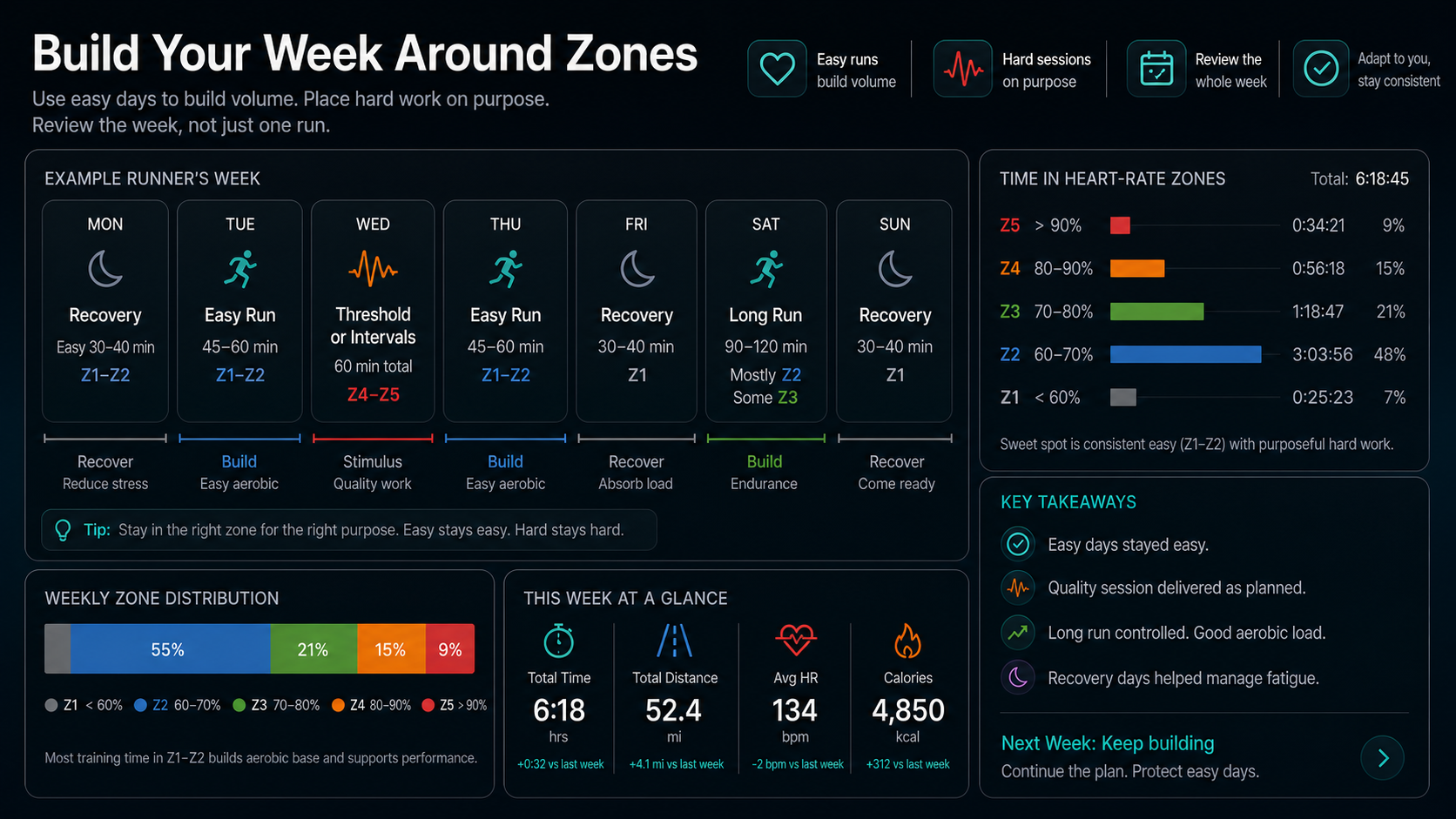
Heart-rate zone training works best when easy running and hard running each have a purpose. Most runners should not try to make every run moderate. Use low-zone running to build repeatable volume, place higher-zone work deliberately, and review the whole week rather than judging one run in isolation.
Research on endurance intensity distribution supports this broad idea. Seiler's review of endurance training distribution describes how successful endurance athletes often keep a large share of training at low intensity, with harder work placed deliberately rather than spread across every day (International Journal of Sports Physiology and Performance). Esteve-Lanao, Foster, Seiler, and Lucia also linked training intensity distribution with performance in trained runners using a low, moderate, and high-intensity model (Journal of Strength and Conditioning Research).
This does not mean every runner needs an exact ratio. It means your week should have a shape. Easy days should be easy enough to support volume and recovery. Hard days should be hard for a reason. Moderate work should be intentional, not accidental.
Example Weekly Structures
The right week depends on fitness, schedule, injury history, goal race, and recovery. These examples are starting points, not prescriptions.
Three Runs Per Week
A simple three-run week can still use zones well:
| Day | Run | Zone focus |
|---|---|---|
| Tuesday | Easy run | Mostly Zone 1-2 |
| Thursday | Quality run | Tempo, threshold, hills, or intervals |
| Weekend | Long easy run | Mostly Zone 2, controlled drift |
The trap with three runs per week is making every run hard because the schedule feels small. Resist that. If every run becomes moderate or hard, you lose the easy volume that supports consistency.
Four Runs Per Week
A four-run week gives more room for separation:
| Day | Run | Zone focus |
|---|---|---|
| Monday | Recovery or easy | Zone 1-2 |
| Wednesday | Quality run | Zone 3-5 depending on workout |
| Friday | Easy run | Zone 1-2 |
| Sunday | Long run | Mostly Zone 2 |
This structure works for many recreational runners because it includes one meaningful workout, one long run, and enough easy running around them.
Five Or More Runs Per Week
Higher-frequency running makes zone control more important. With more runs, it becomes easier to accidentally create too much middle intensity. Use zones to protect the easy days, not just to measure hard days.
A five-run week might include three easy runs, one quality session, and one long run. A more advanced week might include two quality sessions, but that usually requires a stronger base, careful recovery, and a reason tied to a specific training phase.
Stoggl and Sperlich compared different training-intensity distributions in trained athletes and found that how intensity is organized can influence adaptation (Frontiers in Physiology). The practical point for runners is that the distribution itself is a training variable. Do not let it happen by accident.
Progress With Zones Across A Training Block
Heart-rate zone training is not only about controlling today's run. It is also about seeing how the training block changes over time.
In a base phase, many runners should see a large share of time in Zone 1-2. The goal is durable aerobic volume: more repeatable running, better long-run tolerance, and less strain from each easy day. Progress often looks boring. Easy runs stay easy, the long run grows gradually, and effort scores remain stable.
In a build phase, the week may include more deliberate Zone 3-4 work. Tempo runs, threshold intervals, hill sessions, and race-specific blocks can all appear. The key word is deliberate. If Zone 3 grows because the plan added tempo work, that may be productive. If Zone 3 grows because every easy day drifted upward, the block may be accumulating hidden fatigue.
In a race-specific phase, zones should reflect the race distance and workout purpose. A 5K runner may include more high-intensity interval work. A half-marathon runner may include more controlled threshold or steady work. A marathon runner may care more about long aerobic durability and controlled marathon-pace segments. None of those phases should erase easy running.
In a recovery or deload week, the zone chart should usually get quieter. Total time may fall. High-zone work may shrink. Easy days may become shorter or slower. That is not a failed week. It is the point of the week.
Use Zone Training Log's weekly and custom-range summaries to review these phases as blocks, not just single weeks. Ask whether the zone distribution matches the phase:
- Base: mostly easy volume, stable effort, controlled long run.
- Build: more planned quality, easy days still protected.
- Race-specific: intensity matches goal race demands.
- Deload: lower load, fewer hard-zone minutes, better recovery.
This block-level view helps prevent the common runner mistake of making every week slightly harder until fatigue makes the decision for you.
Use Zones Differently By Race Distance
The race you are training for changes how you use zones. Heart-rate zones do not prescribe the exact plan, but they help you organize the stress.
For 5K training, easy running still matters because it supports frequency and recovery. The harder work may include hills, VO2 max intervals, short repetitions, and race-pace sessions. Heart rate is useful for the overall session load, but it may lag during short fast reps. Pace, terrain, rep quality, and RPE should lead the interpretation.
For 10K training, zones often become more balanced. Easy runs and long runs still build the base, while threshold and controlled hard intervals become important. Heart rate can be useful during longer reps because it has time to rise and stabilize.
For half-marathon training, Zone 2 durability and controlled Zone 3-4 work both matter. Long runs, tempo blocks, and threshold sessions become easier to evaluate when you can see whether heart rate stayed controlled or drifted.
For marathon training, the biggest value of heart-rate zones is often preventing easy and long runs from becoming too hard. Marathon plans can involve a lot of volume. If too many miles drift into moderate intensity, the week can become expensive before you notice it. Heart rate helps preserve easy volume and makes long-run drift visible.
Race-distance examples:
| Goal | Zone-training emphasis |
|---|---|
| 5K | Easy volume plus short high-intensity work |
| 10K | Easy volume plus threshold and longer intervals |
| Half marathon | Controlled long runs, threshold, steady aerobic work |
| Marathon | High easy-volume discipline, long-run control, race-specific blocks |
Do not turn this into a rigid rule. Training age, injury history, weekly mileage, course profile, and recovery capacity matter. A new 5K runner may need mostly easy volume. An experienced marathoner may include carefully placed faster work. Zones help you see whether the stress you planned is the stress you actually created.
When The Zone Chart Disagrees With The Run
Sometimes the zone chart and the run do not agree. That is where good runners slow down and interpret instead of reacting.
If the chart says the run was hard but it felt easy, check the sensor, route, heat, caffeine, and zone settings. A loose watch, cold skin, hills, or an underestimated max heart rate can all make the chart misleading. If the pattern repeats across many runs, revisit the zone setup.
If the chart says the run was easy but it felt hard, do not force the pace just because the color looks safe. Low heart rate with high effort can appear when you are fatigued, under-fueled, sore, stressed, or using unreliable data. It can also happen on muscularly demanding routes where heart rate is not the only stress.
If the chart is noisy, fix the measurement before changing the plan. Wear the watch snugly, place it correctly, warm up in cold conditions, clean the sensor, or use a chest strap for key workouts where accurate heart-rate data matters.
Halson's review of training-load monitoring emphasizes that fatigue and training response should be interpreted with multiple signals rather than one metric alone (Sports Medicine). For runners, that means the zone chart is one signal beside RPE, pace, sleep, soreness, mood, and life stress.
The practical rule is: believe patterns more than one-off files. One strange run may be a sensor artifact or a bad day. Three similar runs in a row are information.
Match Zones With RPE, Pace, And Terrain
Zones are most useful when they are read beside other signals. A high heart rate during a fast interval may be expected. A high heart rate during an easy flat run at normal pace may be a warning sign. A high heart rate during a hot uphill trail run may simply reflect the conditions.
Use four checks:
- RPE: How hard did the run feel?
- Pace or power: What external output did you produce?
- Terrain and weather: Did hills, heat, wind, or surface change the cost?
- Purpose: Was the workout supposed to be easy, steady, or hard?
Session rating of perceived exertion is useful because it captures what the sensor cannot. Foster's work on monitoring training used session RPE with duration to quantify training load and discuss strain and monotony (Foster). You do not need to calculate a formal score every day, but you should notice when RPE and heart rate disagree.
Common patterns:
- Same pace, higher heart rate, higher RPE: fatigue, heat, illness, or stress may be raising the cost.
- Same pace, lower heart rate, same RPE: aerobic fitness or better conditions may be improving output.
- Low heart rate, high RPE: fatigue, muscle soreness, fueling, or sensor error may be involved.
- High heart rate, low RPE: check sensor quality, zones, caffeine, heat, and route.
The best training log keeps these signals together. A zone chart without notes is easy to misread.
Watch For Heart Rate Drift
Heart rate drift is one of the most useful zone-training patterns for runners. It happens when heart rate rises during a steady run even though pace stays similar. The longer the run, the more important this becomes.
Mild drift can be normal. Large drift on easy runs may mean the pace is too fast, the conditions are hot, fueling or hydration was poor, fatigue is accumulating, or the long run is too long for the current base.
To check drift, do not judge the first few minutes. Warmups are noisy. Instead, compare the middle of the run with the later part. If pace is steady but heart rate moves from Zone 2 to sustained Zone 3, the workout became more stressful than the early miles suggested.
Use drift to adjust, not panic:
- Start easier for the first 15 to 20 minutes.
- Choose flatter terrain for true easy days.
- Shorten the run while rebuilding base.
- Fuel and hydrate better on longer runs.
- Reduce the next hard session if fatigue is accumulating.
- Check zones if the pattern never matches breathing or RPE.
This is where weekly review matters. One drifting run in heat is context. Several drifting easy runs in a row are a pattern.
Common Mistakes In Heart Rate Zone Training
The first mistake is using default zones forever. Defaults are useful for getting started, but they may not fit your physiology. If every easy run looks too hard or every hard workout looks too easy, review the zone method.
The second mistake is chasing pace on easy days. Heart-rate zone training often forces runners to slow down, especially early in a base phase or in heat. That can be frustrating, but it may be exactly the point.
The third mistake is treating Zone 3 as always bad. Zone 3 can be useful for tempo work, progression runs, hills, and race-specific training. The problem is unplanned Zone 3 replacing easy running.
The fourth mistake is judging short intervals only by Zone 5 time. Heart rate lags, so short fast reps may not show much time in the highest zone even when they were hard.
The fifth mistake is ignoring sensor quality. Wrist heart-rate sensors can be affected by fit, movement, cold, skin perfusion, and other factors. Apple notes that wrist readings can be affected by fit, skin perfusion, motion, tattoos, and cold, and that a Bluetooth chest strap can be paired when needed (Apple Support). Independent studies have also found that wrist heart-rate accuracy varies by device and exercise condition (Wang et al.; Shcherbina et al.).
The sixth mistake is making medical conclusions from training charts. Heart-rate data can show useful patterns, but chest pain, fainting, unusual shortness of breath, palpitations, or unexplained abnormal readings are medical issues, not training puzzles.
How Zone Training Log Helps Runners Train By Zones
Zone Training Log is designed for runners, cyclists, hikers, and endurance athletes who want a clearer training log built around heart-rate zones. The homepage positions the app around a simple workflow: connect Apple Health or Health Connect, set HR zones, log training, review each session, summarize periods, and plan future workouts.
For runners, the useful pieces are straightforward:
- Import workouts, heart rate, distance, duration, effort, and activity data.
- Set custom heart-rate zones that match how you train.
- Review each run by time in zones, average heart rate, effort, distance, calories, and the balance between easy, steady, and high-intensity work.
- Add titles, notes, tags, and workout context.
- Review daily, weekly, monthly, or custom summaries.
- Compare planned workouts with completed sessions.
The product is especially useful because running decisions are usually weekly decisions. One run may be noisy. A week shows whether easy days stayed easy, whether the long run was controlled, and whether hard work happened intentionally.
Privacy matters because health data is sensitive. The Zone Training Log privacy policy says the iOS app reads Apple Health data only after HealthKit permission and can read workouts, heart rate, routes when available, resting heart rate, energy, distance, effort metrics, running and cycling power, and date of birth where needed for zone calculations. It also states that before connecting a web account, detailed workout history is not synced to the Zone Trainer account backend, and normal account sync does not upload every raw heart-rate sample or full HealthKit routes (Zone Training Log Privacy Policy).
That local-first model makes sense for a training log. The app can organize the data you already record, while the review habit stays focused on one question: what should the next run or week do?
A Simple Starter Workflow
If you are new to heart-rate zone training, start simple.
- Set zones using the best available method, then treat them as estimates.
- Choose a heart-rate ceiling for easy runs.
- Run the first 10 to 20 minutes easier than you think you need to.
- Keep one weekly long run mostly controlled.
- Add one quality session only when easy volume is repeatable.
- Review time in zones after each run.
- Review the whole week before adding intensity.
For the first month, the goal is not perfect zone discipline. The goal is learning what your body does at different efforts. Notice which paces feel conversational, which routes create drift, how heat changes heart rate, and whether your zones match breathing.
After a few weeks, use the log to answer better questions:
- Are easy runs actually easy?
- Is long-run drift improving?
- Does threshold work stay controlled?
- Is Zone 3 intentional or accidental?
- Is total weekly easy volume rising too fast?
- Are notes and effort scores explaining the chart?
This is how zone training becomes practical. You stop asking whether one run was perfect and start asking whether the week is moving in the right direction.
Conclusion
Heart rate zone training for runners is a way to make intensity visible. It helps you separate easy running from moderate drift, place hard work deliberately, monitor long-run cost, and review the week with more context than pace alone can provide.
Zones work best when they are set carefully and interpreted with breathing, RPE, terrain, pace, weather, and workout purpose. They are not a replacement for judgment. They are a structure for better judgment.
For most runners, the practical formula is simple: build most volume in easy zones, place harder work on purpose, keep notes on why the data looked the way it did, and review the whole week before changing the plan. Zone Training Log gives that process a stable home: custom zones, run details, notes, tags, summaries, and weekly decisions in one place.

Our editorial approach & AI disclosure
We use AI to help research, organize, and draft some articles. Every article is reviewed by a human editor and aims to reflect current evidence-based training practices and scientific literature.
Read our editorial policy