


What Is Heart Rate Drift?
Heart rate drift is the gradual rise in heart rate during a steady endurance session. Learn what causes it, how to measure it, and how to use it without overreacting.
Jun 16, 20268 min read

Introduction
Heart rate drift is the gradual rise in heart rate during a steady endurance workout even when your pace, power, or perceived effort is meant to stay stable. If you start an easy run at 140 beats per minute and later need 152 beats per minute to hold the same pace, you are seeing heart rate drift.
In exercise physiology, the broader lab term is usually cardiovascular drift. It describes a pattern during prolonged exercise where heart rate rises while stroke volume, the amount of blood pumped per beat, tends to fall. Reviews by Coyle and Gonzalez-Alonso and by Wingo, Ganio, and Cureton describe this as a normal response to prolonged exercise, especially when heat stress, dehydration, or rising body temperature increase cardiovascular strain (Coyle & Gonzalez-Alonso, 2001; Wingo et al., 2012).
For athletes, the useful question is not simply, "Did my heart rate rise?" It is, "Did my heart rate rise more than expected for the same output, and what was the context?" Heart rate drift can point to heat, dehydration, fatigue, poor pacing, under-fueling, sensor error, or a lack of durability at the duration you tried to hold. It is a signal, not a verdict.
Heart Rate Drift Versus Aerobic Decoupling
Heart rate drift and aerobic decoupling are closely related, but they are not exactly the same thing.
Heart rate drift describes the heart rate side of the pattern: heart rate climbs over time during a steady session. Aerobic decoupling is the field-training way to compare heart rate against output. For runners, output is usually pace. For cyclists, it is usually power. For hikers or trail runners, it may be vertical speed, grade-adjusted pace, or a repeatable route effort.
The word "decoupling" is useful because it captures what the athlete sees in a training log: heart rate and output stop moving together. Early in the session, a pace may feel easy and sit comfortably in Zone 2. Later, the same pace may push the athlete toward higher heart-rate zones. That does not automatically mean the workout failed. It means the internal cost of holding the output increased.
This distinction matters because cardiovascular drift is a physiological phenomenon studied under controlled conditions, while aerobic decoupling is a practical metric calculated from messy outdoor training data. Wind, hills, traffic stops, terrain, temperature, caffeine, sleep, and device accuracy all affect the number.
Why Heart Rate Drifts During Steady Exercise
The classic explanation is cardiovascular compensation. During prolonged exercise, the body must keep sending blood to working muscles while also sending more blood toward the skin for cooling. If stroke volume falls, heart rate often rises to help maintain cardiac output. Coyle and Gonzalez-Alonso summarize this time-dependent pattern as a rise in heart rate paired with a fall in stroke volume during prolonged exercise (Coyle & Gonzalez-Alonso, 2001).
Heat makes this more obvious. In heat stress, the body has to defend both movement and temperature regulation. Wingo and colleagues reviewed evidence that cardiovascular drift during heat stress can affect how heart-rate-based exercise prescription should be interpreted, because a fixed heart-rate zone may represent a lower external workload later in the session than it did at the start (Wingo et al., 2012).
Fluid loss can add to the problem. In a controlled cycling study, Hamilton, Gonzalez-Alonso, Montain, and Coyle found that fluid replacement and glucose infusion helped prevent cardiovascular drift during prolonged exercise, while no-fluid conditions showed a larger decline in stroke volume and rise in heart rate (Hamilton et al., 1991). Coyle later reviewed cardiovascular drift during prolonged exercise and the effects of dehydration, reinforcing the link between dehydration, hyperthermia, and cardiovascular strain (Coyle, 1998).
Heat acclimation can change the picture over time. A review on heat acclimation in athletes reports adaptations such as improved sweating, improved skin blood flow, lower body temperatures, reduced cardiovascular strain, and better fluid balance in hot environments (Periard et al., 2015). That is why a workout that shows heavy drift in the first hot week of summer may look very different after repeated heat exposure.
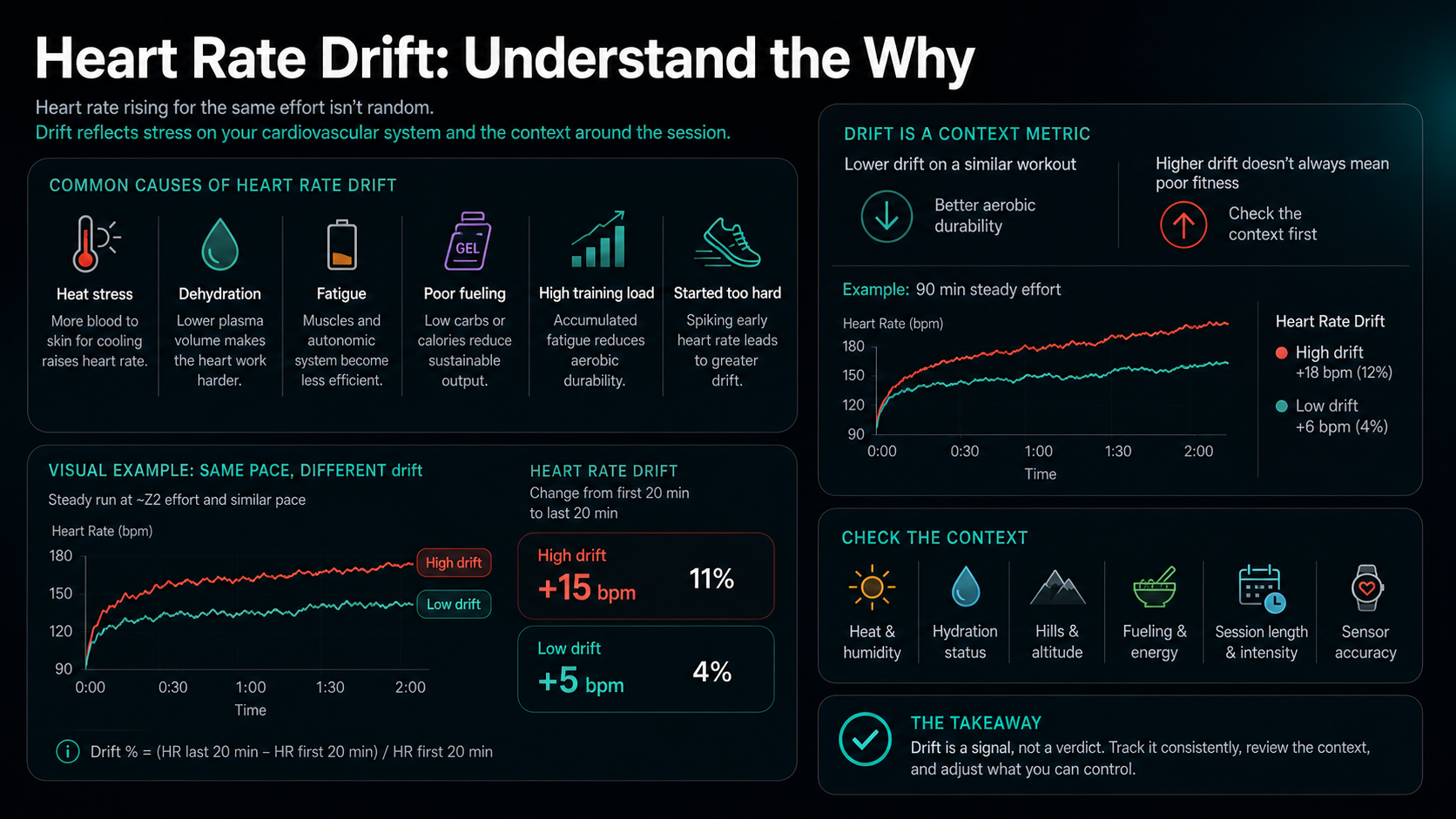
What Heart Rate Drift Can Tell You
Heart rate drift is most useful when you compare similar sessions. A single high-drift workout is often just a clue about that day. A pattern across repeated steady runs, rides, or hikes can tell you more.
Low drift on a repeatable easy session usually suggests that your body handled the duration and intensity well. If you can run 75 minutes at a steady pace with little heart-rate rise, and the weather, route, sleep, and fueling are similar, that is a good sign of aerobic durability.
High drift can mean the workout was no longer as easy as it looked from pace or power alone. The reason might be limited aerobic endurance at that duration, but it might also be heat, humidity, dehydration, accumulated fatigue, poor sleep, illness, or starting too hard. That is why heart rate drift should be reviewed next to notes, temperature, route, elevation, splits, and perceived effort.
It can also expose a pacing mistake. Many athletes begin an "easy" session slightly too hard because the first 15 minutes feel comfortable. Later, heart rate rises and the session becomes a moderate workout. If the goal was aerobic base work, drifting out of the intended zone may reduce the purpose of the session even if the average pace looks fine.
How To Measure Heart Rate Drift
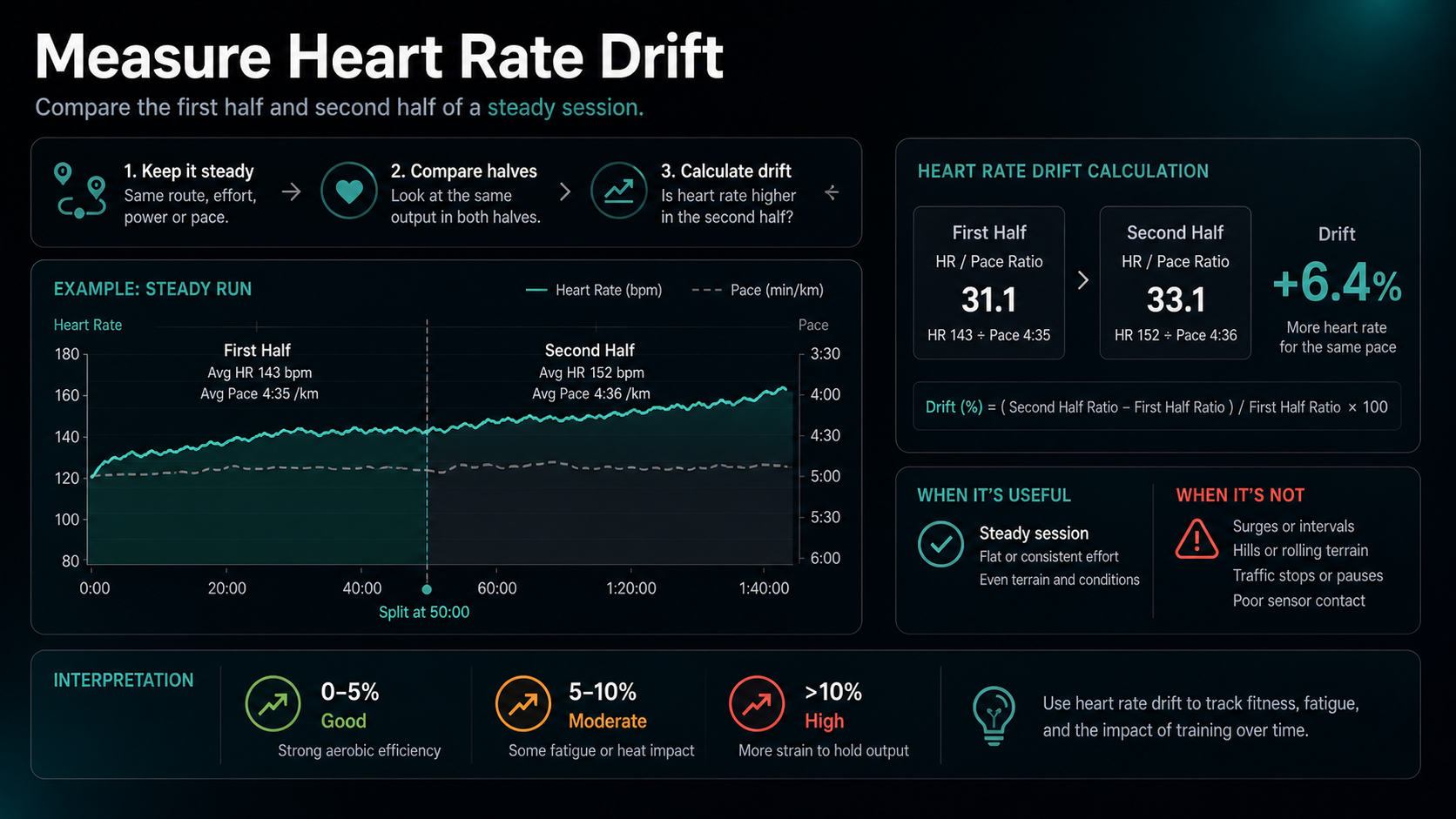
The simplest method is to compare the first half and second half of a steady workout. The session should be long enough for drift to appear, usually at least 45-60 minutes for many endurance athletes, and it should be as steady as practical. A flat route, treadmill, indoor trainer, or repeated loop gives cleaner data than rolling terrain.
For a practical training-log calculation:
- Choose a steady session without intervals, long stops, or major terrain changes.
- Ignore the warm-up if it distorts the first part of the workout.
- Compare the relationship between output and heart rate in the first half and second half.
- Treat the result as context-dependent, not as a clinical test.
For cycling, this is often calculated as heart rate relative to power. For running, it can be calculated with pace, but pace is noisier because terrain, wind, heat, surface, and GPS error matter. The important principle is the same: if heart rate is meaningfully higher for the same output later in the session, drift has increased.
Many coaches and training tools use rough interpretation bands such as 0-5% as low, 5-10% as moderate, and more than 10% as high. Those are practical heuristics, not universal physiological cut points. They are most useful when applied consistently to your own repeatable workouts.
When Heart Rate Drift Is Most Useful
Heart rate drift is especially useful for aerobic base work, long easy sessions, and repeatable durability checks. These sessions are supposed to stay controlled. If the second half regularly becomes much more expensive internally, your training log is showing that the session is harder than the pace or power alone suggests.
It is less useful for workouts with intervals, hills, technical trails, stoplights, surges, group rides, or racing. In those cases, heart rate will naturally lag behind changes in output. A hill or surge can push heart rate upward for several minutes after the effort changes, making split-half comparisons misleading.
Sensor quality also matters. Wrist optical monitors can be convenient, but studies have found variable accuracy across devices and conditions during exercise. A JAMA Cardiology study found differences among wrist-worn heart-rate monitors, and later work has continued to show that wrist photoplethysmography can lag or vary during exercise transitions (Wang et al., 2017; Bretonneau et al., 2024). For drift checks, a chest strap is often cleaner, especially in cold weather, fast running, cycling on rough roads, or sessions with arm movement artifacts.
How To Reduce Excessive Drift
The right response depends on the cause.
If drift is high because the day was hot, slow down, shorten the session, train earlier, or accept that heart-rate zones will behave differently. Heat acclimation can reduce cardiovascular strain over repeated exposures, but it should be built gradually rather than forced through hard sessions in dangerous conditions (Periard et al., 2015).
If drift is high because you started too fast, the fix is pacing. Begin easier than you think you need to, especially on long Zone 2 sessions. A well-paced aerobic session often feels almost too easy at first.
If drift appears across many normal-weather sessions at the same duration, the fix is usually more aerobic durability. That may mean building long easy volume gradually, keeping easy days genuinely easy, and not turning every base run into a moderate workout. Reviews of endurance training intensity distribution consistently note the importance of substantial low-intensity work in endurance programs, though the ideal distribution varies by athlete and sport (Seiler, 2010; Bourgois et al., 2019).
If drift rises when you are tired, sick, under-slept, or under-fueled, do not treat it as a pure fitness test. It may be a readiness signal. Review resting heart rate, sleep, soreness, recent training load, perceived effort, and whether easy paces have started feeling unusually costly.
How To Use Drift In Zone Training Log
Use heart rate drift as a trend metric. Pick a repeatable session, such as a 60-90 minute easy run, an indoor Zone 2 ride, or a steady uphill hike. Keep the route, duration, and intensity similar enough that comparisons are fair. Then look at drift alongside notes and conditions.
A useful review might sound like this:
- "Low drift, normal RPE, cool weather: aerobic durability looked good."
- "High drift, hot day, same route: probably heat and hydration context."
- "High drift, normal weather, high fatigue: likely recovery issue."
- "High drift across several similar easy sessions: build base more gradually."
The goal is not to chase zero drift. Some drift is normal during prolonged exercise. The goal is to understand whether your internal cost is stable enough for the workout you intended.
Conclusion
Heart rate drift is the rise in heart rate that happens during steady endurance exercise as the body works to maintain output under growing cardiovascular and thermal stress. It is closely related to cardiovascular drift in exercise physiology and to aerobic decoupling in training logs.
For athletes, the best use is practical: compare steady sessions, check the context, and watch the trend. Low drift on similar workouts usually suggests good aerobic control. High drift asks for investigation. Before blaming fitness, check heat, hydration, pacing, fatigue, fueling, terrain, and sensor accuracy.
Heart rate drift is not a pass-fail score. It is one of the better clues your training log can give you about how sustainable an "easy" effort really was.
Related