

Training Log & Analytics
How Do You Build a Weekly Endurance Training Review Habit?
Build a weekly endurance training review habit by using the same cue, a short checklist, zone summaries, effort notes, and one clear next-week decision.

Introduction
To build a weekly endurance training review habit, make the review small, scheduled, and decision-focused. Pick the same cue every week, open the same training log view, answer the same short set of questions, and finish with one next-week decision. The habit should take about ten minutes, not an hour.
The goal is not to analyze everything. The goal is to turn the week into a useful training decision: keep building, absorb the load, protect easy days, move a hard session, reduce volume, retest zones, or watch a pattern for another week.
This matters because endurance training is not only a collection of workouts. It is a repeated cycle of stress, recovery, adaptation, and adjustment. Training-load researchers distinguish external load, such as distance, duration, pace, power, and elevation, from internal load, such as heart rate and perceived effort (Bourdon et al.). A weekly review helps you compare both sides before the next plan hardens into habit.
Zone Training Log is built for this kind of review. It turns Apple Health and Health Connect workouts into a heart-rate-zone training log, then lets you review time in zones, effort, distance, notes, tags, planned workouts, readiness, and weekly summaries. The useful habit is simple: look at the week, understand the pattern, and decide what next week needs.
If you are new to the underlying model, start with what heart rate zone training means, then use this weekly process to turn individual workouts into a longer-term pattern.
Why Weekly Reviews Work Better Than Random Analysis
Many athletes review workouts only when something feels wrong. A bad long run triggers a deep dive. A strong race gets a screenshot. An easy week disappears without comment. That kind of analysis is understandable, but it is inconsistent. It tends to overemphasize emotional workouts and ignore quiet trends.
A weekly review is different. It creates a regular checkpoint. You are not waiting for a problem. You are asking the same questions before small problems become patterns.
Habit research supports this kind of repeated, stable routine. Lally and colleagues studied habit formation in everyday behavior and found that automaticity develops gradually through repetition in a consistent context (European Journal of Social Psychology). Gardner, Lally, and Wardle later described habit formation for health behavior as a process of repeating a chosen action in a stable context until the context begins to cue the behavior (British Journal of General Practice).
For training review, that means the best habit is not "I will review my training more." It is more specific: "Every Sunday evening after dinner, I open my weekly summary and choose one adjustment for next week." The cue, place, and action are clear.
The weekly rhythm also matches how endurance training is planned. Most athletes naturally think in weeks: long run day, quality day, easy days, rest day, total volume, and next week's progression. A weekly review gives that structure a feedback loop.
Start With A Fixed Cue
The review habit should begin with a fixed cue. The cue is the event that tells you to start. It can be a time, place, or existing routine.
Good cues are specific:
- Sunday evening after the last workout.
- Monday morning before planning the week.
- After syncing workouts from Apple Health or Health Connect.
- After writing the next week's first planned workout.
- After charging the watch or bike computer.
Weak cues are vague:
- Sometime this weekend.
- When I have time.
- After training.
- Before next week.
Specific cues work better because they reduce negotiation. You do not have to decide whether now is the right time. The cue already decided.
Implementation-intention research is useful here. Gollwitzer and Sheeran reviewed evidence that "if-then" plans can help translate goals into action by linking a situation to a response (Advances in Experimental Social Psychology38002-1)). For an endurance review, the if-then plan might be: "If it is Sunday after dinner, then I open Zone Training Log and review the week."
Make the cue realistic. If Sunday night is chaotic, choose Monday morning. If Monday morning is rushed, choose Sunday afternoon. A habit that fits your life is better than a perfect workflow that you skip.
Keep The Review Small Enough To Repeat
The most common mistake is making the weekly review too ambitious. If your first version requires every chart, every metric, every workout note, and a full training plan rewrite, you will avoid it when life gets busy.
The first rule is: the review should be short enough to do when motivation is low. Ten minutes is enough for most weeks. You can always do a deeper review after a race, during a training block transition, or when something is clearly wrong.
Use a short checklist:
- Did I complete the planned workouts?
- How much total time did I train?
- How was that time split across zones?
- Did easy workouts stay easy?
- Did hard work happen intentionally?
- Do effort, notes, distance, and elevation explain the week?
- What is the one decision for next week?
That checklist is deliberately narrow. It gives you a repeatable pattern without turning the review into homework.
The review should also have a default ending. End with one of three outcomes: build, absorb, or adjust. Build means the week matched the plan and you can progress carefully. Absorb means the week was useful but costly, so you consolidate. Adjust means the plan missed the mark, and next week needs a change.
Review The Plan Before The Data
Start the review with intention, not metrics. Ask what the week was supposed to do. Was it a base week, recovery week, threshold week, race week, return-from-illness week, or travel week?
Without that anchor, the same data can be misread. Thirty minutes in Zone 4 might be excellent in a threshold-focused build week. It might be too much in a recovery week. Four hours of low-zone training might be a strong aerobic week for one athlete and a reduced week for another.
Compare the completed week with the planned week:
| Review question | Why it matters |
|---|---|
| What was the week's purpose? | Gives the data a standard |
| Which workouts were key? | Separates important sessions from filler |
| What changed? | Shows whether the plan survived real life |
| What did I skip or add? | Catches hidden load or missing recovery |
| What should carry forward? | Turns review into planning |
Zone Training Log supports planned workouts and completed workout review, so this comparison can be practical rather than theoretical. The point is not to punish missed sessions. The point is to see whether next week should continue the plan or respond to reality.
Review Zones, Load, And Effort Together
Once you know the week's purpose, review the training data. Start with total time, then look at time in each heart-rate zone. Total time shows the size of the week. Zone distribution shows the shape of the week.
Intensity distribution matters in endurance training. Seiler and Kjerland studied well-trained endurance athletes and found most endurance training occurred below the first ventilatory threshold, with a smaller share at higher intensities (Scandinavian Journal of Medicine & Science in Sports). That does not mean every athlete needs the same distribution. It does mean weekly zone shape is worth watching.
The useful questions are simple:
- Did low-zone time match the goal?
- Did Zone 3 grow because of planned tempo work or accidental drift?
- Did hard-zone time come from key sessions, races, hills, or mistakes?
- Did easy days protect the next hard session?
- Did total volume change faster than expected?
Then add effort. Heart rate is an internal load signal, but it is not the only one. Session rating of perceived exertion, often called session RPE, is a practical way to summarize how hard a session felt. Foster's approach to monitoring training used session RPE with duration to quantify training load and discuss concepts such as monotony and strain (Foster).
Do not treat those subjective notes as second-class data. A systematic review of 56 athlete-monitoring studies found that self-reported well-being measures responded to acute and chronic training load more consistently than commonly used objective measures, while the two types of measures often did not correlate (Saw, Main, and Gastin). The practical lesson is to keep zones and workload beside sleep, fatigue, soreness, stress, and mood—not to expect one metric to replace the others.
You do not need to calculate a formal load score every week. You do need to notice mismatches. If zone distribution looks normal but effort was unusually high, fatigue may be accumulating. If high-zone time increased but it all came from planned sessions and effort stayed stable, the week may be on track.
Use Notes To Explain The Pattern
The weekly review should not stop at numbers. Notes, tags, and short workout titles often explain what the chart cannot.
A week with rising heart rate might look concerning until you remember it was hot, hilly, and sleep was poor. A week with less Zone 2 might make sense if travel forced shorter workouts. A week with more Zone 3 might be exactly right if the goal was controlled tempo work.
Heart-rate monitoring has real training value, but it needs context. Achten and Jeukendrup reviewed applications and limitations of heart-rate monitoring and emphasized that interpretation depends on conditions, individual response, and how the data is used (Sports Medicine). Weekly notes are how you preserve that context.
Use short tags that you will understand later:
- Heat
- Hills
- Poor sleep
- Travel
- Race
- Sick
- Trail
- Fueling issue
- Felt strong
- Watch issue
Do not write an essay unless it helps. A useful note is often one sentence: "Easy run drifted in heat, effort still controlled." That is enough to prevent overreacting later.
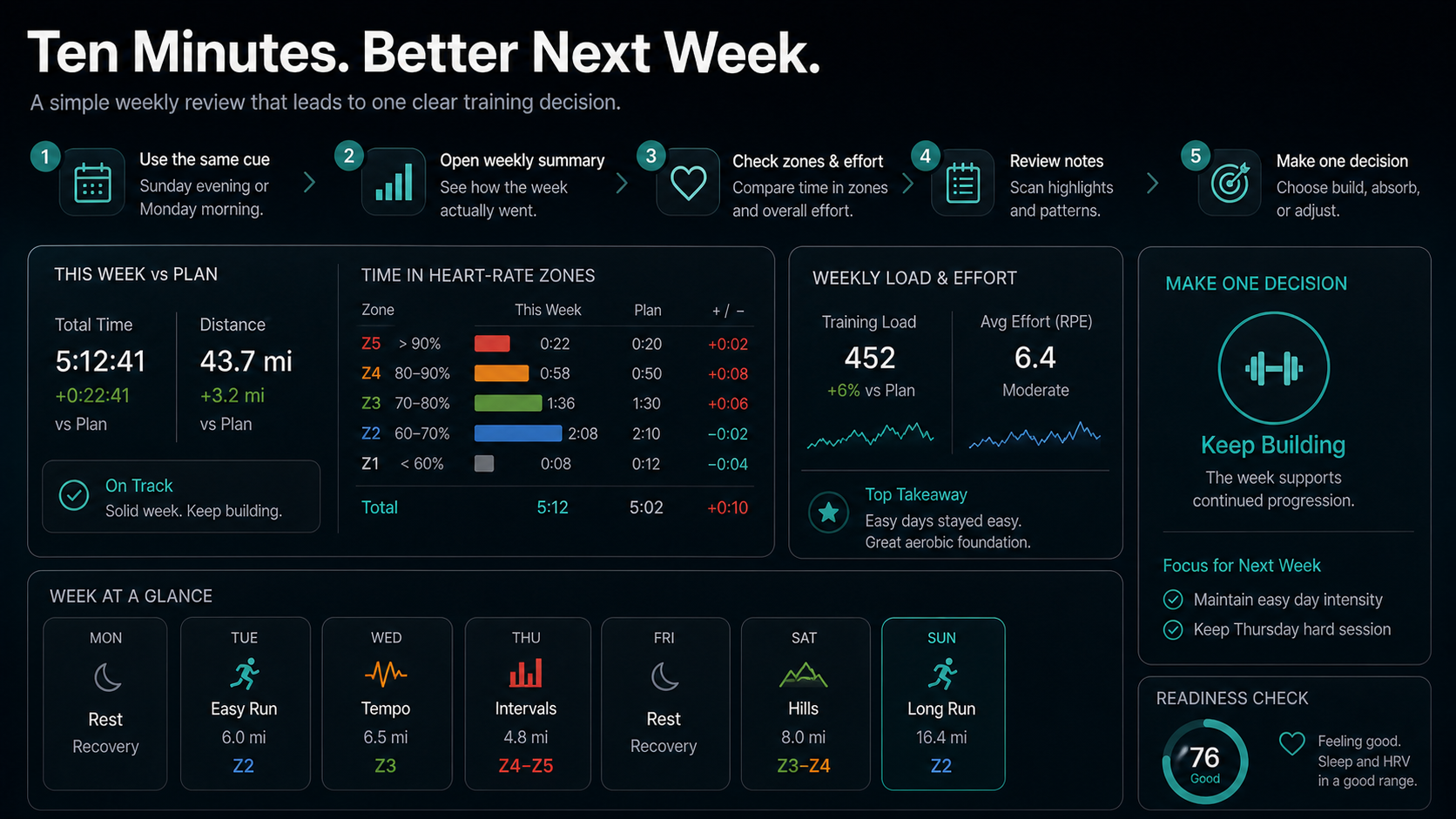
The Ten-Minute Weekly Review Habit
A useful weekly endurance review should be short enough to repeat. Use the same cue each week, such as Sunday evening after your last workout or Monday morning before planning. Open the weekly summary, compare the week with the plan, check time in heart-rate zones, review effort and notes, then choose one decision for the next week: build, absorb, or adjust.
Here is a simple ten-minute structure:
Minute 1: Open the same view. Use the weekly summary, not a random workout. Starting from the same place makes the habit easier.
Minutes 2-3: Compare plan versus done. Check completed workouts, missed sessions, added workouts, and whether the key session happened.
Minutes 4-5: Read zone distribution. Look at total time, low-zone time, Zone 3, and high-zone work. Ask whether the shape matched the goal.
Minutes 6-7: Add effort and context. Scan effort scores, notes, distance, elevation, route, and any life stress that changed the week.
Minutes 8-9: Check the trend. Compare this week with last week and a recent baseline. Look for sudden jumps, repeated drift, or stable progress.
Minute 10: Choose one decision. Write or select the next action. Keep building, absorb, adjust, retest zones, protect easy days, or move a hard workout.
The review is finished when the next decision is clear. If you keep digging after that, you are doing a deeper analysis, not the weekly habit.
Turn The Review Into One Decision
The review habit only works if it changes behavior. The end of the review should always be one practical decision.
Use this decision table:
| Weekly pattern | Next decision |
|---|---|
| Easy days stayed easy, effort stable, plan completed | Keep building |
| Productive week, but effort or life stress was high | Absorb before adding more |
| Zone 3 grew on easy days | Protect easy intensity |
| Hard workout was skipped | Decide whether to replace it or let it go |
| Hard workouts became races | Reduce intensity or increase recovery |
| Same output required higher heart rate | Watch fatigue, heat, illness, or recovery |
| Notes show poor sleep or stress | Adjust expectations for next week |
This keeps the review from becoming passive tracking. You are not collecting data for its own sake. You are asking what the next week needs.
The decision should be proportional. One odd workout may deserve a note. Several similar workouts deserve a plan change. One week with more Zone 3 during a hot spell may not matter. Three weeks of easy days becoming moderate intensity probably does.
Build The Habit Over Four Weeks
If you do not already review training weekly, do not try to build the full habit at once. Build it in layers.
Week 1: Show up. Open the weekly summary at the chosen cue. Do not worry about perfect analysis. Write one sentence: "This week was easy, heavy, missed, or on track."
Week 2: Add zones. Check total time and time in zones. Ask whether easy time stayed easy and whether hard time was intentional.
Week 3: Add context. Add effort, notes, tags, distance, elevation, and plan-versus-done. Explain one pattern.
Week 4: Add the decision. End with one next-week action. This is the moment the review becomes a training tool.
This staged approach fits habit formation better than a large all-at-once routine. The behavior repeats in the same context, and the useful pieces accumulate gradually.
After a month, the habit can stay small. A weekly review does not need to become more complicated just because you are more consistent. In most weeks, the same ten-minute structure is enough.
Where Zone Training Log Fits
Zone Training Log can make the habit easier because it gives the review a stable place to happen. The product is designed to connect Apple Health on iOS or Health Connect on Android, pull in workouts, heart rate, distance, duration, effort, and activity data, then show the training log through zones, summaries, notes, tags, and planned workouts.
The weekly review maps directly to the app workflow:
- Connect Apple Health or Health Connect.
- Set heart-rate zones that match how you train.
- Log workouts with titles, tags, notes, and effort.
- Review time in zones and key metrics.
- Summarize daily, weekly, monthly, or custom periods.
- Use readiness and zone balance as checks before the next plan.
- Compare planned workouts with completed sessions.
Privacy is part of the workflow too. Zone Training Log's privacy policy says the iOS app reads Apple Health data only after HealthKit permission and uses health data to compute training zones, summaries, route displays, and the training log. It also states that before connecting a web account, detailed workout history is not synced to the Zone Trainer account backend, and normal account sync does not upload every raw heart-rate sample or full HealthKit routes (Zone Training Log Privacy Policy).
That matters for a review habit because the habit depends on trust. You need a log that is easy to open every week and clear enough to answer the same questions without rebuilding a spreadsheet.
Make Quiet Weeks Useful Too
Not every weekly review needs a dramatic insight. In fact, the most useful review habit often comes from boring weeks. A normal week gives you a baseline. It shows what training looks like when effort is stable, easy days stay easy, sleep is normal, and nothing unusual needs explaining.
Do not skip those weeks. Write the simple takeaway anyway:
- "Base week complete, easy days controlled."
- "Volume stable, effort normal."
- "Long run drifted slightly, but heat explains it."
- "Good recovery week, ready to resume build."
Those short notes make future comparisons easier. When a later week feels heavy, you can compare it with a week that felt normal. When Zone 3 time starts creeping up, you can see whether it is a new pattern or something that has been happening quietly for a month.
Quiet weeks also protect you from chasing novelty. Endurance training often improves through repeated, unremarkable weeks that are easy enough to recover from and consistent enough to build on. A weekly review habit should notice that. If the week matched the plan and the signals are stable, the right decision may be simply: keep going.
Common Weekly Review Mistakes
The first mistake is reviewing only when training goes badly. That turns the log into a problem file. Review good, boring, and normal weeks too. Those are your baseline.
The second mistake is trying to fix everything. If your review produces five changes, you probably created confusion. Pick one decision.
The third mistake is ignoring the plan. Data without intention is easy to misread. Always ask what the week was supposed to do.
The fourth mistake is relying only on averages. Average heart rate, pace, or duration can hide the structure of the week. Zone distribution, workout purpose, and notes usually tell the clearer story.
The fifth mistake is treating the review as a medical screen. Training data can show useful patterns, but it is not a diagnosis. If you have chest pain, faintness, unusual shortness of breath, palpitations, or unexplained abnormal readings, seek appropriate medical care instead of trying to solve it with a training log.
The sixth mistake is changing zones too often. Zone settings should improve when new information is useful, but constant changes make weekly comparisons harder. If you change zones, note it and interpret the trend carefully.
Conclusion
Build a weekly endurance training review habit by making it small, scheduled, and useful. Pick the same weekly cue. Open the same summary view. Compare the plan with what happened. Review total time, heart-rate zones, effort, notes, and trend. Finish with one next-week decision.
The habit works because it connects training data to action. It is not more tracking for the sake of tracking. It is a repeatable way to ask whether the week matched the plan, whether the stress was worth absorbing, and what the next week should do.
Zone Training Log gives that habit a practical home: workouts, zones, notes, tags, effort, summaries, planned sessions, and readiness context in one place. Ten minutes is enough. The review is successful when next week is clearer than it was before you opened the log.

Our editorial approach & AI disclosure
We use AI to help research, organize, and draft some articles. Every article is reviewed by a human editor and aims to reflect current evidence-based training practices and scientific literature.
Read our editorial policy