

Zone 2 Training
Easy Run Pace vs Zone 2: Are They the Same?
Easy pace and Zone 2 often overlap, but they are not identical targets. Learn when to follow pace, heart rate, breathing, or perceived effort—and how to review the result.

Easy Pace and Zone 2 Often Overlap
An easy run and a Zone 2 run usually serve a similar purpose: accumulate sustainable aerobic work without the recovery cost of a hard session. On a flat route in mild weather, your familiar easy pace may keep your heart rate in Zone 2 for most of the run.
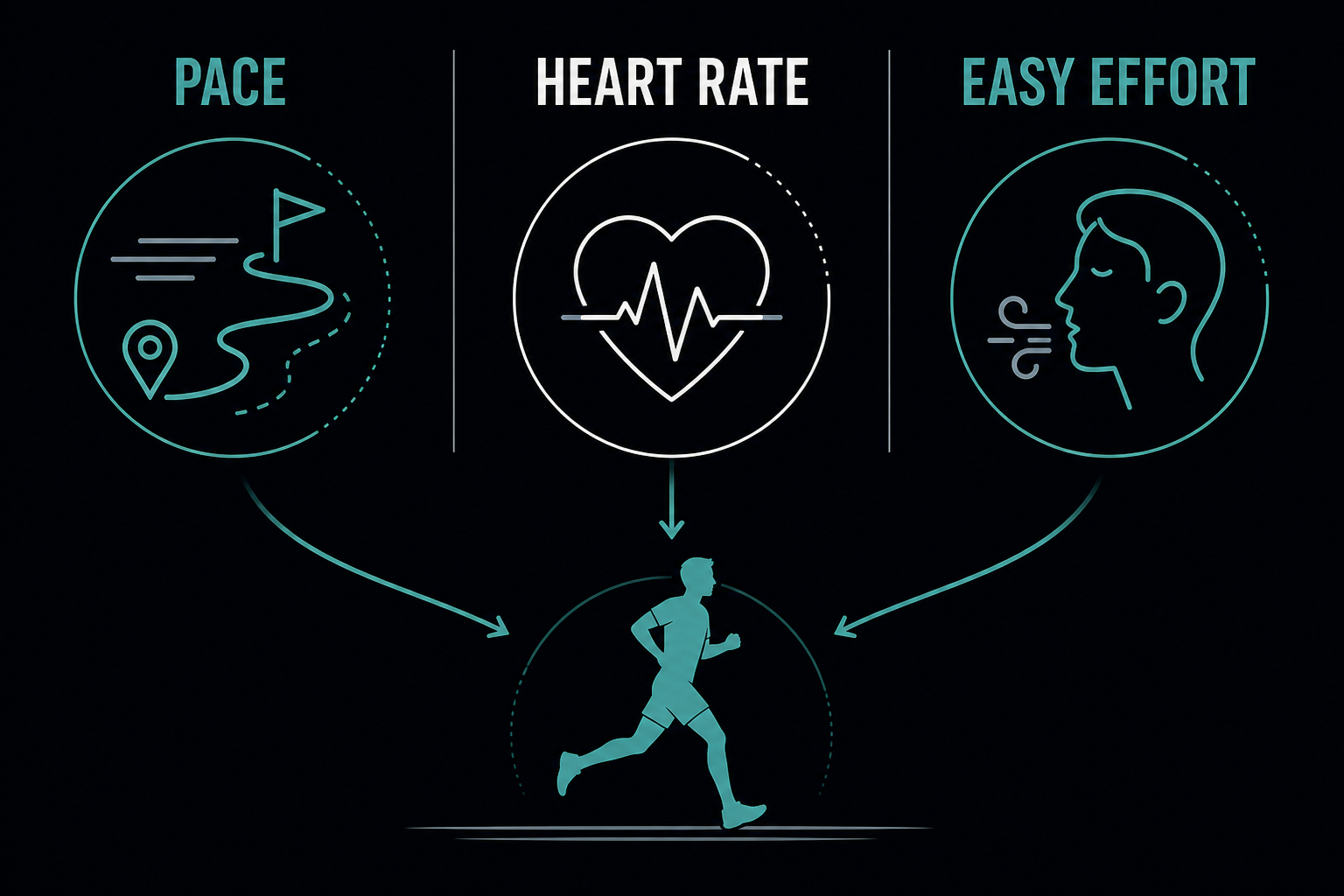
They are still different targets. Pace describes how fast you move. Heart-rate Zone 2 describes an internal response based on a set of BPM boundaries. An easy run describes the intended effort and training role. When conditions change, those three views can separate.
If your plan says “easy,” protect the easy effort. Slow down when heat, hills, fatigue, or accumulated duration make your normal pace harder than usual. If the heart-rate reading looks implausible, use breathing and perceived effort while you check the sensor and zone settings. One number should not overrule all the other evidence.
What “Easy Run Pace” Means
Easy pace is a range of speeds that lets you run with relaxed breathing, controlled mechanics, and enough reserve to repeat training. It is personal and conditional. The same runner may have different easy paces on a cool road, a hilly trail, a treadmill, and the day after intervals.
Coaches often estimate easy pace from a recent race, threshold pace, or training history. Those estimates are useful starting ranges. They are not guarantees that a fixed speed will stay easy every day.
Pace responds immediately when you climb, turn into wind, or run on soft ground. Heart rate responds with a delay. That makes pace useful for controlling the opening minutes, but less reliable as the only target on variable terrain.
What Zone 2 Means
Zone 2 is a heart-rate range within a chosen zone system. In a five-zone model, it commonly represents low-intensity aerobic work, but the exact boundaries depend on the method: percentage of maximum heart rate, heart-rate reserve, lactate-threshold heart rate, or manually entered values.
The label is not standardized across every watch, app, coach, and research paper. A study may describe three physiological intensity domains while a watch shows five colored zones. Before comparing advice, compare the underlying BPM boundaries and definition.
Research on exercise intensity shows why fixed percentages are imperfect. Individual ventilatory and lactate thresholds can occur at different fractions of maximum heart rate, so a generic percentage may classify two athletes differently even when their metabolic responses are similar (Frontiers in Physiology). A recent comparison in cyclists also found substantial individual variability among common Zone 2 markers, with first ventilatory threshold aligning better with maximal fat oxidation than several fixed-percentage methods (Translational Sports Medicine).
Zone 2 is therefore a practical estimate of an aerobic intensity domain. It becomes useful when its boundaries agree with your physiology well enough to guide repeated decisions. If you also cycle, do not assume the same BPM range transfers unchanged: Zone 2 running and cycling can require different heart-rate targets.
Why the Two Targets Disagree
Heat and humidity
Your body sends more blood toward the skin to dissipate heat. Heart rate can rise at the same pace, and the familiar pace may no longer feel easy. Slow down and judge the session by effort and safety rather than trying to reproduce cool-weather speed.
Hills, wind, and surface
Uphill running, headwinds, grass, sand, and technical trails increase the work required for a given pace. A pace target built on flat-road running will understate the effort.
Cardiac drift
During prolonged steady exercise, heart rate can rise while speed remains constant. Stroke volume may fall as temperature and duration increase, and heart rate compensates. The second half of an easy run can therefore move toward the top of Zone 2 or into Zone 3 without an intentional acceleration. Our guide to heart-rate drift explains how to interpret that pattern.
Fatigue, stress, caffeine, and illness
Sleep loss, accumulated training, psychological stress, stimulants, and early illness can change heart rate and perceived effort. A normal easy pace may feel unusually costly. Record the context rather than forcing the pace.
Sensor or boundary errors
Optical sensors can lag, spike, or lock onto cadence. Zone settings can also use an incorrect maximum heart rate. If the number disagrees sharply with breathing and effort, examine the trace and boundaries before redesigning training.
Which Signal Should You Follow?
Use a hierarchy based on the purpose of the run.
For an easy or recovery run
Follow breathing and perceived effort first. You should be able to speak comfortably in complete sentences and finish with reserve. Research in healthy adults found that using the talk test to control 30-minute runs produced physiological responses appropriate for training; the comfortably speaking stage matched recovery or long-duration intensities (Journal of Strength and Conditioning Research).
Use heart rate as a guardrail after the warm-up. Let pace adjust to the terrain and weather.
For a controlled aerobic workout
Heart rate can be the main target when the route is steady, the sensor is credible, and the boundaries are well established. Start below the top of the zone so normal drift does not turn the final third into a moderate workout.
For short repetitions
Pace or power often works better because heart rate lags behind rapid changes. Heart rate remains useful for recovery and for reviewing the overall response, but it may not reach a target before the repetition ends.
For hilly or technical routes
Use effort and heart rate, accept slower splits, and consider run-walk transitions. Chasing flat-road pace uphill changes the workout.
A Simple Decision Rule During the Run
After a 10- to 15-minute warm-up, check four signals:
- Breathing: Can you speak in full sentences without strain?
- Perceived effort: Does the effort feel controlled and repeatable?
- Heart rate: Is the reading stable and broadly inside the intended range?
- Pace: Is the speed reasonable for today’s terrain and conditions?
If three agree and one does not, investigate the outlier. A sudden heart-rate spike with easy breathing and unchanged pace points toward sensor error. Rising heart rate plus harder breathing in the heat points toward a real increase in internal load. Slow down.
If all four disagree with your planned easy day, change the session. A shorter easy run protects the week better than a forced pace that becomes another hard workout.

How to Set a Useful Easy-Pace Range
Choose three to six recent runs that were genuinely easy, mostly flat, and completed in normal weather. Exclude races, progression runs, illness, extreme heat, and sessions with obvious heart-rate errors.
For each run, note:
- average pace after the warm-up;
- median or steady-state heart rate;
- time in Zone 2;
- perceived effort;
- temperature, hills, and surface;
- whether you could speak comfortably;
- how you felt the next day.
The overlapping pace range from those runs is a better practical baseline than one calculator output. Keep it broad enough to absorb normal variation. Review the Zone 2 heart-rate calculator if the heart-rate boundaries themselves need attention. If you train indoors, use the Zone 2 treadmill guide to find a matching effort instead of copying an outdoor pace to the belt.
How to Review an Easy Run Afterwards
Do not grade the workout solely by the percentage of time in Zone 2. Look at the sequence.
A useful easy run may include Zone 1 during the warm-up, Zone 2 through the steady middle, and brief Zone 3 moments on hills. A run that starts in Zone 2 and steadily climbs into Zone 3 at unchanged pace may reveal heat, dehydration, fatigue, or insufficient aerobic durability.
Compare similar routes and conditions. Ask:
- Was the first half controlled?
- Did heart rate drift while pace stayed constant?
- Did breathing remain comfortable?
- Were the Zone 3 minutes brief and terrain-driven, or sustained?
- Did this run leave enough capacity for the next important session?
Use weekly zone-distribution review to place the run in context. Ten unexpected Zone 3 minutes matter more when several other “easy” days drifted the same way.
Common Mistakes
The first mistake is turning a pace estimate into a daily test. Easy pace should adapt to conditions.
The second is treating every second above a boundary as failure. Heart rate fluctuates, and zone edges are estimates. Focus on sustained patterns.
The third is slowing down immediately during the warm-up because heart rate has not settled. Give the cardiovascular response time to stabilize unless the effort already feels wrong.
The fourth is ignoring a consistently implausible zone system. If relaxed running always appears far above Zone 2 in cool, controlled conditions, verify maximum heart rate, resting heart rate, calculation method, and sensor quality.
The fifth is using pace and heart rate without context. Weather, terrain, duration, and fatigue explain much of the day-to-day difference.
Let the Purpose Decide
Easy run pace and Zone 2 are related views of low-intensity training. They are not interchangeable measurements. Pace shows external output, heart rate shows internal response, and “easy” describes the intended cost.
On normal days, the three should broadly agree. When they separate, protect the purpose of the session: relaxed breathing, controlled effort, and repeatable training. Let pace slow when the body is working harder, and question the heart-rate data when the rest of the evidence says the reading is wrong.
If you run three days a week, the 80/20 running guide shows how to place easy runs around one focused harder session without forcing an exact weekly ratio.

Our editorial approach & AI disclosure
We use AI to help research, organize, and draft some articles. Every article is reviewed by a human editor and aims to reflect current evidence-based training practices and scientific literature.
Read our editorial policy