

Zone 2 Training
Zone 2 Running vs Cycling
Running and cycling can both build aerobic fitness, but the same heart-rate number may not represent the same effort. Learn how to set, compare, and review sport-specific Zone 2 training.

Introduction
Zone 2 running and Zone 2 cycling aim at a similar broad outcome: accumulating sustainable aerobic work below the intensity where fatigue rises quickly. They do not always produce the same heart-rate range, however. Running and cycling recruit muscles differently, support body weight differently, and create different local fatigue. Your maximum heart rate and threshold heart rate can also differ between the two sports.
The practical rule is simple: use sport-specific zones when you have enough data to establish them. If you have only one set of zones, treat it as a starting point and confirm the effort with breathing, perceived exertion, and repeatable sessions. Do not force the same beats-per-minute target onto every activity simply because your watch uses one profile.
This guide explains why the numbers differ, how to establish useful targets, and how to compare running and cycling without pretending that pace and power are interchangeable.
Zone 2 Describes an Intensity Domain, Not One Universal Number
Zone labels are convenient, but different systems draw their boundaries in different places. A five-zone model based on maximum heart rate is not identical to a model based on heart-rate reserve, lactate threshold, or ventilatory thresholds. Even two devices can call different ranges “Zone 2.” If the underlying intensity is unclear, start with what Zone 2 training means before comparing sport-specific numbers.
For practical endurance training, the useful question is whether the session stays below the first major metabolic or ventilatory turn point and remains sustainable. The exact boundary is not perfectly observable outside a lab. Heart rate, breathing, pace or power, and perceived effort each provide part of the picture.
A review of cycling and running physiology found that heart rate can differ between the activities at both maximal and submaximal intensities, while the size and direction of the difference depend partly on training history and sport specialization (Millet, Vleck, and Bentley). That is why a runner who rarely cycles may reach local leg fatigue on the bike before their cardiovascular system reaches the heart rate they associate with an easy run.
Why Running Heart Rate Is Often Higher
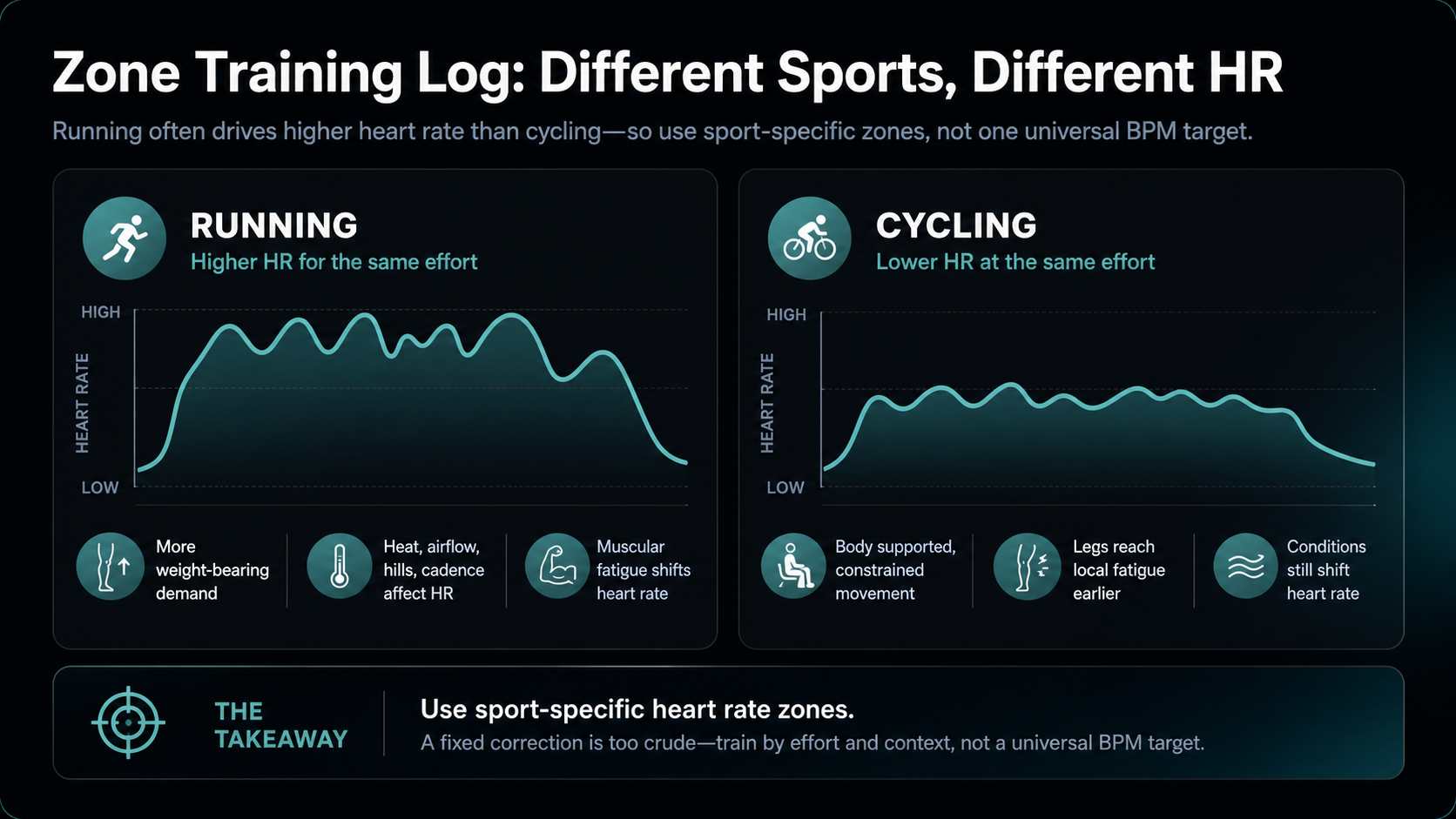
Running usually involves more weight-bearing muscle activity than seated cycling. It also includes impact, elastic energy storage, and stabilization with every step. For many recreational athletes, those demands produce a slightly higher heart rate at a comparable broad aerobic intensity.
This is a tendency, not a law. In a large validation study of endurance athletes, measured maximal heart rate averaged modestly higher in runners than cyclists, but the individual variation was large enough that population equations remained unreliable for many people (Lach and colleagues). A trained cyclist may show little difference between sports, while a runner new to cycling may be limited by quadriceps fatigue at a relatively low heart rate.
Position matters too. Cycling keeps the body supported and uses a constrained movement pattern. Running is upright and weight-bearing. Heat, indoor airflow, cadence, hills, and muscular fatigue can shift heart rate within either activity, so a fixed correction such as “bike zones are always ten beats lower” is too crude.
The Same Heart Rate Can Produce Different Local Stress
Heart rate reflects internal cardiovascular strain, not the full mechanical cost of training. An easy ride and an easy run at similar heart rates can leave very different muscular consequences.
Running adds impact and eccentric loading, especially on descents. Cycling can accumulate large amounts of low-impact volume, but high torque, low cadence, or prolonged climbing can still produce substantial local fatigue. This matters when you compare sessions in a training log: sixty minutes in the same nominal zone does not guarantee the same recovery cost.
Use heart rate to compare internal intensity while preserving sport-specific context:
- Record duration and time in zone for both sports.
- Keep pace for running and power or speed for cycling as sport-specific outputs.
- Note hills, terrain, heat, wind, indoor airflow, and cadence.
- Add perceived effort and a short note about local muscular fatigue.
- Compare trends within each sport before comparing one sport with the other.
This two-layer approach—shared internal load plus sport-specific output—makes cross-training visible without creating false equivalence.
How to Set Separate Zone 2 Targets
Best option: sport-specific testing
The strongest practical anchor is a repeatable assessment performed in the sport you want to train. A laboratory test can identify ventilatory or blood-lactate thresholds. A field test can estimate threshold heart rate, pace, or power, although it should not be treated as identical to a laboratory measurement.
If you test both running and cycling, keep the resulting heart-rate anchors separate. Thresholds are task-specific enough that transferring one result can create avoidable error. The practical setup also differs between heart-rate-zone training for runners and heart-rate-zone training for cyclists. Studies comparing treadmill and cycle testing show both meaningful physiological differences and substantial individual variation (Basset and Boulay).
Practical option: build from repeatable easy sessions
When formal testing is unavailable, collect several steady sessions in each sport under similar conditions. Look for an intensity where:
- breathing remains controlled;
- full sentences are comfortable;
- perceived effort stays around easy to moderate;
- pace or power is stable before fatigue and heat cause drift;
- the session does not compromise the next important workout.
The talk test is useful because it adds a respiratory check to a potentially noisy heart-rate value. The American College of Sports Medicine describes steady conversation as consistent with moderate aerobic exercise and recommends combining heart rate with perceived effort rather than relying on one method (ACSM intensity guide).
Starting option: use a calculator, then verify
A percentage-based Zone 2 heart-rate calculator can provide an initial range. Use it as a hypothesis, not a personal physiological diagnosis. Apply the result separately to running and cycling for a few weeks, then adjust only when a consistent pattern—not one unusual workout—shows that the target is wrong.
What to Do When Your Device Uses One Set of Zones
Some platforms apply one heart-rate-zone profile across multiple activities. You can still train sensibly:
- Choose the zones for your primary sport as the main display.
- Write down a cycling-specific or running-specific adjustment based on repeatable sessions.
- Use perceived effort and breathing when the displayed color conflicts with the session purpose.
- Review time in zone alongside pace, power, terrain, and notes.
- Avoid manually changing global zones back and forth after every workout.
If your cycling heart rate is consistently lower, the ride does not need to chase the running Zone 2 number. Pushing harder simply to make the display turn green can turn an aerobic ride into unnecessary muscular work. Conversely, a runner whose heart rate rises slightly above a cycling-derived ceiling may still be at a controlled running intensity.
How to Compare Progress Across Both Sports
Progress is easier to see within a sport than across sports. Compare repeatable routes, indoor workouts, or steady segments under similar conditions.
For running, look for:
- faster pace at a similar heart rate and perceived effort;
- less late-session heart-rate drift at the same pace;
- lower perceived effort on a familiar easy route;
- better consistency across several weeks.
For cycling, look for:
- higher power at a similar heart rate;
- less drift during a repeatable indoor ride;
- smoother cadence and reduced local leg strain;
- the ability to extend duration without increasing recovery cost.
Do not interpret every change as fitness. Cooler weather, better sleep, lower fatigue, equipment changes, terrain, and fueling can all improve the numbers on one day. A useful training log makes those conditions visible and emphasizes rolling patterns rather than isolated personal bests.
When One Sport Should Stay Easier
Cross-training does not have to mirror the primary sport. A runner may use cycling to add low-impact aerobic time, in which case the ride should remain comfortably below the point where it creates heavy leg fatigue. A cyclist may use short easy runs for bone and tendon loading, but the musculoskeletal cost can be high even when heart rate looks low.
Start conservatively when the movement is unfamiliar. Cardiovascular fitness can make a new sport feel easy before the tissues and movement patterns are ready for a large dose. Increase duration gradually and use soreness, movement quality, and next-day function alongside heart rate.
Common Mistakes
Copying one tested threshold into both sports
A running threshold is useful running information. It is not automatically a cycling threshold. Transfer it only as a provisional estimate.
Chasing heart rate on the bike
If your legs are working hard but heart rate remains below the running target, more resistance may increase local fatigue without creating the intended easy aerobic session.
Comparing speed or distance directly
Ten kilometers of running and ten kilometers of cycling do not represent comparable workload. Duration, internal intensity, and sport-specific output are more useful together.
Treating a short spike as failure
Brief hills, stops, accelerations, and sensor noise do not redefine the entire workout. Review the distribution and the reason for the change.
Ignoring recovery cost
The goal of Zone 2 is not to maximize the number of green minutes. It is to accumulate useful aerobic work that fits the week.
A Simple Weekly Review
At the end of the week, review each sport separately first:
- Total running and cycling duration.
- Time below, within, and above the intended easy range.
- Pace or power during repeatable aerobic sessions.
- Perceived effort and muscular fatigue.
- Conditions that explain unusual heart rate.
- Whether easy sessions supported or interfered with key training.
Then look at the combined week. Ask whether cycling added aerobic volume without crowding out running quality, or whether running added useful specificity without creating disproportionate soreness. This is more informative than merging every minute into one universal score.
Conclusion
Zone 2 running and cycling belong to the same broad aerobic domain, but they are not guaranteed to share the same heart-rate boundaries. Sport-specific testing is best; repeatable easy sessions with breathing and perceived-effort checks are a practical alternative.
Keep one shared view of duration and internal intensity, preserve pace or power and fatigue as sport-specific context, and adjust from trends rather than isolated workouts. The right target is not the number that makes two dashboards match. It is the intensity that produces the intended session in each sport and still fits the rest of your training week.
For cycling-specific setup, use the broader heart-rate zone training guide for cyclists and the practical guide to indoor cycling heart-rate zones.

Our editorial approach & AI disclosure
We use AI to help research, organize, and draft some articles. Every article is reviewed by a human editor and aims to reflect current evidence-based training practices and scientific literature.
Read our editorial policy