

Zone 2 Training
Zone 2 on a Treadmill: How to Choose Speed and Incline
There is no universal Zone 2 treadmill speed or incline. Use heart rate, breathing, and small adjustments to find a repeatable walking or running setting that stays genuinely easy.
Your Zone 2 Setting Is Individual
There is no universal Zone 2 treadmill speed or incline. The correct setting is the combination that produces a steady, conversational aerobic effort for you on that day. One person may reach it with brisk level walking, another with an incline, and another with relaxed running.
Use a simple process: warm up for 10 minutes, choose a comfortable speed, let heart rate settle, then adjust either speed or incline in small steps every three to five minutes. Stop increasing when you approach the top of your easy range or speaking in full sentences becomes strained. Hold the setting long enough to see whether heart rate remains stable.
The treadmill display is the workload. Heart rate and breathing show your response. Zone 2 is defined by the response, so copying a fixed speed-and-incline routine cannot guarantee the intended intensity.
Start With Credible Heart-Rate Zones
A precise treadmill setting is useless when the zone boundaries are wrong. Before building workouts around a watch color, check the maximum heart rate, resting heart rate, and calculation method behind it. The Zone 2 heart-rate calculator can help you compare methods, but every formula remains an estimate until it is checked against your own response.
Heart-rate reserve is one common method. In treadmill testing, Swain and colleagues found that percentage of heart-rate reserve tracked percentage of oxygen-uptake reserve more closely than percentage of maximal oxygen uptake (Medicine & Science in Sports & Exercise). That supports the method for exercise prescription, while still leaving room for individual variation.
Use breathing as a second signal. In a validation study, Foster and colleagues found that the talk test was related robustly enough to ventilatory threshold to support exercise prescription (Journal of Cardiopulmonary Rehabilitation and Prevention). For an easy aerobic session, you should be able to speak comfortably in complete sentences. If your device says Zone 2 while conversation feels difficult, reduce the workload and investigate the mismatch later.
Find Your Starting Point in 20 Minutes
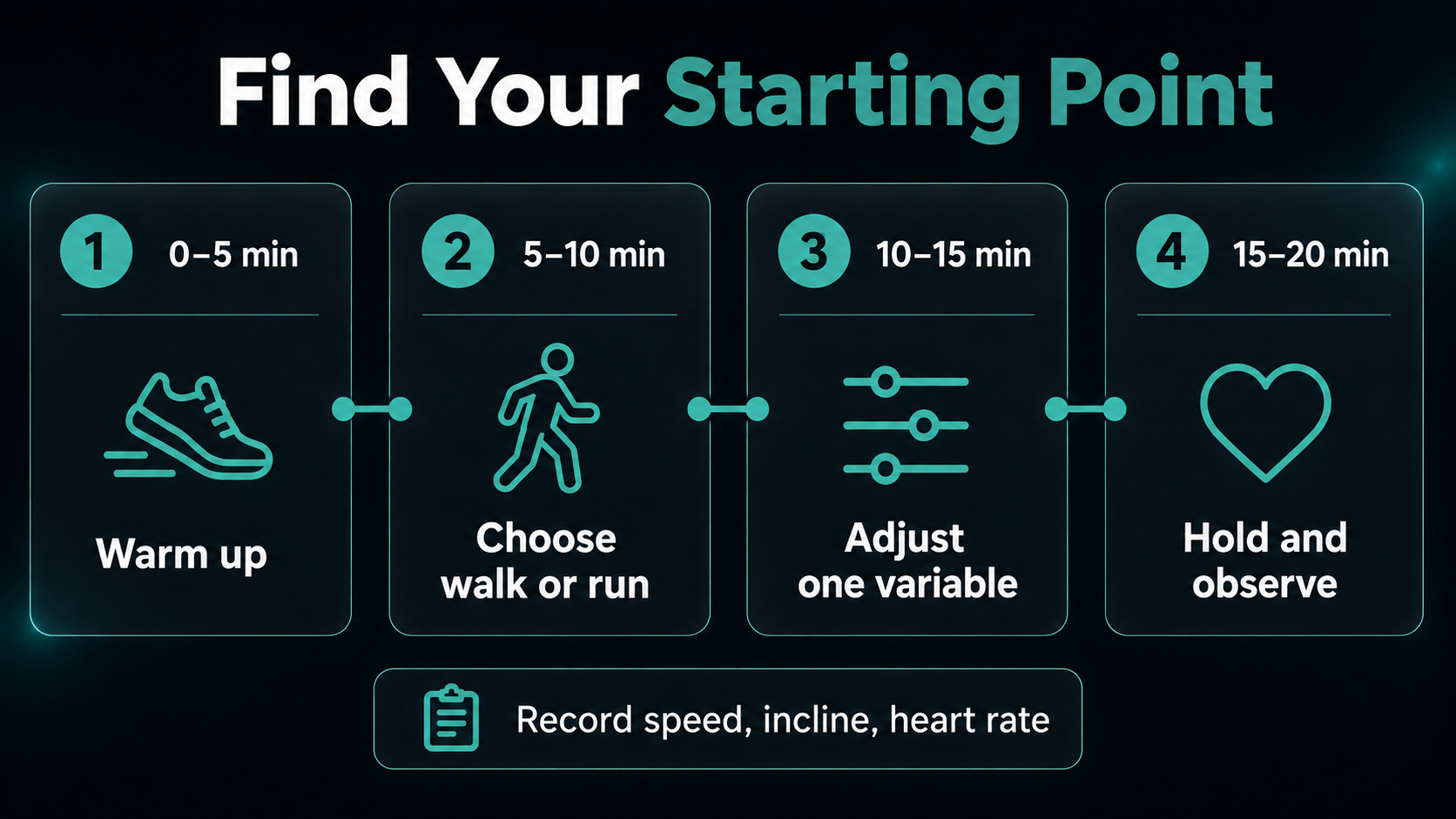
Use this first session as calibration rather than a fitness test.
Minutes 0–5: easy warm-up
Walk at a pace that feels obviously easy with the treadmill level or at a very small incline. Let your stride settle. Avoid judging the session from the first heart-rate reading because wrist sensors and your cardiovascular response both need time to stabilize.
Minutes 5–10: choose walking or running
If brisk walking already approaches your target range, keep walking. If it remains far below the range and feels effortless, add a little speed. Transition to an easy jog only if walking would require an awkwardly steep incline or if running is the specific movement you want to train.
Minutes 10–15: change one variable
Increase either speed or incline, not both. A practical adjustment is 0.3–0.5 km/h in speed or one percentage point of grade. Wait three to five minutes before judging the effect.
Minutes 15–20: hold and observe
When heart rate reaches the lower or middle part of the target range and breathing remains conversational, hold the settings. Notice whether heart rate is still climbing, whether you are gripping the rails, and whether the movement feels natural enough to repeat.
Record the final speed, incline, average heart rate, perceived effort, room temperature, and whether you walked or ran. That becomes a starting point for the next session, not a permanent prescription.
Choose Speed First When Running Form Matters
Use speed as the main control when your goal is easy running. Begin at a relaxed running speed and keep incline low. If heart rate rises above the intended range, slow down before adding more complexity.
This approach preserves the movement pattern you want to practice. It also makes future comparisons easier: the same speed, grade, duration, and temperature give you a repeatable benchmark.
Some runners set the treadmill to 1% because a small study of trained men found that a 1% grade best matched the energetic cost of outdoor running at the tested faster speeds (Jones and Doust). Treat that result as context, not a universal Zone 2 rule. It does not prove that every runner, speed, treadmill, or room requires 1%, and it does not turn a particular pace into Zone 2.
If relaxed running still sends heart rate steadily upward, use planned walk breaks. The run-walk Zone 2 guide explains how to build aerobic time without forcing an unnatural shuffle.
Choose Incline When Walking Is More Comfortable
Incline walking is useful when level walking is too easy but running is uncomfortable, too impactful, or simply not the goal. Keep a natural stride and raise the grade gradually until the cardiovascular response reaches the desired range.
Speed and grade both raise metabolic demand. Equations used to estimate treadmill walking cost include a horizontal speed component and a vertical speed-by-grade component, although real individuals do not match prediction equations perfectly (International Journal of Exercise Science). The practical implication is simple: incline is a genuine workload, not a free way to increase the heart-rate number.
Avoid leaning back and hanging from the rails. Hand support changes the task and makes the displayed speed and incline a poor description of the work you completed. If balance requires continuous support, reduce the grade or speed.
Steep walking can also create local calf, Achilles, and glute fatigue before the cardiovascular effort feels hard. Progress the incline as training load, especially if you are new to it.
Why 12-3-30 Is Not a Zone 2 Formula
The popular 12-3-30 routine means walking at 12% grade and 3 mph for 30 minutes. It is a memorable workout configuration, not a physiological definition.
At those settings, one person may remain comfortably aerobic, another may move into moderate or hard work, and another may need to hold the rails. Body size, fitness, walking economy, treadmill calibration, heat, fatigue, and zone settings all change the response.
Use the routine only if it fits your current capacity and purpose. If 12% makes speaking difficult or heart rate rises beyond the intended range, lower the grade. If the setting remains easy and mechanically comfortable, it may work as one treadmill session, but it has no special claim to Zone 2.
Account for Heart-Rate Drift
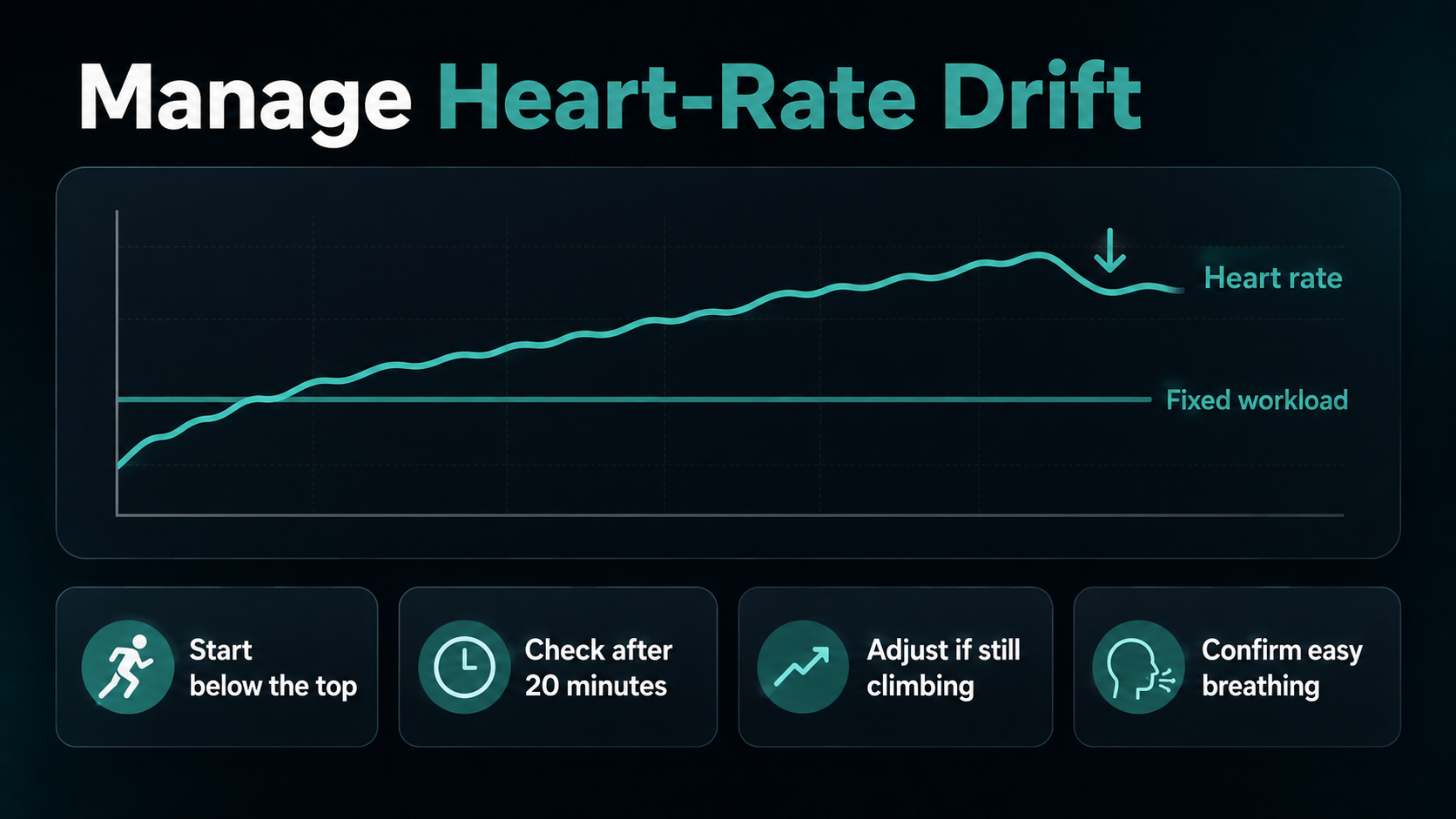
A setting that begins in Zone 2 may not stay there. During prolonged constant work, heart rate can rise even when speed and incline remain fixed. Heat and dehydration can amplify this cardiovascular drift; a major review describes progressive heart-rate increases during sustained exercise and greater strain under heat stress (Physiological Reviews).
Do not choose your setting from minute three and assume it will last for an hour. Calibrate over the duration you plan to train.
For a 30–60 minute easy session:
- Warm up below the target range.
- Settle into the lower or middle part of Zone 2.
- Review the trend after 15–20 minutes.
- Reduce speed slightly if heart rate keeps climbing toward the top boundary.
- Use breathing and perceived effort to confirm the adjustment.
A small late rise does not make the session a failure. The aim is an easy, repeatable workout, not a perfectly flat line.
Use These Starting Strategies
The settings below are approaches rather than prescriptions.
| Situation | Starting strategy | Adjust next |
|---|---|---|
| New to aerobic exercise | Comfortable level walk | Add small speed increases |
| Brisk walking is below target | Keep speed natural | Add 1% incline steps |
| Training for running | Relaxed jog at low grade | Reduce speed if HR climbs |
| Returning from impact-related pain | Comfortable walk | Add grade conservatively |
| Heart rate drifts late | Start lower in the zone | Reduce speed before strain |
| Watch reading looks implausible | Keep effort easy | Fix fit or compare another sensor |
The best starting strategy is the one that lets you move naturally and repeat the session without excessive recovery cost.
Make the Session Repeatable
Treadmill training becomes useful for analysis when the conditions are consistent. Record:
- treadmill or gym location;
- speed and incline;
- duration after warm-up;
- walking, running, or run-walk format;
- average heart rate and time in zones;
- perceived effort and talk-test result;
- temperature, fan use, and unusual fatigue.
Do not compare pace across different treadmills as if the belts were laboratory calibrated. Use the same machine when you want a clean trend. Even then, treat the numbers as a repeatable local workload rather than an exact outdoor pace.
After several similar sessions, look for useful changes. The same workload at a lower heart rate and similar perceived effort may indicate improved efficiency. A higher heart rate on one day may reflect heat, poor sleep, dehydration, stress, illness, or measurement error. Trends deserve more weight than isolated workouts.
Common Problems and Fixes
Heart rate rises immediately
The warm-up may be too fast, the room may be hot, or the zone boundary may be too low. Start easier and check the zone settings.
Walking feels awkward before reaching Zone 2
Add a modest incline or transition to easy running. Do not force an unnaturally fast walk solely to reach a number.
Running is too hard at every speed
Use run-walk intervals or incline walking while you build durability. Continuous running is not required for an aerobic session.
The watch jumps to an implausible value
Check wrist fit, compare the number with breathing and cadence, and consider a chest strap if errors repeat. Do not redesign the workout around one suspicious reading.
Calves fatigue before breathing does
Reduce the incline. Local muscular load can be the limiting factor even when heart rate remains aerobic.
You keep chasing the boundary
Aim for a range, not one BPM. Make fewer adjustments and wait long enough to observe the response.
Safety and Progression
Increase duration before making every session steeper or faster. Add only one meaningful progression at a time and keep easy sessions recoverable. Stop exercising for chest pain, fainting, severe or unusual shortness of breath, or other concerning symptoms, and seek appropriate medical care.
If medication affects heart-rate response or a clinician has given you exercise limits, follow that guidance rather than a generic zone formula.
Conclusion
Find Zone 2 on a treadmill by matching speed and incline to your own heart rate, breathing, and perceived effort. Warm up, change one variable at a time, wait for the response, and choose a setting you can repeat naturally.
Walking, incline walking, easy running, and run-walk can all produce a useful aerobic session. Record the workload and review the pattern over time. For broader planning, use How Much Zone 2 Training per Week? to place the treadmill session inside a sustainable week.
Our editorial approach & AI disclosure
We use AI to help research, organize, and draft some articles. Every article is reviewed by a human editor and aims to reflect current evidence-based training practices and scientific literature.
Read our editorial policy