

Intensity Distribution
80/20 Running With Three Runs a Week: A Practical Guide
Three runs a week can follow the useful principle behind 80/20 running without forcing an exact ratio. Build the week around two easy runs, one quality session, and enough recovery to repeat it.

Three Runs Can Follow the Principle Without Hitting 80/20 Exactly
With three runs a week, use two easy sessions and one focused quality session. Keep the warm-up, recoveries, and cool-down easy, and review the distribution over several weeks. That captures the useful idea behind 80/20 running: most training stays low intensity, while a smaller amount has a clear harder purpose.
Do not force exactly 20% of every week's minutes into high intensity. With only three sessions, the arithmetic becomes coarse. One hard workout is already one-third of the week's sessions, even though only part of that workout is hard. Trying to make a short week reach exactly 20% hard time can produce more intervals than the runner is ready to absorb.
Build the week from repeatable sessions first. Use the ratio as a review tool, not a quota.
What 80/20 Means in Research and Practice
Training-intensity-distribution research often uses three physiological domains:
- low intensity below the first ventilatory or lactate threshold;
- moderate intensity between the first and second thresholds;
- high intensity above the second threshold.
These three domains do not map neatly onto every watch's five colored heart-rate zones. A paper's Zone 1 may include what your watch calls Zones 1 and 2. Always compare definitions before comparing percentages.
The familiar 80/20 shorthand grew from observations that endurance athletes performed a large majority of sessions at low intensity and a smaller share with a high-intensity purpose. Seiler and Kjerland compared total heart-rate time with a session-goal method and found broadly similar distributions in a group of junior cross-country skiers, with roughly three quarters low intensity and less than one fifth high intensity (Scandinavian Journal of Medicine & Science in Sports).
The exact split is less settled than the slogan suggests. A recent individual-participant network meta-analysis found no overall difference between polarized and pyramidal training for time-trial performance when distribution was measured by heart-rate time in zone, and suggested that responses may differ with performance level (Sports Medicine). The durable lesson is that successful endurance training usually contains plenty of low-intensity work and a controlled amount of harder work. It is not that every runner needs the same decimal ratio.
Why Three Runs Make the Ratio Awkward
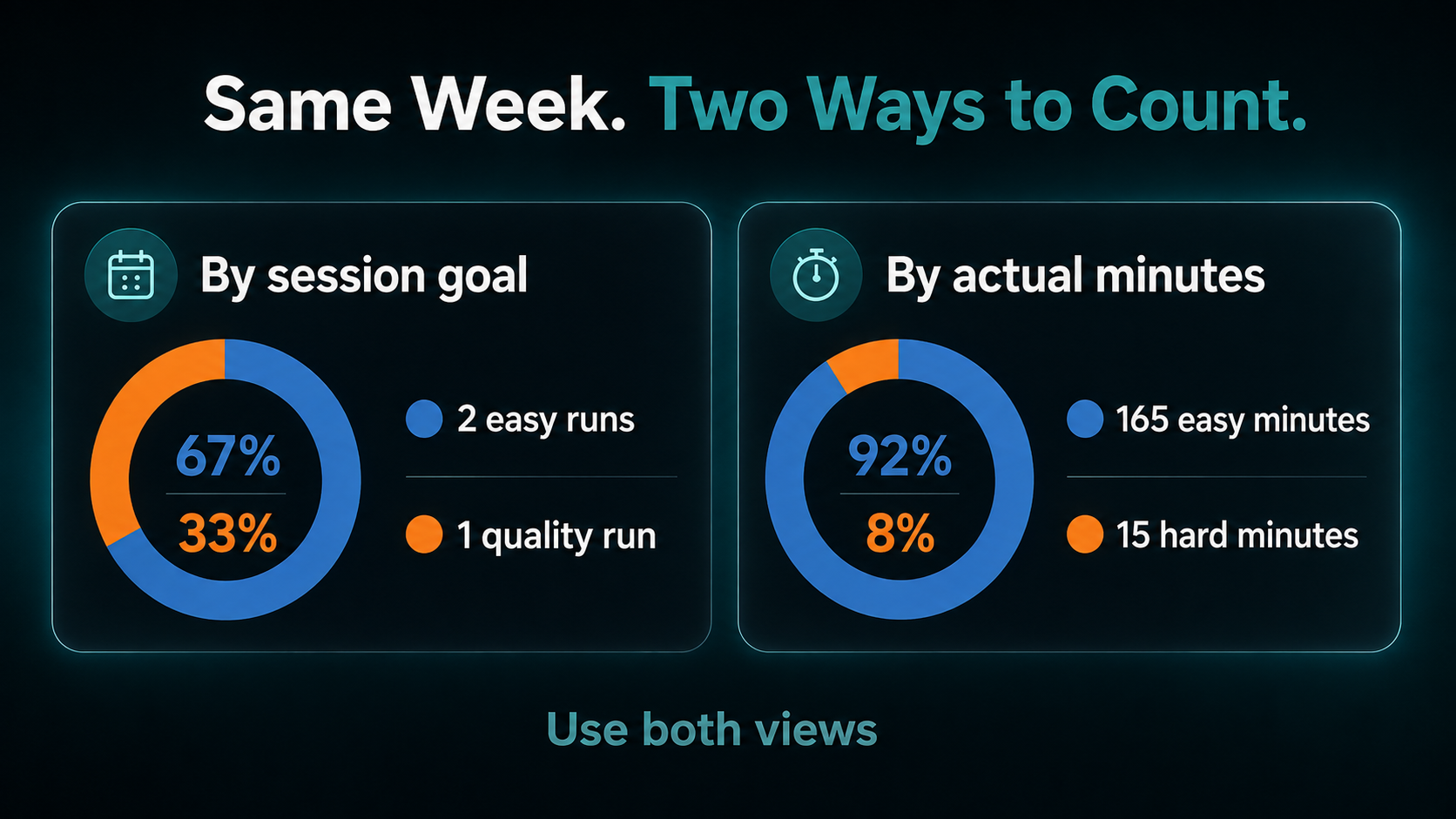
There are two common ways to count intensity, and they tell different stories.
Count by session goal
Two easy runs and one interval workout create a 2:1 split: 67% easy sessions and 33% hard sessions. That looks much harder than 80/20.
Count by actual time
The quality workout includes easy running. Suppose the week contains:
- 45 minutes easy;
- 60 minutes with 15 minutes of hard intervals;
- 75 minutes easy.
The week totals 180 minutes. Only 15 minutes are hard, or about 8%. The remaining 165 minutes include warm-up, recoveries, cool-down, and easy running. That looks much easier than 80/20.
Neither count is fraudulent. They answer different questions. Session goal describes how often you schedule a demanding stimulus. Time in zone describes how the minutes accumulated. Heart rate also lags during short intervals, so a time-in-zone chart can undercount work performed above the second threshold.
A Practical Three-Run Week
Start with this structure:
| Day | Session | Purpose | Example duration |
|---|---|---|---|
| Tuesday | Easy run | Aerobic volume and recovery | 40–50 min |
| Thursday | Quality run | Threshold, hills, or intervals | 45–65 min total |
| Sunday | Long easy run | Aerobic durability | 60–90 min |
Leave at least one non-running day between sessions at first. Strength training, cycling, hiking, and demanding sports still contribute fatigue, so place them with the whole week in mind.
Easy run
Keep the first run conversational and relaxed. The goal is to finish with the sense that you could have continued. Short strides can be added occasionally when they are already familiar, but they should not turn the day into a second hard workout.
Quality run
Give the session one job. Choose threshold intervals, short hills, VO2-max intervals, or a controlled tempo according to the training phase. Include an easy warm-up and cool-down.
For example:
- 15 minutes easy;
- 4 × 4 minutes hard but controlled, with 3 minutes easy between repetitions;
- 12–15 minutes easy.
This is a quality session because of its purpose, although most recorded minutes may still fall in lower heart-rate zones. Our guide to adding intervals without ruining your aerobic base explains how to keep the dose contained.
Long easy run
Keep the long run easy enough that it does not become a second quality session. Duration adds load even when intensity stays low. Build it gradually and shorten it during recovery weeks.
If the route is hilly or the weather is hot, allow pace to change. The session's purpose is aerobic durability, not defending an arbitrary pace.
Three Sample Weeks for Different Stages
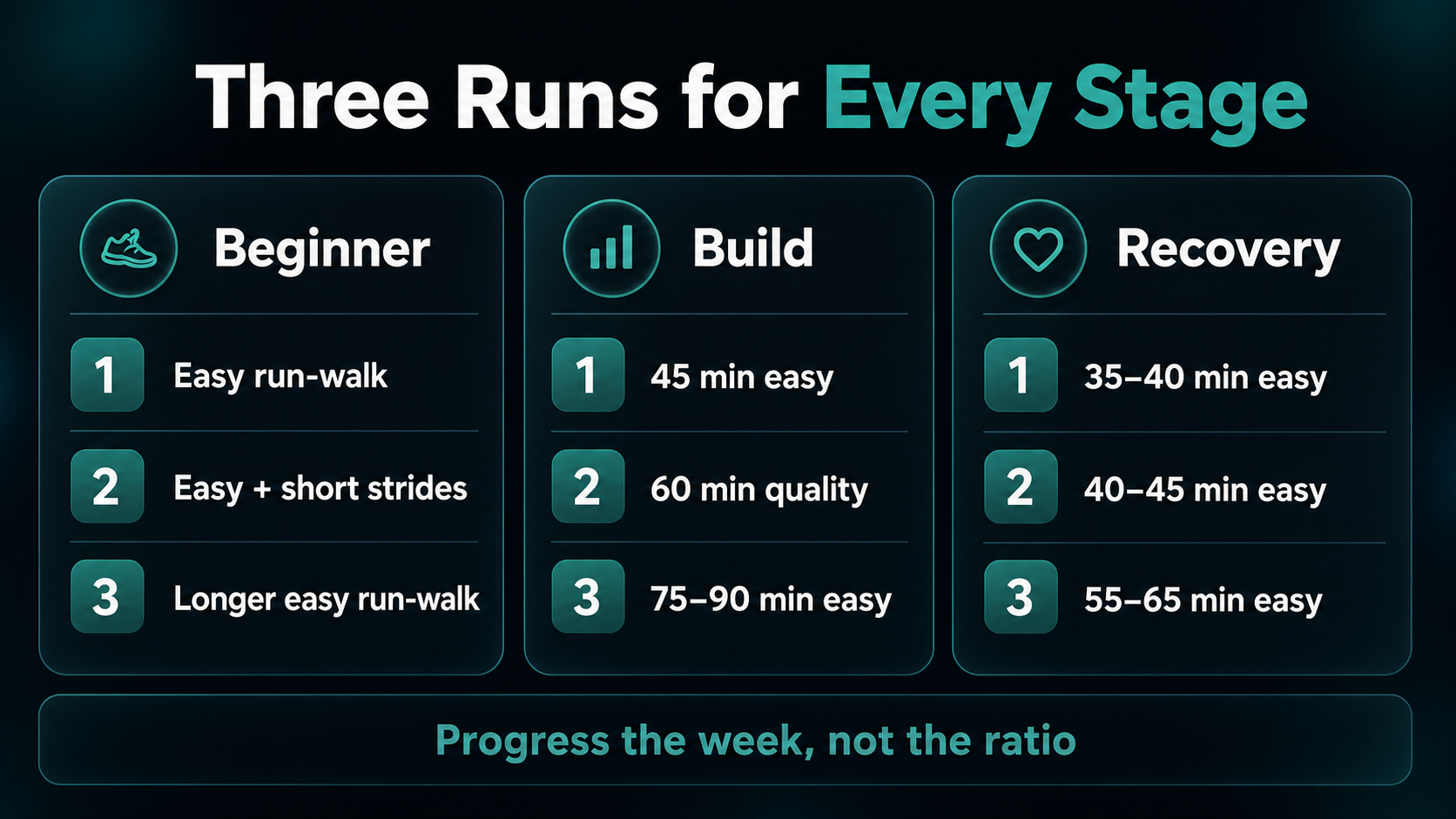
New runner building consistency
| Run | Session |
|---|---|
| 1 | 30–40 min easy run-walk |
| 2 | 30–40 min easy with 6 × 20 sec relaxed strides |
| 3 | 45–55 min easy run-walk |
This runner may not need a full interval session yet. Strides introduce coordination and speed with low volume, while the week remains focused on tolerance and consistency.
Established runner in a general build
| Run | Session |
|---|---|
| 1 | 45 min easy |
| 2 | 60 min including 4 × 5 min controlled threshold work |
| 3 | 75–90 min easy |
The hard minutes are concentrated in one session. The other two runs protect the contrast between easy and hard.
Recovery week
| Run | Session |
|---|---|
| 1 | 35–40 min easy |
| 2 | 40–45 min easy with a few short strides, or fully easy |
| 3 | 55–65 min easy |
A recovery week does not need to preserve the usual hard-minute percentage. Its job is to reduce fatigue while retaining routine. Use weekly zone-distribution review to compare the completed week with its intended purpose.
Choose the Quality Session From the Goal
Do not rotate hard workouts randomly merely to create variety.
For a base phase, use short hills, strides, or modest controlled intervals while most work stays easy. For a 5K or 10K build, one interval or threshold session may carry the week's main race-specific stimulus. For half-marathon or marathon preparation, longer controlled blocks may be useful, but the long run also becomes more demanding as duration grows.
One study of recreational runners compared a polarized distribution of about 77/3/20 with a program containing much more between-threshold work over ten weeks. Both groups improved several measures, while the polarized group improved 10K performance more in the reported comparison (International Journal of Sports Physiology and Performance). That supports keeping easy and hard work distinct, but it does not prove that every three-day runner should copy the study's exact distribution.
The participants trained under controlled threshold testing and a defined program. Your schedule, experience, total volume, injury history, and other exercise may be different.
Count the Whole Training Week
A three-run plan can stop being mostly easy when other activities are ignored. A hard cycling class, demanding team sport, CrossFit session, or heavy lower-body workout adds stress even if it does not appear in running mileage.
Record all meaningful sessions in one log. Keep sport-specific metrics, then review shared information such as duration, session purpose, perceived effort, and recovery. If Thursday's run intervals follow Wednesday's hard cycling and Saturday's strength session leaves Sunday running sore, the nominal running split is hiding the actual week.
Use these questions:
- How many sessions had a hard purpose?
- How many days contained demanding work?
- Did easy runs feel and remain easy?
- Was the long run controlled or did it become moderate throughout?
- Did you recover before the next quality session?
The answers matter more than whether a dashboard reports 78%, 82%, or 87% easy time.
Review the Pattern Over Four Weeks
One week can be distorted by a race, travel, illness, or a missed session. Review a rolling three- or four-week block.
Track:
- total running time;
- low-, moderate-, and high-intensity time using consistent boundaries;
- session goals;
- long-run duration;
- completed hard repetitions;
- session RPE;
- soreness, sleep, and unusual fatigue.
Look for repeatable patterns. If both easy runs frequently drift into moderate intensity, the plan has lost its easy–hard separation. If the quality session repeatedly fails, the interval dose, surrounding training, or recovery may be wrong. If every week feels comfortable and performance is progressing, do not add hard minutes just to satisfy a ratio.
The Zone 2 training-volume calculator can help plan low-intensity time, but the calculated target still needs to fit the runner's current tolerance.
Common Mistakes
Forcing 20% hard time
Twenty percent of a short week may be too much sustained hard work. Let workout design and recovery determine the dose.
Counting the interval session as entirely hard
Warm-up, recovery jogs, and cool-down matter. Use session goal and time in zone as complementary views.
Making the long run moderately hard
A long run creates load through duration. If it becomes a steady race against pace every week, you may have two quality sessions rather than one.
Treating all watch zones as the research model
Five-zone devices and three-domain studies use different labels. Map boundaries before interpreting the split.
Ignoring other sports and strength work
The body experiences the schedule as a whole. Record demanding non-running work when judging recovery.
Progressing duration and intensity together
Increase one major stressor at a time. Adding interval volume, easy mileage, and long-run duration in the same week makes the response difficult to interpret.
When Three Runs Are Not Enough for the Goal
Three runs can support health, consistency, and meaningful performance improvement. A more demanding race goal may eventually require additional running frequency or volume, but the next step is usually another easy exposure rather than another hard session.
Add frequency only when the current week is stable, easy runs are recoverable, and the extra session fits the rest of life and training. A short easy run can distribute volume more comfortably than extending every existing session.
Do not add a fourth run solely to make the session count resemble 80/20. Add it because the additional aerobic work supports the goal and can be recovered from.
Conclusion
With three runs a week, schedule two easy runs and one focused quality session. Keep most minutes easy, count all training stress, and assess the distribution across several weeks.
An exact 80/20 ratio is less useful than a clear separation of purpose. Easy days should leave room for the quality session, and the quality session should be hard for a reason. For the wider theory and its alternatives, read What Is Polarized Training?.

Our editorial approach & AI disclosure
We use AI to help research, organize, and draft some articles. Every article is reviewed by a human editor and aims to reflect current evidence-based training practices and scientific literature.
Read our editorial policy