

Physiology
Running Economy, Strength, and Strides
Learn how running economy works, why heavy strength training can improve it, and how to use relaxed strides without turning every easy run into a hard workout.

Introduction
Running economy describes how much energy you use to hold a submaximal speed. An economical runner can travel at the same pace as another runner while using less oxygen and less energy. That does not automatically make the runner faster—VO₂max, threshold, fatigue resistance, tactics, terrain, and fueling still matter—but it can make a given pace more affordable.
For the broader physiology, measurement methods, and full range of influences, start with Running Economy Explained. This guide is the practical follow-on: an eight-week block that combines strength and relaxed strides without turning every easy run into another hard session.
Two popular ways to support running economy are strength training and strides. They overlap, but they are not interchangeable.
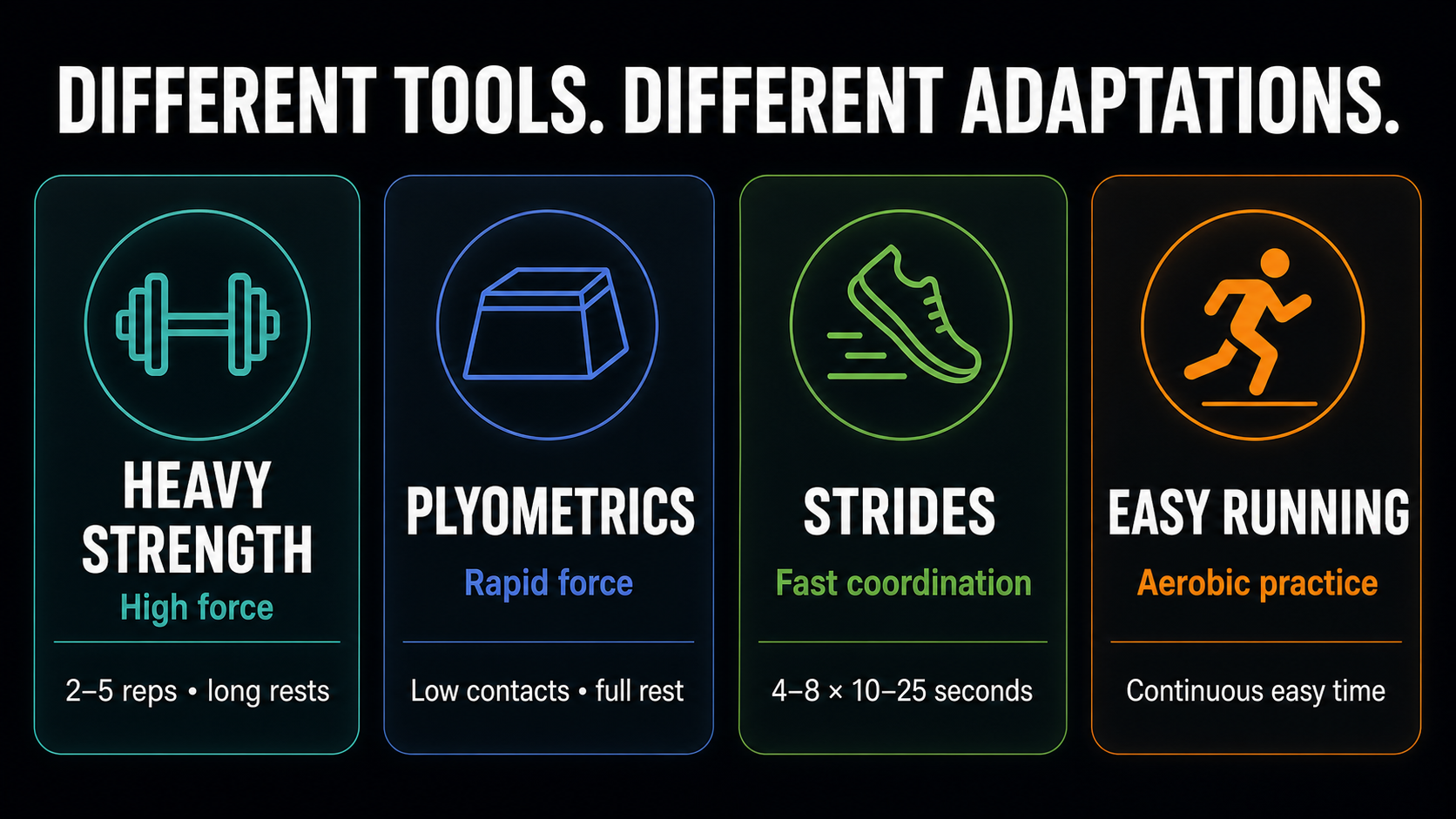
Heavy strength training raises force capacity. Plyometrics train rapid force and the stretch-shortening cycle. Strides provide brief, fast, running-specific practice without the sustained metabolic stress of an interval workout. Together they can expose a distance runner to forces and speeds that easy mileage does not provide.
For a closer look at the gym choice, Muscular Endurance vs Max Strength explains when heavier sets provide a different stimulus from high-repetition work.
The evidence is not equally strong for every piece. Heavy and combined strength programs have direct support from systematic reviews of runners. Classic relaxed strides—brief accelerations with generous recovery—are widely used, but have rarely been isolated as a distinct research intervention. Their rationale comes partly from studies of sprinting, explosive training, neuromuscular performance, and running mechanics. This guide keeps that boundary clear while showing how to use all three tools in a practical week.
Running Economy in Plain Language
Running economy is usually defined as the oxygen or energy demand of running at a fixed submaximal velocity. In a laboratory, a runner holds a controlled treadmill speed while respiratory gases are measured after oxygen uptake reaches a steady state. Lower oxygen or energy cost at the same speed generally means better economy (Barnes and Kilding).
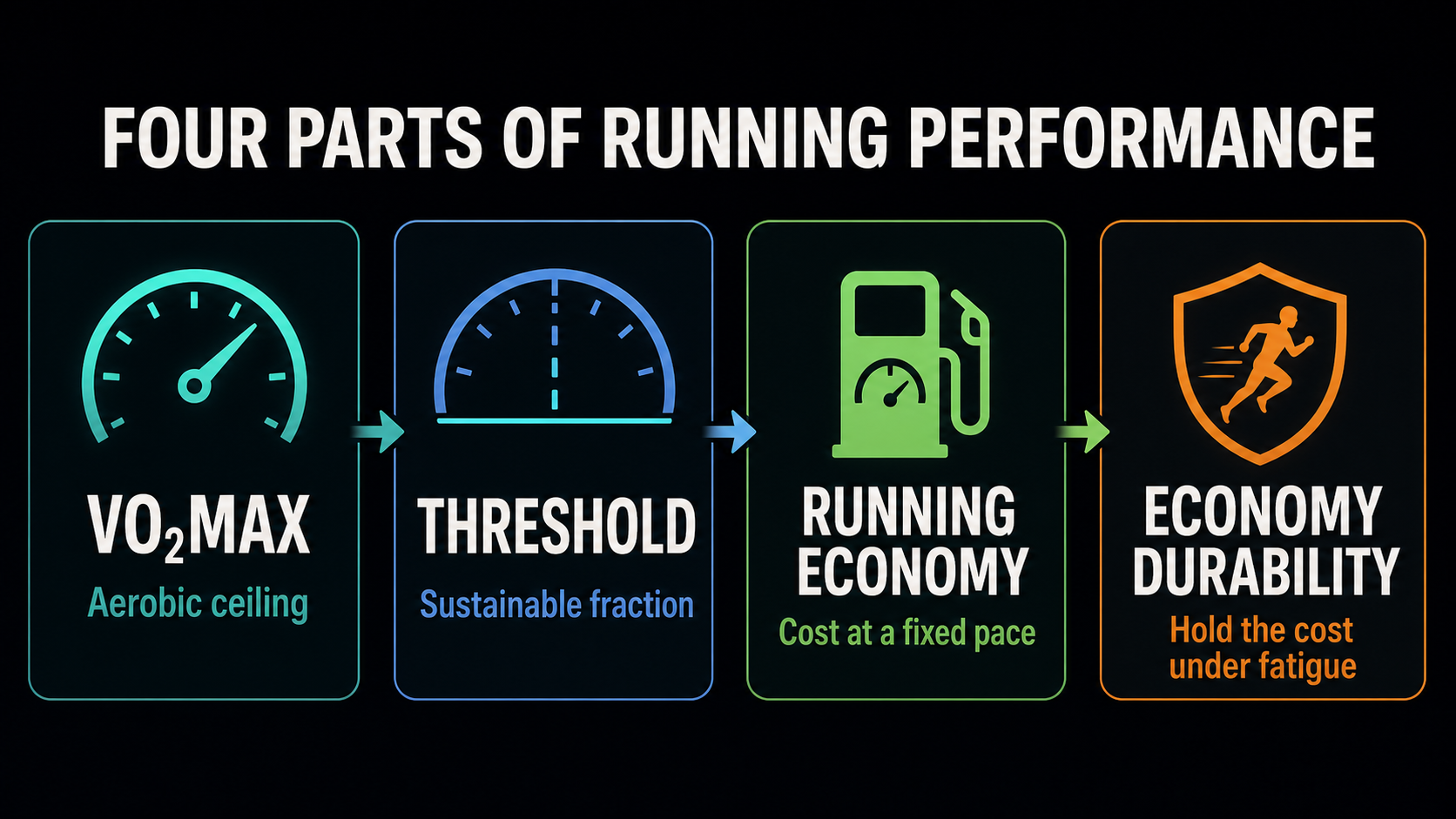
Think of it as fuel consumption, not engine size:
- VO₂max is related to the upper limit of aerobic oxygen use.
- Threshold describes how much of that capacity can be sustained before fatigue rises rapidly.
- Running economy describes the cost of producing a particular submaximal speed.
- Economy durability describes how well that cost is preserved as a run becomes long and fatiguing.
Two runners can have similar VO₂max values yet require different percentages of that capacity to hold the same pace. The more economical runner has more room below the ceiling. Reviews therefore describe economy as an important component of distance-running performance, particularly when athletes have similar aerobic capacities (Saunders and colleagues).
Economy is also pace-specific and protocol-sensitive. A runner can look economical at an easy laboratory speed but less economical near race pace. Footwear, gradient, surface, temperature, fatigue, nutrition, testing equipment, and data-processing choices can all change the result. Comparing one athlete's carefully standardized tests is more useful than comparing isolated numbers from different laboratories.
Economy Is More Than “Good Form”
Running economy emerges from several systems working together. Muscle-fiber characteristics, tendon behavior, force production, limb geometry, cardiorespiratory work, temperature regulation, technique, and training history all contribute. There is no single economical running form that every athlete should copy.
A 2024 systematic review and meta-analysis of observational studies found that most common spatiotemporal variables—including contact time, flight time, stride time, stride length, and duty factor—had trivial, non-significant associations with economy when considered alone. Higher cadence had a small association with lower cost, while lower vertical displacement and greater vertical or leg stiffness had moderate associations. Altogether, isolated biomechanical variables explained only a modest part of the differences between runners (Van Hooren and colleagues).
That finding matters because it discourages cosmetic form chasing. Short ground contact is not automatically better. A cadence of 180 is not a universal target. Forefoot striking does not guarantee lower energy cost. In controlled trials, gait retraining can change mechanics, but a 2022 meta-analysis did not find clear improvements in economy or performance from the studied foot-strike and multiparameter retraining approaches (Doyle and colleagues).
Strides can give the body opportunities to coordinate faster running, but they should not become a forced technique drill. Run tall, relaxed, and quick; do not consciously manufacture an “ideal” stride that feels less natural.
How Strength Training Can Improve Running Economy
Each foot strike requires force to support and redirect body mass. A stronger runner has a larger force reserve: the force required by each submaximal step represents a smaller fraction of maximum capacity. Heavy training can also improve rate of force development, while plyometric work can develop rapid force and use of the stretch-shortening cycle.
These mechanisms are plausible, but the outcome evidence matters more than the story. A 2024 systematic review and meta-analysis covering 652 middle- and long-distance runners found small improvements in economy from high-load strength training and moderate improvements from programs combining strength methods. Plyometric training produced a small benefit at lower tested speeds, while submaximal-load and isometric-only approaches did not show clear improvements. The authors rated evidence certainty as moderate for most individual methods and low for combined programs (Llanos-Lagos and colleagues).
Another meta-analysis directly comparing heavy resistance and plyometric programs found a small pooled benefit from heavy resistance training and a less certain, trivial pooled effect from plyometrics. Longer interventions tended to produce better results, and programs using nearly maximal loads performed particularly well in the heavy-training subgroup (Eihara and colleagues).
Individual trials show why no single effect size should be promised. In one small randomized trial, 17 well-trained runners were assigned to normal training or eight weeks of half-squats at four sets of four repetitions, three times per week. The intervention group improved 1RM, rate of force development, economy, and time to exhaustion without changing VO₂max or body weight (Støren and colleagues). By contrast, an 11-week trial in 19 well-trained female endurance athletes improved strength and jump performance but not economy or 40-minute running performance (Vikmoen and colleagues).
The responsible conclusion is not “lifting makes every runner five percent more economical.” It is that well-designed heavy or mixed strength training can improve economy on average, with individual response shaped by training status, exercise choice, duration, adherence, recovery, and the speed used for testing.
What Strides Add That the Gym Cannot
A stride is a brief, progressive acceleration performed with fast but controlled running. Most last about 10–25 seconds. The runner builds speed smoothly, spends a few seconds moving quickly with relaxed posture, then decelerates. Recovery is long enough that the next repetition is technically clean.
Strides are not:
- All-out sprints from a standing start
- Thirty-second sufferfests with incomplete recovery
- Short VO₂max intervals
- A race between training partners
- A way to rescue an easy run that feels unproductive
Their main value is specificity. Squats can raise force capacity, and jumps can train rapid force, but neither reproduces running at a fast cadence with the exact coordination of the gait cycle. Strides let a runner rehearse speed while keeping the total dose small.
Direct evidence for the classic stride prescription is limited. Studies commonly examine maximal sprinting, repeated 30-second efforts, plyometrics, or mixed explosive programs—not four to eight relaxed 15-second accelerations after an easy run. Those harder interventions cannot be treated as proof that strides deliver the same adaptation.
There is, however, useful indirect evidence. Neuromuscular power and sprint capacity are associated with distance performance and economy in trained runners, although association does not prove that adding strides causes improvement (Nummela and colleagues). A nine-week trial replacing part of endurance training with explosive strength work improved 5K performance, economy, and maximal 20-meter speed without improving VO₂max (Paavolainen and colleagues). More recent sprint-interval research also reports performance and oxygen-cost changes, but its twice-weekly maximal sessions are far more demanding than ordinary strides (Jin and colleagues).
So use strides for what they clearly provide: frequent, low-volume exposure to fast running. Treat improved economy as a plausible longer-term benefit, not a guaranteed result from the strides alone.
Strength and Strides Solve Different Problems
| Training tool | Main stimulus | Typical dose | Recovery need | Main risk |
|---|---|---|---|---|
| Heavy strength | High force and force reserve | 2–5 reps on primary lifts | Long rests; 24–48+ hours between hard lower-body sessions | Soreness or technical overload |
| Plyometrics | Rapid force and reactive strength | Low contacts with full quality | Full rest between sets | Too much impact too soon |
| Strides | Fast, relaxed running coordination | 4–8 × 10–25 seconds | Walk or jog until ready | Turning them into intervals |
| Easy running | Aerobic volume and movement practice | Continuous low-intensity time | Usually short | Accumulated volume fatigue |
Strength expands general capacity. Strides express speed in the running movement. Easy and steady running supplies the repeated aerobic practice that neither can replace.
This is why adding endless high-repetition circuits is not automatically the best economy plan. Distance running already contains thousands of repeated low-force contractions. Heavy lifting offers a more distinct stimulus, while strides add a small dose of running-specific speed.
A Practical Strength Plan for Runners
During a development block, train strength twice per week. One session can maintain quality when races approach or running intensity rises. Beginners should first build movement skill and tissue tolerance before using very heavy loads or reactive jumps.
Choose a small exercise menu
Cover the main functions without creating a bodybuilding marathon:
- Squat or leg press for knee and hip extension
- Romanian deadlift or trap-bar deadlift for hip-dominant strength
- Split squat or step-up for unilateral control
- Straight-knee and bent-knee calf raises
- A pull and a push for general upper-body strength
- A carry or trunk exercise that can be progressed
The primary lower-body lift can use three or four sets of three to six repetitions with two to four minutes of rest. Secondary movements can use two or three sets of five to ten. Stop most sets with one to three good repetitions in reserve. The goal is high force and consistent technique, not failure.
Add plyometrics only when prepared
Plyometrics are optional, not an entry requirement. Begin with low-amplitude pogo jumps, skipping, or simple hops. Use small volumes—perhaps two to four sets of three to eight contacts—and stop while stiffness, landing control, and jump height remain consistent. Progress one variable at a time.
The systematic literature supports strength and conditioning for runners, but the exact mechanisms and best program remain less certain than simplified online prescriptions imply (Blagrove and colleagues). Choose exercises the athlete can learn, load, and recover from. Consistency across months is more important than copying the most advanced study protocol.
Progress the work
Use a repeatable rep range. When all sets reach the top of the range with clean technique and the intended reserve, add a small amount of load. Keep jumps low in volume and progress through quality, modest height, or complexity—not fatigue.
How to Run Strides Well
Start with four strides once or twice per week after an easy run. A flat, predictable surface is the simplest choice. A gentle uphill can reduce top speed and encourage forceful mechanics, but it changes the task and increases calf demand.
Use this sequence:
- Run easily for at least 10–20 minutes first.
- Accelerate smoothly for roughly five seconds.
- Hold a fast, relaxed rhythm for five to ten seconds.
- Decelerate gradually rather than braking sharply.
- Walk or jog for 60–120 seconds, or until breathing and coordination feel ready.
- Repeat only while the stride stays smooth.
The effort may approach mile-to-3K speed for some experienced runners, but pace is a poor universal target. Terrain, wind, training age, and acceleration length change the recorded number. Use the cues fast, relaxed, repeatable. Finish feeling that one or two good repetitions were still available.
Heart-rate zones are not useful for controlling a 15-second stride. Heart rate responds after the mechanical work has already begun, and the recovery occupies most of the recorded time. Keep the surrounding run easy by zone, then describe the strides with count, duration, surface, and feel.
Stop the set when speed drops, shoulders tighten, foot placement becomes noisy, or acceleration turns into straining. A runner returning from calf, hamstring, Achilles, or bone injury should reintroduce faster running with professional guidance and a more conservative progression.
Put Strength and Strides Into the Same Week
The best schedule protects the sessions that matter most. Strides are low volume but still fast. Heavy lifting is not aerobically difficult but can create local fatigue. Both need room around long runs, intervals, and race-specific workouts.
An example for a runner training five days per week:
| Day | Training |
|---|---|
| Monday | Rest or easy cross-training |
| Tuesday | Intervals or hills, then short strength session if experienced |
| Wednesday | Easy run |
| Thursday | Easy run plus 4–6 strides; strength later or separated by several hours |
| Friday | Rest or short recovery run |
| Saturday | Long run |
| Sunday | Easy run; optional light strength or mobility |
Placing hard elements on the same day can preserve genuinely easy days, but it only works if the second session remains high quality. If strength development is the priority, lift before running or separate the sessions. If running intervals are the priority, run first.
An updated concurrent-training meta-analysis found no meaningful overall compromise to maximal strength or hypertrophy, but explosive-strength gains were more likely to be attenuated when aerobic and strength work occurred in the same session rather than being separated by at least three hours (Schumann and colleagues). That does not make same-day training wrong. It means scheduling should reflect the adaptation currently being emphasized.
Avoid placing a new heavy lower-body session the day before a key interval workout. Avoid adding strides to every run simply because each set looks small. Count fast running, jumps, hills, and heavy lower-body work together when judging weekly neuromuscular load.
An Eight-Week Economy-Support Block
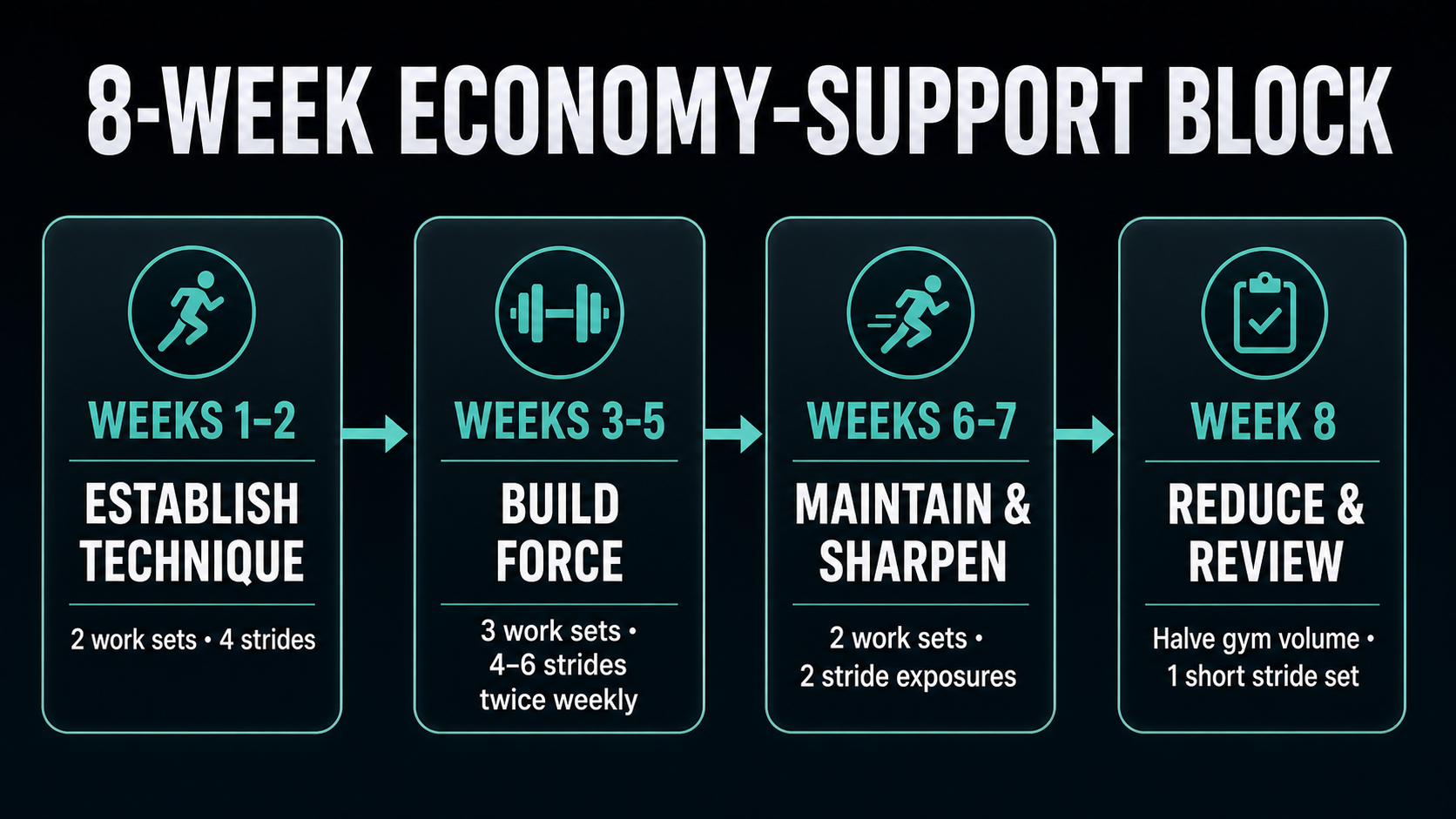
Weeks 1–2: Establish technique
Lift twice weekly with two work sets per movement and moderate loads. Add four 10–15-second strides after one easy run. Keep plyometrics to basic skipping or low pogos if the athlete already tolerates them.
Weeks 3–5: Build force and fast-running exposure
Use three work sets on the main lifts, mainly in the four-to-six-repetition range. Perform four to six strides twice weekly, with full recovery. Add load gradually; do not increase lifting, jump contacts, and stride count in the same week.
Weeks 6–7: Maintain force and sharpen
Reduce the primary lifts to two high-quality work sets. Keep one or two strength sessions depending on the running phase. Use six strides after one easy run and four after another, or place four strides in the warm-up before a quality session.
Week 8: Reduce fatigue and review
Cut gym volume roughly in half while keeping familiar loads submaximal. Perform one short stride set. Review strength, stride quality, easy-run stability, and performance in key workouts. A successful block improves capacity without creating a trail of missed running sessions.
How to Measure Whether Economy Is Improving
The cleanest measurement is a standardized laboratory test of oxygen or energy cost at one or more submaximal speeds. Repeat the same treadmill, footwear, gradient, warm-up, time of day, and fueling conditions. Because protocols differ, laboratory results are best compared with the runner's own previous test, not a universal table.
Field data cannot directly measure laboratory running economy, but it can reveal useful trends. On repeatable flat routes or treadmill sessions, track:
- Pace at a similar heart rate and perceived effort
- Heart rate at a similar pace under similar conditions
- Running power at the same pace, interpreted cautiously
- Cadence and contact-time trends without chasing targets
- Pace or heart-rate drift during longer steady running
- Ability to preserve form and pace late in a session
- Strength loads and stride quality
Weather, hills, fatigue, caffeine, stress, hydration, and sensor error can overwhelm small changes. Do not declare improved economy because one cool morning produced a faster easy pace. Look for repeated patterns across several comparable sessions.
Economy can also deteriorate with duration. In a 2025 randomized trial of 28 well-trained male runners, ten weeks of combined maximal strength and plyometrics improved economy near the end of a 90-minute run and improved subsequent high-intensity time to exhaustion compared with running alone. The result is promising for “durability,” but the sample was small and male, so it should not be generalized to every runner (Zanini and colleagues).
Track the Whole System in Zone Training Log
Running economy is not visible in a single workout title. Zone Training Log can place easy runs, key sessions, long runs, and strength work on one timeline using workouts imported from Apple Health or Health Connect. Add context that heart rate alone cannot supply.
For strength sessions, record:
- Main exercises, work sets, repetitions, and load
- Repetitions in reserve or session RPE
- Jump type and contact count when relevant
- Soreness and the quality of the next run
For strides, record:
- Number and approximate duration
- Flat, hill, grass, track, or treadmill surface
- Whether they followed an easy run or preceded a workout
- A simple quality note: relaxed, sharp, flat, or strained
Keep the parent run classified by its main purpose. An easy 45-minute run with six relaxed strides is still primarily an easy aerobic session; it is not six minutes in a high heart-rate zone. Use a consistent title such as Easy + 6 Strides so the high-speed exposures are searchable without distorting zone totals.
Review four-to-eight-week trends. Are strength loads rising? Do strides remain smooth? Are easy days still easy? Are key sessions improving or repeatedly compromised? Economy-support training succeeds only when it strengthens the running program rather than competing with it.
Common Mistakes
Treating strides as intervals
If recovery is rushed and each repetition becomes slower, the session has changed into speed endurance. That can be useful, but it is a different workout with a different recovery cost.
Lifting light forever
High-repetition circuits can build general conditioning, but the economy evidence is stronger for high-load and mixed strength methods. Learn technique, then progress load appropriately.
Forcing a universal cadence
Cadence rises naturally with speed. Do not use strides to chase an arbitrary number or copy another runner's mechanics.
Adding every tool at once
Heavy lifting, plyometrics, hill sprints, strides, and intervals all create neuromuscular stress. Introduce one or two elements, observe the response, then progress.
Judging economy from one run
Pace and heart rate change with environment and recovery. Use standardized tests or repeated field patterns.
Frequently Asked Questions
Do strides improve running economy?
They may support economy by providing brief, running-specific exposure to higher speed and force, but classic strides have not been studied directly as well as heavy strength, plyometrics, or sprint-interval training. Use them primarily for relaxed speed practice; treat economy improvement as a plausible benefit rather than a guarantee.
How many strides should a runner do?
Four to eight repetitions of roughly 10–25 seconds is a practical range. Start at the low end once weekly. Use full recovery and stop before speed or relaxation deteriorates.
How fast should strides be?
Fast but controlled—not an all-out sprint. Accelerate progressively, reach a smooth speed you could repeat, and decelerate gradually. Exact pace is less useful than quality because the short acceleration and terrain strongly influence the number.
Should strides be in Zone 4 or Zone 5?
Do not prescribe strides by heart-rate zone. The bouts are too short for heart rate to represent the immediate mechanical intensity well. Control the surrounding run by zone, and log strides by duration, count, recovery, and feel.
Should strength training happen before or after running?
Put the priority first. Run first when a key running workout matters most. Lift first when maximal strength or power is the main target. Separating sessions by several hours can help preserve quality, especially for trained athletes.
Can strength training make runners too heavy?
Meaningful mass gain is unlikely from the low-volume, heavy programs commonly used alongside endurance training, particularly when running volume remains high; a systematic review of distance runners found no negative effect on body composition from strength interventions (Blagrove and colleagues). The goal is force capacity, not bodybuilding volume. Body-mass response still varies, so track it only when relevant to the athlete's health and goals.
Are hill strides better than flat strides?
They are different. Gentle uphill strides reduce absolute speed and emphasize force, but increase calf and Achilles demand. Flat strides provide more direct exposure to fast level running. Choose the surface that matches the goal and the runner's injury history.
How long does it take to improve running economy?
Strength studies commonly last six to 24 weeks, and larger effects may require longer exposure. Expect gradual change across a training block, not an immediate transformation after two stride sessions.
Conclusion
Running economy is the energy cost of holding a submaximal speed. It is important, but it is not a single technique score and cannot be reduced to cadence or heart rate.
Heavy strength training has the clearest direct evidence among the tools discussed here. Plyometrics can add rapid-force work when the runner is prepared. Strides supply brief, specific practice at faster speeds, although their isolated effect on economy remains less certain.
Build the combination patiently: two concise strength sessions during development, one or two small stride sets, enough recovery to protect key runs, and a log that connects gym progress to running quality. The aim is not to make every session harder. It is to make race-relevant speed cost less.

Our editorial approach & AI disclosure
We use AI to help research, organize, and draft some articles. Every article is reviewed by a human editor and aims to reflect current evidence-based training practices and scientific literature.
Read our editorial policy