

Endurance Training
Muscular Endurance vs Max Strength
Learn the difference between muscular endurance and maximal strength, which quality matters most for endurance athletes, and how to train both without compromising key sport sessions.

Introduction
Muscular endurance is the ability to repeat or sustain submaximal force, while maximal strength is the greatest force you can produce in one effort. Endurance athletes need both, but they usually do not need equal amounts of both in the gym.
Running, cycling, swimming, rowing, skiing, and hiking already provide thousands of repeated, relatively low-force contractions. That is a large dose of sport-specific muscular endurance. Gym training is often most useful when it supplies what the sport provides less effectively: high force, progressive overload, and sometimes power.
For that reason, maximal-strength training should usually form the foundation of an endurance athlete's resistance program. Muscular-endurance work remains valuable when a specific muscle group, posture, terrain demand, rehabilitation goal, or equipment constraint calls for it. The choice is not “heavy weights or high reps forever.” It is a decision about which adaptation is missing and how much fatigue the athlete can absorb.
This guide compares the two qualities, explains what the research shows, and provides practical ways to train each without undermining key endurance sessions.
Muscular Endurance vs Max Strength at a Glance
| Variable | Muscular endurance | Maximal strength |
|---|---|---|
| Main ability | Repeat or sustain submaximal force | Produce the highest possible force |
| Common gym approach | Lighter loads, more repetitions, shorter rest | Heavier loads, fewer repetitions, longer rest |
| Typical set length | Roughly 12–30+ repetitions or timed holds | Roughly 2–6 repetitions |
| Effort target | Accumulated local fatigue, usually short of failure | High force with technically clean repetitions |
| Rest between sets | Often 30–120 seconds | Often 2–4 minutes |
| Best measured by | Repetitions or time at a fixed task | 1RM, 3RM, estimated 1RM, or force test |
| Main endurance use | Local capacity, posture, long climbs, targeted support | Economy, force reserve, power foundation |
| Main cost | Burning fatigue and longer sets | Higher absolute force and technical demand |
These ranges describe common practice, not biological borders. A set of eight can develop more than one quality. A set of 15 can still increase strength, especially in a beginner. The adaptation depends on load, effort, total volume, movement, rest, training history, and how progress is measured.
What Muscular Endurance Actually Means
Muscular endurance is local. It describes what a muscle or group of muscles can sustain, not the performance of the whole cardiovascular system.
A cyclist can have excellent aerobic fitness but limited neck or trunk endurance in an aggressive position. A runner can breathe comfortably while the calves lose stiffness late in a race. A swimmer may have a strong pull for one repetition yet fail to maintain force and technique over repeated strokes. These are different local problems within an endurance event.
Muscular endurance can be tested in several ways:
- Maximum repetitions with a fixed external load
- Repetitions at a percentage of one-repetition maximum
- Time holding a position or force
- Decline in force or power across repeated contractions
- Ability to preserve sport technique under fatigue
The test changes the result. If an athlete becomes stronger, a fixed 40-kilogram load represents a smaller percentage of maximum, so repetitions may improve even without a high-repetition training block. If the test uses the same percentage of a new, higher 1RM, the athlete is lifting a heavier absolute load and may not show the same increase.
This is why “muscular endurance improved” needs a second sentence explaining the task.
What Maximal Strength Actually Means
Maximal strength is the highest force an athlete can express in a movement or test. In the gym, it is often represented by a one-repetition maximum, but endurance athletes do not need to test true 1RM frequently. A safe three-to-five-repetition maximum or a well-calibrated estimated 1RM can track the same general quality with less testing pressure.
Maximal strength is specific. A strong leg press does not guarantee an equally strong squat, and neither exercise perfectly measures force during running or cycling. Strength gained in a stable gym movement still matters because it expands the athlete's force capacity. Sport practice then determines how well that capacity transfers to economical movement.
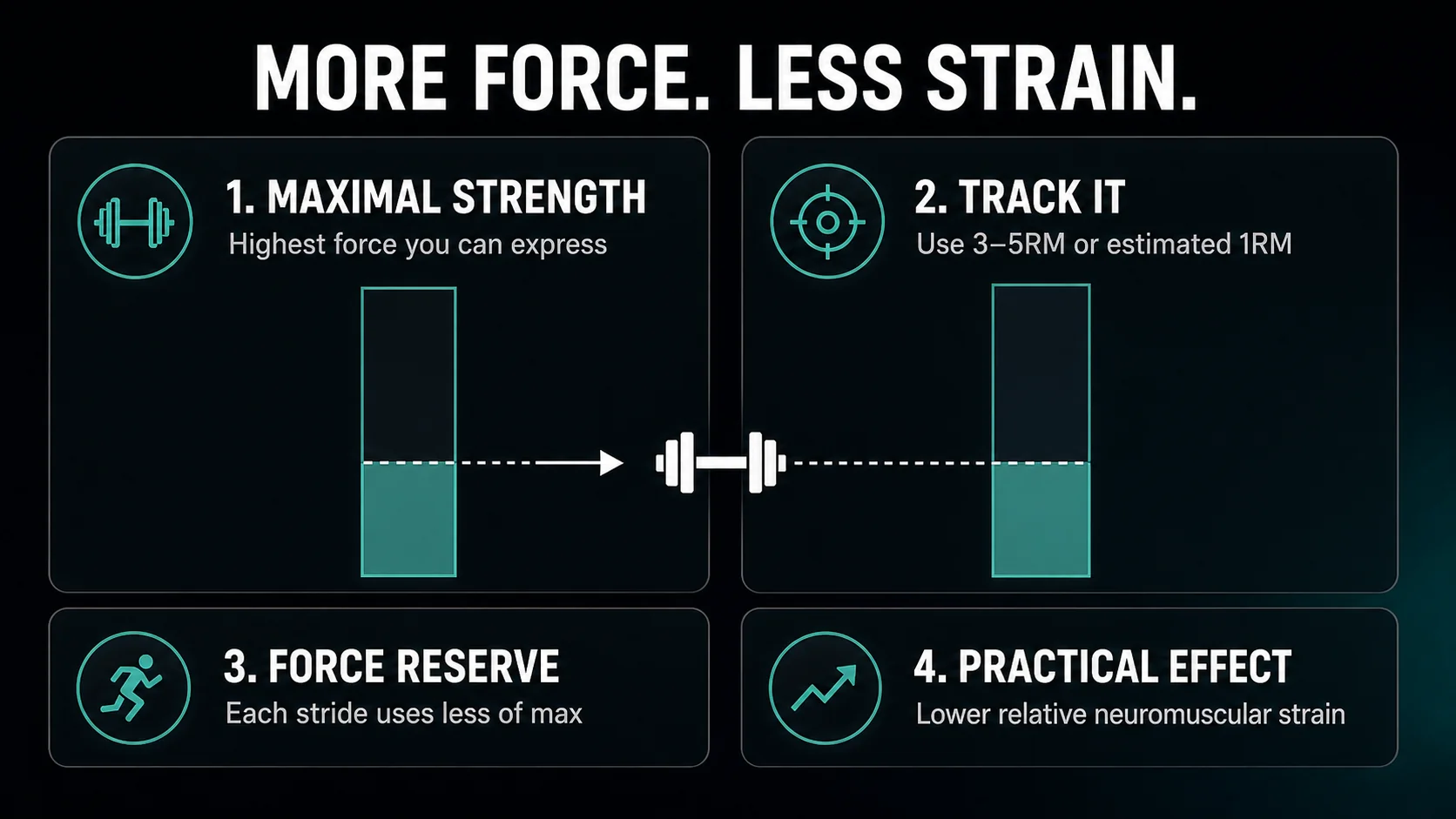
The most useful concept is force reserve. If every stride, pedal stroke, pole plant, or step represents a smaller fraction of maximum, the athlete may perform the same submaximal task with less relative neuromuscular strain. This does not remove the aerobic demand, but it can improve economy, power, and late-session force production.
The Two Qualities Overlap More Than Rep Charts Suggest
Traditional repetition charts imply that a precise percentage of 1RM produces a predictable number of repetitions. Real athletes are less tidy.
In a small study comparing eight endurance runners with eight weightlifters, the endurance runners completed substantially more leg-press repetitions at 70% and 80% of 1RM, while the difference at 90% was smaller and not statistically significant (Richens and Cleather). Training background changed the relationship between load and repetitions.
That matters when a generic plan prescribes “10 reps at 75%.” One athlete may finish comfortably while another approaches failure. Use percentages as an initial estimate, then adjust with technique, bar speed, and repetitions in reserve.
Training adaptations also overlap. A network meta-analysis found that higher loads produced greater gains in maximal strength, while muscle growth was similar across low, moderate, and high loads when sets were taken to volitional failure (Lopez and colleagues). The participants were mostly untrained or recreationally trained adults, not a pure endurance-athlete sample, but the result reinforces a practical point: heavy loads are most specific to maximum-force performance, while lighter loads can still create meaningful adaptation when the effort is high enough.
An eight-week trial in resistance-trained adults compared progressing load with progressing repetitions. Both groups improved strength, muscle size, and local endurance, with only small between-group differences (Plotkin and colleagues). The study does not prove that all loads are interchangeable. It shows that progressive overload can occur through more than one route.
The Same Exercise Can Create Different Stimuli
Exercise selection does not determine the quality on its own. A split squat can train maximal strength, general strength, muscular endurance, or even power depending on how it is loaded and performed.
Compare two versions:
| Split-squat session | Strength emphasis | Muscular-endurance emphasis |
|---|---|---|
| Load | Heavy enough for 4–6 clean reps | Moderate enough for 15–20 reps |
| Sets | 3 per side | 2–3 per side |
| Rest | 2–3 minutes | 45–90 seconds |
| Set ending | 1–3 reps in reserve | Local fatigue, before form fails |
| Main progression | Add load | Add reps, time, or modest load |
| Likely next-day cost | High force, limited set volume | More burning fatigue and soreness |
Neither version is automatically harder. The heavy set has greater absolute force and technical consequence. The long set accumulates more contractions, breathing, and local fatigue. The athlete's training history determines which creates more soreness.
This also explains why circuit design matters. Performing squats, lunges, rows, and carries with almost no rest may train work capacity, but the reduced load limits maximal-force practice. Extending rest and raising the load changes the same exercise menu into a strength session.
For a hybrid workout, place the highest-force or fastest movements first. Use longer-rest heavy sets while fresh, then finish with one or two local-endurance exercises. Reversing the order can be useful when muscular endurance is the priority, but it will usually reduce the quality of subsequent heavy work.
Which Quality Has Better Evidence for Endurance Performance?
For most endurance athletes, maximal-strength or heavy resistance training has the clearer performance case.
A meta-analysis covering runners, cyclists, cross-country skiers, and swimmers associated strength training with moderate improvements in middle- and long-distance performance. Maximal-force programs produced larger effects than lower-intensity approaches, and the overall changes were linked to economy, maximum force, and power rather than a higher VO₂max (Berryman and colleagues).
Running research points in the same direction. A 2024 systematic review and meta-analysis found small improvements in running economy after high-load training and moderate improvements from programs that combined strength methods. Submaximal-load training did not clearly improve economy in the included studies (Llanos-Lagos and colleagues).
For cyclists, a 2025 meta-analysis reported improvements in cycling efficiency, anaerobic power, and cycling performance after heavy strength training, without clear improvements in VO₂max or several other aerobic determinants. The authors rated the certainty of evidence as low, and only 60 of the 262 participants were women (Llanos-Lagos and colleagues).
High-repetition resistance training has a less decisive record. A systematic review and meta-analysis of competitive endurance athletes found no significant performance advantage over control conditions or low-repetition strength training across the included four-to-twelve-week interventions. The evidence base was small, studies averaged about eight weeks, and many participants were recreationally trained (Nugent and colleagues).
That is not evidence that muscular endurance is useless. It means high-repetition gym work has not shown a reliable advantage simply because endurance events involve many contractions. The sport itself may already provide the most specific muscular-endurance stimulus.
An umbrella review published in 2025 supports adding strength training to endurance programs but also notes that confidence in many underlying reviews was low or critically low (Ramos-Campo and colleagues). The responsible conclusion is that heavy strength is generally the better-supported default, not that it guarantees faster performance for every athlete.
When Max Strength Should Be the Priority
Choose maximal-strength development when the athlete:
- Is new to progressive resistance training
- Has low force relative to body mass
- Loses force on climbs, accelerations, or late-race surges
- Needs a stronger foundation for power or plyometrics
- Already receives abundant local endurance from the sport
- Can lift heavily without damaging key endurance sessions
Maximal-strength training is especially efficient for time-limited endurance athletes. A few high-quality sets create a stimulus that is difficult to reproduce through easy mileage or long circuits.
A practical max-strength prescription
Use two sessions per week during a development block. Choose three to six main movements across the whole body, with emphasis determined by the sport.
For the primary squat, leg press, or hinge:
- 2–4 work sets
- 3–6 repetitions
- Approximately 80% 1RM or a load that leaves 1–3 repetitions in reserve
- 2–4 minutes of rest
- Controlled lowering and strong, technically clean lifting
For single-leg, calf, upper-body, and trunk exercises, six to twelve repetitions may be more practical. The session does not need every exercise in the maximal-strength range.
Current American College of Sports Medicine guidance for healthy adults similarly emphasizes heavier loads around or above 80% 1RM for strength, commonly for two or three sets per exercise (ACSM's 2026 resistance-training guidance). Beginners should first learn the movement and build tolerance with lighter loads.
When Muscular Endurance Should Be the Priority
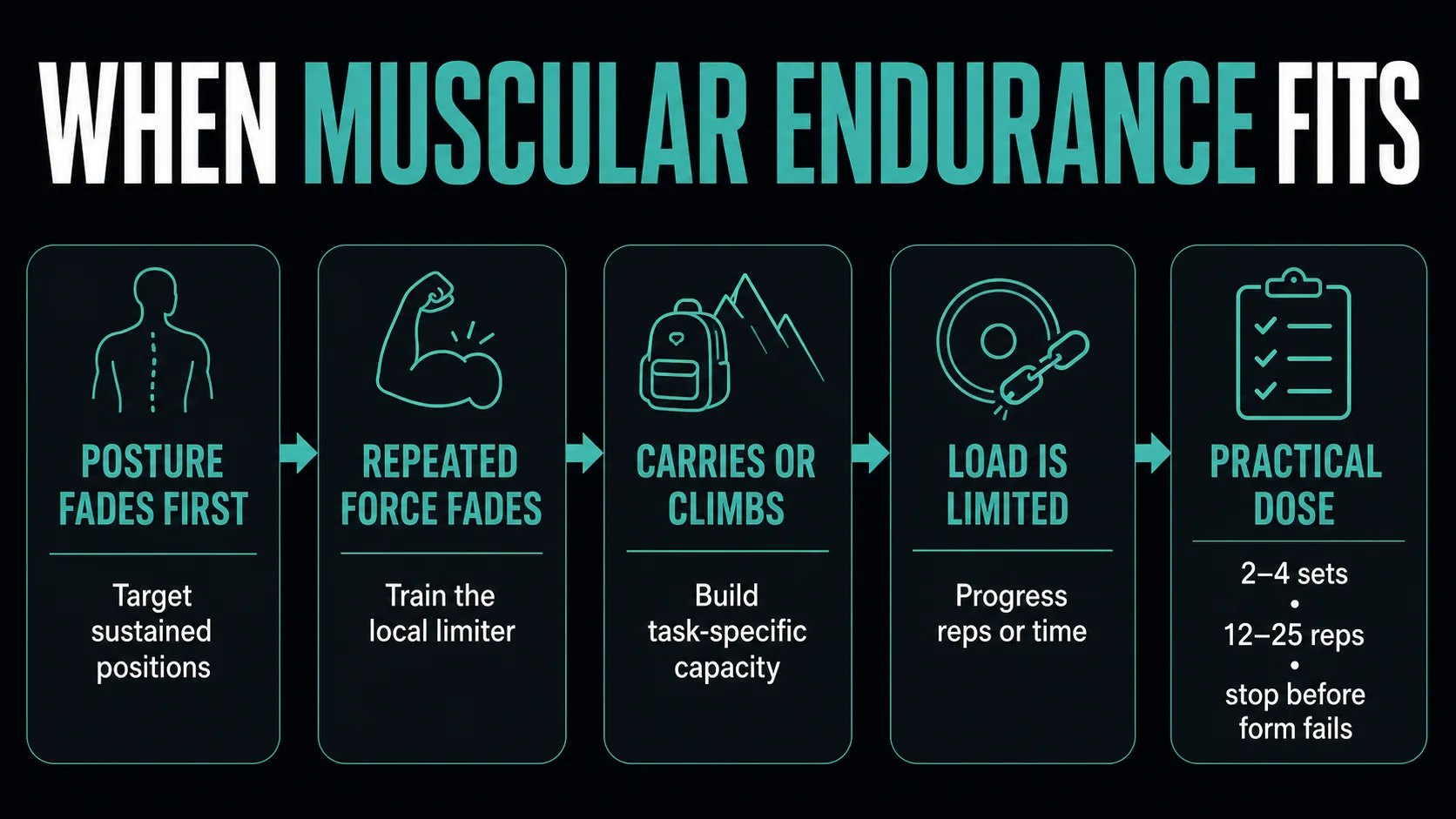
Choose a focused muscular-endurance block when the athlete has a clearly identified local limitation rather than a general belief that endurance athletes should always lift light.
Good reasons include:
- Postural muscles fail before aerobic capacity during long rides or paddles
- Calves, quadriceps, or upper body lose repeated-force capacity in a specific event
- The athlete must tolerate sustained carries, climbing, or a loaded pack
- Rehabilitation calls for controlled submaximal repetitions
- Equipment limits the external load available
- A transition period needs lower joint forces and less technical heavy lifting
A practical muscular-endurance prescription
Use one or two focused sessions per week or add selected endurance sets after the main strength work.
For the target movement:
- 2–4 sets
- Roughly 12–25 repetitions or 30–90 seconds of work
- A load that allows stable technique
- 30–120 seconds of rest, depending on the task
- Stop one to three repetitions before form fails
Progress by adding repetitions, time, load, range of motion, or density—but not all at once. Match the test to the goal. A long isometric hold may help posture but does not automatically transfer to repeated concentric force. A high-repetition squat set creates general leg fatigue but cannot reproduce the coordination of a long climb.
High-repetition work is easy to turn into exhaustion. The burning sensation is not the adaptation itself. If technique shortens, posture collapses, or soreness disrupts sport training, reduce the dose.
Most Endurance Athletes Need a Hybrid, Not a Tie
A hybrid plan includes both qualities but does not split training volume equally. Maximal strength usually receives the main, low-repetition work. Muscular endurance appears in accessories, sport-specific sessions, or short targeted blocks.
Example two-day gym plan
Session A: Maximum-force emphasis
- Countermovement jump: 3 × 3
- Squat or leg press: 3 × 4–6
- Romanian deadlift: 3 × 5–8
- Row: 2 × 6–10
- Standing calf raise: 3 × 6–10
- Side plank: 2 × 30–45 seconds per side
Session B: Strength plus local endurance
- Trap-bar deadlift or split squat: 3 × 4–6
- Step-up: 2 × 8 per side
- Push-up or press: 2 × 6–12
- Bent-knee calf raise: 2 × 15–20
- Suitcase carry: 3 × 30–60 seconds per side
- One sport-specific local-capacity exercise: 2 × 12–20
This is a template, not a universal exercise list. A swimmer may use more upper-body pulling. A cyclist may remove jumps and emphasize knee and hip extension. A hiker may add step-ups and carries. A runner may prioritize calf strength and carefully progressed plyometrics.
How to Progress Each Quality
Progress maximal strength with load and quality
Choose a repetition range such as four to six. When every set reaches six clean repetitions with the planned reserve, add a small amount of load and return to four repetitions. Do not increase weight when range of motion, control, or pain response deteriorates.
Maximal-strength progression can also mean producing the same force with better speed or completing the same load with less perceived effort. Endurance athletes do not need constant 1RM tests.
Progress muscular endurance with a defined task
Keep the test stable long enough to learn from it. If the goal is calf endurance, track repetitions at the same load and tempo. If the goal is riding posture, track the duration before position deteriorates. If the goal is loaded climbing, track a repeatable step-up or hill protocol.
Once the athlete exceeds the useful duration or repetition range, add resistance. Sets that grow indefinitely become time-consuming and may shift away from the event's actual force demands.
Do not take every set to failure
Low-load sets often need to approach fatigue to create a strong stimulus, but failure is not mandatory. A meta-analysis found no overall strength or hypertrophy advantage from training to failure, and failure can create more recovery demand (Grgic and colleagues). Endurance athletes pay for that fatigue in later sessions, so stop most sets while technique is still reliable.
Schedule Strength Without Blunting Endurance Quality
Both muscular-endurance and maximal-strength sessions can interfere with sport training through residual fatigue. High repetitions create metabolic stress and soreness; heavy work creates high force and neuromuscular demand. “Light” does not necessarily mean easy.
Protect the key session:
- If strength is the current priority, lift first or separate it from endurance by several hours.
- If intervals, a long workout, or technical practice is the priority, complete that first.
- Avoid a new high-repetition leg circuit immediately before a long run or threshold ride.
- Avoid hard endurance intervals immediately before heavy lower-body lifting when force quality matters.
- Place low-priority accessories where they cannot damage the next important day.
An updated meta-analysis found that concurrent aerobic and strength training did not meaningfully compromise maximal strength or hypertrophy overall, but explosive-strength gains were smaller when both modes occurred in the same session (Schumann and colleagues). Another meta-analysis found more lower-body strength interference in trained people when strength and endurance were performed within the same session rather than separately (Petré and colleagues).
These findings do not produce one perfect calendar. They support using priority, separation, and recovery rather than stacking every workout wherever space appears.
An Eight-Week Hybrid Progression
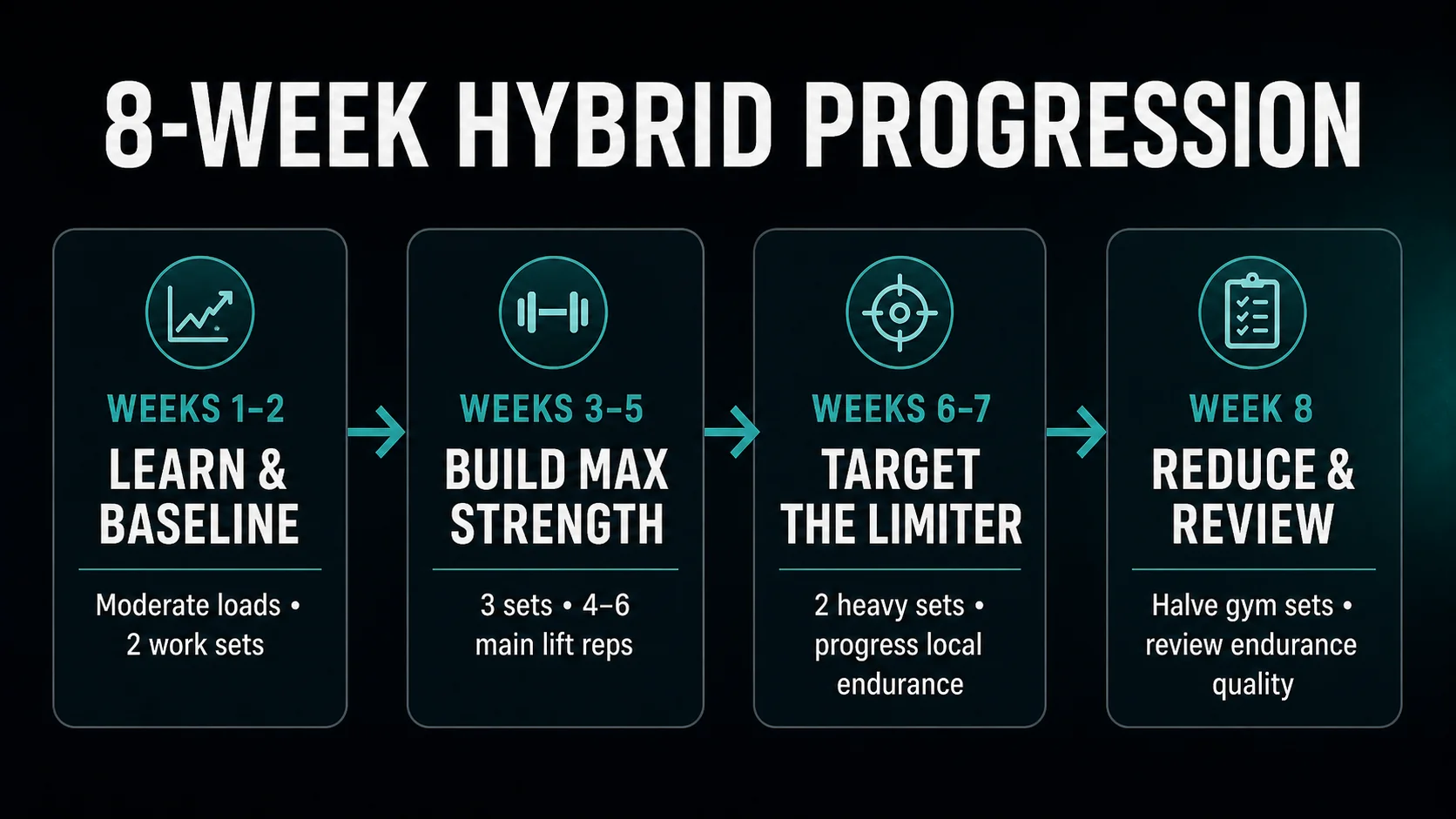
Weeks 1–2: Learn and establish baselines
Train twice weekly. Use two work sets per exercise, moderate loads, and three or more repetitions in reserve. Record a submaximal strength estimate and one relevant muscular-endurance task without testing to complete failure.
Weeks 3–5: Build maximal strength
Use three sets of four to six on the main lower-body movements. Keep accessories at six to twelve repetitions. Include only one or two targeted muscular-endurance exercises so sport training remains the main endurance stimulus.
Weeks 6–7: Maintain strength and target the limiter
Keep the heavy movements but reduce them to two work sets. Add one extra set or a small progression to the identified local-endurance task. The athlete should feel more specific, not simply more exhausted.
Week 8: Reduce fatigue and review
Cut total gym sets by roughly half. Keep familiar movements and moderate load. Review changes in estimated maximal strength, the defined endurance task, sport output at similar heart rate or effort, and the quality of key sessions.
If gym numbers improved but the athlete repeatedly missed endurance targets, the program was not successful as an endurance plan.
Apply the Difference by Sport
Running and trail running
Maximal lower-body and calf strength provide a useful foundation. Use plyometrics separately as power or reactive-strength work rather than calling them muscular endurance. Targeted high-repetition calf, soleus, or trunk work can address local capacity, while hills and long runs provide more specific repeated-force exposure.
Cycling
Heavy squats, leg presses, hinges, and split squats can develop force reserve. Use longer sets selectively for trunk, neck, or position tolerance. Low-cadence riding is sport-specific torque work, but it is not identical to maximal strength because external force and contraction conditions differ.
Swimming, rowing, paddling, and skiing
Upper-body and trunk endurance matter more because propulsion depends on repeated pulling or poling. Still build maximal pulling and pressing strength, then use controlled higher-repetition work for the positions or muscles that fade. Technique in water, on snow, or in the boat remains the most specific endurance practice.
Hiking and fastpacking
Build maximal strength with squats, hinges, and split squats. Add muscular endurance through step-ups, calf work, carries, and progressive pack exposure. Actual climbing and descending are necessary because balance, terrain, and eccentric loading cannot be reduced to a repetition range.
How Zone Training Log Helps
Muscular endurance and maximal strength can look similar in an activity feed unless the workout has useful context. Zone Training Log can place strength sessions beside endurance workouts imported from Apple Health or Health Connect, making it easier to judge whether gym work supports or disrupts the training week.
Use consistent titles such as Max Strength, Strength + Capacity, or Local Endurance. Add the information heart rate cannot explain:
- Main exercise, sets, repetitions, and load
- Repetitions in reserve or session RPE
- Rest interval when it defines the stimulus
- The target quality: strength, endurance, power, or maintenance
- Soreness and next-day sport performance
- The current phase of the training cycle
Do not evaluate a strength session by heart rate alone. A heavy set can be productive with a low average heart rate. A high-repetition circuit can produce a large heart-rate response while doing little for maximal force.
Review trends across weeks. Is load increasing without harming intervals? Are repetitions improving at the same load? Does posture last longer? Is pace or power more stable late in long sessions? The log should connect gym adaptation to the endurance problem it was meant to solve.
Common Mistakes
Assuming endurance athletes should always lift light
The sport already supplies extensive low-force repetition. Heavy training often adds the more distinct and better-supported stimulus.
Treating high heart rate as proof of muscular endurance
Heart rate describes cardiovascular response, not the local force a muscle can repeat. Define the target muscle and task.
Confusing power with maximal strength
Power is force expressed quickly. Heavy strength creates a foundation, but jumps, throws, sprints, and explosive lifts train speed of force production more directly.
Using one rep chart for every athlete
Endurance-trained athletes may complete more repetitions at a given percentage of 1RM. Adjust the prescription from actual performance.
Taking long sets to ugly failure
Extra repetitions with shortened range or collapsed technique train a different movement and add fatigue. Stop before form fails.
Training the quality but testing something else
A fixed-load repetition test and a percentage-of-1RM test answer different questions. Choose the test before interpreting progress.
Frequently Asked Questions
Is muscular endurance more important than strength for endurance athletes?
The event contains more repeated submaximal contractions, but that does not mean the gym should copy the event. Sport training develops specific muscular endurance; maximal-strength work often supplies the missing high-force stimulus. Use targeted muscular-endurance training when a local limitation is clear.
How many reps build muscular endurance?
Sets of roughly 12–25 or more repetitions are commonly used, but there is no exact threshold. Load, proximity to failure, rest, tempo, and the test all matter. Timed holds and carries can also train local endurance.
How many reps build max strength?
Two to six repetitions with heavy resistance is a practical range. Beginners can gain strength with higher repetitions while learning technique. Experienced athletes usually need more exposure to high loads to maximize 1RM strength.
Can heavy strength training improve muscular endurance?
Yes, especially when endurance is tested with a fixed absolute load. Becoming stronger makes that load relatively lighter. Heavy training is less specific to a task that requires very long repeated contractions at a fixed percentage of the athlete's current maximum.
Can high-repetition training build maximal strength?
It can, particularly in beginners or when sets are challenging. Heavier training is generally more effective for maximizing high-load strength because the practice and neural demand are more specific.
Should runners and cyclists do strength circuits?
Circuits can be useful for convenience, general conditioning, or targeted local endurance. They should not automatically replace heavy strength work, and their fatigue must fit around key runs or rides.
Which should come first in a workout?
Train the priority quality first. Heavy strength usually precedes high-repetition accessories because fatigue reduces force and technique. If a muscular-endurance task is the main test or goal, place it earlier on selected days.
Conclusion
Muscular endurance and maximal strength are related but distinct. Muscular endurance repeats or sustains submaximal force. Maximal strength raises the force ceiling.
For most endurance athletes, heavy strength training should form the gym foundation because sport practice already delivers a large dose of repeated contractions and the performance evidence favors maximal-force approaches. Use muscular-endurance work deliberately for local limitations, posture, carries, long climbs, rehabilitation, or equipment constraints.
The best plan is usually a weighted hybrid: heavy compound work first, selected higher-repetition accessories second, and sport-specific endurance where it belongs—in the sport. Define the limitation, choose a matching test, progress one variable at a time, and judge success by both gym adaptation and endurance-session quality.

Our editorial approach & AI disclosure
We use AI to help research, organize, and draft some articles. Every article is reviewed by a human editor and aims to reflect current evidence-based training practices and scientific literature.
Read our editorial policy