

Physiology
Carbs, Glycogen, and Long Workouts
A practical endurance guide to carbohydrate, glycogen, long workouts, gut training, recovery, and when to fuel more aggressively without turning every easy session into a race.

Introduction
Carbs and glycogen matter most when a workout is long enough, hard enough, or specific enough that running out of usable carbohydrate changes the session. That can mean a long run, a long ride, a mountain hike, a fastpacking day, a long climb, a race simulation, or any workout where you want steady output for more than a short burst.
The practical answer is simple: carbohydrate is the body's most useful high-output endurance fuel, and glycogen is the stored form of carbohydrate you carry into training. You do not need to turn every easy session into a gel buffet. You also should not treat long workouts as a test of how little you can eat. The useful middle ground is to match carbohydrate availability to the work required.
Sports nutrition position stands recommend that athletes adjust carbohydrate intake to training demands, performance goals, and recovery needs rather than follow one fixed daily rule (Thomas, Erdman, and Burke). Carbohydrate-periodization research uses the phrase “fuel for the work required” to describe the same idea: some sessions need high carbohydrate availability, while some lower-stress sessions can be done with less aggressive fueling (Impey and colleagues).
This article explains what glycogen does, why long workouts become different after the first hour or two, how fueling changes by intensity and terrain, when carbohydrate during exercise helps, why gut training matters, and how to recover without turning every day into a rigid nutrition math problem.
What Glycogen Is
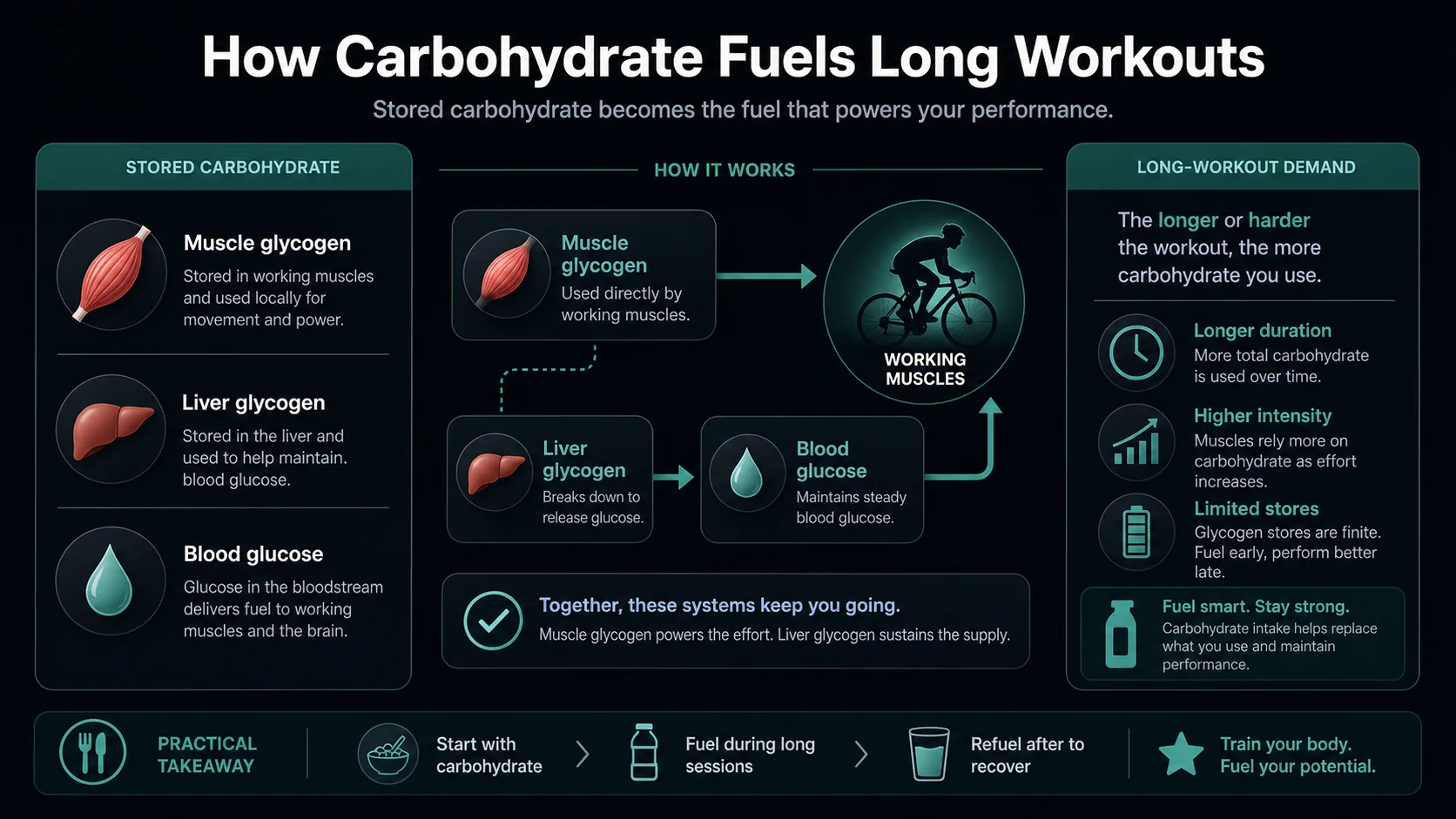
Glycogen is stored carbohydrate. Your body stores it mainly in skeletal muscle and liver. Muscle glycogen is used locally by the working muscle. Liver glycogen helps maintain blood glucose, which matters for the brain, nervous system, and exercising muscles.
That distinction is important. A runner cannot simply move glycogen from the arms to the legs when the legs are depleted. A cyclist cannot use liver glycogen as if it were an unlimited replacement for quadriceps glycogen. The body can regulate blood glucose and use multiple fuels, but local muscle stores still matter when the working muscles need carbohydrate at a high rate.
Glycogen is not just “sugar sitting in the body.” It is a limited reserve that changes with diet, training, recent exercise, and recovery time. Muscle glycogen can be reduced by long endurance work, high-intensity intervals, repeated climbs, strength work, or a cluster of demanding training days. Replenishment depends on carbohydrate intake, total energy intake, time, and the size of the depletion. Classic glycogen-recovery work describes how carbohydrate intake after exercise affects muscle glycogen synthesis, especially when the next demanding session is soon (Ivy).
For athletes, the main takeaway is not that every gram must be tracked. It is that glycogen is trainable, depletable, and restorable. If a long workout starts with low carbohydrate availability, the session may feel harder earlier. If a hard workout follows an under-fueled long session, the second workout may fail for nutrition reasons rather than fitness reasons.
Why Long Workouts Feel Different After the First Hour
Short workouts can often be powered by a mix of normal meals, existing glycogen, and body fat. Long workouts eventually become a supply problem. The longer the session lasts, the more you depend on your starting glycogen, carbohydrate intake during the workout, intensity control, heat management, hydration, and gut tolerance.
This is why the same pace or power can feel very different late in a long session. Early on, the body may have enough carbohydrate available, perceived effort is controlled, and coordination feels normal. Later, glycogen stores are lower, blood glucose may be harder to maintain, muscle damage or fatigue accumulates, the gut may become less cooperative, and the brain may start protecting output. The result is the familiar late-workout slide: pace drops, hills feel steeper, decision-making gets worse, and small surges become expensive.
The effect is not limited to races. A three-hour Zone 2 ride with rolling hills can create a meaningful carbohydrate demand even if the average intensity looks easy. A long mountain hike can become carbohydrate-limited because the climbs repeatedly push intensity higher than the average heart rate suggests. A fastpacking day can include hours of low-intensity movement plus short steep segments that draw heavily on carbohydrate.
This is one reason training logs should not interpret long workouts only by average pace. Duration, terrain, temperature, elevation gain, surface, pack weight, and surges change the metabolic cost. Carbohydrate need follows the work, not just the label on the workout.
Carbohydrate and Fat Are Teammates, Not Enemies
Endurance athletes use both carbohydrate and fat. At lower intensities, fat can provide a large share of energy. At higher intensities, carbohydrate becomes more important because it can support faster energy turnover. The shift is gradual, not a hard switch.
The mistake is turning this into an identity argument. Fat adaptation is real in the sense that training and diet can change fat oxidation. But higher fat oxidation does not automatically mean better endurance performance. For many race demands, the athlete still needs carbohydrate to sustain higher intensity, respond to terrain, climb well, surge, sprint, or hold technique under fatigue.
Research on ketogenic low-carbohydrate, high-fat approaches in elite endurance settings has repeatedly raised this trade-off: fat oxidation can increase, but the cost may be reduced exercise economy or impaired ability to support high-intensity endurance performance (Burke). A well-known study in elite race walkers found that a low-carbohydrate high-fat diet increased fat oxidation but impaired exercise economy and did not produce the same performance improvement seen with higher-carbohydrate approaches (Burke and colleagues).
That does not mean every athlete needs high carbohydrate all the time. It means long-workout fueling should respect the session. If the goal is an easy aerobic session, normal meals and controlled intensity may be enough. If the goal is a long race-specific session, sustained climbing, high output, or quality late in the workout, carbohydrate availability is part of the performance plan.
Starting Glycogen: The Fuel You Bring to the Workout
The first fueling decision happens before the workout starts. Starting glycogen is influenced by what you ate in the previous day or two, what you trained recently, how well you recovered, and whether you are carrying fatigue into the session.
If you do a long workout after several low-carbohydrate days, a hard interval session, poor sleep, and a rushed breakfast, you should not be surprised if the session gets difficult early. The problem may not be your aerobic base. It may be that you started the workout with low available carbohydrate and then asked your body to sustain long output.
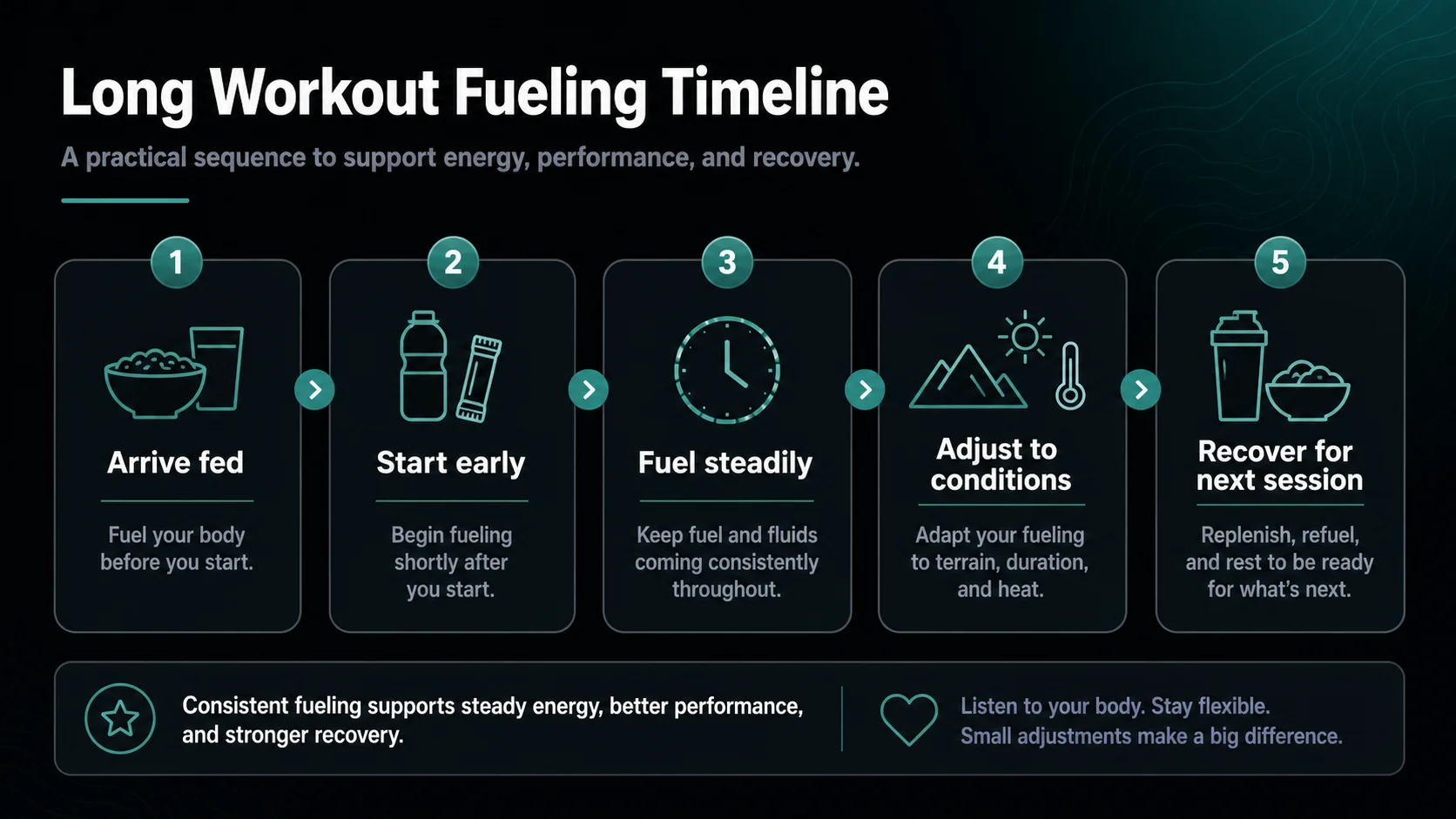
Before an important long workout, the goal is usually to arrive fed, hydrated, and not unnecessarily depleted. That can mean normal carbohydrate-rich meals the day before, a familiar pre-workout meal, and avoiding the temptation to “save calories” before a session that is supposed to build fitness. For races or very long events, formal carbohydrate loading may be appropriate, but most training days do not require a dramatic protocol.
The position stand from the Academy of Nutrition and Dietetics, Dietitians of Canada, and the American College of Sports Medicine emphasizes that carbohydrate needs should scale with daily training demands and that athletes should practice individualized strategies around sessions and competition (Thomas, Erdman, and Burke). In plain language: a recovery day, a short easy run, a long ride, and a race simulation should not all be fueled the same way.
During-Workout Carbohydrate: When It Starts to Matter
Carbohydrate during exercise matters most when duration and intensity create a meaningful risk of depletion or declining blood glucose. The longer the workout, the more important steady intake becomes. The harder the workout, the more important carbohydrate availability becomes. When both are true, fueling is not optional performance decoration; it is part of the workout design.
For short easy sessions, especially when the athlete is generally well fed, carbohydrate during the workout may not be necessary. For long workouts, delayed fueling is a common mistake. Athletes often wait until they feel bad, then try to rescue the session. That is less effective than starting early and keeping intake steady. By the time the classic bonk arrives, the problem is already advanced.
Reviews by Jeukendrup and colleagues describe how carbohydrate ingestion during exercise can improve endurance performance, especially in longer events, and how multiple transportable carbohydrates can allow higher absorption than glucose alone in some contexts (Jeukendrup). Another review highlights that carbohydrate during exercise can influence performance and that the gut itself can be trained to tolerate and absorb carbohydrate more effectively during exercise (Jeukendrup and McLaughlin).
For practical training, that means three rules matter more than any single product:
- Start before you are in trouble.
- Use fuel you have practiced.
- Match intake to the expected duration, intensity, heat, and gut tolerance.
The right amount is individual. Body size, pace, sport, temperature, event duration, intensity, product type, fluid access, and history of gastrointestinal symptoms all matter. The athlete who tolerates a high carbohydrate intake on a bike may not tolerate the same intake while running downhill. The hiker who can eat solid food at low intensity may need simpler options during steep sustained climbing. The runner who can drink frequently on a loop course may need a different plan on a remote trail.
Multiple Transportable Carbohydrates
During exercise, the gut is not an unlimited fuel pipe. Different carbohydrate types use different intestinal transporters. Glucose and maltodextrin rely mainly on one pathway; fructose uses another. Combining carbohydrate types can increase the amount that can be absorbed and oxidized during prolonged exercise compared with relying on one pathway alone.
That is the basic idea behind many modern endurance products that combine glucose or maltodextrin with fructose. The goal is not magic. It is transport capacity. When exercise is long enough and intake is high enough, using multiple transportable carbohydrates can help deliver more usable carbohydrate while reducing the chance that unabsorbed carbohydrate sits in the gut.
The review literature on multiple transportable carbohydrates supports this mechanism and its performance relevance during prolonged exercise (Jeukendrup). But this does not mean every workout needs the highest possible intake. It means that as duration and intensity rise, product composition and gut training become more important.
For a short easy run, this is not the bottleneck. For a multi-hour ride, trail race, long climb day, ultramarathon, fastpacking effort, or race-specific brick workout, it can be. The athlete needs fuel that matches the demands and can actually be tolerated under movement.
The Gut Is Trainable
Many athletes think of fueling problems as willpower problems. Often they are gut-training problems. The stomach and intestines must tolerate fluid, carbohydrate concentration, movement, heat, stress hormones, jostling, and reduced blood flow to the gut. If the first time you attempt aggressive fueling is race day, you are testing a system you did not train.
Gastrointestinal complaints are common during endurance exercise. A review on exercise-related GI problems notes that symptoms are influenced by factors such as intensity, dehydration, heat, mechanical jostling, nutritional choices, and the athlete's individual history (de Oliveira, Burini, and Jeukendrup). This is why fueling advice that works on paper can fail on a hot, hilly, hard day.
Gut training means practicing the actual behavior:
- Eat or drink carbohydrate during long workouts, not only before them.
- Practice at race-like intensity, not only during very easy sessions.
- Test product type, concentration, flavor, caffeine, sodium, and fluid volume.
- Learn what works while running, cycling, climbing, hiking, or carrying a pack.
- Increase intake gradually when needed instead of making a race-day jump.
The goal is not to force the gut into tolerating anything. The goal is to make fueling predictable. A long workout is a good place to test the plan because the cost of a mistake is lower than during a race, but high enough to reveal problems.
Glycogen, Zones, and Terrain
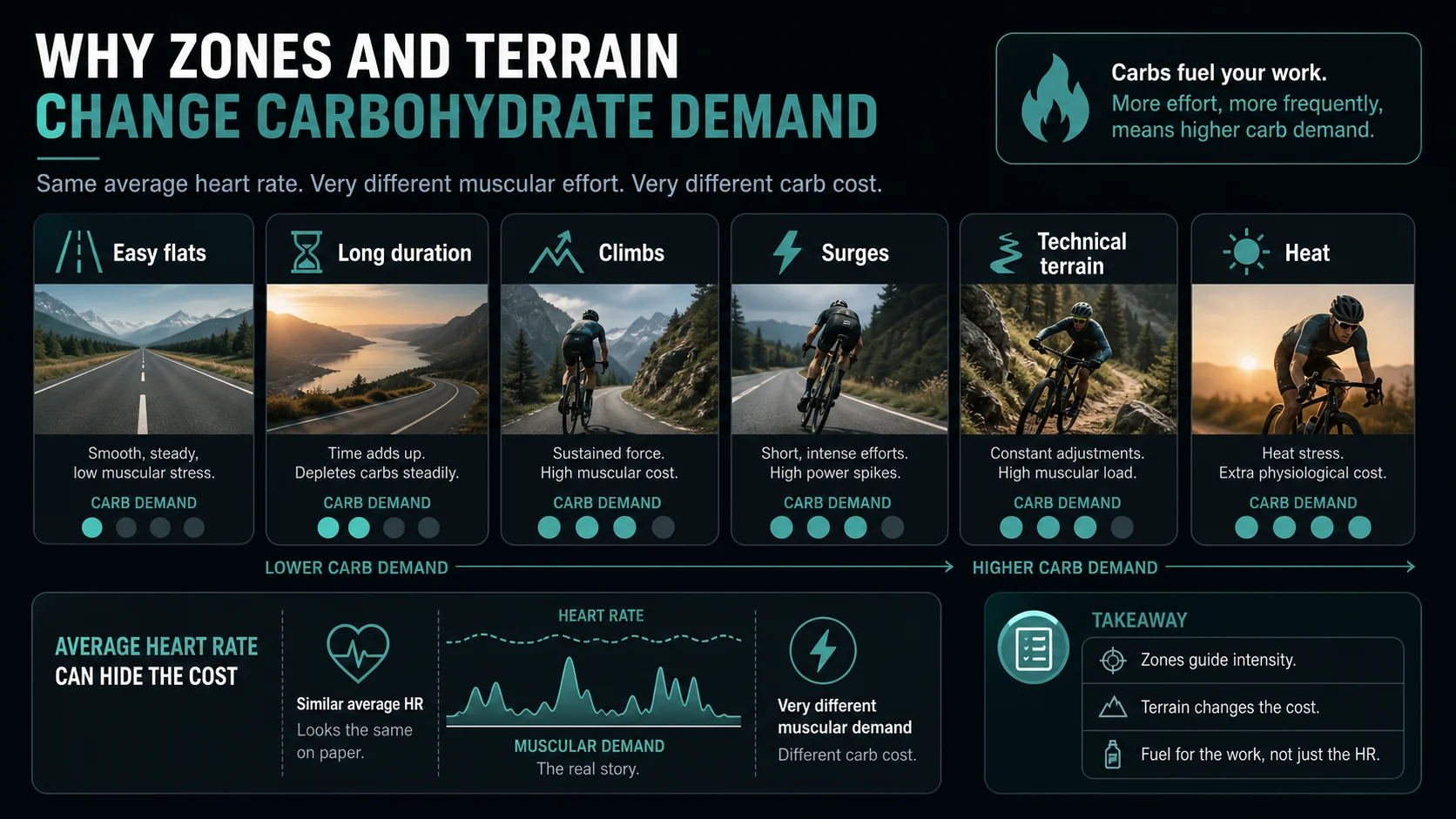
Heart-rate zones are useful, but they do not erase terrain. A workout labeled Zone 2 can include repeated short climbs, technical sections, descents that damage the legs, pack weight, altitude, or heat. The average heart rate may stay controlled while local muscles repeatedly rely on carbohydrate.
This matters for trail runners, hikers, cyclists, ski tourers, mountaineers, and fastpackers. A steady road run and a hilly trail run can have the same duration and average heart rate but very different muscular and carbohydrate demands. A long climb may sit at the top of Zone 2 or drift into Zone 3 for extended periods. Short steep pushes may briefly touch higher intensity even when the whole workout is “aerobic.”
Carbohydrate use tends to rise with intensity. That means a long workout with surges burns through glycogen differently than a flat easy session. The athlete may still be aerobically fit, but the local working muscles can become carbohydrate-limited in the late stages. When that happens, output drops, cadence or stride changes, and the athlete may feel like coordination is disappearing.
This is one reason a training log should include context. Duration, elevation gain, surface, heat, fueling, perceived effort, and late-session drift explain more than pace alone. If a three-hour trail run ends with heavy legs and a craving spiral, the useful question is not only “Was I fit enough?” It is also “Did I fuel the actual terrain I ran?”
Long Workouts Are Not All the Same
“Long workout” is a broad category. A two-hour easy ride, a three-hour trail run, a four-hour hike with a pack, a long indoor trainer ride, and a marathon-specific long run are not the same fueling problem.
The first difference is intensity. Higher intensity increases carbohydrate reliance. A long workout with threshold segments or race-pace blocks needs more carbohydrate support than an easy aerobic outing of the same duration.
The second difference is movement pattern. Running usually creates more gut jostling than cycling. Hiking may allow more solid food, but steep climbing and altitude can reduce appetite. Swimming makes fueling logistics harder. Indoor sessions may increase sweat rate and fluid need because airflow is poor.
The third difference is access. A loop course with bottles every 30 minutes is different from a mountain route where everything must be carried. Fueling strategy must match the logistics of the session, not just the physiology.
The fourth difference is the next workout. A long session before a rest day has different recovery urgency than a long session before intervals, a double day, or a race-specific weekend block. Glycogen restoration matters most when the next demanding session is soon.
This is why good endurance fueling uses categories, not absolutes. Ask:
- Is the workout short, moderate, long, or very long?
- Is it easy, steady, hard, or race-specific?
- Is the terrain smooth or variable?
- Will I need quality late in the session?
- What is the next important workout?
- Have I practiced this fuel under similar conditions?
Those questions produce better decisions than copying a generic number from another athlete.
Before Long Workouts: Arrive Fed, Not Stuffed
The best pre-workout meal is boring in the best sense: familiar, digestible, carbohydrate-inclusive, and timed so it supports the session without creating stomach problems. For many athletes, that means a meal a few hours before a long workout, or a smaller snack closer to the start if the session begins early.
Pre-workout fueling should not become a stress ritual. The main job is to avoid starting unnecessarily depleted. A hard or long morning session after a low-carbohydrate dinner, poor sleep, and no breakfast is a different workout than the plan probably intended.
Some athletes like fasted easy training. That can be compatible with a broader plan when the session is short, controlled, and the athlete eats enough across the day. It becomes a problem when fasted training is applied by default to long workouts, hard workouts, or athletes already struggling with recovery. The “train low” literature is about targeted manipulation, not chronic under-fueling.
If the long workout is important, fuel it like it is important. If it is a low-stress aerobic session, normal meals may be enough. If it includes race pace, long climbs, high volume, or a demanding next-day session, carbohydrate before and during the workout becomes more important.
During Long Workouts: Fuel Early and Keep It Boring
Good during-workout fueling is usually less dramatic than athletes expect. The basics are:
- Choose fuel you can tolerate.
- Start early enough that you are preventing a problem.
- Keep intake steady.
- Pair carbohydrate with appropriate fluid.
- Practice the exact plan in training.
The late-workout panic approach does not work well. If you wait until coordination falls apart or mood collapses, you are no longer simply “a little low.” You are trying to reverse a deficit while continuing to exercise. It is much easier to maintain blood glucose and carbohydrate availability than to rescue them after a long delay.
Boring also matters. Race-day novelty is a major source of avoidable GI problems. A new gel, new drink mix, new caffeine dose, new bar, or new concentration may seem minor, but the gut experiences it during stress. Long workouts should make the plan familiar.
For cyclists, this might mean practicing bottle timing and higher carbohydrate intakes on long rides. For runners, it might mean learning what can be tolerated at marathon pace versus easy pace. For hikers and fastpackers, it might mean mixing drink carbohydrate with small solid-food checkpoints. For long climbs, it might mean fueling before the steep section instead of waiting until appetite disappears.
After Long Workouts: Glycogen Recovery Depends on the Next Demand
Recovery fueling should be based on what comes next. If the long workout is followed by a rest day and normal meals, there is usually less urgency. If another hard or long session is coming soon, glycogen restoration becomes more important.
Carbohydrate after exercise supports glycogen resynthesis. Protein supports muscle repair and adaptation. Total energy intake matters because glycogen restoration and tissue repair do not happen well in a chronic energy deficit. The exact meal can be flexible, but the principle is not: long workouts create a recovery bill.
Ivy's review on muscle glycogen synthesis describes how the timing and amount of carbohydrate after exercise affect glycogen restoration, especially when rapid recovery is needed (Ivy). Modern sports nutrition guidance similarly emphasizes matching intake to training load and recovery timing rather than treating all days the same (Thomas, Erdman, and Burke).
For most athletes, the useful recovery question is: “Do I need to be ready again soon?” If yes, eat promptly and include carbohydrate. If no, normal meals may be sufficient, but under-eating after long work is still a common way to sabotage the week.
Signs that recovery fueling may be insufficient include unusually heavy legs the next day, poor sleep, elevated cravings, irritability, inability to hit a planned quality session, higher perceived effort at normal output, or a pattern of late-week collapse. Those signals are not proof of low glycogen by themselves, but they are worth reviewing alongside training load and fueling notes.
Train Low Without Living Low
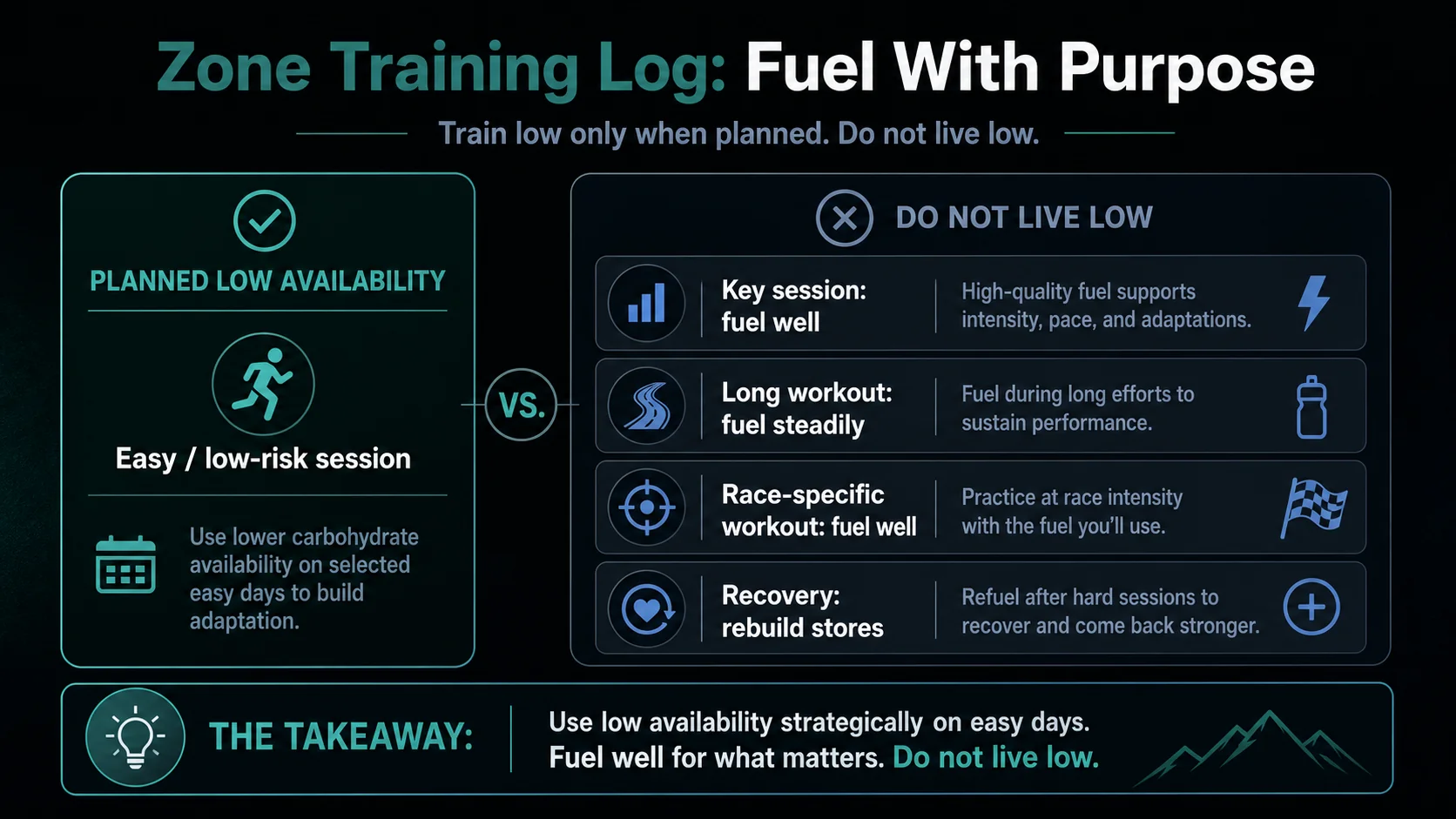
Some endurance athletes deliberately perform selected sessions with lower carbohydrate availability. The goal is to create a specific cellular or metabolic signal. This is where the “fuel for the work required” concept becomes useful. A low-stress session might be placed with lower carbohydrate availability, while a key quality session is fueled well.
The practical paper on fuel-for-the-work-required strategies describes ways athletes might combine train-low approaches with normal training, while acknowledging that implementation must be careful (Impey and colleagues). The later theoretical framework connects carbohydrate periodization to the idea that glycogen availability may influence adaptation signals (Impey and colleagues).
The danger is confusing targeted low-carbohydrate availability with chronic low energy availability. Those are not the same. Low energy availability occurs when energy intake is too low after the cost of exercise is accounted for. It is associated with health and performance problems across systems, including reproductive, bone, endocrine, immune, metabolic, hematological, and psychological effects. The 2023 IOC consensus statement on Relative Energy Deficiency in Sport makes clear that this is a serious risk, not a clever shortcut (Mountjoy and colleagues).
In practical terms:
- A selected short easy session with lower carbohydrate availability may be a training choice.
- A long hard workout under-fueled by accident is usually just a compromised workout.
- Repeated low-energy days are a health and performance risk.
- Key sessions should usually be fueled to protect the intended output.
- Athletes with a history of disordered eating, menstrual dysfunction, bone stress injury, low energy availability, or medical concerns should not experiment casually with restrictive fueling.
Train low is a tool. Living low is a problem.
Bonking: What It Usually Means
Bonking is the sudden or progressive collapse in output that often comes with low carbohydrate availability, falling blood glucose, or severe fatigue. Athletes describe it as empty legs, foggy thinking, irritability, chills, loss of coordination, or an inability to keep moving at normal effort.
Not every bad long workout is a bonk. Heat stress, dehydration, pacing errors, altitude, muscle damage, illness, poor sleep, and excessive training load can all produce a similar collapse. But if the pattern is predictable after long duration, hard terrain, delayed fueling, or low-carbohydrate days, carbohydrate availability should be investigated.
The prevention strategy is not complicated:
- Start the workout with enough carbohydrate availability for the goal.
- Avoid early over-pacing.
- Begin fueling before you feel depleted.
- Keep intake steady.
- Practice fuel and fluid together.
- Adjust for heat, hills, altitude, and duration.
Once a true bonk is underway, slowing down and taking carbohydrate may help, but recovery takes time. The better lesson is usually for the next session: the fueling plan did not match the work.
Why Late-Workout Pace Drops Are Not Always Fitness Problems
Endurance athletes often interpret late-session slowing as a fitness failure. Sometimes it is. But long workouts fail for multiple reasons, and carbohydrate is one of the more fixable ones.
Consider two athletes who both fade after two hours. One started too hard and accumulated muscular fatigue. Another paced well but took in almost no carbohydrate and had a light breakfast. Their training solutions are different. The first may need better intensity discipline. The second may need better fueling. A third athlete may need heat acclimation, more fluid, or route-specific strength.
This is why logging fuel is useful. You do not need a perfect nutrition spreadsheet. A few notes can reveal patterns:
- What did you eat before?
- When did you start fueling?
- What fuel did you use?
- How much fluid did you carry?
- Did symptoms appear at a predictable time?
- Did the fade happen after climbs or steady flats?
- How did the next day's workout feel?
Zone Training Log users should think of fueling notes as context for interpreting zones. Heart-rate distribution shows intensity. Fueling notes help explain why the same intensity felt sustainable one week and fragile the next.
Carbs for Hiking, Fastpacking, and Long Climbs
Hiking and fastpacking create a special fueling problem because average intensity can look moderate while the total workload is high. Long duration, elevation gain, pack weight, altitude, heat, and technical terrain can combine into a major carbohydrate demand.
The athlete may not be “running hard,” but long climbs often push the working muscles into sustained higher effort. Descents can add muscle damage. Appetite may drop at altitude. Access to water may be limited. The result is that fueling must be planned around the route.
For these workouts, practical fueling often works best as a mixed system:
- Drink carbohydrate when chewing is hard.
- Use small solid foods during lower-intensity sections.
- Fuel before long climbs, not only at the top.
- Keep emergency fast carbohydrate accessible.
- Practice with the pack, poles, altitude, and terrain you will actually use.
The goal is stable movement. In long mountain days, the fastest athlete is often the one who avoids deep lows. Glycogen management, pacing, and gut tolerance work together.
Carbs for Runners
Running makes fueling harder because of impact and gut jostling. A product that works on the bike may feel terrible during a run. Downhills, heat, and high intensity increase the challenge.
Runners should practice fueling across different session types. Easy long runs are useful for building the habit, but race-specific fueling also needs race-specific intensity. Marathon fueling, ultramarathon fueling, and mountain-run fueling are related but not identical. Marathon pace may limit solid food. Ultra pacing may allow more variety but creates a longer gut-management problem. Trail terrain may alternate between sections where eating is easy and sections where it is not.
The most common running error is under-fueling early because the stomach feels fine and the pace feels controlled. The second error is over-concentrating carbohydrate without enough fluid, which can contribute to GI distress. The third is testing a new product during a key race or workout.
The fix is progressive practice. Start with small, consistent amounts. Learn what products sit well. Practice drinking with gels or chews if the product requires it. Test caffeine separately before combining it with high carbohydrate intake. Make the plan boring before race day.
Carbs for Cyclists
Cycling generally allows higher carbohydrate intake than running because there is less gut jostling and more opportunity to drink. Long rides, races, gravel events, and indoor trainer sessions can therefore support more structured fueling. But cyclists still make mistakes.
One common mistake is relying on appetite. Appetite may lag behind expenditure, especially in heat or high intensity. Another is forgetting that indoor sessions can increase fluid needs because cooling is worse. A third is practicing high intake only on easy rides, then discovering that race intensity changes tolerance.
Cyclists should use long rides to test bottle concentration, product combinations, caffeine, and timing. Race-like rides should include race-like fueling. If the event includes climbs or technical segments where drinking is difficult, fuel before those sections.
Because cycling often permits steady intake, it is a good environment for gut training. But “possible” does not mean “required every ride.” A short recovery spin does not need the same fueling plan as a five-hour gravel ride.
Carbs for Strength-Endurance and Mixed Days
Endurance athletes often combine long workouts with strength training, hill work, strides, or intervals. These mixed days can increase carbohydrate demand even when the endurance portion is not extremely fast.
Heavy lifting and high-intensity intervals rely substantially on carbohydrate. Hill repeats and long climbs create local muscular demand. A long run with fast finish segments needs more carbohydrate support than a long run kept fully easy. A ride with repeated surges needs more than the same duration at steady low intensity.
The training log should reflect that. If you stack strength and endurance on the same day, fuel the day. If you place hard intervals inside a long workout, fuel the hard parts and the total duration. If the next day is another key workout, recover accordingly.
Under-fueling mixed days is a common way to turn useful training into excessive stress. The athlete completes the session, but quality drops, soreness increases, sleep worsens, and the next session suffers.
Common Fueling Mistakes
The first mistake is treating all long workouts as the same. Duration matters, but so do intensity, terrain, heat, and the next session.
The second mistake is waiting until hunger appears. During hard endurance exercise, hunger is not a reliable early warning system. You can be carbohydrate-limited before you feel hungry.
The third mistake is training the engine but not the gut. If you want to fuel aggressively during long events, the gut needs practice.
The fourth mistake is copying elite fueling without copying the context. Elite athletes may have years of gut training, high energy expenditure, product support, course access, and medical oversight. Their plan may not match your body or session.
The fifth mistake is using low-carbohydrate availability as a default identity. Some sessions can be done with less carbohydrate support. Key sessions, long sessions, and race-specific sessions often need more.
The sixth mistake is recovering based only on appetite. Appetite can be suppressed after hard or hot workouts. If the next session matters, recovery nutrition should be intentional.
A Practical Fueling Map
Use this map as a decision framework, not a prescription.
For short easy sessions, normal meals may be enough. If the session is truly easy and you are not carrying fatigue or low energy availability, carbohydrate during the workout is often unnecessary.
For moderate sessions that approach or exceed the point where energy dips are common for you, bring fuel. You may not need much, but having it prevents a small mistake from becoming a bad session.
For long easy sessions, fuel because duration accumulates cost. Even if intensity is low, the total carbohydrate demand can become meaningful.
For long hard sessions, fuel before and during. These workouts are not the place to prove discipline through restriction.
For race-specific sessions, practice the race plan. Use the same fuel types, timing, fluid strategy, and logistics as closely as possible.
For sessions followed by another important workout, prioritize recovery carbohydrate and enough total food. The goal is not only to survive the first session. It is to absorb the block.
For selected low-carbohydrate sessions, keep the purpose narrow. They should be planned, low-risk, and separated from key performance work unless guided by a qualified professional.
How to Review Carbs and Glycogen in Your Training Log
A training log cannot directly measure muscle glycogen in normal daily use. But it can show patterns that point toward fueling problems.
Look for repeated late-session fades in workouts longer than your usual fuel window. Look for hard sessions that fail after under-fueled days. Look for long workouts followed by poor sleep, high cravings, or unusually bad next-day legs. Look for heart-rate drift that appears alongside heat, dehydration, or low carbohydrate intake. Look for GI symptoms that appear only when intensity rises or product concentration changes.
Useful notes are short:
- “Breakfast: oats and banana.”
- “Started fuel at 35 min.”
- “Two bottles, one gel, hot day.”
- “Stomach fine until climb.”
- “Faded after 2:15; no fuel first hour.”
- “Recovered well; intervals okay next day.”
Over time, these notes turn nutrition from guesswork into pattern recognition. You do not need perfect data. You need enough context to make the next decision better.
What the Evidence Supports, and What It Does Not
The evidence strongly supports carbohydrate as an important fuel for prolonged and higher-intensity endurance exercise. It supports matching carbohydrate availability to training demands. It supports practicing during-workout intake and considering multiple transportable carbohydrates for prolonged exercise where higher intake is useful. It supports the idea that recovery carbohydrate matters when glycogen restoration is needed for subsequent work.
The evidence does not support one universal fueling number for every athlete and every long workout. It does not support chronic under-fueling as a safe adaptation strategy. It does not prove that more carbohydrate is always better in every session. It does not mean low-intensity easy sessions must always include during-workout carbohydrate.
The best interpretation is flexible but not vague: fuel the sessions that need fuel, recover for the next demand, and use selected lower-carbohydrate availability only when it has a specific purpose and low risk.
Conclusion
Carbs and glycogen are not just race-day topics. They shape long-workout quality, late-session durability, recovery, gut tolerance, and the ability to complete training blocks.
Muscle glycogen helps working muscles sustain output. Liver glycogen helps maintain blood glucose. Carbohydrate intake during long exercise can delay depletion and support performance. Recovery carbohydrate matters most when the next hard session is soon. Gut training turns fueling from a theory into a reliable skill.
The practical rule is: match carbohydrate to the work required. Easy short sessions may need little special fueling. Long sessions need a plan. Hard sessions need support. Race-specific sessions need practice. Recovery should prepare you for what comes next, including the sleep that supports endurance adaptation.
If your long workouts keep falling apart, do not only ask whether you are fit enough. Ask whether you brought enough usable fuel for the work you planned.

Our editorial approach & AI disclosure
We use AI to help research, organize, and draft some articles. Every article is reviewed by a human editor and aims to reflect current evidence-based training practices and scientific literature.
Read our editorial policy