

Physiology
Fuel Easy, Fuel Hard
Learn how to match fueling to the workout: enough carbohydrate for hard and long sessions, enough total energy for recovery, and enough restraint to keep easy training easy.

Introduction
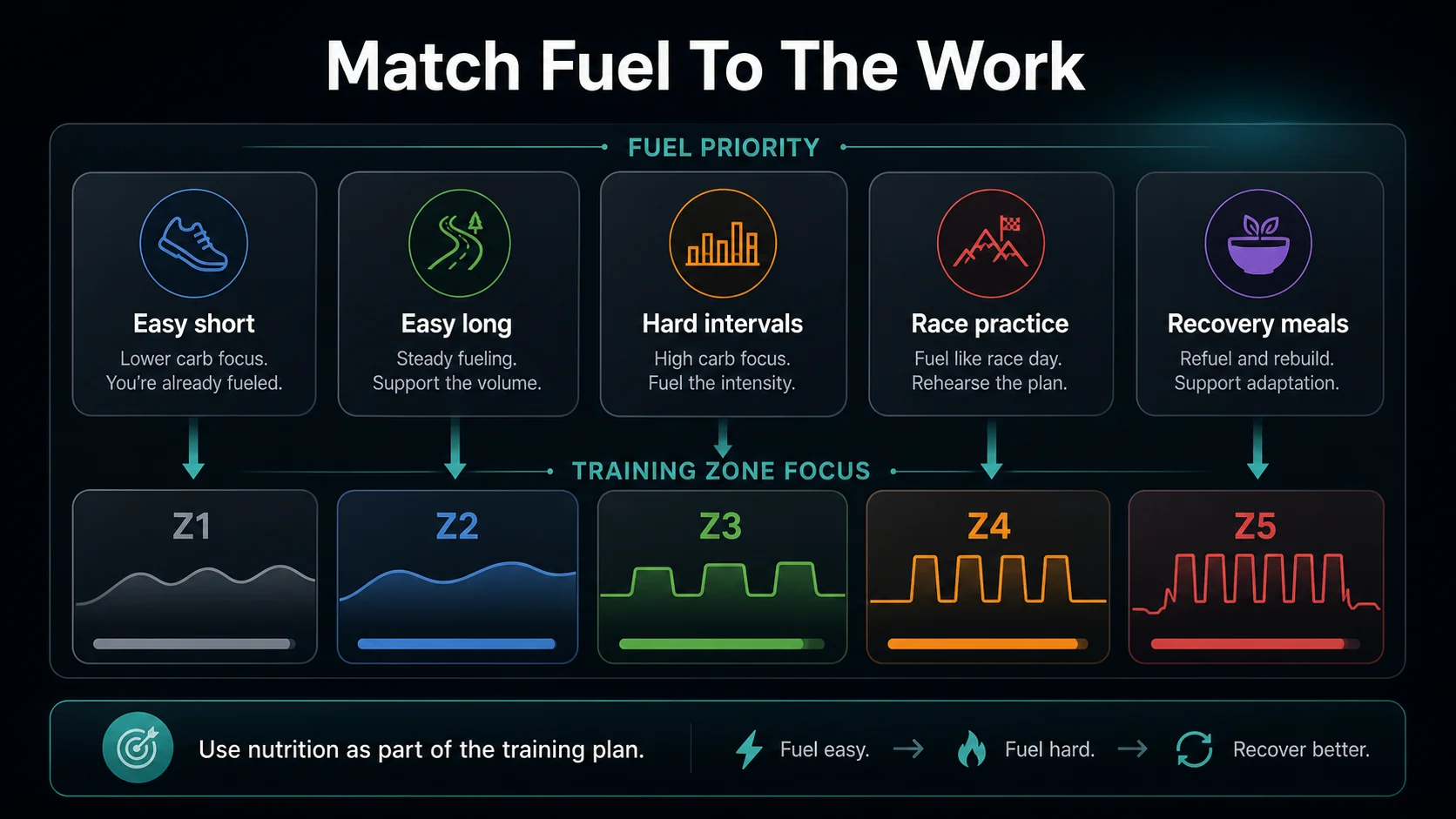
Fuel easy, fuel hard means matching carbohydrate and total energy to the session you are asking your body to perform. It does not mean starving easy days. It does not mean eating as much sugar as possible every time you train. It means using nutrition as part of the training plan.
Easy sessions are often about aerobic volume, low stress, and repeatability. They may not need aggressive carbohydrate during the workout, especially if they are short and you are already well fed. Hard sessions are different. Intervals, threshold work, race simulation, long climbs, and long days depend more on carbohydrate availability. If you under-fuel them, the session often becomes less specific, more stressful, and harder to recover from.
The best summary is: fuel for the work required. That phrase comes from carbohydrate-periodization work proposing that endurance athletes should align carbohydrate availability with the goals of each workout rather than follow one fixed intake every day (Impey and colleagues). The idea is useful, but it is often misused. Strategic low-carbohydrate availability is not the same as chronic low energy availability.
Sports nutrition position stands still emphasize that athletes need enough total energy, carbohydrate, protein, fluid, and micronutrients to support training and health (Thomas, Erdman, and Burke). The 2023 International Olympic Committee consensus statement on Relative Energy Deficiency in Sport describes low energy availability as a serious health and performance risk, not a badge of discipline (Mountjoy and colleagues).
This guide explains how to fuel easy, fuel hard, and avoid turning useful flexibility into accidental under-fueling.
What “Fuel for the Work Required” Actually Means
The central idea is not complicated: the harder, longer, or more race-specific the session, the more important carbohydrate availability becomes. Carbohydrate is stored as glycogen in muscle and liver; Carbs, Glycogen, and Long Workouts explains how duration and terrain change that demand. During harder endurance work, the body relies more heavily on carbohydrate because it can support high rates of energy production. Fat contributes substantially at lower intensities, but fat oxidation cannot replace carbohydrate for every task.
Carbohydrate periodization tries to match fuel availability to the training goal. Some easy or technique-focused sessions can be done with normal meals but no special intra-workout fueling. Some selected low-intensity sessions may be performed with lower carbohydrate availability to create a different metabolic stimulus. Key quality sessions should usually be well fueled so the athlete can hit the intended intensity, volume, and mechanics.
The “fuel for the work required” framework describes this as a way to bring together train-low strategies without making low carbohydrate the default setting (Impey and colleagues). That distinction matters. The goal is not to see how little you can eat. The goal is to decide which sessions need high carbohydrate support and which do not.
In practical terms:
- Easy short aerobic work can often be fueled by normal meals.
- Long easy work may need fuel because duration, not intensity, creates the demand.
- Hard workouts should be supported before, during, and after.
- Race-specific sessions should practice race fueling.
- Recovery nutrition should match the next session, not just the session you finished.
This is why a Zone 2 run and a Zone 4 interval workout should not be fueled the same way by default. They ask different questions of the body.
Easy Does Not Mean Under-Fueled
The most common mistake is hearing “fuel easy” as “do easy sessions fasted.” That is too narrow. Some easy sessions can be done before breakfast or without carbohydrate during the run. But easy training still needs total daily energy.
Easy days are where endurance athletes build volume. They are also where athletes recover from hard work. If an easy day becomes an under-eating day, the cost shows up later: poor sleep and reduced adaptation, elevated hunger, low mood, weaker immune resilience, menstrual disruption, reduced libido, poor bone health, or a sudden inability to hit quality sessions.
The RED-S consensus statement defines the problem around low energy availability, where energy intake is insufficient after the cost of exercise is considered (Mountjoy and colleagues). That can happen even when an athlete eats “healthy” foods and never intentionally diets. A busy runner may skip breakfast, do an easy run, eat a small lunch, and then wonder why threshold work feels terrible the next day.
Fueling easy can mean:
- Eat normal meals around the session.
- Skip intra-workout fuel for a short, low-stress session if you are otherwise fed.
- Bring carbohydrate for longer easy sessions.
- Prioritize protein and carbohydrate after longer volume.
- Avoid making easy days secretly low-energy days.
The important distinction is between not needing a gel during a short easy run and not eating enough across the day. The first can be fine. The second is a problem.
Hard Sessions Need Carbohydrate
Hard training requires enough carbohydrate because the goal is quality. If the session is threshold intervals, VO2max work, hill repeats, race pace, a long climb, or a demanding strength session paired with endurance work, under-fueling changes the workout.
It may lower the power or pace you can sustain. It may increase perceived effort. It may worsen technique late in the session. It may make the workout feel heroic but reduce the exact stimulus you wanted. It can also make recovery worse, because the body exits the session with more depletion and more stress.
The 2016 nutrition and athletic performance position paper recommends carbohydrate intake scaled to training demands, with higher carbohydrate availability for higher-intensity or longer-duration work (Thomas, Erdman, and Burke). This is not just about racing. Training quality matters because adaptation follows repeated useful sessions.
For most endurance athletes, hard-session fueling starts before the workout:
- Eat enough carbohydrate in the previous meal.
- Avoid starting key sessions with obvious hunger.
- Use a pre-session snack when the last meal was several hours earlier.
- Take carbohydrate during longer or more demanding workouts.
- Refuel afterward if another session is coming soon or the session was depleting.
There are times when deliberately training with lower carbohydrate availability may be useful, but the athlete must be precise. Low-carbohydrate availability can change cellular signaling, but it can also reduce intensity, immune function, mood, and recovery if used too often. The theoretical benefit is not an excuse to compromise every hard session.
Long Easy Sessions Are Not the Same as Short Easy Sessions
Intensity is only one part of fueling. Duration matters.
A 35-minute easy run after breakfast may need no special fuel. A four-hour hike, long ride, fastpack, or mountain run at mostly easy intensity is different. It may sit in low heart-rate zones, but the total cost can be high. The athlete may burn through substantial carbohydrate, lose fluid and sodium, and become less coordinated late in the day.
This is where the “easy” label can mislead. Easy by heart rate does not always mean low fueling demand. Long low-intensity sessions are often where athletes practice eating, drinking, and carrying fuel. They are also where gut problems appear if fueling is ignored until race day.
Research on carbohydrate ingestion during exercise supports the performance value of carbohydrate during prolonged work, and also discusses trainability of the gut (Jeukendrup and McLaughlin). Reviews of gastrointestinal complaints during exercise note that GI symptoms are common and can be influenced by intensity, dehydration, mechanical jostling, anxiety, and nutrition choices (de Oliveira, Burini, and Jeukendrup).
For long easy days, the practical goal is not to turn every aerobic session into a buffet. It is to prevent late-session deterioration and practice the fueling you will need when duration matters.
Fueling During Exercise: Start With the Demand
During-exercise fueling depends on duration, intensity, gut tolerance, weather, and the next session.
Short easy sessions often need no carbohydrate during the workout. Moderate sessions around 60-90 minutes may or may not need fuel, depending on the athlete, timing of meals, and session goal. Longer sessions and hard sessions usually benefit from planned carbohydrate intake.
Multiple-transportable carbohydrate research matters when intakes get higher. The gut uses different transporters for glucose and fructose, so mixtures can allow higher carbohydrate delivery than glucose alone in long events. Jeukendrup’s review explains why multiple transportable carbohydrates can improve oxidation rates and reduce some limitations of single-carbohydrate sources during prolonged exercise (Jeukendrup).
For practical training:
- Short easy workout: normal meals may be enough.
- Long easy workout: practice steady intake.
- Hard workout over an hour: consider carbohydrate before and during.
- Race simulation: use the fuel type and timing you plan to race with.
- Back-to-back days: fuel the first day to protect the second.
Do not jump from no fueling to aggressive fueling on race day. Gut training is part of training. The stomach and intestine need practice handling fluid, carbohydrate, movement, heat, and intensity together.
Protein and Recovery Still Matter
Fueling hard is not only about carbohydrate. Protein supports muscle repair, remodeling, and adaptation. Strength training, downhill running, plyometrics, and long trail work all create tissue stress. Endurance athletes who focus only on gels and sports drink may miss the recovery side.
The International Society of Sports Nutrition review summarizes evidence and recommendations around protein intake, nutrient timing, and exercise adaptation (Kerksick and colleagues). The exact target depends on the athlete, body size, total energy intake, training load, and goal, but the broad principle is stable: distribute enough protein across the day and include protein after demanding sessions when recovery matters.
Carbohydrate and protein have different jobs:
- Carbohydrate supports high-intensity work, glycogen restoration, and training quality.
- Protein supports repair, remodeling, and adaptation.
- Total energy availability allows both systems to function.
If an athlete eats protein but chronically under-eats total energy, recovery still suffers. If an athlete takes carbohydrate during workouts but skips meals afterward, adaptation still suffers. The day matters, not only the workout window.
The Train-Low Trap
Some athletes hear about train-low strategies and decide that less carbohydrate must always be more advanced. That is not what the literature says.
Training with low carbohydrate availability can increase some molecular markers associated with endurance adaptation. But stronger signaling does not automatically mean better performance. If the athlete cannot complete the session well, gets sick more often, sleeps poorly, or loses the ability to train consistently, the strategy has failed.
Sports nutrition reviews describe periodized carbohydrate as a tool, not a religion (Close and colleagues). Burke’s reviews on high-fat and ketogenic approaches are also useful cautionary reading: fat adaptation can increase fat oxidation, but this does not guarantee better performance in events where high-intensity economy and carbohydrate-supported work matter (Burke, Burke).
Use low-fuel sessions only when the session goal can survive them. A short easy run before breakfast may be fine for some athletes. A hard interval session under-fueled is usually a different workout than planned. A long mountain run without enough fuel may become a survival session instead of aerobic development.
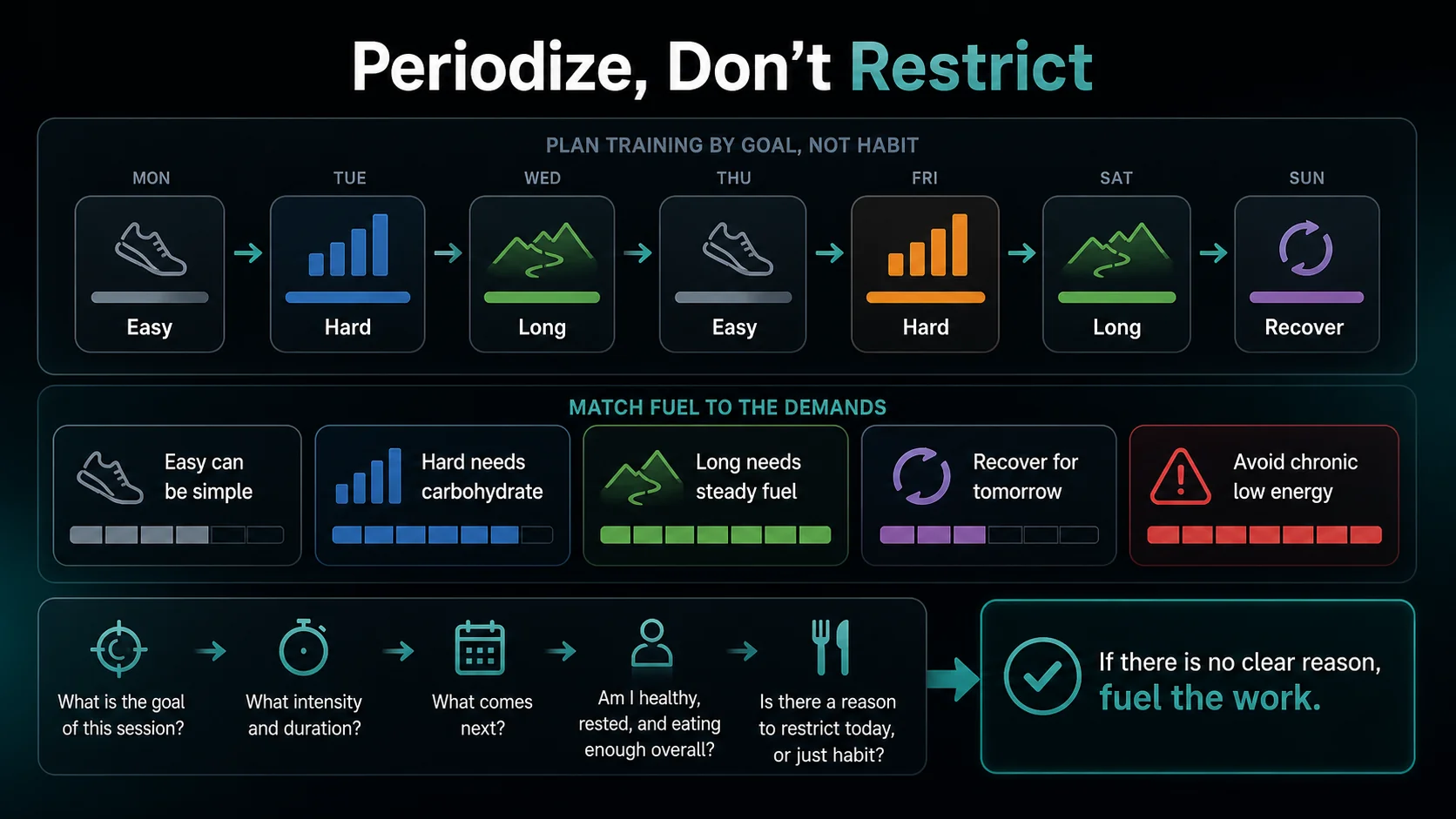
Good carbohydrate periodization asks:
- What is the goal of this session?
- What intensity and duration are required?
- What session comes next?
- Is the athlete healthy, well rested, and eating enough overall?
- Is there a reason to restrict carbohydrate today, or is it just habit?
If there is no clear reason, fuel the work.
Morning Sessions Need a Plan
Morning training is where many fueling mistakes happen. The athlete wakes up, has limited time, and wants to get out the door. That can work for a short easy run. It is a poor default for hard sessions.
After an overnight fast, liver glycogen is lower than it was after dinner. Muscle glycogen may still be adequate if the previous day was well fueled, but the athlete may still feel flat, especially for higher-intensity work. A short Zone 1 or Zone 2 session before breakfast may be fine for some athletes. A hard interval session, long run, or climb is a different ask.
For early easy sessions, the plan can be simple:
- Eat normally the night before.
- Drink water before leaving.
- Keep the session truly easy.
- Eat breakfast afterward.
For early hard sessions, add fuel:
- Eat more carbohydrate at dinner the night before.
- Use a small pre-workout snack if tolerated.
- Use sports drink or gels during longer work.
- Eat a real breakfast afterward.
The pre-session snack does not need to be elaborate. A banana, toast, small bowl of cereal, rice cake with honey, or sports drink may be enough to change the session from “survive” to “execute.” The right choice depends on gut tolerance and time before training.
The worst option is pretending a morning hard workout is the same as a morning easy jog. It is not. If the session demands pace, power, or technical quality, give it fuel.
Two-a-Days and Back-to-Back Days Raise the Stakes
Fueling becomes more important when sessions stack close together. A single easy workout can often be handled with normal meals. A hard workout followed by another session later the same day leaves less time to restore glycogen, repair tissue, and normalize hydration.
This is where nutrient timing matters more. The ISSN nutrient timing position stand notes that timing questions depend heavily on context: the athlete’s total daily intake, the previous meal, the type of exercise, and the time until the next bout (Kerksick and colleagues). If the next session is soon, early carbohydrate and protein become more useful.
For two-a-day endurance training:
- Refuel immediately after the first session if the second matters.
- Use carbohydrate plus protein, not protein alone.
- Replace fluid and sodium when sweat loss is high.
- Keep the second session easy if the first session was under-fueled.
- Do not use every double day as a train-low experiment.
Back-to-back weekend long sessions work the same way. The Saturday session is not only Saturday’s workout. It sets up Sunday. If you finish Saturday depleted and then under-eat, Sunday may become a low-quality slog. Sometimes that is intentional in a specific training block. Most of the time, it is accidental.
Weight-Loss Goals Change the Risk Calculation
Some endurance athletes are trying to improve body composition while training. That does not automatically conflict with performance, but it raises the risk of poor fueling decisions.
The safest rule is to separate body-composition goals from key training execution. If an athlete needs an energy deficit, it should be modest, planned, and compatible with health. It should not come from repeatedly under-fueling hard sessions or long days.
Key workouts are not the right place to cut corners. If you want to reduce intake, it is usually less damaging to trim low-value snacks or adjust portions away from key sessions than to sabotage interval quality. For athletes with a history of disordered eating, menstrual disruption, low libido, bone stress injury, chronic fatigue, or compulsive food rules, weight-loss goals should be handled with qualified professional support.
RED-S is not limited to elite athletes or to one sex. The IOC consensus statement describes a broad syndrome affecting health and performance when energy availability is too low (Mountjoy and colleagues). That is why “fuel easy, fuel hard” must include enough total energy. Otherwise, it becomes a prettier name for chronic restriction.
Signs the strategy is becoming too aggressive include:
- Key sessions feel worse despite consistent training.
- Easy runs feel unusually hard.
- Sleep quality declines.
- Mood, libido, or motivation drops.
- Frequent illness or slow healing appears.
- Menstrual cycle changes occur.
- Bone, tendon, or soft-tissue pain repeats.
- Food anxiety grows around training.
If those signs appear, the answer is not another fueling hack. The answer is to restore enough energy availability and simplify the plan.
What to Eat Is Less Important Than What It Solves
Athletes often want exact foods. Exact foods matter less than the problem you need the meal or snack to solve.
Before a hard session, the problem is carbohydrate availability and gut comfort. Choose familiar, digestible carbohydrate. That may be rice, oats, bread, potatoes, fruit, cereal, pancakes, sports drink, or a gel. High-fiber, high-fat, or very large meals close to hard training may cause gut issues for some athletes.
During long sessions, the problem is steady delivery. Choose foods or drinks you can keep consuming while moving. On roads, that may be gels, chews, drink mix, or bars. On trails and hikes, it may include sandwiches, rice balls, fruit puree, soft bars, boiled potatoes, or salty snacks. The best fuel is the one you actually take early and consistently.
After training, the problem is repair and restoration. Carbohydrate helps replace glycogen. Protein supports tissue repair and remodeling. Fluid and sodium help restore hydration. The meal can be ordinary food: rice bowl with eggs, pasta with meat or tofu, potatoes with fish, yogurt with cereal and fruit, burrito, soup with bread, or a smoothie plus a meal.
Do not confuse sports nutrition products with sports nutrition. Products are useful because they are portable and predictable. They are not mandatory for every situation.
Fuel the Next Session, Not Just This One
Recovery fueling depends on what comes next. If tomorrow is a rest day after a short easy jog, the urgency is low. If tomorrow is a long run, threshold workout, race, or second session, refueling matters.
Glycogen restoration is not only a race-week topic. It determines whether you can repeat useful sessions. Hard endurance work and long duration can reduce muscle glycogen substantially. The athlete who under-fuels after a hard session may not notice the cost until the next day’s workout feels strangely flat.
Nutrient timing reviews emphasize that the value of immediate post-exercise intake depends on context: previous meals, session duration, depletion, and timing of the next session (Kerksick and colleagues). The narrower the recovery window, the more important early refueling becomes.
Simple rules:
- If the session was easy and short, normal meals are usually enough.
- If the session was long or hard, eat carbohydrate and protein afterward.
- If another session is within 24 hours, refuel more deliberately.
- If appetite is low after heat or intensity, use simple foods or fluids first.
- If sleep is poor after evening training, review late caffeine, under-fueling, and meal timing.
Fueling is not just about performance during the current workout. It is about arriving ready for the next one.
A Practical Fueling Map
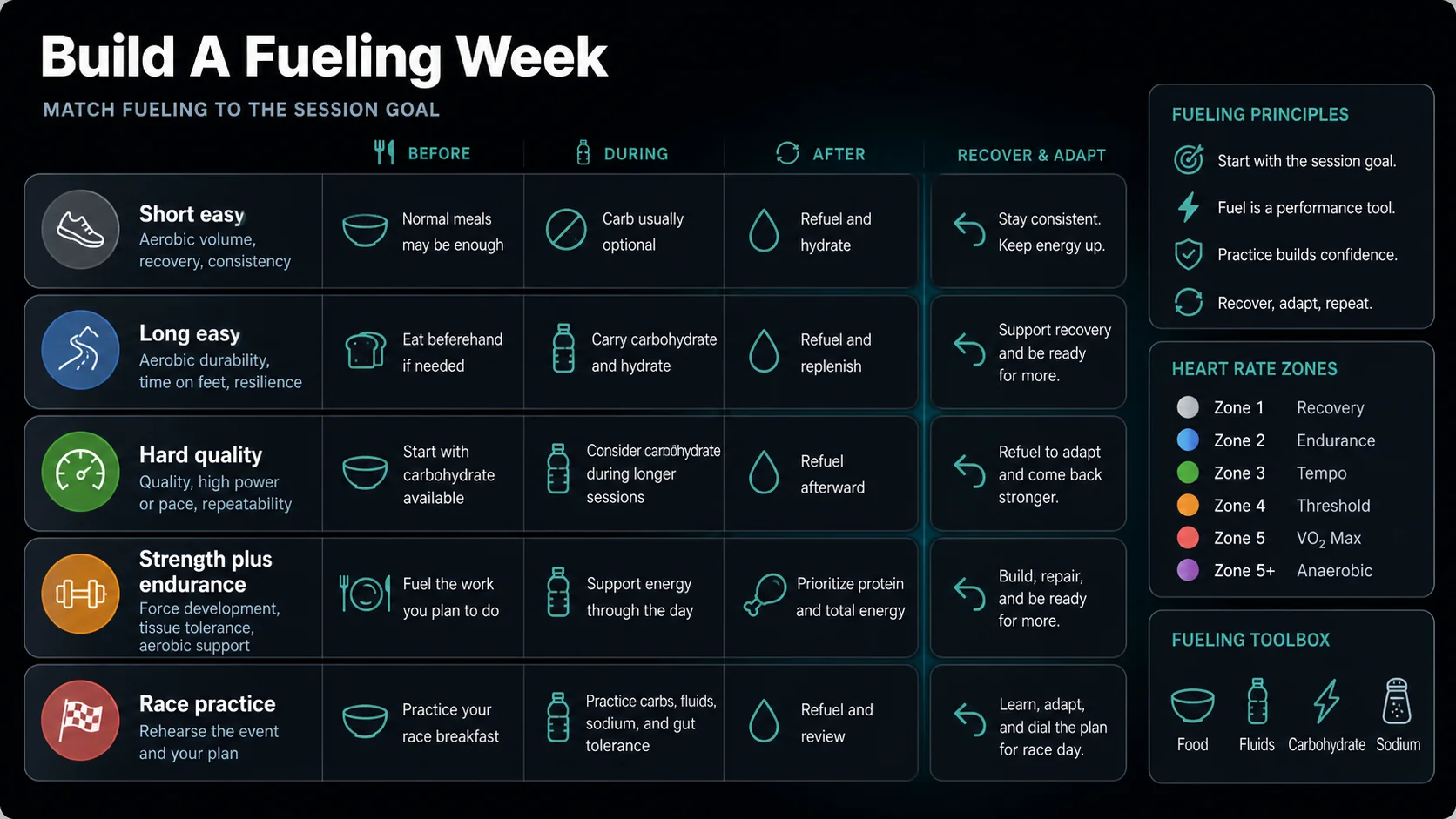
Use the session goal as the starting point.
Easy short aerobic session
Goal: aerobic volume, recovery, consistency.
Fueling: normal meals may be enough. Intra-workout carbohydrate is usually optional if the session is short and truly easy. Do not let the day become low energy overall.
Easy long session
Goal: aerobic durability, time on feet, fatigue resistance, terrain practice.
Fueling: eat beforehand if needed, carry carbohydrate, and practice steady intake. Fueling supports coordination, mood, and recovery even when intensity is low.
Hard interval or threshold session
Goal: quality, high power or pace, repeatability, specific adaptation.
Fueling: start with carbohydrate available. Consider carbohydrate during longer sessions. Refuel afterward. Do not make key quality work the place where you prove how little you can eat.
Strength plus endurance day
Goal: force development, tissue tolerance, aerobic support.
Fueling: total energy and protein matter. Carbohydrate may be important if the endurance session is hard or if strength quality matters.
Race-specific session
Goal: rehearse the event.
Fueling: practice race breakfast, fluids, carbohydrate dose, sodium strategy, and gut tolerance. Nothing new on race day is still a good rule.
Common Mistakes
The first mistake is fueling by ego. Under-fueling a key session does not make it more serious. It often makes it less specific.
The second mistake is fueling only during workouts. A gel during a hard session cannot fix a week of low energy intake.
The third mistake is treating all Zone 2 work the same. A short easy run and a long alpine day can both be low intensity, but their fueling demands are different.
The fourth mistake is never practicing race fuel. Many GI problems are training problems, not just product problems. The gut has to learn the job.
The fifth mistake is copying elite carbohydrate restriction without elite support. Professional athletes often have nutritionists, testing, recovery time, and close monitoring. Recreational athletes usually have jobs, family stress, limited sleep, and fewer guardrails.
How Zone Training Log Can Help
Fueling decisions become easier when you can see the session clearly. Heart-rate zones help identify the physiological demand. Duration shows the total exposure. Notes show whether the session felt controlled, under-fueled, or too hard for the intended zone.
After each session, log three simple nutrition notes:
- Did I start fed, normal, or hungry?
- Did I fuel during the workout?
- Did the session quality match the plan?
Over time, patterns emerge. You may find that short easy runs need no special fuel, but long Zone 2 days go better with steady carbohydrate. You may find that threshold sessions fail when lunch is too light. You may find that evening workouts disturb sleep when you under-eat afterward.
That is the point of “fuel easy, fuel hard.” It is not a fixed menu. It is a feedback loop between training demand, fueling, performance, recovery, and health.
Conclusion
Fuel easy, fuel hard means matching nutrition to the job. Easy short sessions may only need normal meals. Long easy sessions need respect because duration creates fuel demand. Hard sessions need carbohydrate because quality matters. Recovery needs protein, carbohydrate, and enough total energy across the day.
The evidence supports a flexible approach: periodize carbohydrate availability, but do not normalize chronic under-fueling. Use lower-fuel sessions carefully, protect key workouts, practice gut training, and watch for signs that energy availability is too low.
The best fueling plan is not the most restrictive one. It is the one that lets you complete the right sessions, recover from them, and keep adapting week after week.

Our editorial approach & AI disclosure
We use AI to help research, organize, and draft some articles. Every article is reviewed by a human editor and aims to reflect current evidence-based training practices and scientific literature.
Read our editorial policy