

Periodization
Review Your Deload Week
A deload works when it reduces fatigue without losing the thread of training. Learn which metrics to compare, how to judge the first sessions back, and what to change in the next training block.

Introduction
Review a deload week by comparing it with the hard week before it and the first normal week after it. Check whether training volume and strain actually decreased, whether fatigue, soreness, and motivation improved, and whether the first sessions back felt more capable—not merely more aggressive.
A deload is not successful because the calendar says “recovery.” It is successful when the reduction in training creates a useful response. Your training log should help answer three questions:
- Did you reduce the stress that needed reducing?
- Did recovery improve during or shortly after the deload?
- What should change in the next block?
This article focuses on reviewing a deload after it happens. For the difference between a deload and a race taper, including how training may be reduced, start with Deload Week vs Taper.
Define the Purpose Before Judging the Result
A deload can serve different purposes:
- reduce accumulated fatigue after a training block;
- manage soreness or minor irritation;
- create space during a stressful life week;
- transition between training phases;
- restore motivation;
- consolidate adaptation before the next progression.
Write the purpose in the log before the week begins. Otherwise, the review can become vague. An athlete who deloaded to reduce tendon irritation should not judge success only from resting heart rate. An athlete who felt mentally flat should track motivation and willingness to train, not just total minutes.
The evidence for deloading is less developed in endurance sport than the evidence for pre-competition tapering. A survey of strength and physique athletes found that fatigue management was the most common reason for deloading; respondents commonly reduced volume and effort, and judged success through lower fatigue, greater motivation, better performance, and reduced aches (Bell and colleagues). Those observations are not a prescription for every endurance athlete, but they provide a useful review framework.
Compare Three Windows, Not Two
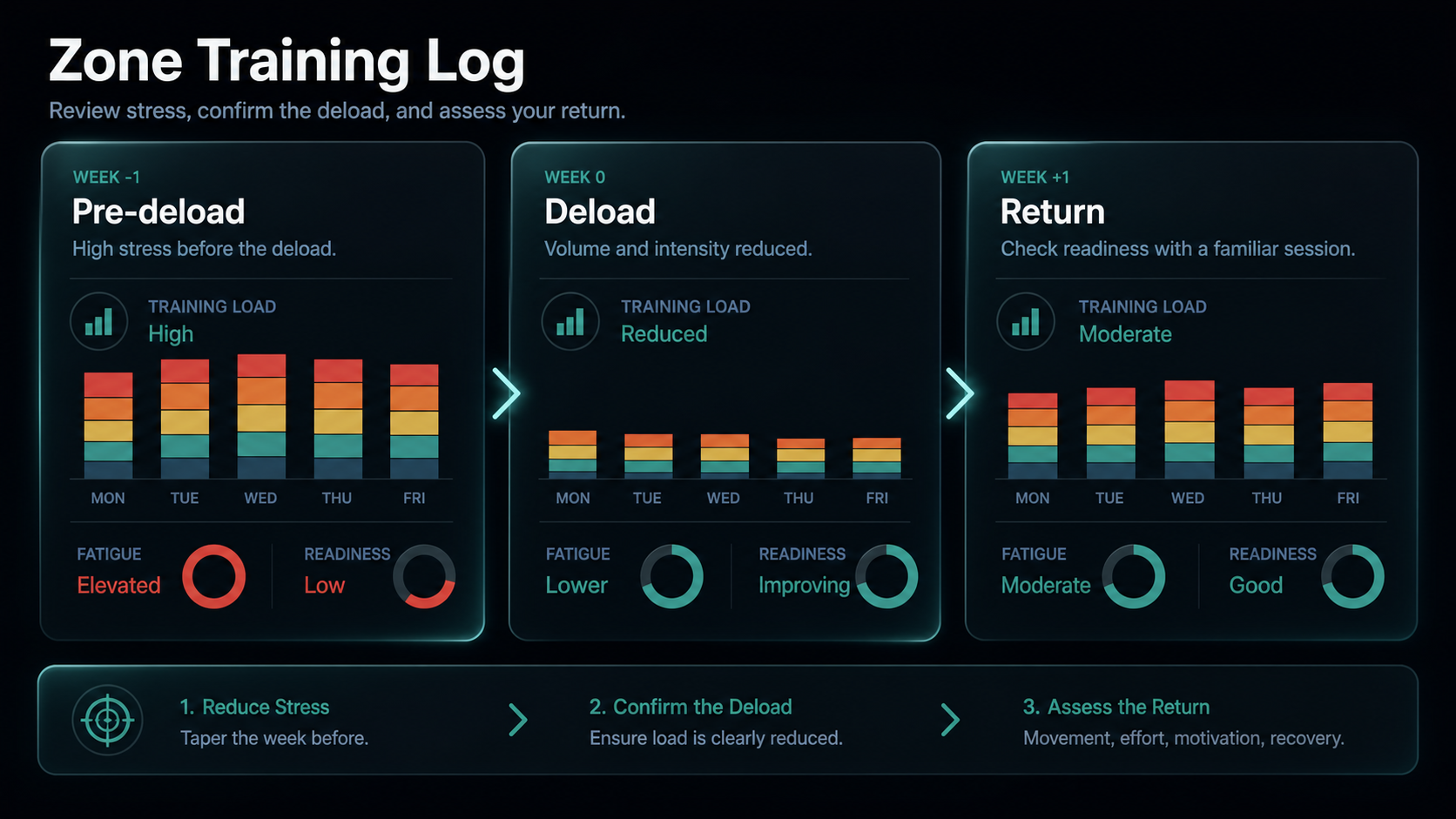
The cleanest review uses three periods:
- Pre-deload: the final hard or normal week before the reduction.
- Deload: the reduced-load week.
- Return: the first week or key sessions after the deload.
Comparing only the pre-deload and deload weeks tells you whether training was reduced. It does not show whether the reduction helped. Comparing the return period adds the outcome.
Use a longer reference when the previous week was unusual. If the pre-deload week contained illness, travel, or a race, compare the deload with the preceding three- or four-week pattern as well.
Step 1: Confirm That Load Actually Decreased
Start with external work:
- total training duration;
- running or cycling distance where appropriate;
- number of sessions;
- long-session duration;
- interval minutes or repetitions;
- strength-training sets and proximity to failure.
Then review internal load:
- session perceived effort;
- average or representative heart rate;
- time in moderate and high zones;
- muscular fatigue;
- recovery time between sessions.
A deload can fail quietly when total duration falls but every remaining session stays hard. It can also become more stressful when an athlete uses extra free time for unrecorded hiking, recreational sport, house projects, or poor sleep.
Do not aim for one universal percentage. The necessary reduction depends on why the deload exists and how fatigued the athlete is. The log should show a clear decrease in the stressor that created the problem.
Step 2: Review Intensity and Frequency Separately
Volume, intensity, and frequency are different levers. Record which one changed.
An endurance deload may retain a small dose of intensity while reducing the amount of work. This can preserve movement quality and the feel of faster training without reproducing the previous week’s fatigue. Evidence from endurance tapering is not identical to deloading, but it consistently shows that reducing volume while retaining some intensity can preserve performance. A 2023 meta-analysis found effective taper strategies commonly reduced volume substantially over no more than 21 days while maintaining intensity and frequency (Wang and colleagues).
That does not mean every recovery week needs intervals. If illness symptoms, injury, or severe fatigue caused the reduction, intensity may be inappropriate. Review the decision against the original purpose.
Step 3: Look for Recovery Across Multiple Signals
Useful recovery signals include:
- lower general fatigue;
- improved sleep quality;
- reduced soreness or irritation;
- restored motivation;
- normal appetite and mood;
- resting heart rate returning toward its personal pattern;
- HRV returning toward its personal pattern;
- easier movement during warm-ups.
Do not require every metric to improve. Subjective and objective measures often disagree. A systematic review found that subjective well-being measures were frequently more sensitive and consistent in reflecting changes in athlete training load than commonly used objective measures (Saw, Main, and Gastin). A simple fatigue, soreness, sleep, stress, and motivation check can therefore be more informative than a single readiness score.
The trend matters more than one morning. A deload may not immediately normalize sleep after travel or resolve an injury that requires specific treatment.
Step 4: Use the First Sessions Back as Information
The first session after a deload should not be a test of toughness. Use a familiar workout or route so comparison is easier.
Look for:
- normal coordination and movement quality;
- expected heart rate at a familiar pace or power;
- lower perceived effort;
- willingness to work without agitation or heaviness;
- normal recovery between repetitions;
- no return of the pain or symptom that prompted the deload.
Feeling unusually energetic can tempt an athlete to add work immediately. Keep the planned session intact. The goal is to observe whether readiness returned, not to spend all of it on the first day.
One mediocre session does not prove the deload failed. Travel, heat, sleep, nutrition, and the unfamiliar feeling of reduced training can affect the return. Look at two or three sessions unless symptoms require a faster decision.
Step 5: Decide What the Next Block Should Change
The review is incomplete until it changes a decision. Choose one of four outcomes.
Resume the plan
Fatigue decreased, motivation and movement improved, and the return sessions look normal. Begin the next block as planned, without compensating for “lost” training.
Resume with a smaller first week
Recovery improved but is incomplete. Start below the previous peak and progress only when easy and key sessions remain stable.
Modify the next block
The same fatigue pattern has appeared repeatedly. Reduce progression rate, separate hard sessions, shorten the long workout, change strength placement, or improve sleep and fueling support.
Extend recovery or seek help
Persistent fatigue, worsening performance, illness symptoms, or pain may require more than a standard deload. Avoid repeatedly prescribing another generic easy week without investigating the cause.
A Deload Review Template
Use this structure in your weekly note.
Purpose
What was the deload meant to change?
Training reduction
- Duration before / during deload:
- Hard minutes before / during deload:
- Long session before / during deload:
- Strength volume before / during deload:
- Additional life or activity stress:
Recovery response
- Fatigue:
- Sleep:
- Soreness or pain:
- Motivation:
- Resting heart rate / HRV trend:
- Illness symptoms:
First sessions back
- Familiar output at similar heart rate:
- Perceived effort:
- Movement quality:
- Recovery after session:
Decision
Resume, resume smaller, modify the next block, or extend recovery.
What a Successful Deload Usually Looks Like
A successful deload does not need to produce a personal best. It usually produces enough improvement that normal training becomes appropriate again.
Typical signs include:
- less heaviness and soreness;
- greater desire to train;
- controlled easy-session heart rate and effort;
- familiar pace or power feeling more available;
- better sleep or daytime energy;
- confidence that the next block can progress.
Some athletes feel flat during a reduction and better only after returning to normal training. Judge the complete three-window pattern rather than the quietest day of the deload.
What an Unsuccessful Deload Can Reveal
If recovery did not improve, ask why.
The reduction was too small
Volume dropped, but hard training, strength effort, or outside activity stayed high.
The deload addressed the wrong stressor
Reducing running volume will not fix severe sleep restriction, inadequate fueling, workplace stress, or an untreated injury.
Fatigue was already too deep
A standard seven-day reduction may be insufficient after illness, an aggressive race block, or prolonged under-recovery.
The return was too aggressive
The deload may have worked, but the first week back immediately reproduced the previous load peak.
Expectations were unrealistic
The purpose was recovery, not instant fitness. Performance may stabilize before it improves.
Do Not Confuse a Deload With a Taper
A taper is designed to express performance for an event. A deload is usually designed to manage fatigue within ongoing training. Their review questions overlap, but the success criteria differ.
For a taper, race or time-trial performance matters. For a deload, the better question is whether the athlete can resume productive training. Do not turn every deload into a mini-peak or every taper into complete rest.
Common Review Mistakes
Looking only at total time
Intensity, strength work, terrain, and outside stress may explain why a shorter week was not easier.
Expecting every wearable metric to turn green
Recovery scores are inputs, not pass/fail tests.
Testing fitness immediately
A maximal effort adds fatigue and can obscure the reason for the deload.
Repeating the old peak week
The return should begin the next progression, not repay a training debt.
Failing to record the original purpose
Without a stated problem, almost any outcome can be rationalized after the fact.
Conclusion
Review a deload across the week before, the deload itself, and the first week back. Confirm that the relevant training stress decreased, combine objective trends with fatigue, sleep, soreness, motivation, and symptoms, and use familiar return sessions as evidence rather than tests.
The final output of the review should be a decision: resume, resume smaller, modify the next block, or extend recovery. A deload earns its place in the training plan when it improves the quality of what comes next.

Our editorial approach & AI disclosure
We use AI to help research, organize, and draft some articles. Every article is reviewed by a human editor and aims to reflect current evidence-based training practices and scientific literature.
Read our editorial policy