

Physiology
Running Economy Explained
Running economy is the energy cost of running at a given pace. This research-grade guide explains how it is measured, why it predicts performance, what changes it, and how runners can improve it.

Introduction
Running economy is the energy cost of running at a given speed. If two runners are moving at the same pace and one uses less oxygen or metabolic energy to hold that pace, that runner is more economical.
That simple definition explains why running economy matters so much. A runner with better economy spends less energy at easy pace, less energy at marathon pace, and less energy near threshold. Better economy does not automatically make someone faster, because performance also depends on VO2 max, threshold, durability, training history, race execution, fueling, and health. But it changes the cost of every mile.
Research on endurance performance has treated running economy as one of the main physiological determinants of distance-running performance for decades. Bassett and Howley described endurance performance as being shaped by maximal oxygen uptake, the fraction of VO2 max that can be sustained, and economy or efficiency (Medicine & Science in Sports & Exercise). Joyner's classic marathon-performance model also combined VO2 max, lactate threshold, and running economy to estimate what an athlete could sustain over the marathon distance (Journal of Applied Physiology).
For runners, the practical takeaway is this: fitness is not only how large your engine is. It is also how much fuel you spend for each pace.
This article explains running economy from first principles. It covers what it measures, how labs test it, why it predicts performance, what changes it, which interventions have the best evidence, what runners can track without a lab, and how to avoid common mistakes when interpreting pace, heart rate, and training data.
Running Economy In One Sentence
Running economy is the metabolic cost of running at a fixed submaximal speed.
"Metabolic cost" usually means oxygen cost, energy cost, or both. "Fixed speed" matters because economy is always tied to a pace. A runner is not simply economical in the abstract. A runner is economical at a given speed, on a given surface, in given footwear, under given conditions.
In the lab, running economy is often expressed as oxygen uptake at a submaximal speed, such as milliliters of oxygen per kilogram of body mass per minute. A more comparable expression is oxygen cost per distance, such as milliliters of oxygen per kilogram per kilometer. Some researchers prefer energy cost, such as kilocalories per kilogram per kilometer or joules per kilogram per meter, because oxygen use alone can be affected by the mix of carbohydrate and fat being oxidized. Fletcher, Esau, and MacIntosh argued that running economy should look beyond oxygen uptake when substrate use differs, because oxygen cost and energy cost are related but not identical (Journal of Applied Physiology).
For everyday runners, the laboratory units matter less than the concept. At the same pace, lower cost is better. If your easy pace requires less oxygen than it used to, or your heart rate and perceived effort are lower on the same route in similar conditions, you may be seeing an improvement in the cost of running.
The word "economy" is useful because it avoids a common misunderstanding. Running economy is not the same as running form. Form can influence economy, but economy is the measured cost of the whole system: muscles, tendons, stride mechanics, body size, footwear, breathing, neuromuscular coordination, fatigue resistance, and the conditions around the run.
What Running Economy Actually Measures
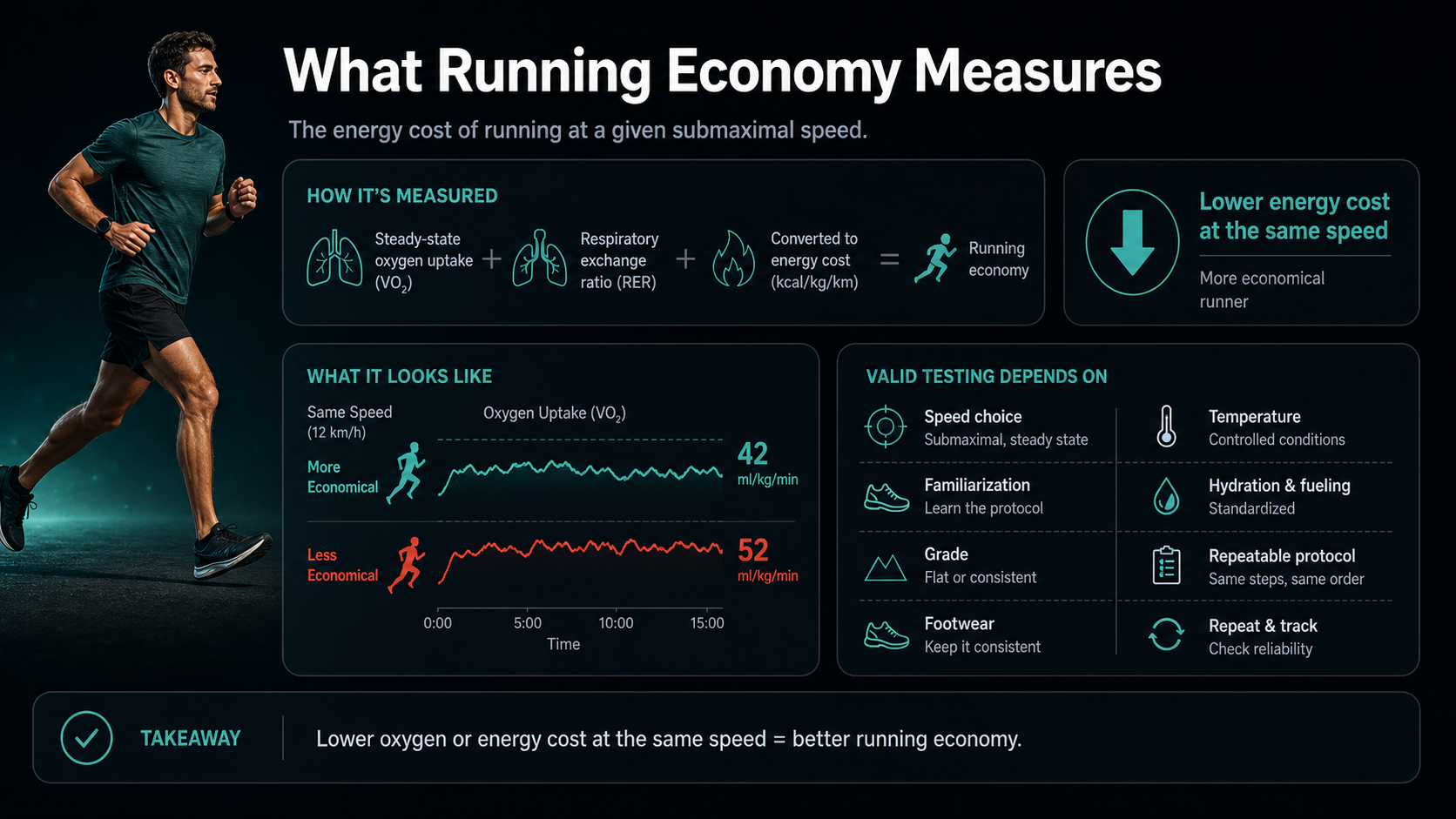
Running economy is measured during submaximal running, not during an all-out test. The runner holds a speed that is below their maximum sustainable intensity, and the lab measures how much oxygen or energy is required to maintain that speed.
Barnes and Kilding's review defines running economy as the steady-state oxygen uptake or energy demand for a given submaximal running velocity, and it emphasizes that measurement methods strongly affect interpretation (Sports Medicine - Open). That last point is important. A running economy number is not meaningful unless you know how it was measured.
In a typical test, the runner uses a treadmill while wearing a metabolic mask. The system measures oxygen uptake and carbon dioxide production. The lab sets a speed, waits for the runner to reach steady state, and records gas-exchange data near the end of the stage. The process may repeat at multiple speeds.
The test sounds simple, but the details matter.
The speed must be submaximal enough to allow steady-state measurement. If the stage is too hard, oxygen uptake may keep drifting upward and no longer represent a stable cost for the speed. The runner should be familiar with treadmill running, because unfamiliar treadmill movement can change mechanics. Footwear, grade, temperature, warmup, stage duration, prior training, caffeine, nutrition, and fatigue should be standardized when the goal is to compare two tests.
Shaw, Ingham, and Folland's work on valid running economy measurement highlights the need for careful protocols when researchers or practitioners want repeatable results (Medicine & Science in Sports & Exercise). In practice, the noisier the protocol, the harder it is to know whether a change in economy is real.
Oxygen Cost Versus Energy Cost
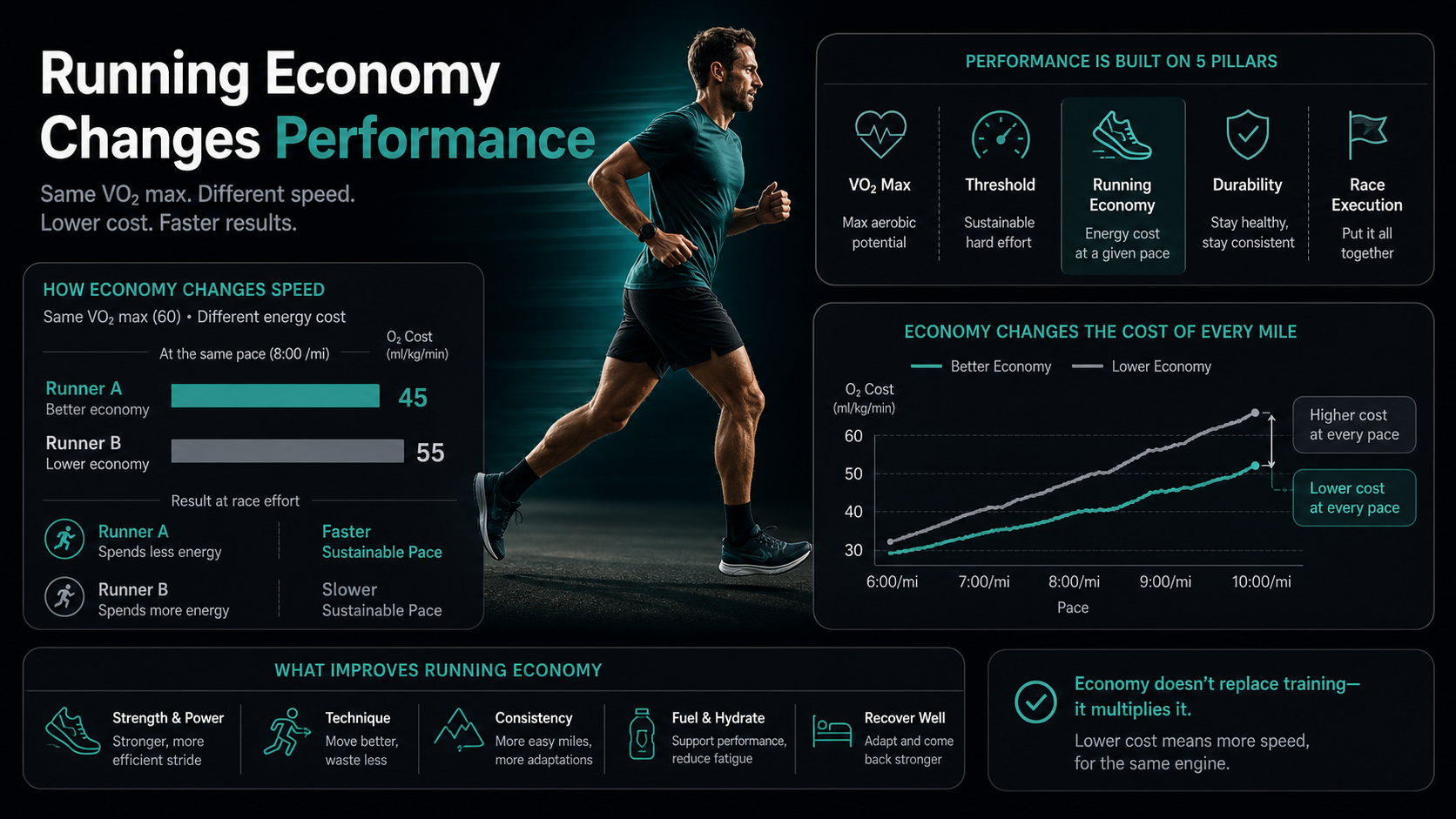
Many runners first encounter running economy as oxygen cost. If Runner A uses 45 ml/kg/min at a given pace and Runner B uses 50 ml/kg/min at that same pace, Runner A appears more economical.
That comparison is useful, but incomplete. Oxygen uptake does not map perfectly to energy expenditure unless you also know the respiratory exchange ratio, or RER. RER gives information about whether the body is relying more on carbohydrate or fat. Because carbohydrate and fat yield slightly different amounts of energy per liter of oxygen, two runners can have the same oxygen uptake but slightly different energy cost.
This is why research papers often distinguish oxygen cost from caloric or energetic cost. Fletcher and colleagues made this point directly: oxygen uptake alone can miss differences in substrate use, so energy cost can be a more precise expression when substrate mix changes (Journal of Applied Physiology).
For practical running, the distinction matters most when interpreting lab reports or comparing studies. If a report gives oxygen cost only, it is still useful. If it gives energy cost too, it may be more complete. If a device claims to estimate running economy without gas exchange, treat the number as a field proxy unless the method has been validated.
Why Running Economy Changes Performance
Distance running performance is not determined by one variable. A high VO2 max gives an athlete a large aerobic ceiling. Threshold determines how much of that ceiling the runner can sustain before fatigue accelerates. Running economy determines the cost of running at any given speed. Durability determines how well those variables hold up late in a long race.
Running economy is powerful because it changes the relationship between speed and physiological strain. If a runner can hold 4:30 per kilometer with less oxygen, less carbohydrate use, lower heart rate, or lower perceived effort, that pace is farther below their sustainable limit. The runner may be able to hold the same pace longer or run faster at the same internal cost.
Conley and Krahenbuhl's early work showed that running economy was related to performance among highly trained runners with similar VO2 max values (Medicine & Science in Sports & Exercise). That idea is still central: when athletes are already well trained, differences in economy can separate runners who look similar by VO2 max alone.
Economy does not override the other determinants. A very economical runner with a low aerobic ceiling may still be slower than a less economical runner with much higher VO2 max and threshold. A runner with good lab economy may still underperform if they fade late, fuel poorly, pace badly, or cannot stay healthy. But when the rest of the physiology is comparable, lower cost is a major advantage.
The Performance Model: VO2 Max, Threshold, Economy, Durability
Running economy is easiest to understand when placed beside the other main performance variables.
VO2 max is the maximum rate at which the body can take in, transport, and use oxygen during intense exercise. It is a ceiling variable. A higher ceiling can support higher speeds, but only if the runner can sustain a high fraction of that ceiling and move efficiently enough to turn oxygen into pace.
Threshold is the intensity a runner can sustain before fatigue-related metabolites and physiological strain accumulate more quickly. Threshold is often described in relation to lactate or ventilatory markers, but the practical meaning is simple: it is the hard effort you can hold for a meaningful duration without rapidly falling apart.
Running economy is the cost side of the equation. If VO2 max is the size of the engine and threshold is the sustainable operating point, economy is how much energy the vehicle spends at a given speed.
Durability is the ability to preserve these qualities over time. A runner may be economical in the first 20 minutes of a test, but a marathon is not run in a fresh laboratory state. Late-race fatigue can change biomechanics, muscle recruitment, stride stiffness, substrate use, and internal strain. A runner whose economy deteriorates less as fatigue accumulates has a meaningful advantage.
This is why a runner's best training plan is rarely "improve economy" in isolation. The plan should build the whole system: aerobic capacity, threshold, low-stress volume, strength, resilience, fueling habits, and race-specific durability.
What Good Running Economy Looks Like
There is no single universal "good" running economy number. Values depend on speed, grade, body size, sex, training status, treadmill protocol, footwear, altitude, temperature, and whether the report uses oxygen cost or energy cost.
Still, there are useful patterns.
At a fixed submaximal speed, more trained runners generally tend to use less oxygen than less trained runners. Elite runners often have unusually low oxygen cost at race-relevant speeds, but not always in the same way. Some elite runners win with exceptional VO2 max. Others have more ordinary VO2 max values but very strong economy and threshold. Some have all three.
Barnes and Kilding reviewed measurement norms and determining factors, but they also made clear that economy is protocol-dependent (Sports Medicine - Open). That is why runners should be cautious when comparing their lab report against a number from a paper, a podcast, or another athlete.
The most useful comparison is often within the same runner. If the same lab uses the same protocol, the same shoes, the same treadmill grade, the same warmup, and a similar readiness state, a lower energy cost at the same speed is meaningful. If your field route is the same, the weather is similar, and your heart rate at a given easy pace drops over months while perceived effort is stable or lower, that may be a practical sign that your running cost has improved.
Running Economy Is Not The Same As Easy Pace
Easy pace and running economy are related, but they are not the same thing.
Easy pace is the speed you can run while keeping the internal load low enough for the purpose of the day. It depends on fitness, fatigue, heat, hills, sleep, nutrition, and stress. Running economy is the energy cost of a speed under defined conditions.
A runner can have good economy and still need to run easy days slowly because they are tired, in heat, or training at high volume. A runner can have poor economy and still run fast for a short time because they have high VO2 max or strong anaerobic contribution. A runner can also appear economical at easy pace but inefficient at faster speeds, because mechanics can change as pace increases.
This is important for heart-rate-zone training. If your heart rate at a familiar Zone 2 pace gradually falls over a training block, that can be a useful field signal. But it is not a pure running economy measurement. It may reflect improved aerobic fitness, better heat tolerance, lower fatigue, different weather, or a change in sensor quality. Field data is valuable, but it should be interpreted as a trend, not a lab conclusion.
Determinants Of Running Economy
Running economy is multi-factorial. Saunders, Pyne, Telford, and Hawley reviewed many of the factors that affect economy in trained distance runners, including metabolic, cardiorespiratory, biomechanical, and neuromuscular contributors (Sports Medicine).
No single factor explains everyone. One runner may improve economy through better stiffness and force production. Another may benefit from more consistent aerobic volume. Another may need footwear that reduces energy cost. Another may simply need to avoid fatigue, because their mechanics degrade when tired.
The following sections break down the main contributors.
Biomechanics And Technique
Technique matters, but not in the simplistic way runners often hear it discussed.
There is no single perfect running form that every runner should copy. Moore's review of economical running technique found that certain biomechanical features are often associated with better economy, but evidence is complex and individual differences matter (Sports Medicine). Features such as excessive vertical oscillation, overstriding, braking forces, ground contact patterns, stride frequency, and stiffness can all influence cost, but changing one variable can create tradeoffs elsewhere.
The most useful principle is to reduce waste without forcing an unnatural pattern.
Overstriding is a good example. If a runner lands far in front of the center of mass and creates a large braking impulse, the body must spend energy overcoming that brake with every step. A modest increase in cadence, shorter stride, or better posture may reduce braking for some runners. But forcing cadence to an arbitrary number can make another runner tense, choppy, and less economical.
Stride length is similar. Experienced runners often self-select a stride length near their economical preference. Large forced changes can increase cost, even when they look more "correct" to an observer. Technique work should therefore be subtle, tested, and tied to the individual runner's response.
Good technique cues are usually simple:
- Run tall without leaning backward.
- Keep the stride relaxed under the body.
- Avoid reaching aggressively with the foot.
- Let cadence respond naturally to pace and terrain.
- Stay smooth when tired instead of forcing stiffness.
The goal is not to look like an elite runner in a freeze frame. The goal is to spend less energy at the same pace.
Muscle-Tendon Stiffness And Elastic Energy
Running is a bouncing gait. With every step, muscles and tendons absorb, store, and release energy. The Achilles tendon, arch, calf complex, quadriceps, hamstrings, glutes, and connective tissues all contribute to how effectively the body behaves like a spring.
Too little stiffness can waste energy because the runner collapses into the ground and must generate more active muscular work. Too much stiffness can also be costly, especially if it creates harsh loading or reduces the ability to adapt to terrain. Economical running often involves an effective balance: enough stiffness to return elastic energy, enough control to keep movement smooth, and enough strength to maintain mechanics under fatigue.
This helps explain why strength and plyometric training can improve economy. They may not raise VO2 max directly, but they can improve force production, tendon behavior, neuromuscular coordination, and the ability to use elastic energy. The runner may then produce the same pace with less metabolic cost.
Strength, Power, And Neuromuscular Coordination
Running economy is not only an aerobic trait. It has a neuromuscular component.
Heavy strength training can improve maximal force capacity. If each running stride requires a smaller percentage of a runner's maximum force, the stride may become easier to produce. Explosive training and plyometrics can improve rate of force development and stiffness characteristics. Short strides, hill sprints, and fast-but-relaxed running can also help a runner practice producing force quickly without turning every session into a hard aerobic workout.
Denadai and colleagues reviewed explosive training and heavy weight training and concluded that both can improve running economy in endurance athletes (Sports Medicine). Balsalobre-Fernandez, Santos-Concejero, and Grivas also reported in a systematic review with meta-analysis that strength training can improve running economy in highly trained runners (Journal of Strength and Conditioning Research).
The practical implication is not that every runner should become a powerlifter. It is that a small amount of well-planned strength and power work can make the running stride less expensive.
For many runners, the useful dose is modest: two strength sessions per week in a general preparation phase, then one or two maintenance sessions when running volume or race specificity increases. Exercises should be selected for competence, progressive overload, and recovery cost. Heavy squats, deadlifts, split squats, step-ups, calf raises, hip hinge patterns, and trunk work can all be useful when coached and progressed appropriately. Plyometrics should start small: pogo hops, skipping, low-level bounds, short hill sprints, or strides before large volumes of high-impact jumping.
Aerobic Training History
Running economy tends to improve with training history. A runner who has spent years building consistent mileage often moves more efficiently than a newer runner at the same relative effort. The improvement is not only cardiovascular. It includes better coordination, tissue tolerance, stride consistency, pacing judgment, and the ability to keep mechanics stable while fatigued.
This is one reason easy mileage matters. Low-intensity volume gives the body many repetitions of relaxed running without the recovery cost of frequent hard sessions. Over time, those repetitions can refine coordination and build tissue capacity. They also support the aerobic system that allows a runner to hold submaximal speeds with less strain.
The key word is progressive. More mileage can help economy, but sudden mileage spikes can increase injury risk, fatigue, and mechanical breakdown. A runner who doubles volume too quickly may see worse field economy because they are tired all the time. The training that improves economy is the training the body can absorb.
Fatigue And Durability
Running economy measured fresh is not the same as running economy late in a long run. Fatigue can increase oxygen cost, change stride mechanics, raise heart rate, and increase perceived effort at the same pace.
For distance runners, durability may be as important as fresh economy. A half marathon, marathon, ultramarathon, or long trail race rewards the runner who can preserve cost late. A runner who looks efficient for 20 minutes in the lab but loses mechanics after 90 minutes may pay a large performance penalty.
This is where training logs become useful. If easy pace looks normal but heart rate drifts upward more than usual, or if a long run ends with a much higher internal cost at the same pace, you may be seeing fatigue rather than a change in true economy. Monitoring both external load and internal load is useful because the same pace and distance can produce different internal responses depending on recovery status. Bourdon and colleagues make that distinction in their consensus statement on training-load monitoring (International Journal of Sports Physiology and Performance).
For practical training, durability improves through consistent volume, long runs, race-specific workouts, fueling practice, strength work, and recovery. It is not built by turning every easy run into a moderate run.
Body Mass And Scaling
Running economy is often normalized to body mass, but that does not make body size irrelevant. Oxygen cost expressed as ml/kg/min or ml/kg/km allows comparison across runners, yet the relationship between body mass and running cost is not perfectly simple.
Carrying unnecessary mass can raise the absolute cost of running. But aggressive weight loss can reduce strength, recovery, hormonal health, immune function, and training quality. A lighter runner is not automatically more economical in the way that matters for performance. A runner who loses muscle, under-fuels, and trains poorly may become lighter and slower.
This topic should be handled carefully. For most runners, the most productive economy interventions are not weight manipulation. They are consistent training, strength work, sleep, fueling, technique refinement, and appropriate footwear. Body composition may matter at the elite level, but it should not become the center of a recreational runner's performance plan unless handled with appropriate professional support.
Footwear And Surface
Shoes can meaningfully change running economy. Shoe mass, midsole compliance, longitudinal bending stiffness, foam resilience, stack height, geometry, and plate design can all affect energy cost.
The modern "super shoe" era made this obvious. Hoogkamer and colleagues compared the energetic cost of running in marathon racing shoes and found that a prototype shoe reduced energy cost by about 4 percent compared with conventional racing shoes in their test conditions (Sports Medicine). That does not mean every runner gets the same benefit from every shoe, but it shows that footwear can change economy enough to matter.
Shoe mass also matters. A heavier shoe generally costs more to swing and lift, though cushioning and geometry can offset or reverse that cost. Surface matters too. A hard, flat road, a soft trail, a treadmill belt, track spikes, grass, mud, sand, and hills all change energy cost. Economy measured on a treadmill in one shoe should not be assumed to transfer perfectly to a rocky trail in another shoe.
For runners, the practical approach is to choose shoes that are comfortable, appropriate for the session, and proven in training. If a shoe makes you faster in a lab but beats up your calves or changes your mechanics in a way you cannot tolerate, the performance benefit may not survive real training.
Environment, Grade, And Wind
Running economy is condition-specific. Grade, wind, temperature, humidity, altitude, surface, and clothing can all change the cost of a pace.
Treadmill testing often uses a small grade to approximate outdoor running cost. Jones and Doust found that a 1 percent treadmill grade more closely reflected the energetic cost of outdoor running than level treadmill running at certain speeds (Journal of Sports Sciences). This is one reason lab protocols specify grade clearly.
Outdoor runners should remember that pace is not the same workload across conditions. A headwind raises cost. Heat raises cardiovascular strain. Hills change muscle recruitment and mechanical work. Technical trails require stabilization and braking. If heart rate is higher at the same pace on a hot, windy, hilly day, that does not necessarily mean your running economy has worsened. The task changed.
This matters when using field data. Compare like with like whenever possible: same route, similar temperature, similar wind, similar shoes, similar fatigue, similar time of day, and similar fueling. The cleaner the comparison, the more confidently you can interpret the trend.
How To Improve Running Economy
Running economy can improve, but the best approach is not one magic drill. It is a layered training process.
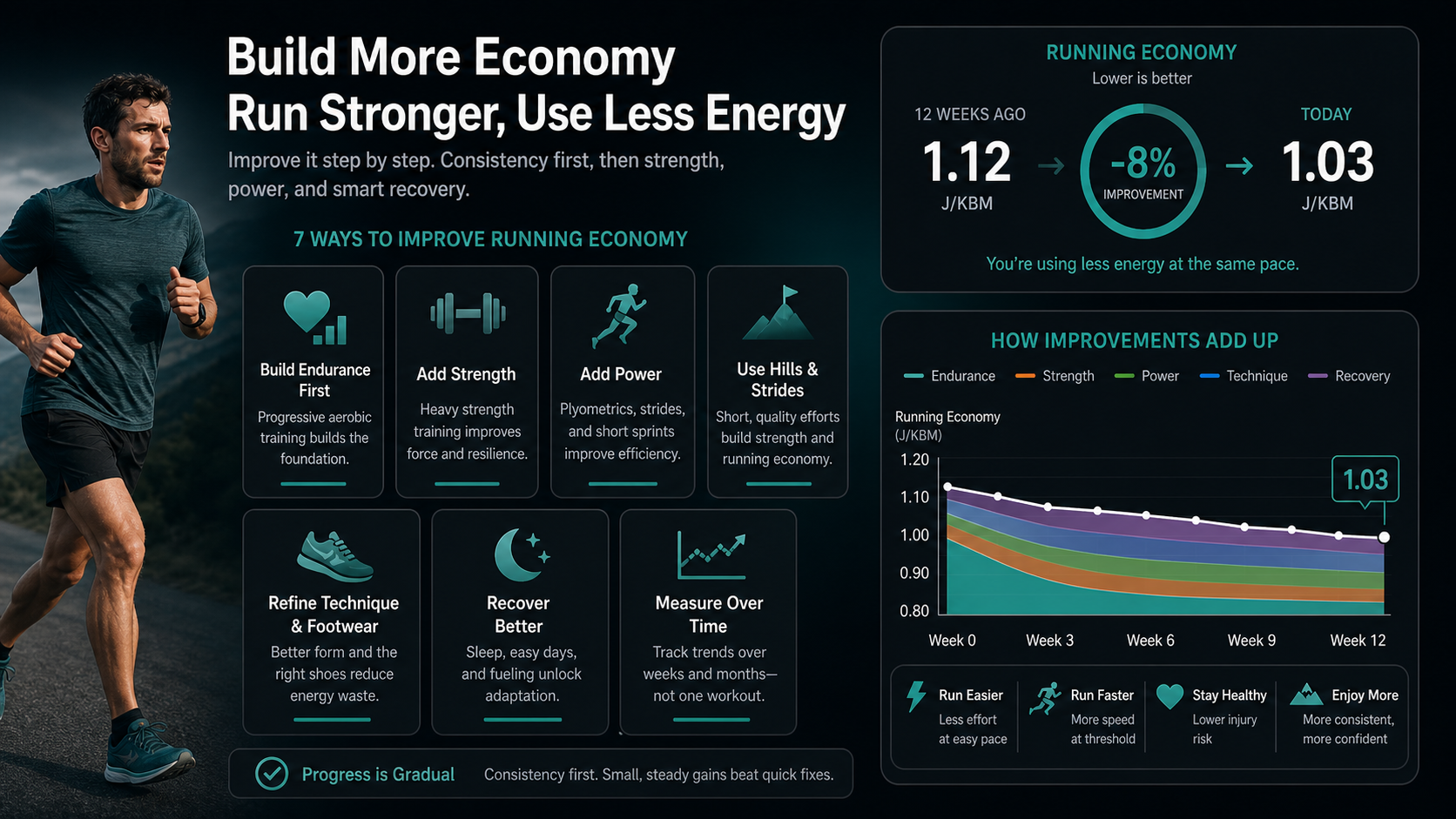
The main evidence-supported categories are progressive endurance training, strength training, explosive or plyometric work, sprint or hill-stride exposure, technique refinement, appropriate footwear, and recovery that lets adaptations happen.
Build The Aerobic Base First
The foundation is consistent running that you can recover from. A runner who trains sporadically, rushes every easy day, and gets hurt repeatedly is unlikely to build durable economy. The body needs repeated exposure to relaxed running.
Easy mileage gives you thousands of low-cost steps. It improves coordination, connective-tissue tolerance, aerobic support, pacing judgment, and mechanical consistency. It also creates the capacity to absorb later strength, hill, tempo, and race-specific work.
This is where heart-rate-zone training is useful. Zone 1 and Zone 2 running can build volume while limiting stress. If every easy run becomes Zone 3, you may still be running, but you are changing the purpose of the session. The week becomes more moderate, recovery decreases, and the next quality session may suffer. Economy improves best when training is consistent enough to accumulate, not when every run is just hard enough to be draining.
Add Heavy Strength Training
Heavy strength training has some of the strongest practical evidence for improving economy, especially when added to endurance training without replacing the running that matters.
The mechanism is likely multi-factorial. Strength work can improve maximal force, tendon stiffness, motor-unit recruitment, rate of force development, and resistance to fatigue. If the stride becomes easier to produce, the runner may spend less energy at a given pace.
The best strength plan is simple and sustainable. A runner does not need bodybuilding volume. Many runners do well with two sessions per week for 8 to 12 weeks, then one or two maintenance sessions. The exercises should be technically sound and progressively loaded.
Examples include:
| Pattern | Examples | Why it may help |
|---|---|---|
| Squat or split squat | Back squat, front squat, split squat | Leg force and control |
| Hip hinge | Deadlift, Romanian deadlift, hip thrust | Posterior-chain strength |
| Calf and ankle | Standing calf raise, seated calf raise, pogo progression | Stiffness and lower-leg capacity |
| Step pattern | Step-up, lunge, rear-foot elevated split squat | Single-leg force and stability |
| Trunk | Carry, side plank, anti-rotation press | Posture and force transfer |
Keep strength work away from your hardest running sessions if it compromises them. Some soreness is normal when starting, but chronic heavy legs are a sign the dose is too high.
Use Plyometrics And Explosive Work Carefully
Plyometrics can improve economy by training the spring-like qualities of the lower body. Spurrs, Murphy, and Watsford found that plyometric training improved running economy and distance-running performance measures in trained runners (European Journal of Applied Physiology). Paavolainen and colleagues also reported that explosive-strength training improved 5 km performance, with running economy and neuromuscular changes part of the explanation (Journal of Applied Physiology).
That does not mean runners should jump aggressively on day one. Plyometric work is potent because it creates high tendon and muscle loading. Start with small doses:
- 4 to 6 relaxed strides after easy runs.
- Short hill sprints of 8 to 12 seconds with full recovery.
- Low-level pogo hops.
- Skips and bounds only after basic tolerance is established.
- More advanced jumps only when strength, landing control, and tissue capacity are ready.
The goal is crisp quality, not exhaustion. If plyometrics leave you sore enough to alter easy runs, the dose is too high.
Refine Technique Without Forcing A New Identity
Technique can improve economy, but forced form overhauls often backfire. The safest path is to make small changes, test them, and keep what actually reduces cost or discomfort.
Useful technique changes often focus on reducing obvious waste:
- Avoid excessive overstriding.
- Keep the foot strike closer to under the body.
- Run tall without leaning back.
- Reduce side-to-side crossover if it creates instability.
- Let cadence rise naturally at faster paces.
- Relax shoulders, hands, and face.
- Keep arms compact without becoming rigid.
Do not chase one universal cadence. Do not assume forefoot striking is always more economical. Do not copy a professional runner's form without considering their anatomy, speed, training history, and footwear.
The better question is: does this cue help you run the same pace with lower cost, smoother breathing, and less strain over time?
Use Hills, Strides, And Race-Specific Running
Short hill sprints and strides can improve economy by adding neuromuscular quality without the metabolic cost of long hard intervals. They teach the body to produce force quickly, coordinate at faster speeds, and keep mechanics sharp.
These sessions should not become hidden workouts. A useful stride session might be 6 to 8 repetitions of 15 to 20 seconds fast but relaxed, with full recovery. A hill sprint session might be 4 to 8 repetitions of 8 to 12 seconds on a moderate hill, again with full recovery. If you are gasping, grinding, or accumulating lactate, you have changed the stimulus.
Race-specific running also matters. Economy at easy pace is not always the same as economy at marathon pace, 10 km pace, or trail-race effort. A marathon runner needs enough practice at marathon rhythm to make that pace mechanically and metabolically familiar. A 5 km runner needs controlled exposure to faster mechanics. A trail runner needs economy on uneven ground, not only on a treadmill.
Choose Footwear Intelligently
Footwear can improve or impair economy, but the effect is individual. Some runners respond strongly to highly resilient foams and plated geometry. Others respond modestly. Some feel faster but recover worse if the shoe shifts load to tissues they have not prepared.
Use training to test shoes, not just marketing claims. Compare similar workouts on similar routes. Notice heart rate, perceived effort, soreness, and how the shoe feels late in the run. Racing shoes may be best saved for workouts and races, while daily trainers may be better for volume and tissue resilience.
Do not assume the lightest shoe is always best. Do not assume the tallest shoe is always best. The economical shoe is the one that lets you run faster or easier without creating a recovery cost that ruins the rest of training.
Recover Enough To Adapt
Running economy improves from training only when the body adapts. Sleep, fueling, protein intake, carbohydrate availability, easy days, and rest are not separate from economy. They influence whether strength work creates neuromuscular adaptation, whether easy volume is absorbed, and whether mechanics stay stable under fatigue.
Under-fueled runners may see short-term weight loss but worse training quality, poor recovery, and higher injury risk. Sleep-restricted runners may struggle to coordinate and absorb load. Runners who stack hard sessions too close together may interpret fatigue as poor economy when the actual issue is insufficient recovery.
If you want better economy, protect the training that creates it.
What Not To Do
Do not try to improve running economy by forcing every run faster. That may improve tolerance for moderate effort, but it can also reduce recovery and flatten the quality of workouts.
Do not make large form changes all at once. A dramatic switch in foot strike, cadence, posture, or shoe type can move load to tissues that are not prepared. Even if the new form looks cleaner, it may be less economical or more injury-prone for that runner.
Do not judge economy from one run. Heart rate, temperature, wind, hills, caffeine, sleep, sensor quality, and stress can all change the apparent cost of a pace.
Do not interpret lower heart rate at pace as automatically better economy. It may be improved aerobic fitness, cooler weather, lower fatigue, different shoes, lower stress, or a device difference. It is a useful field signal, not a lab measurement.
Do not chase weight loss as the primary economy strategy. Body mass matters, but under-fueling can destroy the training process that improves performance.
Do not add strength, plyometrics, hills, and extra mileage all at once. If the goal is adaptation, the plan has to be recoverable.
How To Measure Running Economy Without A Lab
You cannot truly measure running economy without measuring metabolic cost. A watch cannot directly tell you oxygen cost. A heart-rate chart cannot separate economy from aerobic fitness, heat adaptation, fatigue, and sensor behavior. But field tracking can still help.
The best field proxy is a repeatable submaximal run.
Choose a route that is flat or consistently rolling. Use the same shoes if possible. Run at the same time of day. Avoid comparing windy days with calm days or hot days with cool days. Warm up the same way. Run a fixed pace and observe heart rate and perceived effort, or run at a fixed easy heart-rate cap and observe pace. Repeat every few weeks, not every day.
A useful field test might look like this:
- Warm up for 10 to 15 minutes.
- Run 20 to 30 minutes on a familiar route at a fixed easy pace.
- Record average heart rate for the stable middle portion.
- Note temperature, wind, shoes, sleep, soreness, and perceived effort.
- Repeat under similar conditions.
If the same pace gradually requires lower heart rate and feels easier, you may be improving the cost of that pace. If the same heart rate supports a faster pace under similar conditions, that is also useful. But do not call the trend "running economy" too confidently unless conditions and internal state are controlled.
For heart-rate-zone users, the most practical marker is pace at a controlled Zone 2 effort on a familiar route. If your Zone 2 pace improves over months while perceived effort stays easy and training is consistent, that is a strong field sign that your aerobic system and movement cost are improving together.
How Zone Training Log Helps You Track Economy Signals
Zone Training Log does not replace a metabolic cart. It does something more practical for daily training: it helps you connect pace, heart rate zones, time, notes, and weekly patterns.
For running economy, the useful workflow is to create repeatable comparisons.
Tag a familiar route as an easy benchmark. Add notes about shoes, terrain, weather, fatigue, and whether the run felt smooth. Review average heart rate, zone distribution, pace, and drift. Look at the stable middle of the run rather than the first few minutes or every stoplight.
Over time, look for three patterns:
- Same pace, lower heart-rate cost.
- Same heart-rate zone, faster pace.
- Same long-run pace, less late drift.
None of those proves a lab-level improvement in running economy. But they are meaningful training signals. They tell you that the cost of running in real life is changing in the direction you want.
The weekly view also helps prevent a common mistake. Runners trying to improve economy often add strength, strides, hills, and faster running while accidentally turning easy days into Zone 3. The result is more fatigue, not better economy. Reviewing zone distribution keeps the easy work easy enough to absorb the neuromuscular work that improves economy.
A Practical 12-Week Economy Block
A running economy block should improve the cost of running without disrupting the training foundation. The exact plan depends on the runner, but a conservative structure can look like this.
Weeks 1 to 4 should focus on consistency and strength technique. Keep most running easy. Add two short strength sessions per week. Include relaxed strides once or twice per week after easy runs. Do not add hard plyometrics yet if you are not prepared for them.
Weeks 5 to 8 can add heavier strength and small explosive doses. Keep the strength exercises simple and progress load gradually. Add short hill sprints or low-level plyometrics once per week if tissues are tolerating the work. Keep easy runs genuinely easy.
Weeks 9 to 12 should make the work more specific. Maintain strength with slightly lower volume. Keep strides or hill sprints. Add race-specific running if you are preparing for an event: marathon rhythm for marathoners, controlled tempo for longer road races, or faster mechanics for 5 km and 10 km runners.
A sample week for a runner already comfortable with five runs per week might look like this:
| Day | Session | Economy purpose |
|---|---|---|
| Monday | Easy run + light strength | Low-stress volume and tissue capacity |
| Tuesday | Quality run or tempo | Race-specific rhythm |
| Wednesday | Easy run | Aerobic support and recovery |
| Thursday | Strength + short strides | Force production and coordination |
| Friday | Rest or very easy run | Absorb training |
| Saturday | Long easy run | Durability and fatigue resistance |
| Sunday | Easy run with relaxed strides | Mechanics without major fatigue |
The most important rule is sequencing. Add one new stressor at a time. If you increase mileage, add heavy lifting, introduce plyometrics, and change shoes in the same two weeks, you will not know what helped or what caused soreness.
How Long Does It Take To Improve Running Economy?
Running economy changes slowly enough that patience matters, but quickly enough that training choices can make a difference within a season.
Strength and plyometric interventions in studies often run for 6 to 12 weeks. Endurance training history accumulates over months and years. Footwear can change measured cost immediately, but the performance value depends on adaptation, tolerance, and race context. Technique changes may help quickly if they remove obvious waste, or they may take weeks to feel natural.
The best expectation is staged:
- Days to weeks: footwear or fatigue changes can alter apparent cost.
- 6 to 12 weeks: strength, plyometric, and stride work may show measurable changes.
- Months: consistent aerobic training and durability become more visible.
- Years: long-term training history shapes coordination and resilience.
Be careful when interpreting rapid improvement. If heart rate is lower this week, it may be cooler weather or better recovery. If pace improves suddenly in new shoes, it may be footwear economy rather than fitness. If a lab report improves after familiarization, part of the change may be better treadmill comfort.
The more important question is whether the improvement survives normal training and racing.
Running Economy For Beginners
Beginners should not obsess over economy numbers. The biggest gains usually come from consistency, injury prevention, basic aerobic development, and learning to run at the right effort.
For a newer runner, running economy often improves simply because running becomes more familiar. Coordination improves. Unnecessary tension drops. Pacing becomes smoother. Tendons and muscles adapt gradually. Easy running becomes less costly because the body has practiced the movement.
The best beginner economy plan is not complicated:
- Run consistently at manageable volume.
- Keep most runs easy enough to recover.
- Add gentle strides only when basic volume feels stable.
- Build simple strength for calves, hips, quads, hamstrings, and trunk.
- Avoid sudden shoe, form, or mileage changes.
Beginners often make the mistake of turning every run into a test. That slows adaptation. Economy is built through repeatable running, not constant proof of fitness.
Running Economy For Experienced Runners
Experienced runners often need a more targeted approach because easy consistency is already present. The useful question becomes: where is the waste?
If the runner lacks strength, heavy resistance training may help. If the runner is strong but flat, explosive work, hill sprints, or strides may help. If the runner overstrides, small technique cues may help. If the runner fades late, long-run durability and fueling may help. If the runner has never tested footwear, shoes may be a meaningful variable. If the runner is always tired, recovery may be the limiting factor.
Experienced runners should also think about pace specificity. Economy at 5 km pace, marathon pace, and easy pace may not respond the same way. A marathoner needs efficient mechanics at marathon rhythm after substantial fatigue. A 1500 m runner needs efficient mechanics at much faster speeds. A trail runner needs economical climbing, descending, and technical movement.
For experienced runners, economy work should support the event, not become a separate hobby.
Common Questions About Running Economy
Is Running Economy Genetic?
Genetics likely influence running economy through body dimensions, tendon properties, muscle fiber characteristics, limb proportions, and responsiveness to training. But economy is also trainable. Training history, strength, technique, footwear, and recovery all matter. A runner cannot choose their anatomy, but they can improve the way the system functions.
Does Better Form Always Mean Better Economy?
No. Better-looking form is not always more economical. Some technique patterns that look smooth may cost more for a particular runner. Some elite runners have unusual-looking mechanics but excellent economy. The standard should be cost, comfort, durability, and performance, not visual conformity.
Does Cadence Improve Running Economy?
Sometimes. A small cadence increase can help an overstriding runner reduce braking and feel smoother. But a forced cadence target can increase cost if it makes the runner tense or shortens the stride excessively. Cadence should be adjusted carefully and tested against effort, heart rate, comfort, and performance.
Can Heart Rate Measure Running Economy?
Heart rate cannot directly measure running economy. It can provide a field signal. If pace is the same, conditions are similar, and heart rate is lower, the cost of running may be lower. But heart rate is influenced by heat, fatigue, hydration, caffeine, stress, altitude, and sensor quality. Use it as a trend, not a lab value.
Are Super Shoes Just Better Economy?
Their main measured benefit is often lower energetic cost at a given speed, but performance depends on the athlete, shoe model, race distance, biomechanics, course, and tolerance. A shoe that improves lab economy for one runner may not feel stable or sustainable for another.
Can You Improve Economy While Training For A Race?
Yes, but the dose matters. Strength maintenance, strides, hill sprints, and race-specific rhythm can support economy during a race build. The mistake is adding too much new stress when race workouts and long runs are already demanding.
How To Interpret A Running Economy Test
If you get a lab test, ask for the protocol before focusing on the number.
Useful questions include:
- What speeds were used?
- Was the runner at steady state?
- Was treadmill grade standardized?
- Were shoes standardized?
- Was energy cost calculated or only oxygen cost?
- Was RER reported?
- Was the runner familiar with treadmill running?
- How reliable is the lab's repeat testing?
- Were conditions similar to prior tests?
A single number without protocol context is easy to overinterpret. A repeated test under the same conditions is more useful. The best lab reports explain not only whether economy changed, but whether the change is larger than normal measurement error.
If your economy worsened slightly but you tested after a hard training block, in different shoes, on poor sleep, or at a different speed, the result may not mean much. If your economy improved at multiple speeds under matched conditions and your field training also feels better, the finding is stronger.
The Biggest Mistakes Runners Make
The first mistake is treating economy as a form contest. Running economy is not awarded to the runner with the prettiest stride. It is measured by energy cost.
The second mistake is separating economy from recovery. Strength, plyometrics, and hills can help, but only if the runner absorbs them. Economy work that creates constant soreness can make the cost of normal running worse.
The third mistake is comparing numbers across labs, protocols, speeds, or shoes. Running economy values are not interchangeable unless the method is comparable.
The fourth mistake is using pace alone. If your pace improves because every run has become harder, you have not necessarily improved economy. You may have changed intensity.
The fifth mistake is ignoring durability. A fresh economy test is useful, but racing rewards the runner who stays economical when tired.
The sixth mistake is expecting one intervention to solve everything. The best results usually come from stacking small advantages: more consistent easy running, better strength, sharper strides, less wasted motion, better shoes, and better recovery.
Related Running Economy Guides
- Use strength work and strides to improve economy
- Compare base training with build training
- Understand how VO2 max, lactate threshold, and economy fit together
- Explore the Physiology guide hub
Conclusion
Running economy is the energy cost of running at a given speed. Better economy means you spend less oxygen or energy at the same pace. That can make easy running easier, threshold pace more sustainable, and race pace less expensive.
The research is clear on the broad idea: economy is one of the major determinants of distance-running performance, especially when runners have similar VO2 max and threshold. The details are more nuanced. Economy depends on protocol, speed, grade, footwear, biomechanics, strength, tendon behavior, training history, fatigue, and environment.
The best way to improve it is not a shortcut. Build consistent aerobic volume. Keep easy days easy enough to absorb. Add strength and power work gradually. Use strides and hills as high-quality neuromuscular touches. Refine technique without forcing dramatic changes. Choose footwear that works for your body and your event. Recover enough to adapt.
If you have access to lab testing, use repeatable protocols and interpret the numbers carefully. If you do not, use field trends: heart rate at a familiar pace, pace at a familiar zone, late-run drift, perceived effort, and notes about conditions. Zone Training Log can help you keep those signals organized.
Running economy is not just about looking efficient. It is about making each mile cost less.
Improve Economy Without Making Every Run Hard
Running economy usually improves through a training system, not one magic drill. Preserve easy aerobic volume, add targeted work gradually, and judge changes across repeatable conditions.
- Strength training: Heavy and explosive strength methods can improve economy in trained endurance athletes when they complement rather than displace key running (Berryman and colleagues).
- Relaxed strides: Short, fast-but-controlled accelerations can maintain coordination and speed exposure with much less fatigue than a full interval session. Stop before mechanics tighten.
- Hills: Short uphill efforts can develop force and posture, but they still count as intensity and need recovery.
- Specific running: Cycling and general fitness help aerobic capacity, but running economy remains movement-specific. Consistent running at appropriate volume matters.
- Recovery: Strength, strides, and hills do not improve economy when they repeatedly compromise long runs, workouts, or sleep.
Track economy indirectly on a familiar flat route or treadmill: pace at a similar heart rate and perceived effort, conditions, shoe choice, and fatigue. A single faster day is not proof. Look for a stable change across several weeks.

Our editorial approach & AI disclosure
We use AI to help research, organize, and draft some articles. Every article is reviewed by a human editor and aims to reflect current evidence-based training practices and scientific literature.
Read our editorial policy