
How Do You Know If You Are Under-Recovered?
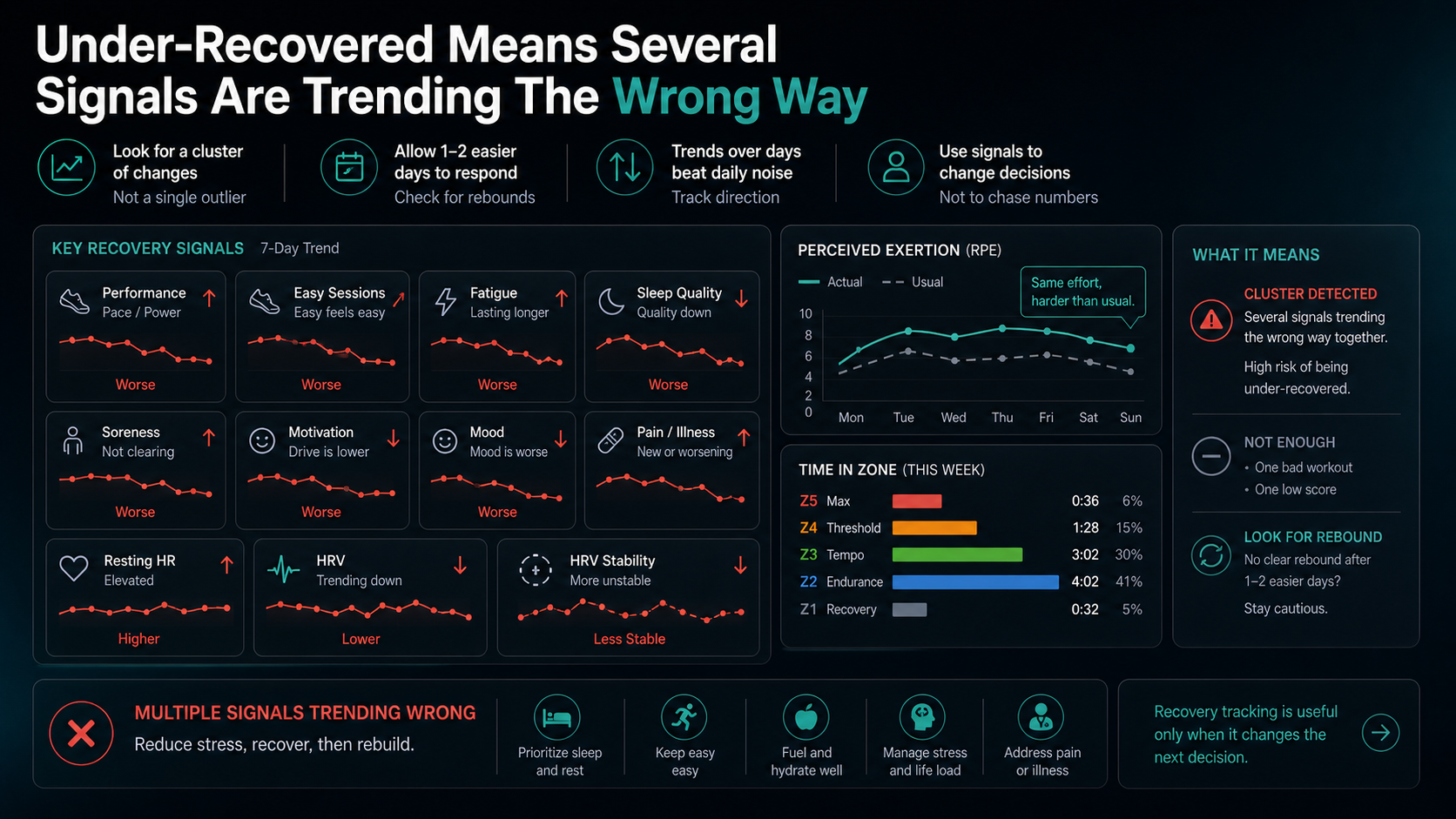
You are likely under-recovered when performance, effort, sleep, mood, soreness, HRV, resting heart rate, and pain signals trend worse together and do not rebound after easier days.
Jun 24, 202613 min read
Introduction
You know you may be under-recovered when normal training no longer produces a normal response. Your usual easy pace feels harder, your legs stay heavy, sleep gets worse, motivation drops, soreness does not clear, resting heart rate is higher than usual, HRV trends down or becomes unstable, and small pains or illness symptoms start to appear.
The key word is "cluster." One bad workout does not prove under-recovery. One poor night of sleep does not prove under-recovery. One low readiness score does not prove under-recovery. A stronger warning sign is several signals moving in the wrong direction at the same time, especially when they do not rebound after one or two easier days.
That is why under-recovery is best treated as a pattern, not a diagnosis from a single metric. The 2018 Recovery and Performance in Sport consensus statement emphasizes that recovery depends on the balance between stress, restoration, and the athlete's individual context. For endurance athletes, that context includes training load, sleep, fueling, illness, work stress, travel, heat, racing, and pain.
This article gives you a practical way to recognize under-recovery without overreacting to normal fatigue. It explains the clearest signs, how to interpret subjective and objective metrics, and what to do when the pattern points toward too much stress and not enough recovery.
The Short Answer: Under-Recovered Means Several Signals Are Trending The Wrong Way
You are probably under-recovered when several normal signals change together:
- Your usual pace or power feels harder than normal.
- Easy sessions stop feeling easy.
- Fatigue lasts longer than it usually does.
- Sleep duration or sleep quality drops.
- Soreness does not clear between sessions.
- Motivation, mood, or patience is worse than usual.
- Resting heart rate is elevated compared with your baseline.
- HRV trends down or becomes unusually unstable.
- Pain, illness symptoms, or heavy legs keep showing up.
The most useful test is not whether one signal is red today. It is whether your body rebounds when stress is reduced. If you take one or two easier days, sleep and fuel well, and the signs improve, you were likely carrying short-term fatigue. If the signs keep worsening or performance continues to fall, the under-recovery signal is stronger.
Research supports this mixed-signal approach. In a systematic review, Saw, Main, and Gastin reported that subjective self-reported measures such as mood, stress, fatigue, soreness, and sleep often reflected acute and chronic training loads with better sensitivity and consistency than commonly used objective measures (British Journal of Sports Medicine, 2016). That does not mean you should ignore HRV, resting heart rate, pace, power, or sleep data. It means your feelings are part of the data.
The practical rule is simple: take subjective signals seriously, use device metrics as context, and look for a pattern over several days.
Under-Recovered Is Not The Same As Tired
Endurance training is supposed to create fatigue. A long ride, threshold session, race, hill workout, strength session, or big weekend can leave you tired. That is not automatically a problem. Fatigue is part of the adaptation process.
Under-recovery is different. It means fatigue is accumulating faster than you are absorbing it. The training plan may still look reasonable on paper, but your response says the dose is too high for your current recovery capacity.
The distinction matters because athletes often make two opposite mistakes. Some panic at normal training fatigue and remove every productive stressor. Others ignore clear warning signs because the plan says they should be able to handle the work.
The overtraining consensus statement from the European College of Sport Science and the American College of Sports Medicine separates short-term performance decrement, functional overreaching, nonfunctional overreaching, and overtraining syndrome (Meeusen et al., 2013). In plain language, hard training can temporarily reduce performance and still be productive if recovery follows. The concern rises when performance and well-being stay impaired longer than expected, especially without a clear rebound.
Most everyday endurance athletes are not diagnosing overtraining syndrome. They are trying to catch the earlier point where training stress is exceeding recovery. That is a much more useful target. If you notice the trend early, the correction may be small: reduce intensity, hold volume, sleep more, fuel better, or separate hard days. If you ignore the trend, the correction often gets larger.
The Clearest Sign Is Performance Plus Effort
The most important under-recovery sign is a mismatch between performance and perceived effort.
If your usual easy run pace suddenly feels moderate, that is information. If your normal Zone 2 ride requires unusual focus to keep power steady, that is information. If a threshold workout that normally feels controlled becomes a survival effort, that is information. If the same pace, power, or heart rate costs more mentally and physically than usual, your body is telling you the load is not landing normally.
Session RPE, or rating of perceived exertion for the whole workout, is useful here because it captures the athlete's internal response to a session. Halson's review on monitoring training load to understand fatigue highlights that fatigue monitoring should consider both training load and the athlete's response, because fatigue can come from training, sleep, nutrition, travel, illness, psychological stress, and environmental demands.
The pattern matters more than a single day. A bad session after poor sleep may be easy to explain. A bad session after a race may be expected. A bad session in hot weather may reflect heat stress, not a deeper recovery problem. But if several normal workouts in a row feel too hard, and you cannot explain it by heat, terrain, fueling, or measurement error, pay attention.
Look for these combinations:
- Same pace, higher RPE.
- Same power, higher heart rate.
- Same heart rate, lower pace or power.
- Easy days that feel mentally draining.
- Hard sessions that fail earlier than usual.
- Long sessions that create an unusually long recovery cost.
Performance alone can mislead you. Effort alone can mislead you. Together, they are much stronger.
Subjective Signs Often Show Up First
Subjective signs are not soft data. They are the way your brain and body report the total stress load.
Fatigue is the obvious one. Under-recovery often feels like a tiredness that does not match the session you just did. It may show up as heavy legs, low drive, poor concentration, or an unusual reluctance to start training. Many athletes can push through one day of this. The warning sign is when it becomes the default.
Sleep is another major signal. Poor sleep can both contribute to under-recovery and reflect it. Fullagar and colleagues reviewed evidence that sleep loss can affect exercise performance and physiological or cognitive responses to exercise (Sports Medicine, 2015). If training stress is high and sleep gets shorter, lighter, or more fragmented, recovery capacity is shrinking at the same time stress is rising.
Mood and motivation matter too. Under-recovered athletes often describe irritability, low patience, flat mood, reduced confidence, or a sense that training is becoming a chore. That does not mean every low-motivation day is a crisis. It means mood becomes more meaningful when it changes with fatigue, poor sleep, declining performance, and persistent soreness.
Soreness needs context. Normal delayed soreness after hills, strength work, or racing is expected. Under-recovery is more likely when soreness does not clear, spreads across multiple areas, or changes mechanics. Pain is different from soreness. A new pain that changes your stride, pedal stroke, or willingness to load a limb should override any green readiness score.
Illness symptoms are also relevant. Repeated sore throats, unusual congestion, swollen glands, chills, or feeling feverish are not training badges. They are signs to reduce stress and assess whether you should train at all.
Objective Metrics Can Help, But They Need Baselines
Objective metrics are useful when they are measured consistently and interpreted against your own baseline.
Resting heart rate is one of the simplest. A higher-than-normal resting heart rate can reflect fatigue, dehydration, heat stress, illness, alcohol, poor sleep, caffeine, travel, or psychological stress. It is not specific enough to diagnose under-recovery by itself, but it becomes useful when it rises alongside worse sleep, higher RPE, low mood, and declining performance.
HRV, or heart rate variability, is another common recovery marker. Plews and colleagues described HRV as a tool that can help monitor endurance training adaptation when interpreted carefully and individually (Sports Medicine, 2013). Buchheit's review on heart-rate measures and training status also makes the larger point: HR-based measures can be informative, but different roads do not always lead to the same conclusion.
For practical use, HRV should be a trend, not a command. Measure it at the same time, in the same position, with the same device. Look for rolling changes. A single low HRV reading after a poor night of sleep may not matter much. A multi-day HRV drop, unstable HRV, elevated resting heart rate, poor mood, and harder-than-usual easy sessions is more meaningful.
Workout data can also show under-recovery. Watch for unusual heart rate drift, lower power at normal heart rate, slower pace at normal effort, or a need to cut sessions short repeatedly. But avoid interpreting these metrics without context. Heat, dehydration, altitude, terrain, wind, poor fueling, sensor error, and caffeine can all distort the signal.
The best use of objective metrics is confirmation. If your body says something is off and your metrics agree, act sooner. If the metrics are noisy but you feel fine and perform normally, do not let one number control the plan.
How To Check Whether You Are Actually Under-Recovered
Use a short recovery audit before making a big decision. This is not a medical diagnosis. It is a practical training check.
First, compare the last 7 to 14 days with your normal baseline. Did volume rise? Did intensity crowd together? Did your long session get longer? Did you race? Did strength work change? Did heat, travel, altitude, poor fueling, or life stress increase? A training week that looks normal in hours may still be harder than normal in total stress.
Second, score your daily recovery signals. Use 1 to 5 ratings for sleep quality, fatigue, soreness, mood, motivation, and stress. Add resting heart rate and HRV if you measure them consistently. Add pain or illness as separate yes/no fields.
Third, review workout response. Were easy sessions easy? Were hard sessions close to normal? Did you need more recovery after normal workouts? Was session RPE higher than expected?
Fourth, look for the rebound. Reduce stress for one to three days. Remove intensity, keep movement easy, sleep more if possible, fuel well, hydrate, and address pain or illness. If the signs improve quickly, you were probably carrying short-term fatigue. If they do not improve, treat the situation more seriously.
This rebound test is useful because endurance athletes often need permission to do less before the body forces the issue. You are not losing fitness by taking a short correction. You are testing whether the system can recover.
What Under-Recovery Looks Like Across A Real Week
Under-recovery is often easier to see in a weekly pattern than in a single workout.
Imagine a runner who completes a hard interval session on Tuesday, an easy run on Wednesday, a strength session on Thursday, and a long run on Saturday. None of those sessions is extreme by itself. The problem appears in the response. Wednesday's easy run feels oddly labored. Thursday's strength work leaves soreness that does not clear. Saturday's long run starts at a normal pace but requires more effort than usual after 40 minutes. Sleep is lighter, motivation is lower, and resting heart rate is higher than normal for several mornings.
That week does not prove anything from one datapoint. It does show a pattern: the body is not absorbing the sequence as expected. The right adjustment may be to reduce the next hard session, keep the next two days easy, or hold weekly volume instead of adding more.
Now imagine a cyclist with the same total weekly hours as usual, but a different distribution. Tuesday has threshold intervals, Wednesday includes a group ride that turns into tempo, Friday has VO2 max work, and Sunday has a long ride with climbs. The total duration may look normal. The recovery cost may not be normal because intensity is crowded into the week. A 2017 training-load consensus statement notes that athlete monitoring is meant to connect training load, competition, fatigue, adaptation, and health risk, not simply count training volume.
This is why "I did not train that much" can be misleading. Under-recovery can come from too many hard days, too little spacing, poor fueling, heat, travel, illness, work stress, or sleep loss. It can also come from a return-to-training week that looks modest but follows illness, injury, or a stressful life period.
When reviewing a week, ask three questions:
- Was the load higher than it looked?
- Was the spacing between hard sessions too tight?
- Did my recovery response match the plan?
If the load was reasonable and recovery was stable, keep going. If the load looked reasonable but your response was poor, repeat or reduce before progressing. The training plan does not get the final vote. Your response does.
What To Do If The Signs Point To Under-Recovery
If the signs point to under-recovery, the first move is not always a full week off. The first move is to reduce training stress enough to see whether your body rebounds.
For one to three days, remove intensity, shorten volume, keep sessions easy, prioritize sleep, fuel properly, hydrate, and address pain or illness symptoms. If the trend improves, rebuild gradually. If performance, mood, sleep, pain, or illness symptoms keep worsening, stop pushing the plan and consider medical or coaching support.
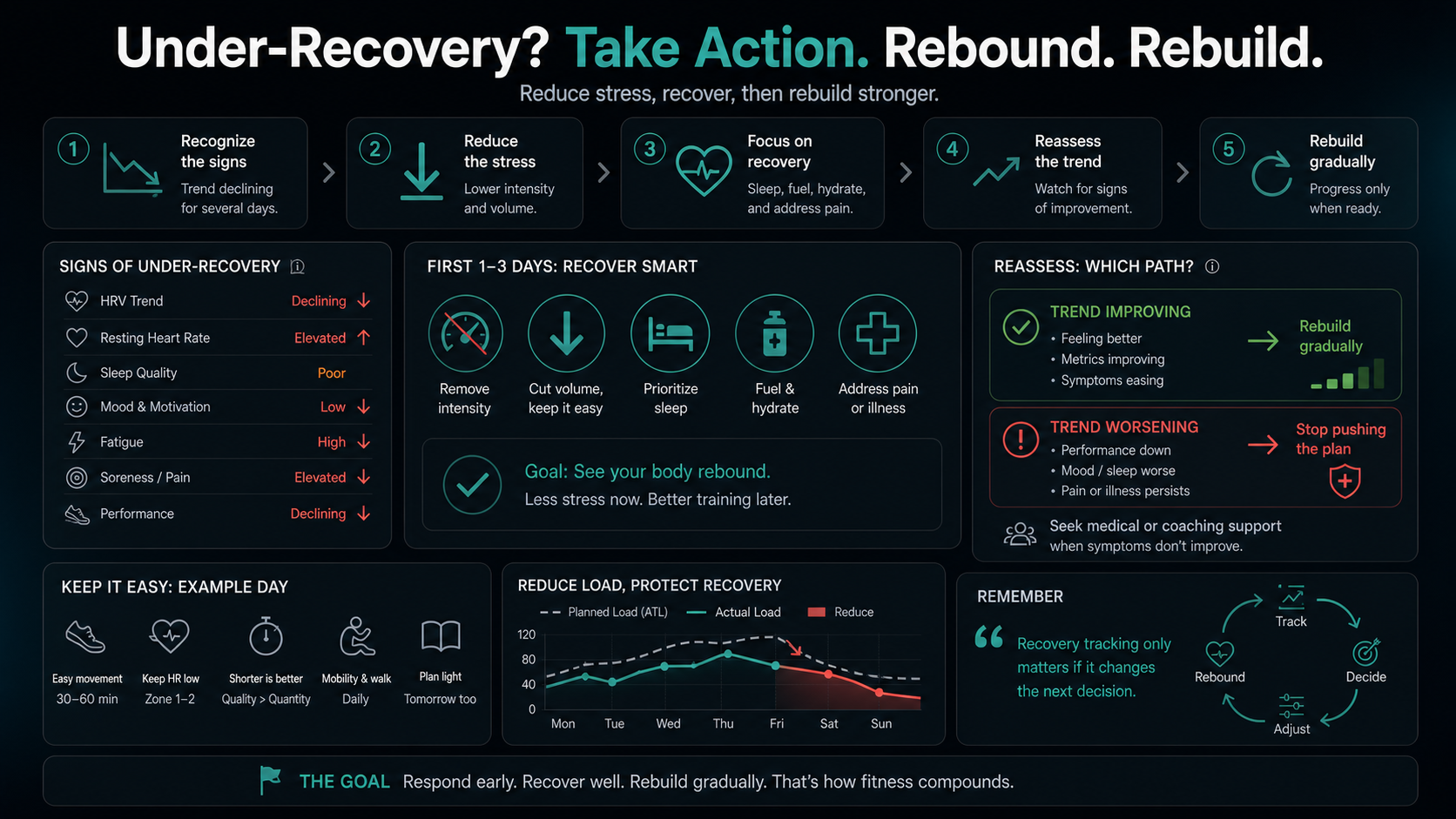
Use this decision table:
| Pattern | What it may mean | Next decision |
|---|---|---|
| One bad workout, otherwise normal | Normal variation | Keep the plan flexible |
| Poor sleep plus one hard session feeling bad | Acute fatigue or poor readiness | Make the next day easy |
| Several signals worse for 2 to 3 days | Possible under-recovery | Remove intensity and reduce volume |
| Performance down despite easier days | Recovery is not rebounding | Extend recovery and reassess |
| Pain changes mechanics | Injury risk is more important than fitness | Modify or stop the session |
| Illness symptoms are present | Training may add stress without benefit | Rest or train only if clearly safe |
| Mood, sleep, and fatigue keep worsening | Stress may be broader than training | Seek support and reduce load |
When you rebuild, do not jump straight back into the missed work. Missed hard sessions do not need to be repaid. Start with easy aerobic work, then add one controlled quality session when easy sessions feel normal again. If that goes well, rebuild volume before stacking intensity.
Recovery tracking only matters if it changes the next decision. The point is not to label yourself fragile. The point is to keep training consistent.
When To Be More Cautious
Some signs deserve more caution than others.
Be cautious if performance declines for more than a week despite easier training. Be cautious if sleep gets worse as you train less. Be cautious if mood, irritability, anxiety, or low motivation becomes unusual for you. Be cautious if resting heart rate remains elevated with illness symptoms. Be cautious if soreness becomes pain, pain changes mechanics, or a niggle worsens with each session.
The Meeusen consensus statement describes overtraining syndrome as difficult to diagnose and tied to persistent underperformance with other physiological and psychological symptoms (Medicine and Science in Sports and Exercise, 2013). You do not need to diagnose that yourself. But if symptoms persist, broaden the problem beyond training tweaks. Medical issues, iron status, infection, low energy availability, major life stress, and injury can all mimic or contribute to poor recovery.
If you are unsure, err on the side of reducing stress and getting qualified help. Endurance athletes are often good at tolerating discomfort. That is useful in races. It is not always useful when the body is asking for recovery.
A Simple Under-Recovery Checklist
Use this checklist when you suspect you are under-recovered:
- Did my normal easy pace or power feel harder than usual?
- Did I need unusually high effort to complete normal training?
- Has fatigue lasted longer than expected?
- Has sleep quality or duration dropped?
- Is soreness failing to clear?
- Is motivation unusually low?
- Is mood worse than normal?
- Is resting heart rate higher than my baseline?
- Is HRV trending down or unusually unstable?
- Is there new or worsening pain?
- Are illness symptoms present?
- Did the pattern improve after one to three easier days?
If you answer yes to one question, collect context. If you answer yes to several questions, adjust the plan. If you answer yes to several questions and there is no rebound after easier days, stop treating it as normal fatigue.
Conclusion
You know you may be under-recovered when several signals trend the wrong way together: performance drops, effort rises, easy training feels harder, fatigue lingers, sleep worsens, mood or motivation falls, soreness does not clear, resting heart rate is elevated, HRV trends poorly, and pain or illness symptoms appear.
Do not overreact to one bad day. Do not ignore a cluster. The most useful question is whether your body rebounds when you reduce stress. If it does, rebuild gradually. If it does not, keep the load low, look for non-training causes, and get support when symptoms persist.
Under-recovery is easier to fix early than late. The goal is not to avoid fatigue. The goal is to apply enough recovery for training to become adaptation.