
Sleep and Endurance Adaptation
Sleep is not a passive recovery bonus. For endurance athletes, it shapes readiness, execution, immune resilience, and the repeated training adaptations that turn workouts into fitness.
Sep 21, 202613 min read

Introduction
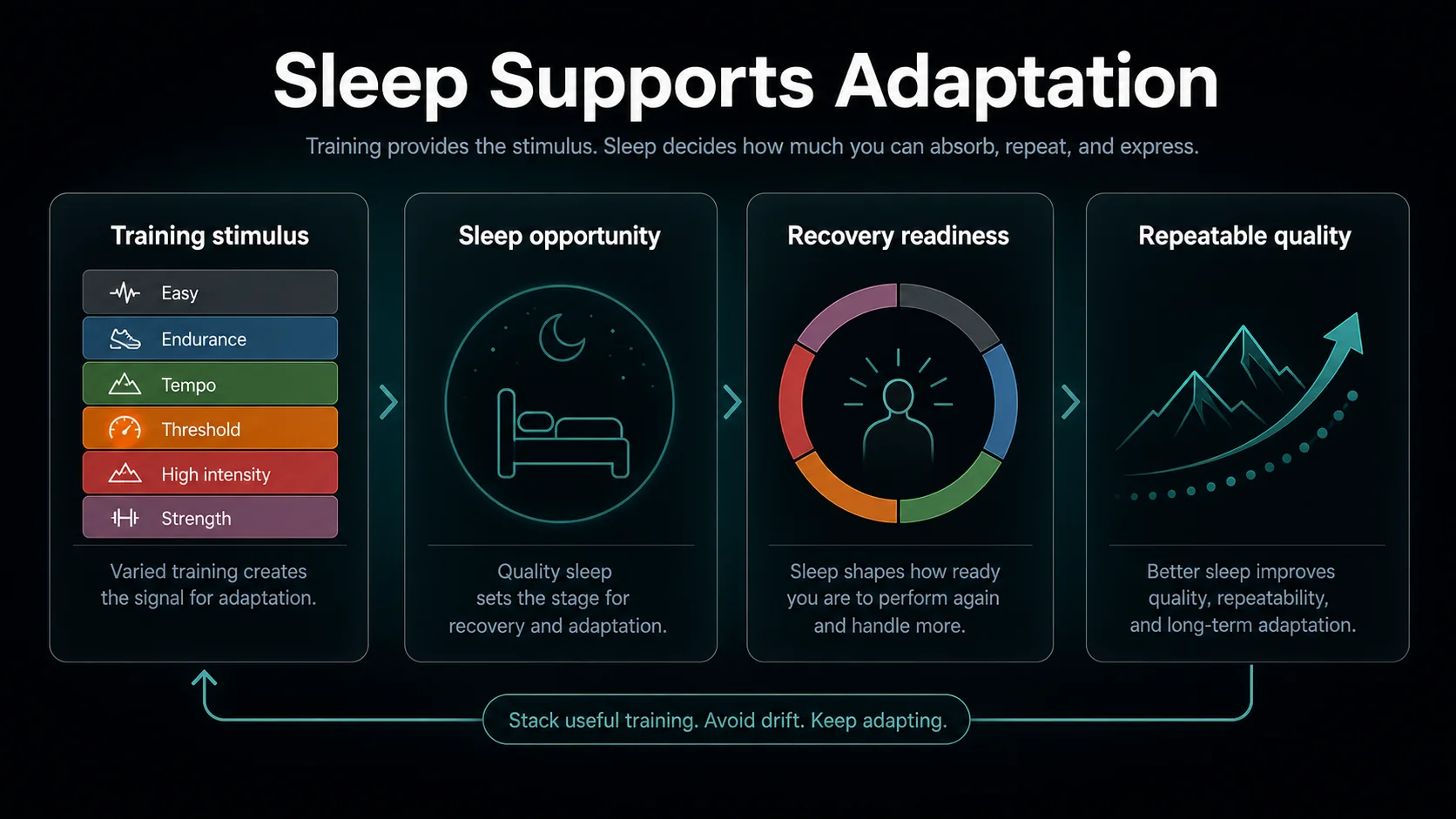
Sleep is where much of endurance adaptation is consolidated, but it is not a magic switch that makes every workout better. A better way to think about it is this: training provides the stimulus, and sleep helps decide how much of that stimulus you can absorb, repeat, and express.
For runners, cyclists, hikers, fastpackers, triathletes, and ski mountaineers, sleep affects three layers at once. It influences next-day readiness. It changes how hard a given session feels. Over weeks and months, it affects whether you can keep stacking useful training without drifting into illness, injury, or stale fatigue.
The evidence is strongest for the practical claim that sleep loss can impair endurance performance and recovery. A systematic review and meta-analysis on endurance performance found that sleep deprivation has a measurable negative effect, with longer events and more severe sleep loss generally creating more risk (Lopes and colleagues). Athlete-focused consensus recommendations also treat sleep as a major pillar of health, performance, and recovery, while acknowledging that individual sleep needs vary (Walsh and colleagues).
The evidence is less tidy for the exact adaptation question. You will not find a simple rule saying that 8.5 hours of sleep improves mitochondrial biogenesis by a predictable amount in every endurance athlete. Human training adaptation is too complex for that. What the research does support is a conservative and useful conclusion: chronic poor sleep reduces the quality, repeatability, and recoverability of training. Protecting sleep improves the environment in which endurance adaptations occur.
Sleep Is Part of the Training Signal
Endurance athletes often separate the "work" from the "recovery." The work is the long run, interval session, climb, gym session, or back-to-back weekend. Recovery is what happens afterward. That split is convenient, but incomplete.
Adaptation is a loop:
- You apply stress through training.
- The body responds with fatigue, signaling, repair, and remodeling.
- You recover enough to perform the next useful session.
- Over time, the same workload costs less or a higher workload becomes possible.
Sleep sits inside the middle of that loop. It affects hormonal regulation, immune function, autonomic balance, mood, pain sensitivity, cognition, glycogen restoration behavior, and appetite regulation. Reviews of sleep and sport performance describe these pathways as biologically plausible mechanisms linking sleep to both performance and recovery (Fullagar and colleagues).
That does not mean sleep replaces training quality. A perfectly slept athlete still needs progressive load, enough easy volume, specific intensity, and adequate nutrition. But sleep changes the athlete who shows up to the workout. A threshold session done after several poor nights may produce more strain for less useful work. A long run after short sleep may be completed, but with poorer pacing, higher perceived effort, worse fueling decisions, and more downstream fatigue.
For endurance adaptation, the most important question is not "Did I sleep well after one workout?" It is "Can I keep repeating high-quality training weeks without accumulating hidden debt?" That is where sleep becomes a training variable.
What Sleep Loss Does to Endurance Performance
Endurance performance is vulnerable to sleep loss because it depends on sustained attention, pacing judgment, thermoregulation, motivation, substrate use, and the willingness to tolerate discomfort. Sleep restriction does not have to destroy a workout to matter. A small increase in perceived effort can change pacing, reduce time at the intended intensity, or make the next day less productive.
The endurance-specific evidence supports that concern. In the systematic review and meta-analysis by Lopes and colleagues, sleep deprivation impaired endurance performance overall, but the magnitude varied with study design, task duration, timing, and the type of sleep loss (Lopes and colleagues). That variation matters. A short easy jog may survive a bad night. A long race, a hard climb, or a key interval day is much less forgiving.
Individual studies show similar patterns. A randomized crossover trial reported that partial sleep deprivation affected performance and psychophysiological responses during a 12-minute self-paced running test (Souissi and colleagues). Another study found that partial sleep deprivation after prolonged exercise influenced metabolic responses and next-day exercise performance (Mamiya and colleagues). A 2025 crossover trial in runners found that one night of partial sleep deprivation impaired 10K performance, while caffeine offset some of the decrement under the tested conditions (Tsai and colleagues).
Caffeine is useful, but it is not a recovery strategy. It can improve alertness and performance when sleep has been compromised, yet it may also push sleep later if used too late in the day. For an endurance athlete, that trade-off matters. Solving today's workout by damaging tonight's sleep can turn one compromised day into a sequence.
Adaptation Depends on Repeated Good Enough Days
A single night of poor sleep is usually not a crisis. Endurance athletes travel, race early, care for children, work shifts, and sometimes sleep badly for no obvious reason. The problem is repeated sleep restriction during heavy training.
Endurance adaptation is cumulative. Aerobic base, fatigue resistance, climbing durability, running economy, and threshold all improve through repeated exposures. That requires not just hard sessions, but the ability to execute the right session on the right day and recover enough to continue.
Sleep debt interferes with that in practical ways:
- Easy sessions drift harder because perceived effort is elevated.
- Hard sessions become less precise because pacing and motivation are poorer.
- Strength work is skipped or becomes sloppy.
- Food choices and appetite regulation become less consistent.
- Minor soreness feels more threatening.
- The athlete becomes more likely to interpret every bad session as a fitness problem.
Not all of these are direct molecular adaptation claims. Some are behavioral and execution claims, which is exactly why sleep matters in real training. A training plan is only as good as the athlete's ability to carry it out.
There is also emerging evidence that sleep restriction can interact with skeletal muscle responses. For example, a randomized study in young females examined sustained sleep restriction and resistance exercise effects on skeletal muscle transcriptomics, highlighting that sleep loss can alter the biological context around exercise stress (Knowles and colleagues). This is not endurance-specific proof that a bad week of sleep ruins aerobic adaptation. It is a reminder that sleep is part of the physiology in which training signals are processed.
Health Is Part of Adaptation
Endurance athletes sometimes treat health as separate from fitness: first build the engine, then manage the body around it. In reality, health is one of the main limits on adaptation. Missed training from illness, irritated tendons, low mood, and persistent fatigue can erase the theoretical benefit of a well-designed block.
Sleep matters here because immune function, tissue repair, attention, coordination, and decision-making all affect whether training stays repeatable. The athlete consensus recommendations describe sleep as relevant not only to performance but also to illness risk, injury risk, mental health, learning, and recovery behaviors (Walsh and colleagues). A narrative review focused on adolescent athletes also discusses sleep, nutrition, and injury risk together, which is useful because young athletes often combine high training load, school stress, growth, and inconsistent routines (Mason and colleagues).
For adult endurance athletes, the same principle still applies. If sleep is poor during a heavy block, the first warning sign is not always a failed workout. It may be a scratchy throat, a small tendon complaint that does not settle, unusually poor concentration on descents, or an inability to keep easy days easy.
This is why sleep should influence training decisions before the athlete is obviously broken. Reducing a workout by 20 minutes, skipping optional strides, or moving intervals by one day can preserve the block. Ignoring several short nights because the plan says "threshold today" may cost more than it gains.
Sleep Extension Is Useful, But Not a Hack
If poor sleep constrains training, it is reasonable to ask whether extra sleep improves performance. The answer is promising but not universal.
One classic study asked collegiate basketball players to extend sleep over several weeks. The athletes improved sprint times, shooting accuracy, reaction time, mood, and daytime sleepiness during the sleep-extension period (Mah and colleagues). Basketball is not endurance sport, and the study design does not prove that every athlete should chase nine or ten hours indefinitely. But it supports a practical point: athletes who are habitually underslept may perform better when they create more sleep opportunity.
That phrase, "sleep opportunity," matters. You cannot command sleep with the same precision as interval pace. You can, however, protect the window in which sleep is likely to happen. The athlete consensus paper recommends sleep hygiene, regular timing, sufficient opportunity, and individualized screening for persistent problems rather than treating sleep as a one-size prescription (Walsh and colleagues).
For endurance athletes, the best use of sleep extension is usually targeted:
- During high-volume blocks
- Before long races or training camps
- After travel or unusually poor sleep
- During heavy strength-training phases
- When subjective fatigue is rising faster than training load
Do not treat extra time in bed as a way to justify excessive training load. If you need heroic sleep strategies just to survive a normal week, the training plan may be too aggressive.
Naps Can Help, But Timing Matters
Naps are useful when night sleep is short, but they should support the sleep system rather than disrupt it. A systematic review of daytime napping in physically active participants found benefits across several physical and cognitive outcomes, although protocols and populations varied (Souabni and colleagues).
For endurance athletes, naps work best as a controlled tool:
- Keep most naps short, around 20-30 minutes.
- Place them early enough that they do not delay bedtime.
- Use longer naps only when the schedule allows a full sleep cycle and grogginess is acceptable.
- Avoid using naps to hide a chronically overloaded plan.
A nap can make an afternoon workout safer and more productive after a bad night. It cannot fully replace consistent nighttime sleep, especially if the athlete needs several naps every week to keep functioning.
Training Timing Can Protect or Damage Sleep
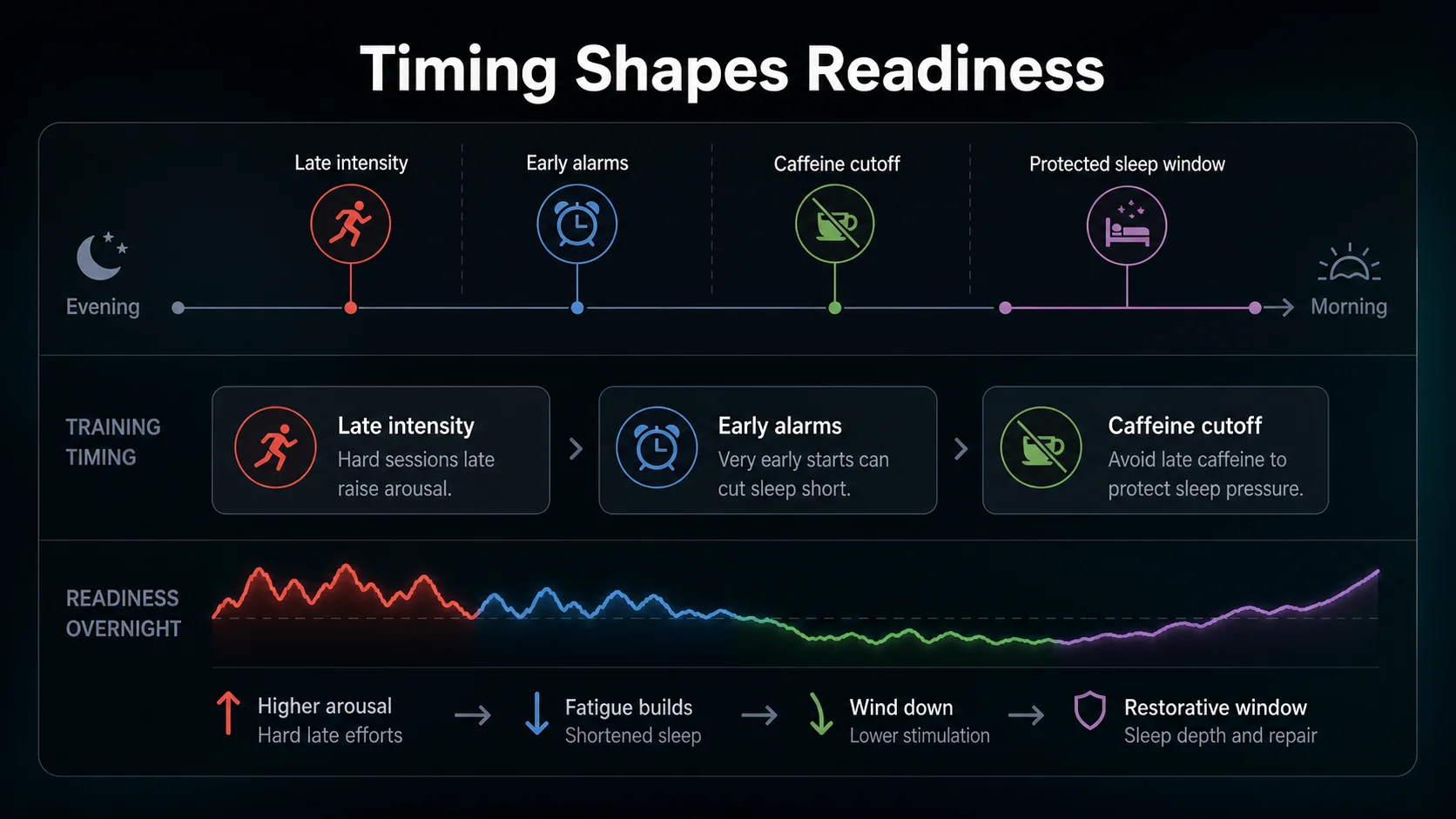
Many endurance athletes cannot choose ideal training times. Work, family, weather, daylight, and facility access often decide the schedule. Still, timing matters because training changes arousal, body temperature, light exposure, caffeine use, meal timing, and bedtime routine.
Late-night competition and evening high-intensity sessions are common sleep disruptors. Studies in elite football players found impaired sleep and recovery after night matches, and a sleep hygiene strategy after late-night match play was tested as a recovery intervention (Fullagar and colleagues, Fullagar and colleagues). Team-sport match play is not the same as endurance training, but the mechanism is familiar to any athlete who finishes intervals at 8:30 p.m. and then cannot downshift.
Use a simple rule: the later the hard session, the more deliberate the wind-down needs to be. That may include reducing bright light, finishing the post-workout meal early enough, avoiding late caffeine, setting a firm stop time for screens or work, and accepting that the next morning may need to be easier.
Early sessions have a different cost. A 5:30 a.m. run can be useful, but if it repeatedly cuts sleep to six hours, it may reduce the adaptation you are trying to build. The solution is not always to abandon morning training. It may be to move bedtime earlier, shorten the warm-up logistics, reserve early starts for easy days, or avoid stacking early sessions after late evenings.
How to Use Sleep Data Without Overreacting
Wearables can help athletes notice patterns, but they are not sleep laboratories. Sleep duration is usually more actionable than a proprietary recovery score. Sleep timing, consistency, and how you feel on waking are also more useful than obsessing over whether one device estimated enough deep sleep.
Track sleep like a training variable:
- Bedtime and wake time
- Estimated sleep duration
- Number of awakenings if obvious
- Morning mood and energy
- Resting heart rate or HRV trend if you already use it
- The session planned for that day
The goal is not to cancel every workout after a bad score. The goal is to make better decisions when poor sleep and high training stress overlap. A consistent recovery baseline makes that comparison more useful than reacting to one morning's number.
Use a traffic-light approach:
Green: one normal or good night, stable mood, normal soreness, planned session proceeds.
Yellow: one poor night or mild accumulated fatigue, keep the session but reduce optional extras, extend warm-up, and avoid forcing pace.
Red: several short nights, rising resting heart rate, poor mood, unusual soreness, or illness signs. Replace intensity with easy aerobic work or rest.
This is especially important for Zone Training Log users because zone targets only help if the body behind the heart-rate response is ready for the intended stimulus. Poor sleep can make Zone 2 feel like tempo, make threshold work unstable, and make heat or hills feel harsher than expected.
A Practical Sleep Plan for Endurance Athletes
The most useful sleep plan is boring enough to repeat. Start with sleep opportunity before optimizing supplements, trackers, or expensive recovery tools.
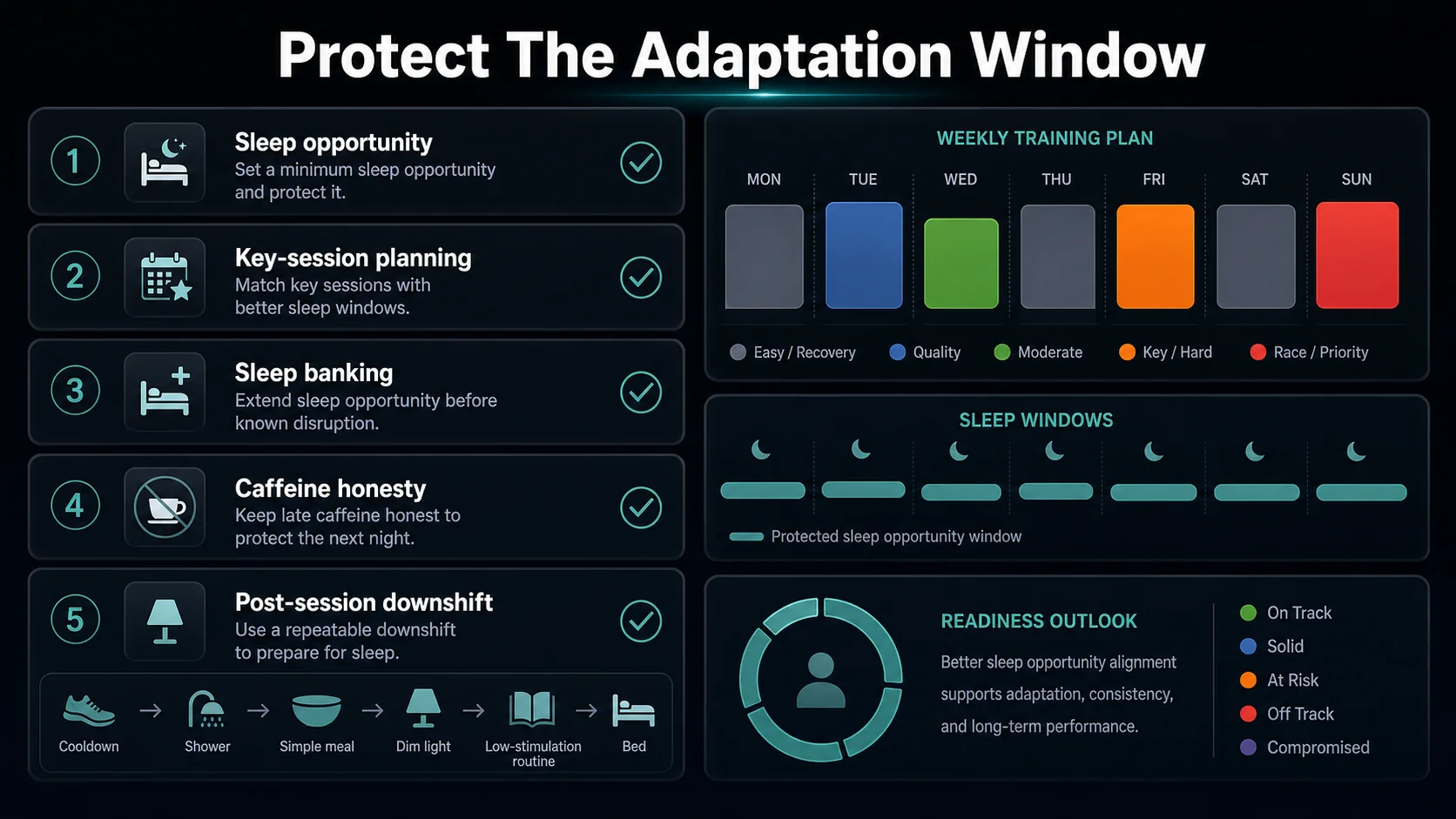
1. Set a minimum sleep opportunity
Most adult athletes should aim for at least 7-9 hours of sleep opportunity, with many needing more during heavy training. The athlete consensus recommendations emphasize individual sleep need and sufficient opportunity rather than one rigid number (Walsh and colleagues).
If you cannot sleep nine hours, do not make that the standard. Start by protecting the first realistic improvement: 30 minutes earlier in bed, a consistent wake time, or removing one late-night work block.
2. Match key sessions with better sleep windows
Do not place the hardest workout after the shortest predictable night. If Tuesday always follows a late Monday, Tuesday should not be the main interval day. If Saturday is your long mountain day, Friday night deserves the same planning attention as fueling.
3. Use sleep banking before known disruption
Before races, travel, night events, or early starts, extend sleep opportunity for several nights. Sleep banking is not unlimited protection, but reviews suggest that extra sleep before restriction can reduce some cognitive and motor impairments from later sleep loss (Juginovic and Rodman). For endurance athletes, this is most useful before events where the final night is likely to be poor.
4. Keep late caffeine honest
Caffeine can rescue a workout after poor sleep, as shown in the 10K sleep-deprivation trial by Tsai and colleagues, but late use may compromise the next night (Tsai and colleagues). Set a personal caffeine cutoff and treat exceptions as exceptions.
5. Build a post-session downshift
After late training, do not expect the body to fall asleep just because the workout is over. Use a repeatable sequence: cooldown, shower, simple meal, dimmer light, low-stimulation routine, bed. The exact routine matters less than having one.
When Poor Sleep Should Change the Workout
Sleep should not make athletes fragile. Training through an occasional bad night is normal. The mistake is ignoring patterns.
Keep the workout mostly unchanged when:
- The poor sleep was isolated.
- The session is easy or low risk.
- Warm-up feels normal.
- Mood improves once moving.
- Heart rate and perceived effort align normally.
Modify the workout when:
- Poor sleep has lasted several nights.
- The session is high intensity, technical, or long.
- Warm-up feels unusually heavy.
- Perceived effort is high at normal easy-zone output.
- You notice illness signs, poor coordination, or unusual irritability.
The best modification is often not total rest. It might be a shorter Zone 2 session, fewer intervals, lower hill volume, or moving the key workout by 24 hours. The decision should preserve the training week, not punish the athlete for being tired. If poor sleep follows illness or injury, combine the signal with a gradual return-to-training plan instead of jumping straight back to the old schedule.
Common Mistakes
The first mistake is treating sleep as a moral score. Bad sleep is information, not failure. Stress, travel, parenting, altitude, heat, alcohol, late racing, and work all affect sleep. The useful response is adjustment, not guilt.
The second mistake is chasing deep sleep numbers. Consumer devices estimate sleep stages imperfectly. If total sleep duration, consistency, mood, and training response are improving, do not redesign your life around a single stage estimate.
The third mistake is using easy days to catch up on intensity missed after bad sleep. If sleep restriction caused you to reduce Tuesday intervals, do not automatically cram them into Wednesday's recovery run. That turns sleep debt into training chaos.
The fourth mistake is ignoring fueling. Sleep and nutrition interact. A hungry athlete wakes more often, recovers poorly, and may struggle to maintain training quality. Sleep is not a substitute for carbohydrate availability, protein distribution, hydration, and enough total energy.
Conclusion
Sleep supports endurance adaptation by making useful training repeatable. It helps athletes show up ready, tolerate the intended workload, recover from it, and make better decisions across the week.
The strongest evidence says that sleep loss can impair endurance performance and that athlete sleep should be protected as part of health and performance planning. The more nuanced claim is that sleep improves the environment for adaptation rather than guaranteeing a specific physiological upgrade.
For practical training, that distinction is enough. Protect sleep before key sessions. Extend sleep opportunity during heavy blocks. Use naps and caffeine carefully. Treat repeated poor sleep as a reason to adjust load, not as a sign that fitness has disappeared.
Endurance fitness is built by stacking many good enough days. Sleep is one of the main reasons those days can keep stacking. For the morning after a key session, see how to interpret recovery metrics after hard training without overreacting.
Related