

Zone 2 Training
Can Walking Count as Zone 2 Training?
Walking can count as Zone 2 when it raises your heart rate into a credible aerobic range while breathing stays controlled. Learn how to use speed, hills, incline, and duration.

Walking Can Be Real Zone 2 Training
Walking counts as Zone 2 when it produces the internal effort your Zone 2 range is meant to represent. For one athlete, brisk level walking is enough. Another may need a hill, treadmill incline, weighted terrain, or a faster hike. A well-trained runner may struggle to reach Zone 2 while walking on flat ground at all.
The mode does not decide the zone. Your physiological response does. If heart rate settles in a credible aerobic range, breathing remains controlled, and the effort is sustainable, the session can provide useful low-intensity volume.
Walking is especially valuable for beginners, people returning after a break, athletes managing impact, and runners using steep terrain. It can extend aerobic time with less musculoskeletal stress than running. The practical question is not whether walking “counts,” but whether the chosen walk is hard enough to reach the target without becoming awkward or unsustainably steep.
Zone 2 Is an Intensity, Not a Speed
Zone 2 is usually the second band in a five-zone heart-rate model. It aims to capture relatively easy aerobic work below the intensity where breathing and metabolic disturbance rise sharply. Exact BPM boundaries depend on the calculation method and the individual.
That means a universal walking speed cannot guarantee Zone 2. Body size, age, fitness, terrain, gradient, heat, medication, and walking economy all influence the heart-rate response.
Research also shows that different Zone 2 definitions do not place every person at the same physiological intensity. In a study of 50 cyclists, fixed percentages of maximum heart rate showed substantial individual variability compared with markers such as first ventilatory threshold (Translational Sports Medicine). Use your watch as a guide, then confirm the result with breathing and perceived effort.
How Fast Does Walking Need to Be?
Cadence research offers a starting point. In adults aged 21 to 40, approximately 100 steps per minute worked as a practical marker of an absolute moderate intensity, although individual results varied (International Journal of Behavioral Nutrition and Physical Activity). A related study in adults aged 41 to 60 reached the same rounded heuristic for moderate-intensity walking (International Journal of Behavioral Nutrition and Physical Activity).
That number is useful for a first experiment, not a personal Zone 2 threshold. “Moderate intensity” based on metabolic equivalents and Zone 2 based on personal heart-rate boundaries are related but not identical. Older adults, shorter or taller walkers, trained runners, and people with different resting heart rates may reach the same cadence with different internal loads.
Start with natural brisk walking. Count steps for 30 seconds and double the result, or use a device’s cadence estimate. Then check heart rate and breathing after at least 10 minutes, once the response has stabilized.
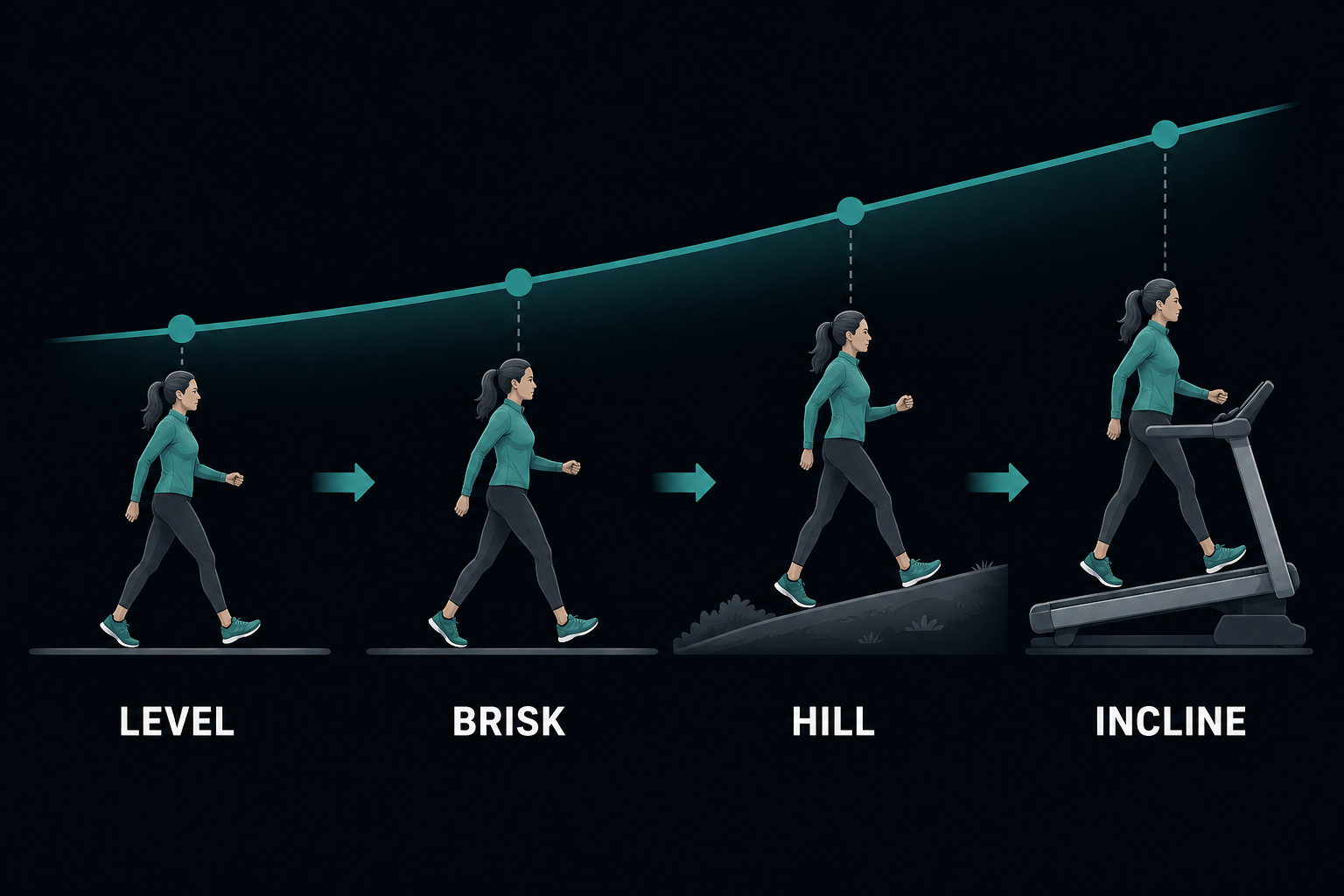
Four Ways to Reach Zone 2 While Walking
Increase speed
Walk with a purposeful stride and active arm swing. Increase speed gradually until heart rate reaches the lower part of your target range. Avoid extending the stride so far that your movement becomes forced; a slightly quicker cadence is usually more natural.
Add a gentle incline
On a treadmill, keep speed comfortable and raise incline in small steps. Wait two to three minutes after each change because heart rate lags behind workload. Incline often raises the aerobic demand without forcing an awkward near-jog pace. For a repeatable speed-and-incline test, use the Zone 2 treadmill guide.
Use rolling hills
Outdoors, choose a route with sustained gentle climbs. Let pace fall on steeper sections so the walk stays aerobic. Descents may drop heart rate below Zone 2, which is fine if the overall session still includes a useful steady block.
Extend duration
Duration will not transform a very light stroll into Zone 2 immediately, but heart rate may rise gradually during a longer brisk walk. Start conservatively and observe the steady middle of the session rather than chasing the zone in the first five minutes.
A 30-Minute Zone 2 Walking Test
Use this test on a day when you feel normal and conditions are mild.
- Walk easily for 8 minutes.
- Increase to a purposeful pace for 5 minutes.
- If heart rate remains below Zone 2 and breathing is very easy, add a little speed or incline.
- Hold the new workload for another 5 minutes before adjusting again.
- Once heart rate settles in Zone 2, maintain the workload for 10 to 15 minutes.
- Finish with 3 to 5 easy minutes.
During the steady block, you should be able to speak comfortably in complete sentences. The talk test has been shown to regulate exercise intensity in a practical setting, although its correspondence with laboratory thresholds is not exact (Journal of Strength and Conditioning Research).
Record speed, incline or route, average heart rate after the warm-up, breathing, and perceived effort. Repeat the same test once or twice before deciding that the setup is reliable.
What If Heart Rate Stays in Zone 1?
Zone 1 walking is still useful activity. It can support recovery, daily movement, and gradual tolerance. It simply may not deliver the same aerobic stimulus you intended from a focused Zone 2 session.
If you want more intensity, try a small incline before adding extreme speed. A treadmill walk at a sustainable gradient can be more controlled than power-walking on flat ground. Outdoors, choose a longer hill or use stairs carefully if your joints and balance tolerate them.
Do not add a weighted vest or heavy pack merely to force heart rate upward. Load changes musculoskeletal stress and posture, and it can outpace your tissue tolerance. Build unweighted walking consistency first. If hiking with a pack is part of your sport, progress the load separately and gradually.
If a hard-feeling walk remains in Zone 1, inspect the sensor and zone settings. Cold wrists, loose fit, motion artifact, and an overestimated maximum heart rate can all distort classification.
What If Walking Pushes You Into Zone 3?
Slow down, reduce incline, or alternate short steady blocks with easier walking. Beginners and people returning after time away may cross the upper boundary quickly, especially on hills.
Run-walk is another option when you want to develop running while controlling effort. Short easy running segments combined with walking recoveries can accumulate aerobic time without forcing continuous running. See our run-walk Zone 2 guide for a progression.
Brief Zone 3 moments on a hill do not ruin the workout. Focus on sustained time and the session’s overall cost. Repeated hard breathing, a rapidly rising heart rate, or a long period above the target means the workload no longer matches an easy aerobic day.
Walking Versus Running for Zone 2
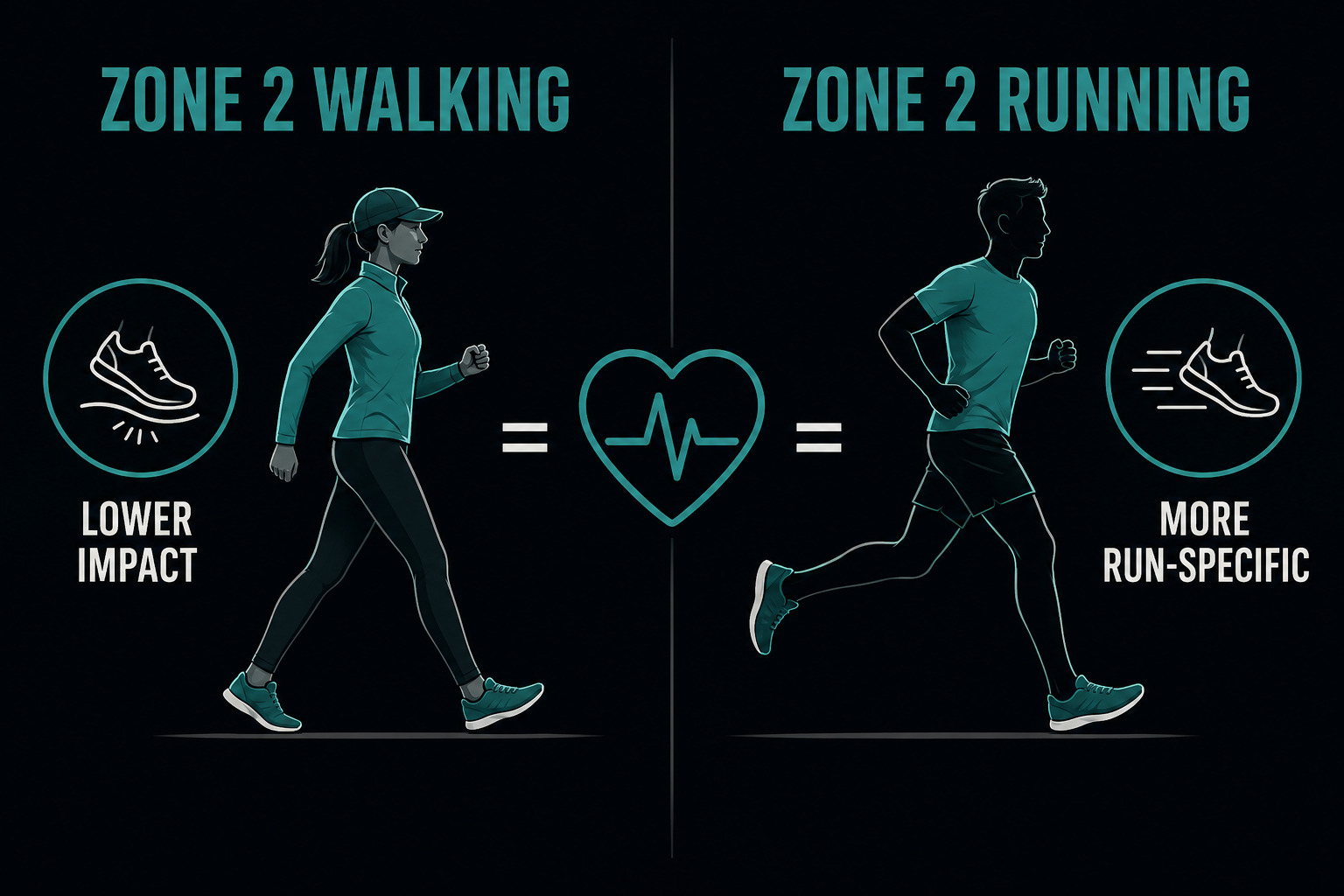
Both can train the aerobic system, but they do not create identical mechanical demands. Running adds more impact, elastic loading, and sport-specific coordination. Walking usually allows more volume with less impact and a lower recovery cost. The same principle applies to other modes: running and cycling may need separate Zone 2 heart-rate targets even when both sessions feel aerobically easy.
Use walking when it solves a real constraint:
- continuous running pushes you above the target;
- you are building tolerance after inactivity;
- impact limits total training time;
- steep hills make running inefficient;
- you want extra easy volume without another run;
- recovery between key sessions is the priority.
Use running when your goal requires running-specific durability and you can stay at the intended effort. The best plan may include both.
How to Progress a Zone 2 Walking Plan
Begin with two or three sessions of 25 to 40 minutes per week. Keep the steady aerobic portion shorter than the total session because warm-up and cool-down will often sit in Zone 1.
Progress one variable at a time:
- Add 5 to 10 minutes to one session.
- Make the steady portion more continuous.
- Add a small amount of incline or a rolling route.
- Add another day only when recovery remains easy.
The Zone 2 training-volume calculator can help turn a weekly target into realistic sessions. Count actual time near the intended effort rather than assuming the entire walk was Zone 2.
After several weeks, the same route may produce a lower heart rate or faster pace at similar effort. That can indicate improved efficiency, but temperature, wind, fatigue, and sensor behavior also matter. Compare similar conditions and look for a trend rather than celebrating one unusually good walk.
Keep the Zone Honest
Walking is valid Zone 2 training when the internal load fits the target. Start with brisk purposeful movement, then use hills or incline if needed. Confirm the result with stable heart rate, comfortable sentence-level speech, and a session you could repeat without disrupting recovery.
If walking remains too light, that does not make it pointless. Use it for recovery or daily movement and choose running, cycling, rowing, or another mode for focused Zone 2. The right mode is the one that produces the intended aerobic stimulus with a manageable cost.

Our editorial approach & AI disclosure
We use AI to help research, organize, and draft some articles. Every article is reviewed by a human editor and aims to reflect current evidence-based training practices and scientific literature.
Read our editorial policy