


Deload Weeks and Tapers
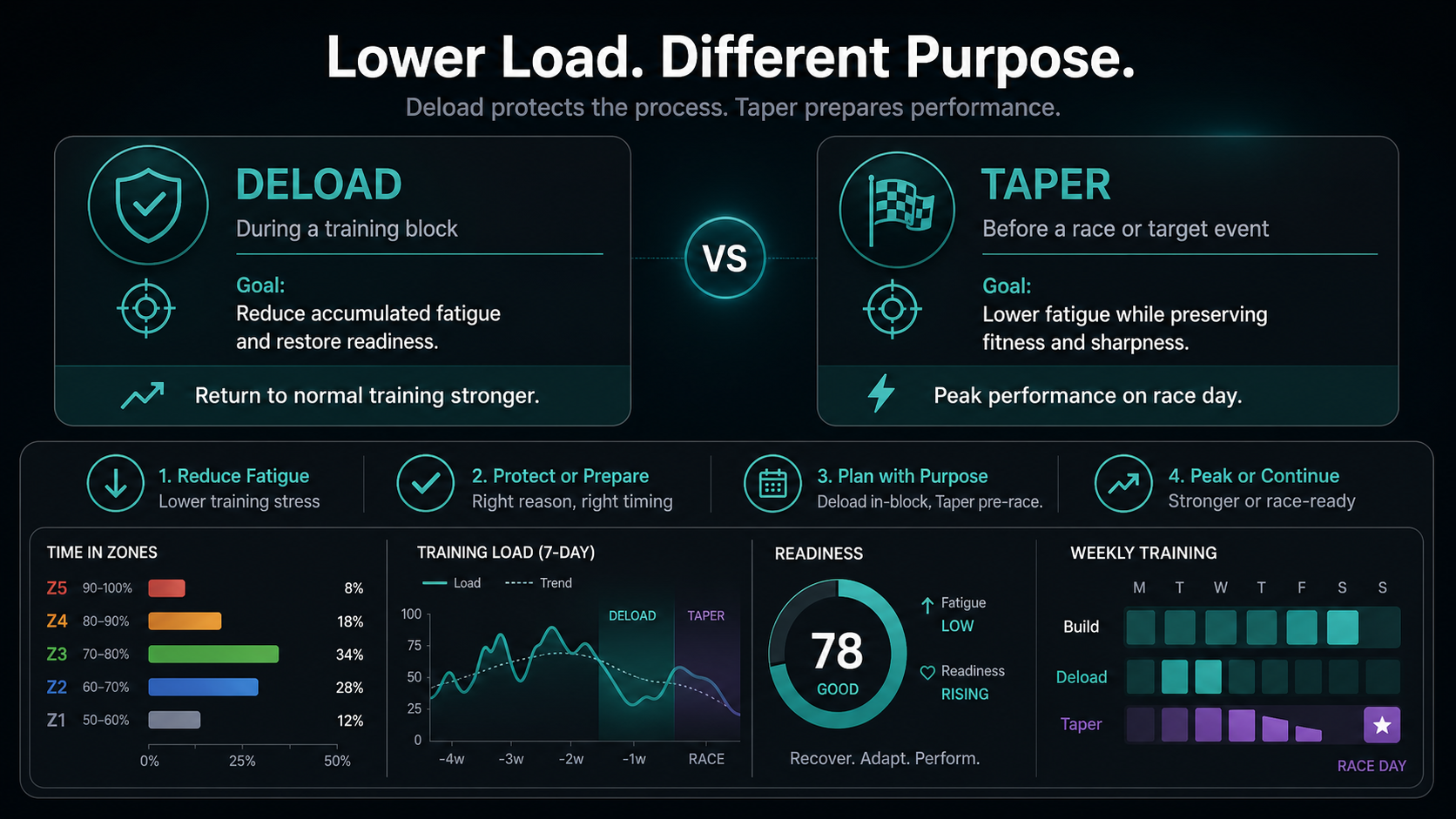
Deload weeks reduce fatigue inside a training block. Tapers reduce fatigue before a goal event. Learn how they differ, when to use each, and how to cut load without losing fitness.
Jun 19, 202619 min read

Introduction
Deload weeks and tapers are both planned reductions in training load, but they solve different problems.
A deload week is a lower-stress week inside a training block. Its job is to reduce accumulated fatigue, protect consistency, and help you absorb the work you already did. You use a deload when the training process needs recovery before it can move forward.
A taper is a planned reduction before a race or target event. Its job is to reduce fatigue while preserving the fitness, coordination, and confidence you need on a specific day. You use a taper when the goal is not more training, but better performance from the training you have already completed.
The two ideas are often confused because both involve doing less. That confusion creates bad decisions. Athletes skip deloads until they are forced into rest. They turn tapers into last-minute fitness tests. They panic when they feel flat for a few days. Or they cut so much training that they feel stale instead of fresh.
The better view is simple: a deload protects the block, and a taper prepares the event. Both are part of serious training. Neither is a sign that you are losing fitness.
Research on tapering is stronger than research on the coaching term "deload." A 2023 systematic review and meta-analysis found that tapering improved endurance performance outcomes such as time-trial and time-to-exhaustion performance, while changes in VO2max and economy were not consistently improved (Wang et al., 2023). That matters because it explains what a taper actually does. It does not magically build a new athlete in the final week. It lets the athlete express more of the fitness that is already there.
Deloads are supported more indirectly through what we know about training load, fatigue, recovery, and overreaching. The joint European College of Sport Science and American College of Sports Medicine consensus statement on overtraining describes a spectrum from functional overreaching to non-functional overreaching and overtraining syndrome (Meeusen et al., 2013). In normal language: hard training can be useful, but unresolved fatigue can stop being productive. Deload weeks are one practical way to prevent that drift.
This guide explains how deload weeks and tapers differ, when to use each one, how much to reduce training, and how to avoid the most common mistakes.
The Short Answer: Deload vs Taper
A deload week is a recovery week during training. You are still building toward the future, but you temporarily reduce stress so the body can catch up.
A taper is a performance week or performance phase before an event. You are no longer trying to build much new fitness. You are trying to arrive with less fatigue and enough sharpness to perform well.
| Question | Deload Week | Taper |
|---|---|---|
| Main purpose | Recover inside a training block | Arrive fresh for a target event |
| Timing | Every few weeks, after overload, or when fatigue trends upward | Before a race, test, trip, or important performance |
| Main reduction | Volume, long-session size, and workout density | Volume more than intensity |
| Intensity | Often reduced, simplified, or kept as tiny touches | Usually maintained in small controlled doses |
| Frequency | Often kept similar, but sessions are shorter | Often kept similar, especially for experienced athletes |
| Success looks like | You resume normal training better | You perform well on the target day |
Both require restraint. A deload is not a punishment for training hard. A taper is not a chance to cram. They work because they change the timing of stress and recovery.
What Is A Deload Week?
A deload week is a planned reduction in training load used to manage fatigue during a training cycle. Most endurance athletes use deloads after a block of harder or higher-volume training, but a deload can also be reactive when fatigue signs accumulate.
Training load has two broad parts: external load and internal load. External load is what you did: miles, minutes, elevation, power, pace, gym sets, interval volume. Internal load is how your body responded: heart rate, perceived effort, soreness, mood, sleep, and readiness. Halson's review on training-load monitoring emphasizes that understanding fatigue requires looking at both the work performed and the athlete's response to that work (Halson, 2014).
That is why deloads should not be planned only from a spreadsheet. A runner who handles 50 miles per week easily may not need the same deload as a runner who survives 50 miles by sacrificing sleep and limping through easy days. A cyclist holding the same weekly hours with lower heart rate drift and better mood is in a different place from a cyclist who needs caffeine just to start every ride.
The most common deload structure is a 3-7 day reduction. In many plans, it is simply called a recovery week. The exact size depends on the athlete and the reason for the deload, but common adjustments include:
- Reduce total weekly volume by about 20-50%.
- Shorten or remove the longest session.
- Replace one hard workout with easy aerobic work.
- Keep short strides, drills, or light cadence work if they make you feel better.
- Reduce heavy strength training volume or avoid grinding sets.
- Keep movement frequent enough that the week feels like training, not shutdown.
A deload should leave you fresher, not detached from training. Many athletes feel flat for the first day or two because fatigue is still clearing. That does not mean the deload is failing. The question is how you feel by the end of the week and during the return to normal work.
What Is A Taper?
A taper is a planned reduction in training before an event. It is not just a lighter week. It is a specific performance strategy.
The classic definition comes from tapering literature: reduce training load in the final period before competition to reduce physiological and psychological stress while preserving adaptations. Mujika and Padilla's review on precompetition tapering argued that the best tapers reduce accumulated fatigue without losing key training adaptations (Mujika and Padilla, 2003).
The practical difference from a deload is the deadline. A deload asks, "What lets me train well next week?" A taper asks, "What lets me perform well on this date?"
That deadline changes the choices. During a normal deload, you may remove intensity almost completely if you are overloaded. During a taper, you usually keep small reminders of race rhythm or race intensity. During a normal deload, it may be fine to be slightly undertrained for a few days. During a taper, you want to stay coordinated and confident.
The 2023 systematic review by Wang and colleagues reported that effective tapering strategies often involved a 41-60% reduction in training volume, maintained training intensity and frequency, and taper durations ranging from one to three weeks depending on context (Wang et al., 2023). A classic meta-analysis also supported the broad idea that a reduction in volume, while maintaining intensity, can improve endurance performance (Bosquet et al., 2007).
These numbers are useful, but they are not magic. A marathon taper is not the same as a 5K taper. A first-time racer is not the same as a high-volume athlete. A cyclist tapering for a one-day time trial needs different rhythm than a runner tapering for an ultramarathon. Still, the pattern is consistent: reduce total work, keep some specific intensity, and avoid new stress.
Why Reducing Training Can Improve Performance
Training creates two overlapping effects: fitness and fatigue.
Fitness is the set of adaptations you want: better aerobic capacity, stronger muscles and tendons, improved efficiency, better fueling, higher tolerance for long sessions, and more skill at the target intensity. Fatigue is the cost of creating those adaptations. It can include muscle damage, nervous-system tiredness, low motivation, poor sleep, soreness, glycogen depletion, emotional strain, and disrupted readiness.
During a hard block, both fitness and fatigue can rise. You may be fitter than you were three weeks ago, but not able to show it because the fatigue is masking performance. When you reduce load, some fatigue drops faster than fitness. That is the basic reason a well-timed deload or taper can make you feel better and perform better.
This does not mean rest is always better. If you reduce the training stimulus too much for too long, fitness starts to decay. Mujika and Padilla's review of short-term detraining describes how insufficient training stimulus can lead to loss of training-induced adaptations (Mujika and Padilla, 2000). So the goal is not inactivity. The goal is the minimum useful dose of training while fatigue clears.
This is the heart of the taper problem. You need enough reduction to arrive fresh, but enough familiar training to avoid feeling stale. The same principle applies to deloads. You need enough reduction to recover, but not so much that every deload becomes a restart.
How Deloads and Tapers Differ In Practice
The words matter because they lead to different decisions.
If you call every lighter week a taper, you may start treating ordinary recovery like an event. That can make training too precious. You worry about feeling perfect all the time instead of building repeatable fitness.
If you call every lighter week a deload, you may underprepare for actual races. A race taper is more strategic than "do less." It has to preserve the skills and sensations you need to perform.
Here is the practical difference:
| Training Decision | Deload Logic | Taper Logic |
|---|---|---|
| Volume | Cut enough to restore readiness | Cut enough to unload fatigue before race day |
| Long session | Shorten it, keep it easy, or skip it | Make it event-appropriate, then reduce sharply near race day |
| Hard workout | Often remove, reduce, or simplify | Keep short controlled race-specific touches |
| Strength training | Reduce load, volume, or intensity | Avoid soreness and heavy fatigue near the event |
| Testing fitness | Usually avoid | Avoid unless the event itself is the test |
| Main risk | Returning too hard too soon | Panic training or becoming stale |
A deload can be highly flexible. If you feel great after four lighter days, you may return to normal training. If you are still tired after seven days, you may need more recovery or a deeper look at sleep, fueling, illness, work stress, or overall load.
A taper is less flexible because the event does not move. You can still adjust, but you are adjusting around a date. That is why taper mistakes feel so costly. There is less time to correct them.
How To Plan A Deload Week
Start by identifying why you need the deload. The best deload for a healthy, well-adapted athlete is different from the best deload for someone sliding toward non-functional fatigue.
If the deload is planned after a normal training block, keep the week simple. Reduce total volume. Shorten the long session. Keep most training easy. Include one small neuromuscular touch if you like, such as relaxed strides, short hill sprints with full recovery, or a few cadence pickups on the bike. These touches should leave you feeling better, not create a second workout.
If the deload is reactive because fatigue signs are strong, be more conservative. Remove intensity. Cut the long session more aggressively. Move strength work to maintenance. Add extra sleep opportunity. Avoid turning every easy session into a "check whether I am recovered yet" test.
A basic runner deload might look like this:
| Day | Normal Week | Deload Week |
|---|---|---|
| Monday | Rest or easy 30 min | Rest or easy 25 min |
| Tuesday | Threshold intervals | Easy 35-45 min with 4 relaxed strides |
| Wednesday | Easy 50 min | Easy 35 min |
| Thursday | Medium-long run | Easy 40 min |
| Friday | Strength and easy run | Light mobility or short easy run |
| Saturday | Long run 90 min | Long easy run 60 min |
| Sunday | Recovery run | Rest or easy 25 min |
A basic cyclist deload might look like this:
| Day | Normal Week | Deload Week |
|---|---|---|
| Monday | Rest | Rest |
| Tuesday | Threshold workout | Easy endurance 45-60 min |
| Wednesday | Endurance 90 min | Easy 60 min |
| Thursday | VO2 max intervals | Easy spin 45 min with short cadence pickups |
| Friday | Strength | Mobility or light strength |
| Saturday | Long ride 3-4 hours | Endurance ride 1.5-2 hours |
| Sunday | Recovery spin | Rest or recovery spin |
The pattern is not complicated. You keep the rhythm of training but remove enough load that the week stops digging the hole deeper.
The most important rule is to resume gradually. Many athletes ruin a deload by celebrating the first good day with an oversized workout. If the goal is to absorb training, the return week should be purposeful, not reckless. Start with a normal week, not a heroic one.
How To Plan A Taper
A good taper reduces volume more than intensity. The goal is not to become inactive. The goal is to arrive fresh while keeping the nervous system, movement pattern, and race-specific rhythm alive.
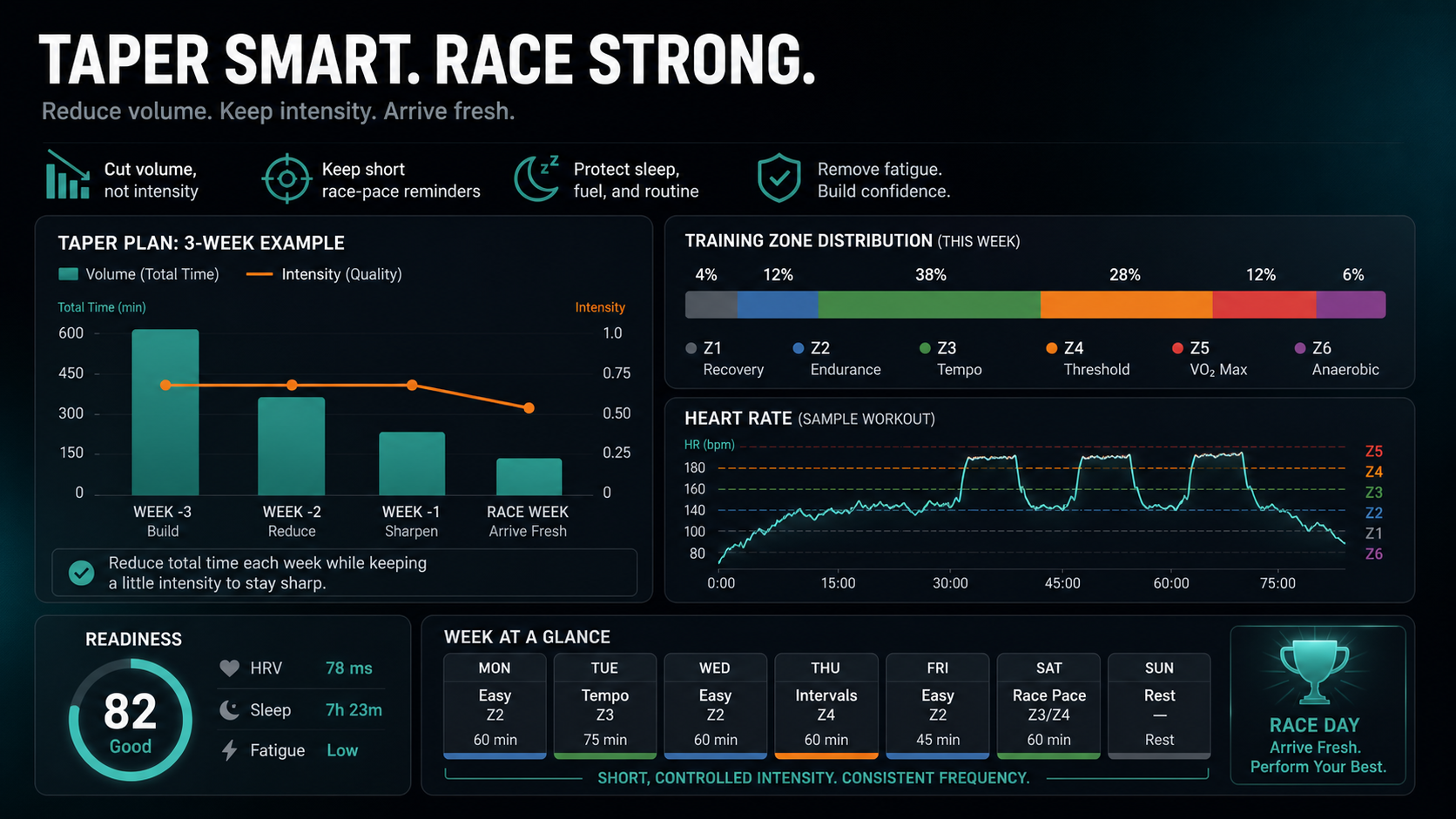
The exact taper depends on event length, training history, and how much fatigue you are carrying. As a general pattern:
- For a 5K, 10K, short time trial, or short hard cycling event, a 5-10 day taper is often enough.
- For a half marathon, Olympic-distance triathlon, long sportive, or demanding trail race, 7-14 days is common.
- For a marathon, ultramarathon, long triathlon, or very long cycling event, 14-21 days may be appropriate, especially after a large training block.
These are starting points, not laws. High-volume athletes often need a bigger taper because they have more fatigue to unload. Low-volume athletes may need less because a large reduction can remove too much rhythm. Older athletes or athletes with high life stress may need more recovery. Athletes who feel stale quickly may need slightly more frequency and short intensity touches.
The evidence points away from complete rest as the default. Wang and colleagues reported benefits from tapering strategies that reduced volume while maintaining intensity and frequency (Wang et al., 2023). Mujika and Padilla also emphasized preserving intensity in taper design (Mujika and Padilla, 2003).
In practice, that might mean:
- Keep the number of training days similar, but make sessions shorter.
- Keep one or two short quality touches, but cut the number of reps.
- Keep race pace familiar, but stop before fatigue builds.
- Remove heavy strength work that causes soreness.
- Practice fueling and equipment, but do not experiment.
- Protect sleep, carbohydrate intake, hydration, and routine.
For example, a 10K runner might do a short workout five days before the race: 3-4 x 3 minutes around 10K effort with full control, then a few easy days and short strides. A marathon runner might do a final medium-long run two weeks out, then reduce long-run size and keep short marathon-pace touches. A cyclist might keep a few openers in race week: short controlled efforts that remind the body how to produce power without adding much fatigue.
The taper should not be the hardest part of the plan. If you are doing workouts in race week that require emotional commitment, you are probably training too hard.
Warning Signs You Need A Deload, Not More Discipline
Endurance athletes often mistake fatigue management for weakness. That is understandable. Training rewards consistency, and consistency requires showing up on days when you do not feel perfect. But there is a difference between normal resistance and a clear fatigue trend.
Halson's review notes that training-load monitoring works best when athletes combine objective measures with subjective measures, because no single metric captures readiness perfectly (Halson, 2014). In plain terms, do not wait for one magic number. Look for patterns.
Signs you may need a deload include:
- Easy sessions feel harder for several days in a row.
- Pace or power drops at the same heart rate.
- Heart rate is unusually high for easy work, or unusually suppressed during harder work.
- Sleep quality declines even though you are tired.
- Motivation drops below normal training reluctance.
- Soreness persists longer than usual.
- Small aches become louder across the week.
- You need more caffeine or emotional effort to start normal sessions.
- Workouts require race-day focus just to finish.
- Mood, appetite, or concentration change alongside training fatigue.
One bad workout does not automatically mean you need a deload. One poor night's sleep does not mean the plan is broken. The useful signal is persistence. If several markers trend the wrong way across multiple days, the body is telling you the current load is not being absorbed.
This is where the overtraining literature is useful, even for everyday athletes. Meeusen and colleagues describe overtraining syndrome as complex and difficult to diagnose, with no single marker that cleanly identifies it (Meeusen et al., 2013). That should make athletes cautious. You do not need to wait until a serious problem has a label. A well-timed deload is a small adjustment. Ignoring the trend can become a bigger interruption.
Common Deload Mistakes
The first mistake is turning a deload into complete inactivity when complete rest is not needed. Full rest can be right for illness, injury, deep exhaustion, or a genuine mental break. As a default, though, many athletes do better with shorter, easier training that keeps routine alive.
The second mistake is keeping the long session too long. Long runs and long rides create a large share of weekly stress, so shortening them is often the cleanest way to reduce load.
The third mistake is replacing endurance stress with gym stress. A deload is not helpful if you add heavy eccentric lifting, new plyometrics, or a hard class that creates soreness. Strength can stay, but it should support recovery.
The fourth mistake is testing too early. When the legs start to feel better, the athlete wants proof. That proof often becomes another hard workout. Let readiness return quietly, then confirm it when normal training resumes.
The fifth mistake is treating every fourth week as automatically correct. A calendar pattern is useful, but it should not override the athlete in front of you.
Common Taper Mistakes
The biggest taper mistake is panic training. The athlete sees the race approaching, remembers missed sessions, and tries to buy fitness late. That usually adds fatigue faster than it adds adaptation.
Other common mistakes are removing all intensity, changing equipment or fueling, reducing volume too late for a long event, or cutting so much training that a lower-volume athlete feels stale. A taper should make the body feel familiar. It should not introduce new variables.
Many athletes also overvalue how they feel during the taper. Some feel heavy, restless, flat, or anxious when load drops. The taper is not judged by every mood swing. It is judged by the target event.
Sample Deload Week For A Runner
Imagine a runner building toward a half marathon. A normal week is 35 miles with one threshold workout, one long run, and four easy days. The athlete has finished three solid weeks, but easy pace now feels a little harder, sleep is slightly worse, and the long run left more soreness than usual.
A deload week might reduce total volume to about 22-26 miles:
| Day | Session |
|---|---|
| Monday | Rest or 25 minutes very easy |
| Tuesday | 40 minutes easy with 4 x 15-second relaxed strides |
| Wednesday | 30-40 minutes easy |
| Thursday | 35 minutes easy, no workout |
| Friday | Rest or light mobility |
| Saturday | 60-70 minutes easy long run |
| Sunday | 25-35 minutes recovery |
The athlete still runs. The weekly rhythm remains. But the threshold workout is removed, the long run is shorter, and the total stress is lower. The following week does not need to be a supercompensation fantasy. It just needs to return to normal training with better readiness.
Sample Taper For A 10K Runner
Now imagine the same runner is tapering for a 10K. The race is on Sunday. The athlete is healthy and has completed the build.
A simple race-week taper might look like this:
| Day | Session |
|---|---|
| Monday | Easy 40 minutes |
| Tuesday | 3 x 3 minutes at 10K effort, full control |
| Wednesday | Easy 35 minutes |
| Thursday | Easy 30 minutes with 4 relaxed strides |
| Friday | Rest or 20-25 minutes easy |
| Saturday | 15-25 minutes easy with 3 short strides |
| Sunday | Race |
This is not a deload in the usual training-block sense. It has a target. The short workout keeps 10K effort familiar but does not create deep fatigue. The easy days keep routine. The final strides are reminders, not tests.
Sample Taper For A Marathon Runner
Marathon tapers often need more time because the final long runs and marathon-pace blocks create substantial fatigue. A common approach is a two- or three-week taper.
For a runner who peaked at 50 miles per week, a three-week outline might be:
| Week | Main Idea |
|---|---|
| Three weeks out | Last major long run or long run with marathon-pace work |
| Two weeks out | Reduce volume about 20-30%, keep a controlled workout |
| Race week | Reduce volume more sharply, keep short rhythm touches |
The final long run should not become a race. The last medium workout should build confidence, not reveal new fitness. Strength, fueling, shoes, and kit should already be familiar. The final weeks are about converting preparation into performance.
Sample Taper For A Cyclist
Cyclists often tolerate frequency well but need careful control of intensity and total load. A rider preparing for a hilly sportive, gran fondo, or time trial might reduce total weekly hours while keeping short efforts.
Race week might include:
| Day | Session |
|---|---|
| Monday | Rest |
| Tuesday | 60 minutes endurance with 3 x 3 minutes at target effort |
| Wednesday | 45-60 minutes easy |
| Thursday | 45 minutes with 3-5 short openers |
| Friday | Rest or 30 minutes easy |
| Saturday | 30-45 minutes easy with 2-3 short efforts |
| Sunday | Event |
The exact details depend on the athlete. The shared rule is the same: keep the signal, reduce the cost.
How To Decide Which One You Need
Ask four questions.
First, is there a specific event date? If yes, you may need a taper. If no, you probably need a deload or a normal recovery week.
Second, is the main problem accumulated fatigue or event readiness? If you are struggling to absorb training, deload. If you are fit but carrying fatigue into a goal event, taper.
Third, how big was the load before the reduction? The larger and harder the preceding block, the more recovery you may need. Gabbett's training-injury prevention work argues that athletes benefit from being prepared for demands, but problems arise when workloads are poorly managed or spiked too aggressively (Gabbett, 2016). A deload or taper should be understood in that broader workload context.
Fourth, what response do you usually have to reduced training? Some athletes bounce back quickly. Some need several days before they feel good. Some feel stale if frequency drops too much. Your history matters.
If you are unsure, choose the lower-risk option. Inside a training block, a conservative deload is rarely disastrous. Before an event, avoid last-minute heroic training. Fitness is built over weeks and months. Race-week fatigue can be created in one workout.
Use Your Training Log to Decide
A deload or taper should respond to evidence, not a fixed calendar rule alone. Before changing the week, compare recent training load, workout quality, sleep, soreness, mood, and perceived effort. The guide to under-recovery can help separate normal fatigue from a pattern that deserves a larger reduction.
After the reduced week, use a weekly endurance review to check whether normal effort and motivation returned. For a taper, judge success by readiness for the event rather than by adding one last fitness test.
Related Periodization and Load Guides
- Compare acute and chronic training load
- Review a deload week in your training log
- Use the Periodization guide hub
- Use the Training Load guide hub
Conclusion
Deload weeks and tapers both reduce training load, but they are not the same tool.
A deload week is for the training process. It helps you absorb a block, lower fatigue, protect consistency, and return to normal training with better readiness. It is most useful after overload, during heavy life stress, or when fatigue signs persist for several days.
A taper is for a target event. It reduces fatigue while preserving the intensity, rhythm, and confidence needed to perform. The best-supported taper pattern is to reduce volume while keeping some controlled intensity and enough frequency to stay sharp.
The practical rule is this: deload to keep building, taper to perform. Both require enough discipline to do less at the right time.
Illustrative Deload Examples
These examples show structure, not universal prescriptions. The correct reduction depends on accumulated fatigue, training history, health, and the purpose of the week.
Runner
A runner completing five weekly sessions might keep four or five familiar training days but shorten most runs, reduce the long run substantially, and replace a demanding interval session with a few relaxed strides. The week still feels like running, but it removes the density of stress that created the fatigue.
Cyclist
A cyclist might retain normal riding frequency, cut endurance-ride duration, remove prolonged sweet-spot or threshold work, and keep a few short controlled efforts with full recovery. Indoor riders should reduce total work, not merely lower the resistance while keeping every session equally long.
Mixed endurance athlete
A triathlete or multisport athlete should review the combined week. Reducing running while preserving hard cycling, strength work, and a long hike may not reduce overall fatigue. Compare duration, hard minutes, session effort, soreness, and outside activity across all sports.
Judge the result after the deload as well as during it. Better motivation, lower soreness, normal easy-session effort, and a controlled first key workout are more useful than expecting every wearable metric to become ideal.