

Zone 2 Training
Run-Walk Zone 2
If every easy run climbs into Zone 3, planned walk breaks can keep the session aerobic while you build durability. Learn how to choose intervals, progress gradually, and review the workout without embarrassment or guesswork.

Introduction
If your heart rate climbs into Zone 3 whenever you run continuously, use planned walk breaks before the effort becomes strained. Alternate relaxed running with brisk or easy walking, keep breathing conversational, and extend the running portions only when the entire session remains controlled.
Run-walk is not a lesser version of running. It is a pacing method that lets new or returning runners accumulate aerobic time while reducing the pressure to shuffle at an awkward pace. It can also help runners manage hills, heat, fatigue, and long sessions. The objective is not to force every heartbeat into a colored band; it is to produce the intended easy session with a recoverable mechanical cost.
This guide shows how to choose intervals, avoid common heart-rate mistakes, and progress toward longer continuous running when that is your goal. If the zone itself is new to you, start with What Is Zone 2 Training? for the effort cues and ways to set a starting range.
First Check Whether Zone 3 Is Real
Before redesigning your training, confirm that the signal deserves a response. An easy run can appear to be Zone 3 because:
- the pace is too ambitious;
- the route is hilly or technical;
- heat and dehydration raise cardiovascular strain;
- heart rate drifts during a long session;
- fatigue or poor sleep changes the response;
- the wrist sensor reads poorly;
- your zone boundaries are too low.
Use the talk test. At an easy aerobic effort, you should be able to speak in full sentences without repeatedly pausing for breath. The American College of Sports Medicine describes steady conversation as consistent with moderate aerobic intensity and encourages using perceived effort alongside heart rate (ACSM intensity guide).
If the run feels genuinely easy while the watch briefly reports Zone 3, do not stop every time the display changes color. Look at the pattern. If breathing becomes strained, heart rate keeps rising, or the session leaves you disproportionately tired, the intensity probably needs adjustment.
For a deeper diagnosis, read Why Easy Runs Become Zone 3 and check whether your range is plausible with the Zone 2 Heart Rate Calculator.
Why Walk Breaks Work
Walking lowers the immediate metabolic and mechanical demand while allowing you to continue moving. Heart rate may take a minute to respond because it lags behind changes in effort, but a sufficiently easy walk usually brings breathing and cardiovascular strain back under control.
The method is especially useful when continuous running creates a binary choice between awkward shuffling and moderate effort. A purposeful walk interval creates a third option: run with comfortable mechanics, then recover before the effort drifts too high.
Research on run-walk pacing is not extensive, and most studies do not specifically test Zone 2 development. In one randomized marathon study, non-elite runners using a run-walk strategy finished in statistically similar times to continuous runners and reported less muscle pain and fatigue, although cardiac biomarker responses were not reduced (Hottenrott and colleagues). That does not prove a universal performance advantage. It does show that planned walking can be compatible with meaningful endurance performance rather than representing failure.
Choose Your Starting Interval
Start with an interval that feels almost too easy. The correct ratio depends on running history, terrain, heat, body size, recent training, and how quickly heart rate rises.
Useful starting options include:
- 30 seconds running, 60–90 seconds walking;
- 1 minute running, 1 minute walking;
- 2 minutes running, 1 minute walking;
- 3 minutes running, 1 minute walking.
These are not physiological formulas. They are practical trial structures. Choose the shortest running interval that lets you maintain relaxed posture and breathing throughout the session.
Do not wait until you are exhausted before walking. Start the walk break while you still feel in control. Preventing excessive drift is easier than trying to reverse it after several minutes of harder effort.
Use Breathing Before the Watch
Heart rate responds with delay. If you begin walking only after the watch shows a high number, the underlying effort may have been rising for a while. Use these earlier cues:
- conversation becomes broken;
- shoulders and hands tense;
- foot strike becomes louder;
- you start chasing pace;
- the route begins to climb;
- perceived effort moves above easy.
Walk before those cues become pronounced. Resume running when breathing is calm and movement feels coordinated. The heart rate does not have to return to the bottom of the zone before every repetition.
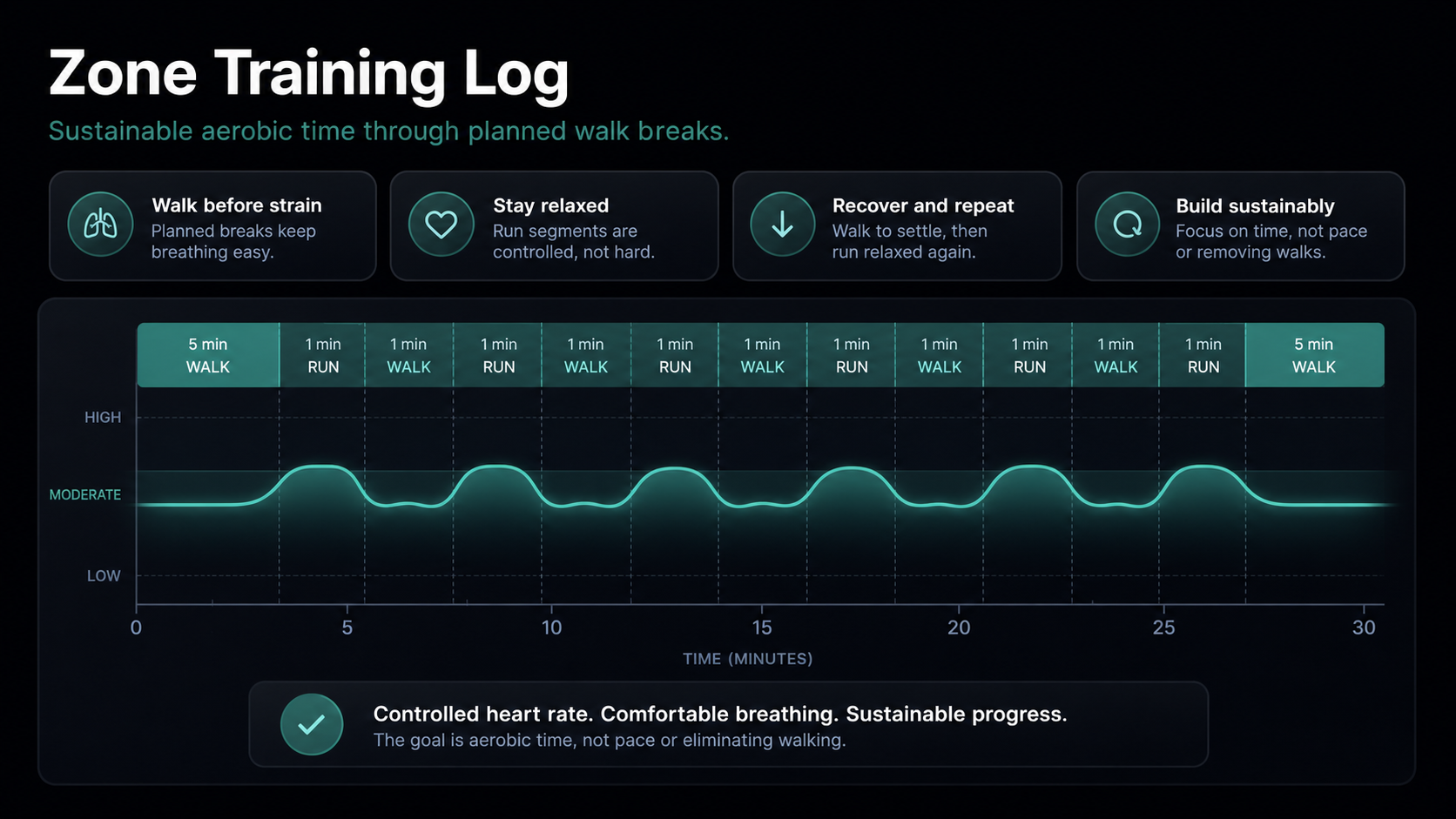
A 30-Minute Starter Session
Use this simple structure on flat or gently rolling terrain:
- Walk easily for 5 minutes.
- Alternate 1 minute of relaxed running with 1 minute of walking for 20 minutes.
- Walk easily for 5 minutes.
Keep the running segments slower than you think necessary. The first repetition should feel like restraint, not a test. If heart rate and breathing rise throughout the session, shorten the running portions or lengthen the walks next time.
If 1:1 is already comfortable, try 2 minutes running and 1 minute walking. If one minute of running becomes strained, use 30 seconds running and 60–90 seconds walking. The session purpose matters more than the ratio.
Progress One Variable at a Time
Progression should preserve control. Change only one element in a given week:
- add 5 minutes to total duration;
- lengthen running intervals;
- shorten walking intervals slightly;
- add one extra weekly session;
- move from flat terrain to gentle hills.
Do not increase all five together. Cardiovascular fitness can improve faster than tendons, bones, and joints adapt to impact. A session may feel aerobically easy while its mechanical dose is increasing substantially.
One progression might look like this:
| Week | Main interval | Session duration |
|---|---|---|
| 1 | 1 min run / 1 min walk | 30 min |
| 2 | 90 sec run / 1 min walk | 30 min |
| 3 | 2 min run / 1 min walk | 30–35 min |
| 4 | Repeat week 3 | 30–35 min |
| 5 | 3 min run / 1 min walk | 35 min |
| 6 | 5 min run / 1 min walk | 35–40 min |
Repeat a week when soreness, fatigue, or heart-rate drift increases. Progress is not delayed by consolidation; it is protected by it.
How to Handle Hills and Heat
Walk hills proactively. Holding flat-ground pace uphill can turn an easy run into threshold work before the watch catches up. Resume running when the grade and breathing permit.
In hot weather, slow both the running and walking portions, choose shade, shorten the session, and account for hydration. The same pace can produce a higher heart rate because circulation is also supporting heat loss. A hotter day is not the time to prove that last week’s ratio still works.
Trail runners can use terrain-based intervals: run smooth flats and gentle descents, walk steep climbs, and avoid using downhill speed to “repay” walking time. The internal intensity and mechanical cost both matter.
What to Record in Your Training Log
Record enough context to make the next decision:
- total duration;
- run-walk ratio;
- time in each heart-rate zone;
- average heart rate;
- perceived effort;
- route and elevation;
- heat or wind;
- soreness during and after;
- whether breathing stayed conversational.
Do not judge the workout from average pace. Walking guarantees a slower average, which is the point. Review whether you accumulated the intended aerobic time with controlled mechanics and reasonable recovery.
After several weeks, compare sessions with the same ratio and similar conditions. Useful progress includes a lower perceived effort, less drift, smoother running, faster running segments at a similar heart rate, or the ability to extend intervals without strain.
When to Move Toward Continuous Running
Continuous running becomes a reasonable next step when:
- several run-walk sessions feel controlled;
- soreness returns to normal quickly;
- breathing stays conversational;
- heart rate no longer climbs rapidly in each running segment;
- you can extend running intervals without changing mechanics;
- the next workout is not compromised.
Try one continuous block rather than removing all walks. For example, after warming up, run easily for 10 minutes, walk for 2 minutes, then return to your usual intervals. Extend the continuous block gradually.
You never have to eliminate walking completely. Planned walks remain useful for hills, long events, hot weather, fueling, and fatigue management.
Common Mistakes
Running too hard during the run portions
Walk breaks do not compensate for repeated surges. The running segments should remain relaxed.
Waiting for a high-heart-rate alert
Use breathing and movement cues before the number becomes extreme.
Choosing awkwardly slow mechanics
If slowing further makes running uncomfortable, shorten the running interval and walk purposefully.
Increasing duration and ratio together
Progress one variable at a time so you can identify what caused a change in fatigue or soreness.
Comparing average pace with continuous runs
The session serves a different purpose. Compare control, time, and repeatability.
Treating all Zone 3 as harmful
Zone 3 can be useful when intentional. The problem is repeatedly turning an easy session into moderate work without planning for its recovery cost.
When to Stop and Seek Advice
Stop exercising and seek urgent medical care for chest pain, fainting, severe shortness of breath, or a new irregular heartbeat. Speak with a clinician before progressing if exercise produces unexplained symptoms, or if you are returning after a significant illness, injury, or long period of inactivity and are unsure what is appropriate.
Heart-rate zones are training tools, not medical diagnostic ranges.
Conclusion
Run-walk Zone 2 is a practical way to build aerobic time when continuous running keeps becoming moderate effort. Start walking before strain develops, choose conservative intervals, use conversation and movement quality alongside heart rate, and progress only one variable at a time.
The goal is not to graduate from walking as quickly as possible. It is to create repeatable easy training that your cardiovascular system and tissues can absorb. Continuous running often follows naturally when consistency, not pride, controls the progression.

Our editorial approach & AI disclosure
We use AI to help research, organize, and draft some articles. Every article is reviewed by a human editor and aims to reflect current evidence-based training practices and scientific literature.
Read our editorial policy