


AirPods Pro 3 vs Chest Strap
AirPods Pro 3 can track heart rate closely during steady treadmill exercise, while a chest strap remains the better reference for rapid changes, threshold tests, and precision-focused analysis.
Sep 13, 20267 min read
The Short Answer
Choose AirPods Pro 3 for convenient heart-rate tracking during steady runs, rides, walks, and everyday endurance training when the earbuds fit securely. Choose a chest strap for short intervals, threshold tests, rapid recovery tracking, or any analysis where timing and small differences matter.
Independent research makes this a closer comparison than the form factors suggest. In a controlled treadmill study, AirPods Pro 3 had a mean absolute error of 2.08 beats per minute against a Polar H10 chest strap. The earbuds were accurate on average across a range of intensities, but moment-to-moment variation widened at higher heart rates. A chest strap still has the advantage of electrical measurement and remains the stronger reference for high-resolution work. Start with the full AirPods Pro 3 accuracy analysis if you want the study design and limitations before choosing between sensors.
The right sensor is the one that answers the training question reliably. Convenience may be more valuable than theoretical precision on an easy run; faster response may be worth the extra equipment during a threshold test.
AirPods and Chest Straps Measure Different Signals
AirPods Pro 3 use an in-ear optical sensor. Infrared light detects pulse-related changes in blood volume, and software combines the optical signal with movement data to estimate heart rate. Apple says the sensor pulses light 256 times per second and works with motion sensors and an iPhone model during supported workouts (Apple Newsroom).
A typical heart-rate chest strap uses electrodes to detect the electrical signal associated with each heartbeat. That is closer to ECG timing, although a consumer strap is not a diagnostic ECG. Because it senses on the torso and does not depend on optical blood-flow changes, a good strap usually responds quickly and is less vulnerable to the motion artifacts that affect PPG.
The chest strap is not infallible. Dry electrodes, a loose band, static from clothing, a weak battery, poor maintenance, or a failed connection can create spikes and dropouts. AirPods also have practical failure modes: a loose ear tip, sweat, earwax, piercings, cold, head movement, or jaw motion can reduce contact and confidence.
What the Direct Comparison Found
The most relevant evidence is a 2026 PLOS Digital Health study that compared AirPods Pro 3 directly with Polar H10 during rest, walking, graded treadmill running, rapid workload transitions, and recovery.
Across 40 healthy adults and 16,735 paired five-second samples, the AirPods results showed:
- almost no average directional bias;
- 2.08 beats per minute mean absolute error;
- 2.02% mean absolute percentage error;
- similarly low average error across intensity categories;
- greater spread between individual readings at higher heart rates;
- overall 95% limits of agreement of roughly 10 beats per minute in either direction.
The study authors concluded that AirPods Pro 3 tracked heart-rate patterns well during treadmill exercise but should not be treated as interchangeable with an ECG-derived system for beat-level precision or clinical decisions. They also noted that chest-worn monitors consistently show near-perfect agreement with ECG across many activities in the wider literature.
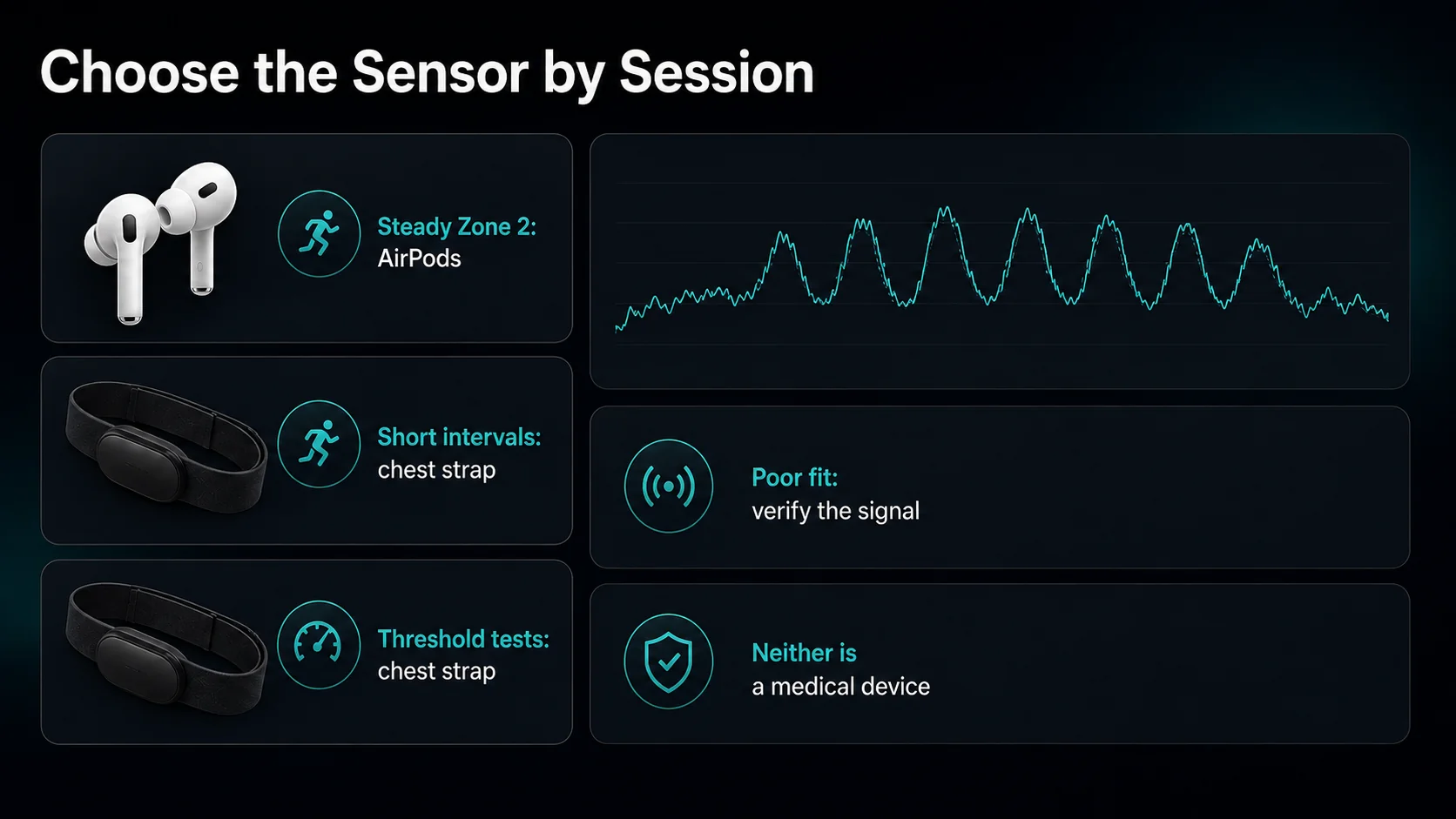
The result supports a practical middle position: AirPods Pro 3 are not merely a rough convenience sensor, and a chest strap is not mandatory for every zone workout. The differences matter most when the workout demands exact timing or when fit becomes unstable.
Which Sensor Fits Which Workout?
| Workout or decision | Better default | Why |
|---|---|---|
| Steady Zone 2 run or walk | AirPods Pro 3 | Convenient, low average error, and steady effort reduces the need for instant response. |
| Long endurance ride | Depends | AirPods are comfortable if secure; use a strap when comparing heart rate with power or cardiac drift. |
| Short intervals | Chest strap | Electrical timing usually follows rapid changes more reliably. |
| Threshold test | Chest strap | A few beats can change the estimated boundary. |
| Strength or circuit session | Depends | AirPods avoid wrist-grip problems, but heart rate is not the main measure of muscular load. |
| Repeated unexplained disagreement | Chest strap | It is the stronger consumer reference for troubleshooting an optical signal. |
Steady Zone 2
AirPods Pro 3 are a strong fit for steady aerobic work. Zone 2 is normally a range, not a single target number, and the athlete should confirm it with breathing and the talk test. If the curve is smooth and plausible, a brief difference of a few beats is unlikely to change the session.
Sensor accuracy is only half the problem. Incorrect maximum heart rate or threshold settings can create the wrong zone even when the measured pulse is excellent. Review the Zone 2 Heart Rate Calculator before buying another sensor to fix a zone-definition problem.
Short intervals and rapid recoveries
Use a chest strap when the rise and fall of heart rate is part of the analysis. AirPods performed well during rapid changes in the treadmill study, but wider momentary spread at higher intensity still makes the electrical signal a better default.
Heart rate itself lags effort, so pace, power, or interval structure may be the best real-time target for very short repetitions. The strap does not remove physiology's delay; it reduces measurement uncertainty on top of that delay.
Threshold tests
A threshold result may be used to set zones for weeks or months. That raises the cost of a noisy signal. Use a charged, moistened, well-fitted chest strap, verify that it is connected, and confirm the curve after the test before updating zone boundaries.
Cycling
AirPods can avoid wrist-specific issues caused by gripping handlebars, road vibration, and wrist angle. That makes them appealing for ordinary rides. A chest strap becomes more valuable when you compare stable power with heart-rate drift, study short climbs, or need a consistent reference across many sessions.
Strength training
Ear sensing can be more convenient than wrist sensing when gripping weights or bending the wrist. A chest strap may still respond more cleanly, but neither sensor fully represents local muscular strain. Record exercises, load, repetitions, rest, and perceived effort instead of turning heart rate into the primary strength metric.
Comfort and Reliability Matter Too
The most accurate device in a paper is not useful if you refuse to wear it. AirPods Pro 3 may already be part of your workout for audio, so heart-rate sensing adds almost no setup. A chest strap adds a band, pairing, washing, battery checks, and skin contact.
The tradeoff reverses if the earbuds loosen during running or do not fit your ears. Apple advises choosing tips for sensor contact, keeping AirPods clean, and considering cold, moisture, earwax, skin conditions, and nearby piercings when readings are poor (Apple Support).
Chest straps need care as well. Moisten the electrodes before a dry start, tighten the strap enough to prevent movement, rinse it according to the manufacturer's instructions, and replace a weak battery. Many apparent accuracy failures are contact failures.
How to Compare Them Fairly
Do not compare an AirPods run on Tuesday with a chest-strap run on Friday. Heart rate changes with heat, fatigue, hydration, caffeine, terrain, stress, and recovery. Record both devices during the same controlled session if your setup allows separate capture.
Use this protocol:
- Charge both devices and verify the chest-strap battery.
- Fit the earbuds and strap carefully.
- Confirm the intended connections and recording apps.
- Warm up for 10 to 15 minutes.
- Hold a steady section at easy intensity.
- Add several controlled increases and recoveries.
- Mark the changes with laps or timestamps.
- Compare the curves after the workout.
Check more than average and maximum heart rate. Look for response delay, missing samples, impossible spikes, recovery shape, and whether disagreement occurs in the same movement pattern each time.
One test can reveal a dropout, not prove long-term superiority. Repeat it in the conditions that usually cause trouble: cold weather, hard intervals, cycling position, or a long sweaty session.
Which Reading Should You Trust When They Disagree?
First ask whether either number is physiologically plausible. A sudden jump with no change in pace, power, breathing, or terrain is more likely sensor noise than a real training response.
If a well-fitted chest strap shows a coherent curve and AirPods repeatedly diverge during the same movement, trust the strap for that section. If the strap shows isolated spikes at the start while the AirPods curve matches effort, check electrode contact and battery before treating the strap as ground truth.
Do not change your zones to make one noisy workout look correct. Fix measurement quality first, then review how heart-rate sensor differences affect Apple Watch zones.
Do AirPods Pro 3 Replace a Chest Strap?
For many athletes' everyday steady training, they can. The independent treadmill evidence supports low average error, and the convenience advantage is real. If you already wear AirPods Pro 3, you may not need a chest strap just to confirm that a conversational run stayed broadly easy.
They do not replace a chest strap for every use. Keep the strap for threshold calibration, short intervals, precise recovery timing, repeated device validation, and any analysis where small or brief differences change the conclusion.
Neither device should be used for diagnosis. Seek medical help for concerning symptoms regardless of the displayed reading.
Conclusion
AirPods Pro 3 narrow the gap between convenient optical sensing and a dedicated heart-rate monitor. They were accurate on average against Polar H10 during controlled treadmill exercise and are a sensible choice for steady endurance sessions. If you also train with Apple Watch, see how Apple selects between the ear and wrist heart-rate streams.
A chest strap remains the stronger tool when fast response and high-resolution accuracy matter. Choose based on the session, verify fit, and interpret heart rate with pace, power, terrain, breathing, and effort. Once you trust the signal, store it with the context that makes it useful.