

Pace, Power & RPE
Why Pace Breaks on Trails but Zones Still Work
Trail pace changes with grade, footing, terrain, heat, altitude, and fatigue. Learn why heart-rate zones remain useful, where they also fail, and how to review trail runs without chasing road pace.
Introduction
Pace breaks on trails because a minute per kilometer no longer represents a stable amount of work. Grade, surface, turns, obstacles, altitude, weather, and fatigue can all change the effort required to cover the same distance. Heart-rate zones still work because they track your internal response as speed rises and falls—but they work best when you pair them with perceived effort and terrain context.
That difference matters. On a road, a steady easy pace can be a practical target when conditions are repeatable. On a trail, maintaining that pace uphill may turn an aerobic run into threshold work. Trying to recover the “lost” pace downhill may add risk and muscle damage without producing the workout you planned.
The useful trail question is not, “Why was I so slow?” It is, “What intensity did this terrain require, and did that intensity match the purpose of the session?”
This guide explains exactly why pace loses meaning, why zones transfer better across terrain, when heart rate also becomes misleading, and how to analyze a trail workout without forcing road-running logic onto a mountain.
Pace Works Only When the Cost of Speed Is Stable
Pace is the time required to cover a unit of distance. It is an output metric. For pace to represent intensity consistently, the energetic cost of moving at that speed needs to stay reasonably stable.
Flat road running often comes close enough. The surface is predictable, gradients are small, and interruptions may be limited. Compare similar routes in similar weather and a change in pace at the same heart rate can reveal something useful.
Trails remove those controls. The same 6:00 per kilometer can be relaxed on smooth dirt, demanding on a shallow climb, reckless on a rocky descent, or impossible through mud. Even two kilometers within one run may require different gait, balance, stride length, and muscular force.
This does not make pace useless. It changes pace from a universal intensity target into a local outcome. Trail pace is most meaningful when you compare:
- The same segment or climb
- Similar surface and weather
- Similar pack and equipment
- Similar fatigue point within the run
- Similar direction, including uphill or downhill
Outside those conditions, pace needs explanation before comparison.
Grade Changes the Meaning of Every Kilometer
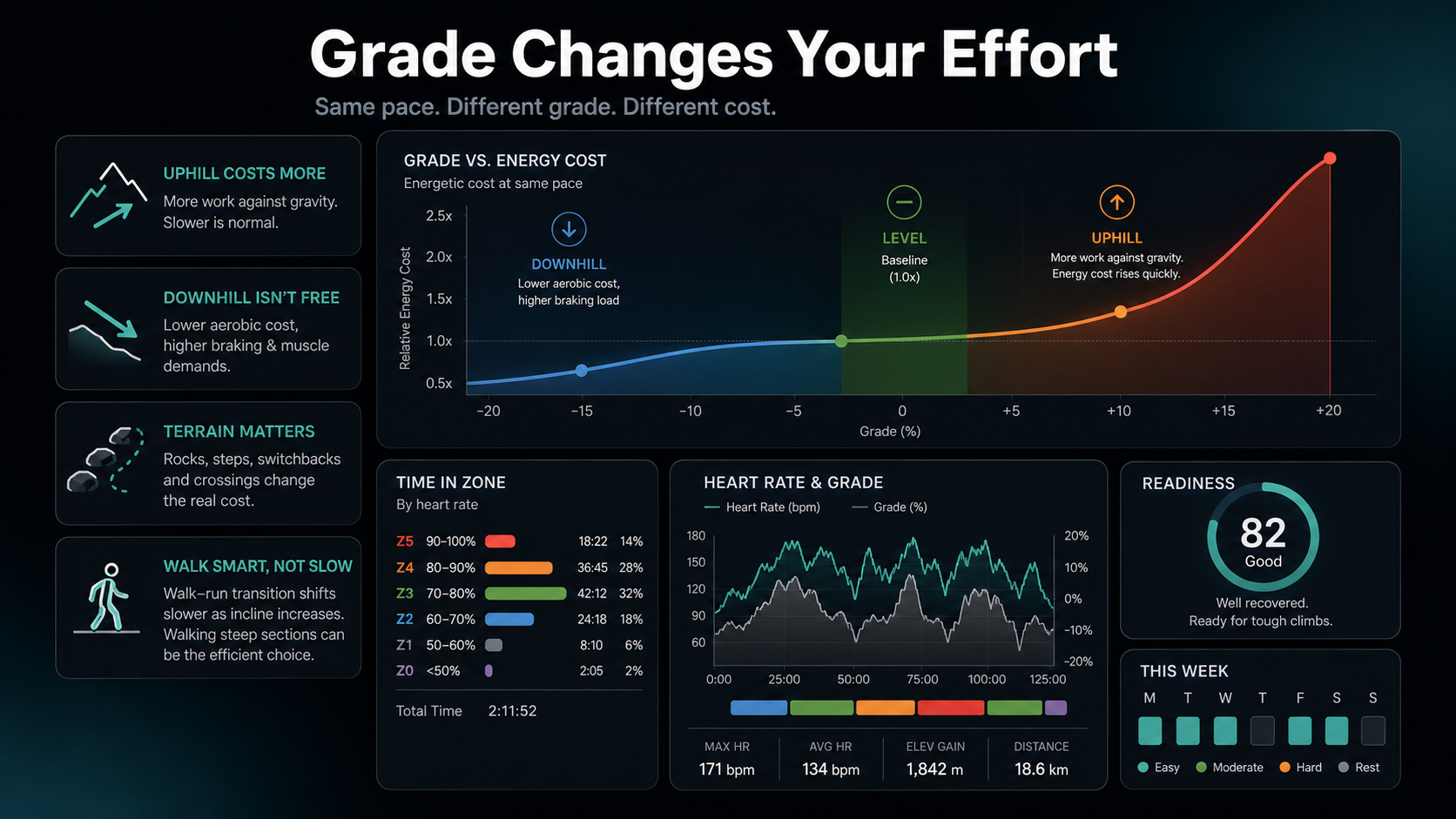
Slope is the most obvious reason trail pace breaks. Moving uphill requires positive mechanical work against gravity. Moving downhill reduces the aerobic cost at some gradients but increases braking and eccentric muscle demands.
Laboratory measurements across gradients from steep downhill to steep uphill found large, nonlinear changes in the energetic cost of walking and running (Minetti and colleagues). At steep grades, uphill, level, and downhill economy may reflect meaningfully different constraints. A later study found that running-economy relationships stopped carrying over cleanly between level and the steepest uphill or downhill conditions tested (Lemire and colleagues).
That is why grade-adjusted pace estimates can be useful for summaries but cannot fully standardize trail effort. A formula may estimate the cost of a smooth, consistent incline. It cannot know whether the grade contains loose rock, high steps, switchbacks, a stream crossing, or a section where running turns into hiking.
The walk–run transition also moves with slope. Research in trained mountain runners found that preferred and energetically optimal transition speeds became slower as incline increased, while heart rate did not accurately predict the optimal transition for each person (Brill and Kram). Walking a steep section can therefore be the efficient choice, not a failed pace target.
Surface and Technicality Add Cost Pace Cannot See
Trails do not need to be steep to become expensive. Soft ground absorbs energy. Loose surfaces demand stabilization. Roots and rocks change foot placement. Narrow turns interrupt rhythm. Technical sections shorten stride and increase attention even when GPS pace falls.
Real-world walking research found that metabolic cost rose across progressively less stable surfaces, with woodchips costing more than sidewalk at the same speed in that small study (Kowalsky and colleagues). Controlled uneven-terrain walking has also shown increased joint work, muscle activity, and metabolic expenditure compared with smooth ground (Voloshina and colleagues).
Running evidence is more nuanced. One experiment using trail-like undulating terrain found that runners maintained stability with little change in overall energy consumption compared with flat ground (Dhawale and Venkadesan). That does not cancel the walking findings. It shows that “uneven terrain” is not one standardized exposure: bump size, compliance, speed, experience, and the task itself influence the result.
For training decisions, label the surface instead of pretending every trail kilometer is equivalent. Useful tags include smooth-dirt, rocky, mud, sand, technical, and snow. Over time, these notes let pace regain meaning within a repeatable context.
Pace Becomes Useful Again When You Narrow the Comparison
Trail pace is not broken beyond repair. It becomes useful when you stop asking it to compare unlike terrain.
Choose a repeatable segment: one climb, a smooth rolling loop, a fire-road tempo section, or a technical descent you run with control. Keep direction, start and finish points, and measurement method consistent. Record enough context to recognize when the comparison is unfair.
Then compare pace with internal load:
| Repeated-segment result | Possible interpretation |
|---|---|
| Faster pace at similar HR and RPE | Improved fitness, economy, technique, or conditions |
| Same pace at lower HR and RPE | Lower internal cost |
| Slower pace at higher HR and RPE | Fatigue, heat, illness, poor fueling, or worse terrain |
| Faster pace at much higher HR | Greater effort, not necessarily improved efficiency |
| Same HR but slower on mud or snow | Conditions explain output loss |
“Possible” matters. Heart rate varies day to day, GPS and elevation data contain error, and trail condition can change overnight. One result is a clue; several similar results form a trend.
Vertical speed can help on continuous climbs because it expresses elevation gained per unit of time. Use it as another output, not as a universal intensity metric. A runner may gain fewer meters per hour at the same heart rate when the trail becomes steeper, more technical, or heavily switchbacked. Compare vertical speed on similar climbs, just as you would compare pace on similar flats.
Whole-run average pace remains the weakest comparison when route profiles differ. A fast descent can offset a slow climb mathematically even though the two segments impose different aerobic and mechanical demands. Segment the run first; average it second.
Why Heart-Rate Zones Travel Better Across Terrain
Heart rate is an internal-load signal. Pace tells you what speed you produced; heart rate helps describe what that movement cost your cardiovascular system. When the trail tilts upward and pace slows, heart rate can show that the session did not become easier.
This makes zones valuable for three trail-running jobs:
- Protecting easy days: slow down or hike when the climb pushes an aerobic run above its purpose.
- Structuring uphill work: accumulate deliberate time around a threshold or high-intensity zone without requiring one pace across changing grades.
- Reviewing intensity distribution: see how much of the outing was easy, moderate, or hard even when average pace is meaningless.
Field evidence supports using threshold-related heart-rate ranges in mountain endurance work. In a study of amateur runners completing a 65-kilometer mountain ultramarathon, the large majority of race time occurred below the first ventilatory threshold (Fornasiero and colleagues). That one race does not establish an ideal distribution for every runner, but it demonstrates how physiological zones can describe an event whose pace changes continuously with topography.
Heart rate is also practical. A major review described it as accessible and useful for monitoring exercise intensity while emphasizing that temperature, dehydration, duration, and other factors alter the relationship between heart rate and oxygen demand (Achten and Jeukendrup). “Zones still work” should therefore mean “zones remain informative,” not “zones are infallible.”
Set Zones Before You Trust Them
Bad zones do not become good because the route is hilly. Age-predicted maximum heart rate and generic percentages can place different runners at different physiological intensities. A review of intensity-prescription methods explains that identical percentages of maximum heart rate do not guarantee equivalent metabolic stress across individuals (Mann, Lamberts, and Lambert).
The strongest setup uses measured ventilatory or lactate thresholds, ideally from a suitable test and verified in practice. When laboratory testing is unavailable, use a well-designed field assessment and compare the result with breathing, speech, and perceived effort.
Keep the system stable long enough to learn from it. Do not recalculate zones because one hot run looked high or one tired run looked low. Record when you change a threshold so comparisons across months do not confuse a settings change with a fitness change.
For trail running, the practical interpretation is:
| Zone | Trail use |
|---|---|
| Zone 1 | Recovery, warmup, easy hiking |
| Zone 2 | Aerobic trail runs, long sustainable climbs |
| Zone 3 | Steady climbing, purposeful tempo blocks |
| Zone 4 | Threshold climbs and controlled repeats |
| Zone 5 | Short hard hill work with full intent |
Walking and running can occur in any zone. Gait is not intensity.
Where Heart-Rate Zones Also Break
Zones travel better than pace, but several trail conditions can distort them.
Heart rate lags on short climbs
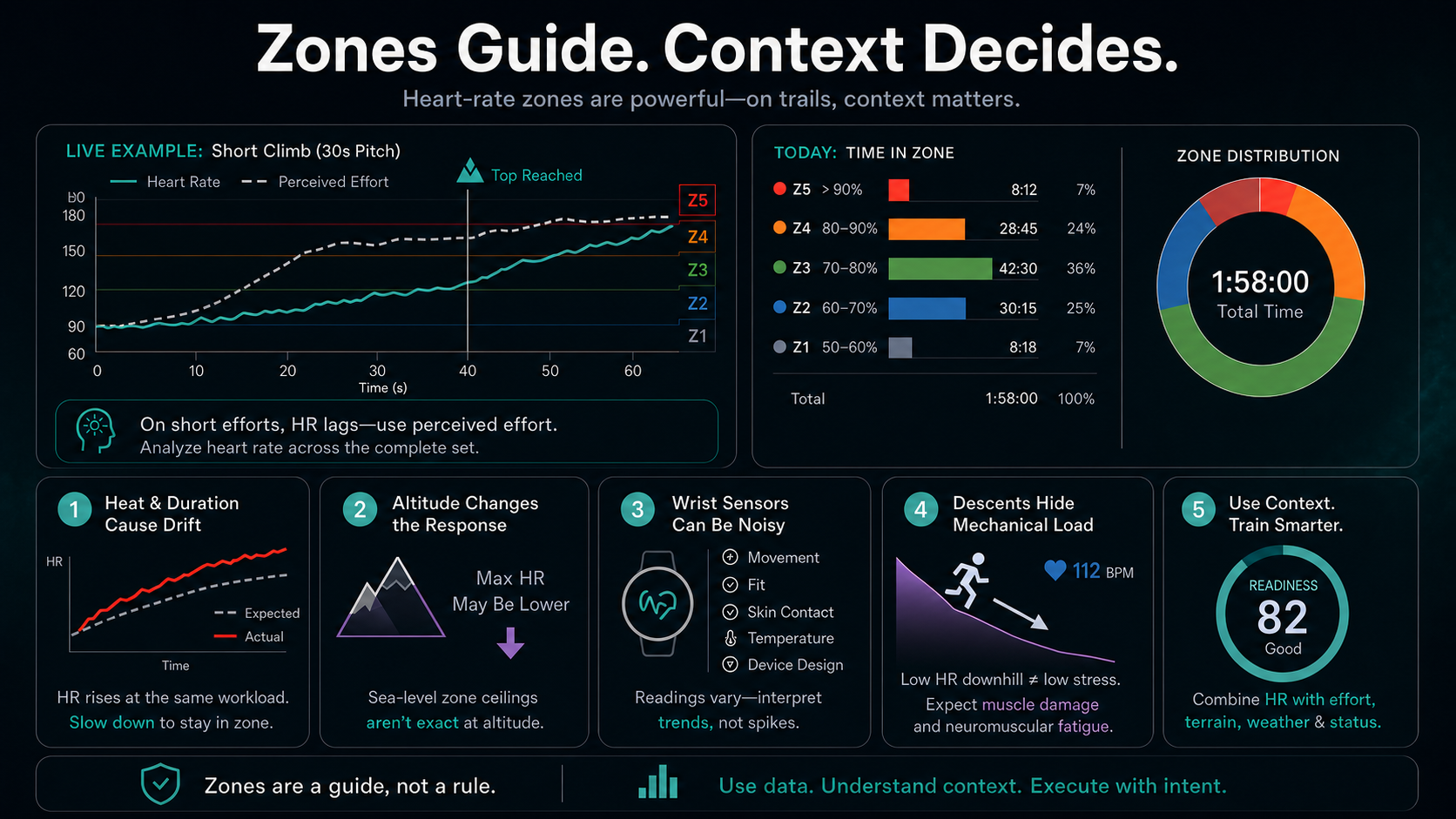
Heart rate takes time to rise. On a 30-second pitch, you may reach the top before the number reflects the effort. Chasing the zone early can cause an unnecessary surge. Use perceived effort on short repetitions and analyze heart rate across the complete set.
Heat and duration create cardiovascular drift
During prolonged exercise, heart rate may rise at a stable external workload. Heat can amplify that drift. A review by Wingo, Ganio, and Cureton connects progressive heart-rate rise with falling stroke volume and changing relative exercise intensity during heat stress (Exercise and Sport Sciences Reviews). On a long summer trail run, slowing down to preserve the intended zone may be the correct execution.
Altitude changes the response
Hypoxia can reduce maximal heart rate, although the magnitude varies across people and conditions. A review of 86 studies found an overall decline in maximal heart rate as hypoxia increased, with substantial variability (Mourot). Sea-level zone ceilings should not be treated as exact at meaningful altitude.
Wrist sensors can be noisy
Optical wrist monitors are convenient, but movement, fit, skin contact, temperature, and device design affect readings. A systematic review and meta-analysis found acceptable average validity for many common activities while still reporting variation by activity and device (Zhang and colleagues). If accuracy matters during intervals or cold, technical outings, a compatible chest strap may provide a cleaner trace.
Descents hide mechanical load
Downhill running can create eccentric muscle damage and neuromuscular fatigue even when heart rate falls. A narrative review found that downhill slope, duration, and speed influence the magnitude of these effects (Bontemps and colleagues). Low-zone descending is not automatically low-stress training.
Use a Trail Signal Hierarchy
When pace and heart rate disagree, do not choose one blindly. Use a hierarchy that starts with the workout's purpose.
| Situation | Lead signal | Supporting signals |
|---|---|---|
| Long easy trail run | Heart-rate zone | RPE, talk test, duration |
| Short uphill intervals | RPE and repeat quality | Heart rate after the lag |
| Steady sustained climb | Heart rate plus RPE | Vertical speed on similar climbs |
| Technical descent | Control and muscular effort | Pace, HR, soreness afterward |
| Hot long run | Heart rate plus drift context | RPE, hydration, temperature |
| High-altitude outing | Conservative RPE | HR trend, symptoms, altitude plan |
This hierarchy prevents a common mistake: forcing one metric to answer a question it was not designed to answer. Pace is excellent for output on comparable terrain. Heart rate is valuable for cardiovascular intensity. RPE integrates sensations the devices cannot measure. Technique and safety override both on difficult ground.
How to Execute Common Trail Workouts
For an easy trail run, set a Zone 2 ceiling and let pace float. Hike the steepest grades before breathing becomes labored. Brief spikes around obstacles are normal; repeated long excursions mean the route, pace, or plan is too aggressive for an easy day.
For a steady climbing workout, choose a continuous climb and hold a controlled Zone 3 effort. Compare vertical speed only with previous attempts on the same or similar grade. The goal is steady internal load, not an identical pace through every switchback.
For uphill intervals, prescribe duration and effort rather than distance pace. For example, complete five four-minute climbs around Zone 4 with easy downhill recovery. Let heart rate rise naturally during the first repeat. Judge the set by control, repeat consistency, and whether the final repeat resembles the first.
For a long trail run, use zones to prevent early overpacing. Many long events and outings become harder even while speed and heart rate fall. In one 106-kilometer mountain ultramarathon study, speed and heart rate declined through much of the event while perceived exertion increased (Kerhervé and colleagues). Fatigue changes the relationship among output, cardiovascular response, and perception.
For technical descents, ignore the temptation to “make up” average pace. Run at the speed that preserves foot placement and control. Record descent time, elevation loss, surface, and quadriceps soreness so the log captures the load that heart rate misses.
Review Trail Runs Segment by Segment
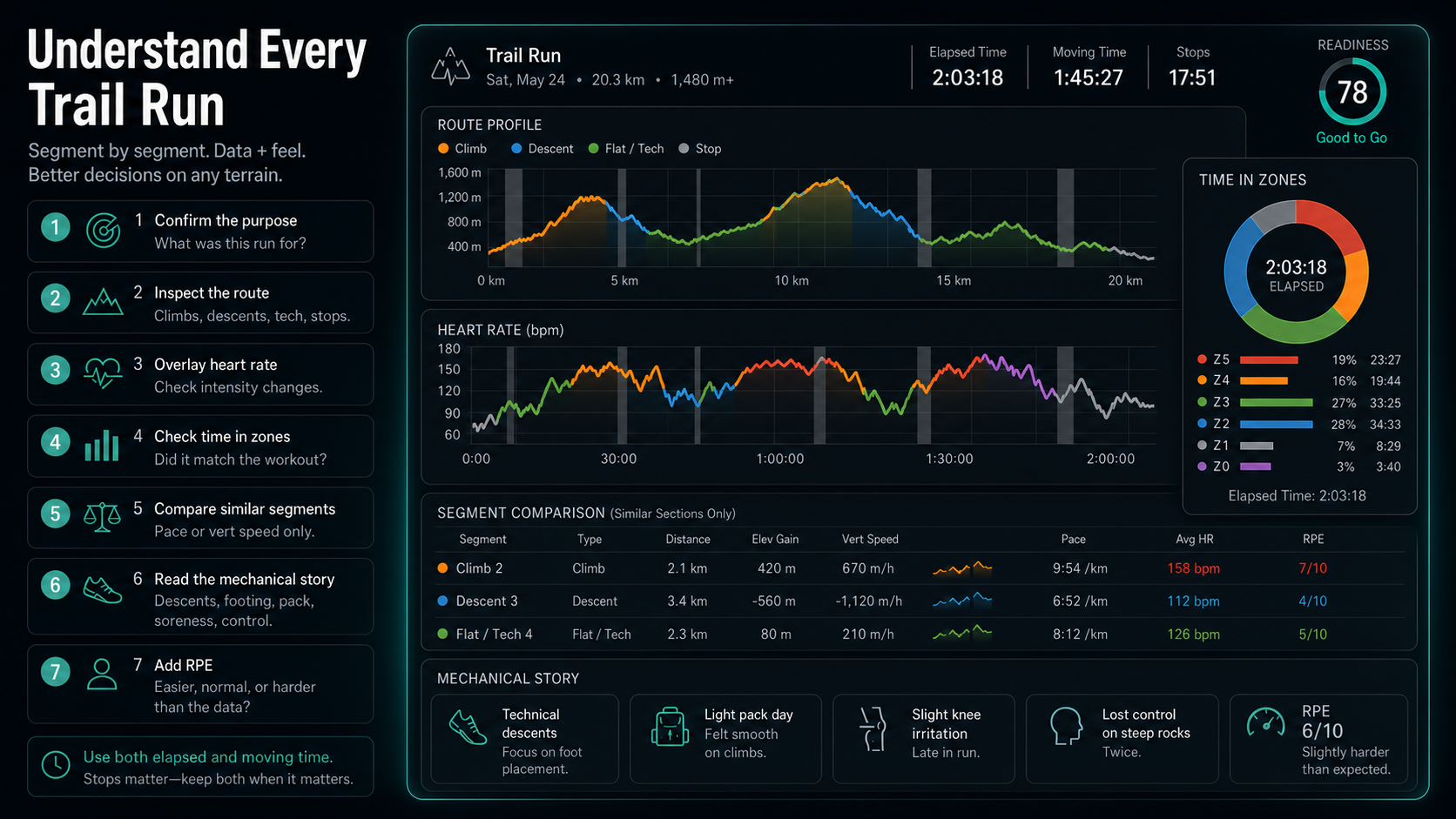
The average for a trail run blends unlike work. A two-hour activity may contain a Zone 2 approach, a Zone 4 climb, a low-heart-rate descent, and several stopped minutes. One average pace and one average heart rate conceal that structure.
Review the workout in this order:
- Confirm the purpose. Easy endurance, climbing tempo, hill intervals, long run, or race-specific practice?
- Inspect the route profile. Where were the climbs, descents, technical sections, and stops?
- Overlay heart rate. Did intensity rise where expected? Were there unexplained spikes or gaps?
- Check time in zones. Did the distribution match the workout type?
- Compare segments. Use pace or vertical speed only on sections similar enough to compare.
- Read the mechanical story. Note descents, footing, pack, soreness, and loss of control.
- Add RPE. Did the session feel easier, normal, or harder than the data suggest?
Use elapsed time and moving time deliberately. Stops are part of the outing experience, especially in races, navigation-heavy routes, or group runs. Removing every stop may exaggerate the pace you can sustain continuously; including long aid-station or photo stops may obscure running output. Keep both when the distinction matters.
How Zone Training Log Helps
Zone Training Log turns the workout from Apple Health or Health Connect into an intensity timeline rather than a pace verdict. Review time in heart-rate zones, average and maximum heart rate, duration, pace, distance, and elevation, then add the context the sensor cannot know.
Use titles and tags such as easy-trail, hill-repeats, technical, mud, heat, or altitude. In notes, record the smallest detail that changes interpretation: “hiked all pitches above 15%,” “watch lost HR in the cold,” “descent caused heavy quadriceps,” or “same climb, lower HR than last month.”
The useful comparison is rarely “all trail runs.” Filter down to the same workout type, route, climb, or terrain category. Then ask whether pace improved at the same zone, whether heart rate fell at the same vertical speed, or whether the same external output required less perceived effort.
That approach respects what trail performance research already suggests: performance is multifactorial, and standard road-running physiology explains only part of the result (de Waal and colleagues).
Common Mistakes
The first mistake is treating road pace as a trail entitlement. The mountain does not owe you a kilometer split.
The second is treating grade-adjusted pace as measured truth. It is an estimate that cannot fully model surface, turns, technicality, or gait changes.
The third is obeying heart rate when the trace is obviously wrong. Cadence lock, dropouts, or implausible jumps should reduce confidence, not change the workout.
The fourth is ignoring lag during short intervals. Use the intended effort and let heart rate catch up.
The fifth is calling every low-heart-rate descent easy. Cardiovascular intensity and mechanical stress are different load stories.
The sixth is comparing unrelated trail routes. Build benchmarks from repeatable segments, not from every run labeled “trail.”
The seventh is reviewing only averages. Trails are sequences of distinct demands. Analyze the parts before judging the whole.
Conclusion
Pace breaks on trails because speed no longer maps cleanly to effort. Grade, surface, technicality, weather, altitude, and fatigue change the cost of every kilometer. Heart-rate zones still work because they follow internal cardiovascular response as speed changes.
But zones are not magic. Set them well, combine them with perceived effort, account for lag and drift, distrust bad sensor data, and record downhill muscle load separately. Use pace as an output on comparable segments, zones as an intensity framework, and context as the explanation that makes both useful.
For longer mountain days where pack weight, sustained climbing, and descents become part of the training load, continue with zone training for hiking, fastpacking, and long climbs.

Our editorial approach & AI disclosure
We use AI to help research, organize, and draft some articles. Every article is reviewed by a human editor and aims to reflect current evidence-based training practices and scientific literature.
Read our editorial policy