
Heart Rate Zones
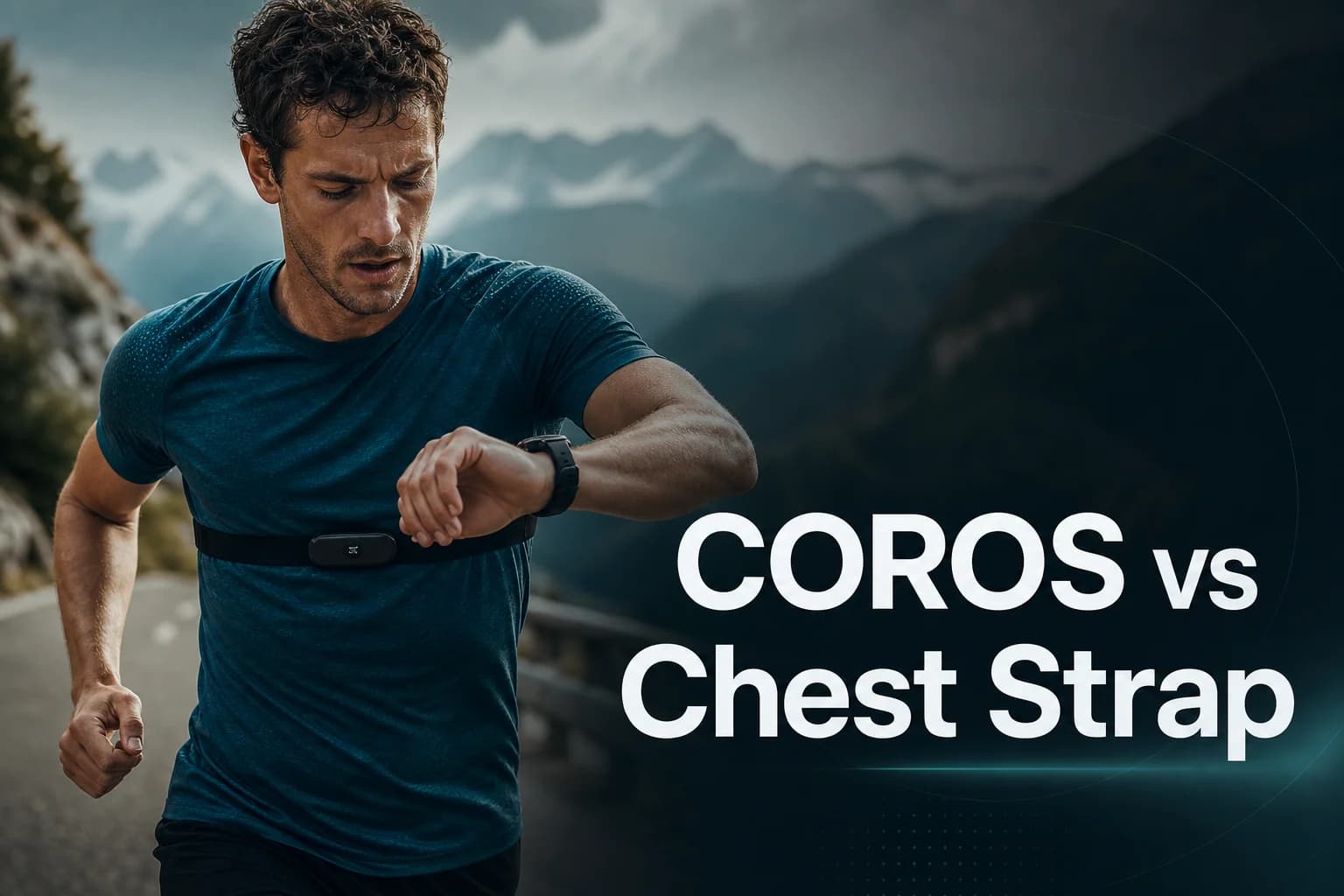
COROS vs Chest Strap
Compare COROS watch wrist heart rate with a chest strap, including cadence lock, cold weather, trail vibration, intervals, cycling, and the COROS optical arm monitor.
Introduction
A COROS watch can provide useful wrist heart-rate data during steady endurance sessions, especially when fit and temperature are favorable. A chest strap is the safer source for heart-rate-guided intervals, cold-weather training, cycling analysis, and workouts where cadence lock or trail vibration repeatedly distorts the optical signal.
Independent model-specific validation for COROS watches is limited compared with Apple, Garmin, Fitbit, Polar, and Samsung. That evidence gap matters. It means the most responsible answer combines established optical-sensor research, transparent COROS documentation, and a personal comparison rather than inventing a universal accuracy number.
COROS also offers an optical upper-arm monitor. It can reduce wrist-motion problems, but it remains an optical pulse sensor rather than an electrical chest strap.
How COROS Wrist Measurement Works
COROS explains that its watches use photoplethysmography: light enters the wrist and the reflected signal changes with blood flow. Algorithms attempt to separate pulse from noise and use activity-specific processing for running, cycling, swimming, and interval running (COROS measurement guide).
The signal can be affected by watch tightness, wrist position, cold, tattoos, skin characteristics, sweat, water, and movement. A chest strap instead detects electrical cardiac activity through electrodes. That usually improves responsiveness and reduces the influence of wrist mechanics.
Both can fail. A loose watch may admit light or move. A dry chest strap may spike or drop. Always ask which trace is physiologically plausible.
Cadence Lock Is the Signature Wrist Problem
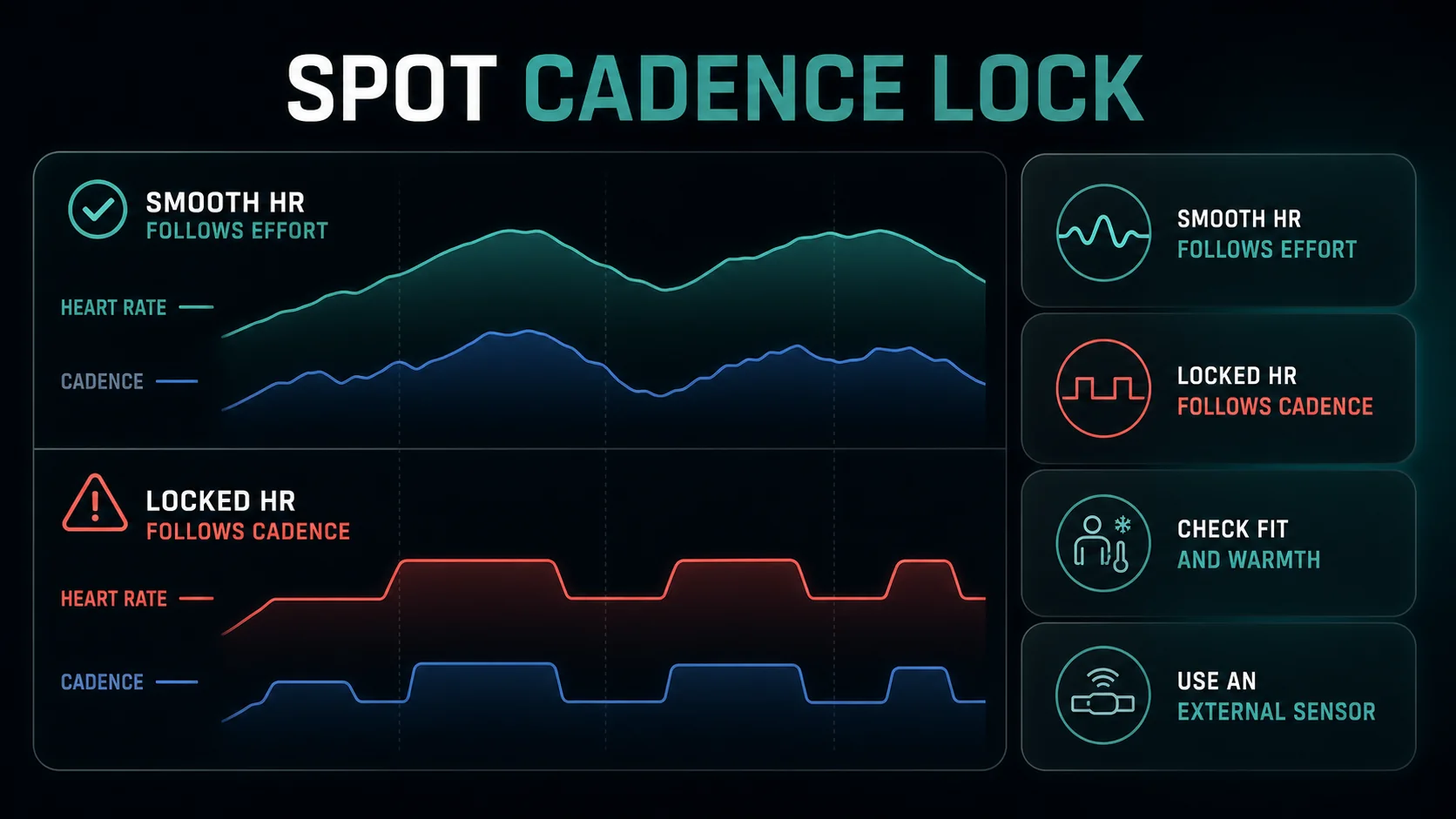
Cadence lock occurs when an optical system mistakes rhythmic movement for pulse and produces heart rate close to step cadence. COROS explicitly documents this problem, particularly in running and cycling, and recommends secure fit, clean sensors, and external sensors when accuracy is important (COROS inaccurate-data guidance).
The clue is not merely a high reading. Look for a sudden jump to a value close to cadence, a long unnaturally flat section, or heart rate that follows changes in step rate more quickly than changes in breathing and effort.
Cadence lock can inflate time in a higher zone during an easy run. It can also hide a real rise if the locked value is lower than physiological heart rate. Do not change zones or fitness conclusions from an affected segment.
What Broader Research Can Tell Us
A systematic review and meta-analysis of wrist optical devices found small average differences at rest and during treadmill activity, but larger differences during resistance training and cycling. Results varied across brands and protocols (Zhang and colleagues).
Another large systematic review emphasized that device accuracy changes with model and activity and that rapid product updates limit generalization from older studies (Fuller and colleagues). These studies support principles relevant to COROS, but they do not validate a particular COROS watch.
Until more independent model-specific work is available, treat COROS marketing or support statements as documentation of intended behavior, not independent proof. Your repeated comparison matters more than an unsupported precision claim.
Easy Runs and Long Trail Sessions
For steady road running, COROS wrist heart rate may be adequate when the watch sits above the wrist bone, fits snugly, and shows a plausible warm-up. Start easy and wait for the signal to stabilize before using it as a cap.
Trails add descents, poles, scrambling, vibration, temperature changes, and variable wrist motion. COROS warns that bumps and vibration can affect optical arm-monitor data as well, recommending secure upper-arm fit for trail and off-road cycling (COROS arm-monitor guidance).
Use breathing and perceived effort beside the watch. If a steep climb feels controlled and the trace rises gradually, the data may be useful. If a technical descent produces an implausible high plateau, mark the segment as sensor noise rather than cardiovascular strain.
Cold Weather
Cold reduces peripheral blood flow, weakening the optical pulse signal. COROS specifically recommends warming the body and hands and notes that the weather need not be extreme before readings are affected.
Wear gloves, cover the wrist, begin with a longer warm-up, and delay zone judgments until circulation improves. If winter heart-rate training matters, a chest strap usually removes the uncertainty more efficiently than repeated watch adjustments.
Document the source change. Chest-derived winter data may respond differently from wrist-derived summer data even when fitness is unchanged.
Intervals and Threshold Sessions
COROS provides an interval-running mode with processing intended for faster changes, but physiology and optics still lag work rate. Control short repetitions with pace, power, grade, and perceived effort. Review heart rate afterward.
Use a chest strap when interval peaks, recovery slopes, or threshold boundaries drive the session. COROS itself recommends chest straps or arm sensors for heart-rate-based programs and recognizes that electrical straps generally receive a stronger signal with less movement noise during intervals (COROS measurement guide).
For long tempo blocks, the watch may stabilize well. Compare the middle of each block rather than the opening seconds. Repeat unexpected findings before changing threshold settings.
Cycling and Strength Training
Cycling introduces wrist angle, handlebar pressure, and road vibration. A strap is the better choice for relating power to heart rate, calculating decoupling, or controlling indoor intervals.
Strength work adds gripping and wrist flexion, making the local optical environment unstable. Use COROS wrist heart rate as a broad session trace, not a precise measure of every set. Heart rate also misses much of the mechanical and neuromuscular load of lifting, so a more accurate strap does not turn heart rate into a complete strength metric.
An upper-arm optical monitor can improve comfort and reduce wrist artifacts. Choose it when a chest strap is impractical and your personal comparison shows acceptable response. Choose electrical sensing when exact response remains the priority.
Run a Three-Session Accuracy Check
Pair a compatible chest strap to the COROS watch, or record the strap on another synchronized device. Test:
- A flat 40-minute easy run.
- A progressive session with three five-minute stages.
- A trail, ride, or interval workout where wrist data often fails.
Compare average heart rate, stage plateaus, response lag, recovery, cadence-like flat sections, and dropouts. Inspect whether differences cross important zone boundaries. Repeat the problematic session after improving watch fit before concluding the hardware is unsuitable.
Which Sensor Should You Use?
Use COROS wrist data for convenient steady training and trends when the graph is plausible. Try the COROS upper-arm monitor if wrist movement is the main limitation and comfort matters. Use a chest strap for precise heart-rate prescriptions, winter intervals, cycling analysis, threshold testing, and repeated cadence lock.
The goal is not perfect agreement across every second. It is a reliable signal for the decision you need to make.
Diagnose COROS Error Shapes
Heart rate matches cadence
Treat the affected segment as probable cadence lock. Reposition and tighten the watch, use a stable warm-up, and repeat on the same route with a strap.
The first cold kilometers are unusually low
Reduced wrist circulation is a plausible cause. Warm the hands and body, cover the sensor, and compare the later stable segment separately.
Descents create high or noisy readings
Trail vibration and arm movement may dominate the optical signal. Use breathing, speed, grade, and the following climb to assess plausibility. A strap is preferable when descent data affects overall zone distribution.
Indoor cycling drops while gripping
Wrist angle and pressure are likely contributors. Move the watch higher, relax the grip during a check, or use the strap for all comparable rides.
The chest trace spikes at the start
Improve electrode contact and inspect the battery. Do not use an obviously faulty reference to “correct” the watch.
COROS Arm Monitor Versus a Chest Strap
The COROS arm monitor moves optical sensing to the upper arm, where there may be less wrist flexion and more stable contact. It is a sensible option for athletes who dislike chest straps or repeatedly encounter wrist cadence lock.
It does not remove every optical limitation. Vibration, fit, tattoos, temperature, and rapid motion can still affect it. COROS recommends a tight upper-arm fit for trail running, gravel, and mountain biking because external vibration can introduce noise.
Test the arm monitor and chest strap during the same progressive workout. If stage averages and transitions agree closely enough for your decision, the more comfortable arm source may be the better everyday choice. If precise RR timing or fast interval response matters, retain the electrical strap.
Example Decisions
- Road easy run: Wrist trace is smooth and consistent with conversation. Keep using the watch.
- Technical trail: Descents show cadence-like plateaus while climbs look plausible. Use a strap or arm sensor when whole-session distribution matters.
- Winter intervals: Wrist data remains low through the first repetitions. Use a chest strap rather than repeatedly adjusting effort.
- Long tempo: COROS settles after the opening minute and matches the strap through each block. The watch may be sufficient if the pattern repeats.
- Bike intervals: Power rises immediately while wrist heart rate reacts inconsistently. Use a strap for power-to-heart-rate comparisons.
Record the Source in Your Training Log
Write down whether each benchmark used wrist, upper-arm optical, or chest electrical data. Also note a device upgrade, firmware period, unusually cold weather, or a known cadence-lock segment.
Without those notes, cleaner data from a new source can look like sudden fitness improvement or decline. Measurement continuity is part of good training analysis.
Avoid False Precision
Even a perfect sensor would not make heart rate a fixed output. Heat, hydration, sleep, stress, caffeine, altitude, fatigue, and recent training all change the response. Compare standardized sessions and broad trends rather than correcting every beat.
Conclusion
COROS wrist heart rate is useful, but the available independent evidence does not justify a single universal accuracy rating. Fit, cold, cadence, vibration, activity, and individual physiology all change the result.
Use your watch confidently when steady data is plausible, and use an external sensor when errors alter the workout. Read Apple Watch vs Chest Strap for the underlying technology and check equivalent boundaries with the Zone 2 Heart Rate Calculator.
Our editorial approach & AI disclosure
We use AI to help research, organize, and draft some articles. Every article is reviewed by a human editor and aims to reflect current evidence-based training practices and scientific literature.
Read our editorial policy