

Zone 2 Training
Zone 2 Training in the Heat: How to Adjust Pace
Heat raises heart rate and makes familiar paces more costly. Learn how to adjust Zone 2 pace, warm-up, hydration, route, and expectations while keeping the workout useful.

Expect Zone 2 Pace to Slow in the Heat
Hot-weather Zone 2 training often requires a slower pace or lower power than the same workout in cool conditions. Your body must support working muscles and move heat toward the skin at the same time. Heart rate rises, perceived effort increases, and a familiar easy pace can become a moderate effort.
The right adjustment is usually to protect the internal intensity and let speed change. Begin more slowly, choose cooler times and routes, use breathing and perceived effort with heart rate, and shorten the session when strain keeps rising.
Do not compare a hot run with your cool-weather pace as if the conditions were equal. The workout can still be productive even when the distance is shorter.
Why Heart Rate Rises at the Same Pace
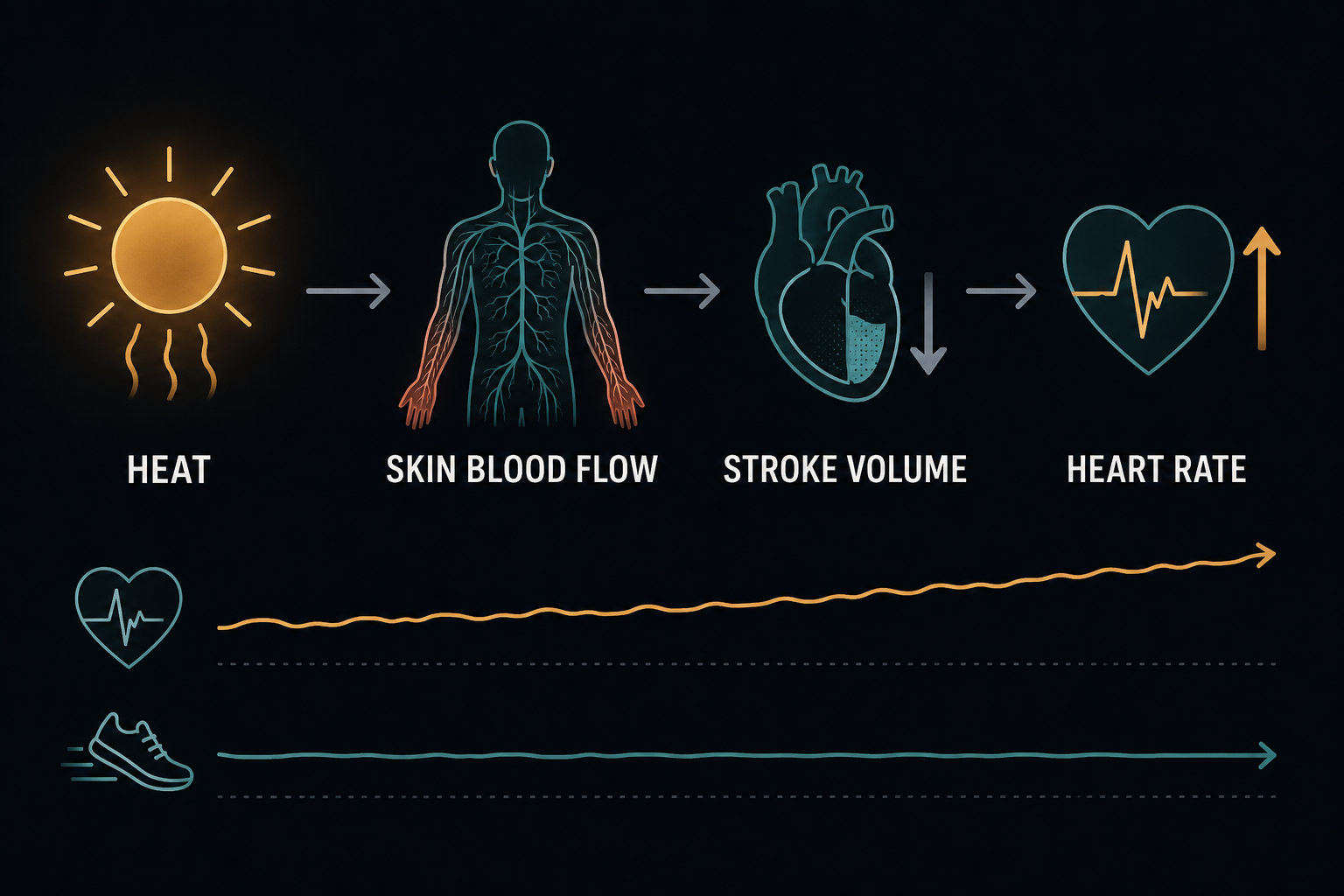
During prolonged exercise, heart rate may gradually increase while stroke volume falls. This pattern is called cardiovascular drift. Heat makes the challenge larger because more blood flows toward the skin to support cooling.
A review by Wingo, Ganio, and Cureton describes cardiovascular drift as a progressive rise in heart rate and fall in stroke volume during prolonged moderate exercise, with stronger implications under heat stress (Exercise and Sport Sciences Reviews). A later review explains that hot skin changes blood-flow demands and can reduce stroke volume during moderate and intense exercise, contributing to a higher heart rate (Temperature).
Heart rate in the heat is not merely “wrong.” It reflects part of the increased internal cost. At the same time, heart rate alone cannot tell you core temperature, hydration status, or heat-illness risk. Use it with symptoms, conditions, breathing, and perceived effort.
Heart Rate or Pace: Which Should Control the Session?
For an easy aerobic day, let internal effort control the workout. Heart rate is useful after the warm-up when the signal is stable and your zone boundaries are credible. Breathing and perceived effort help confirm whether the reading matches how hard the body is working.
Use this order:
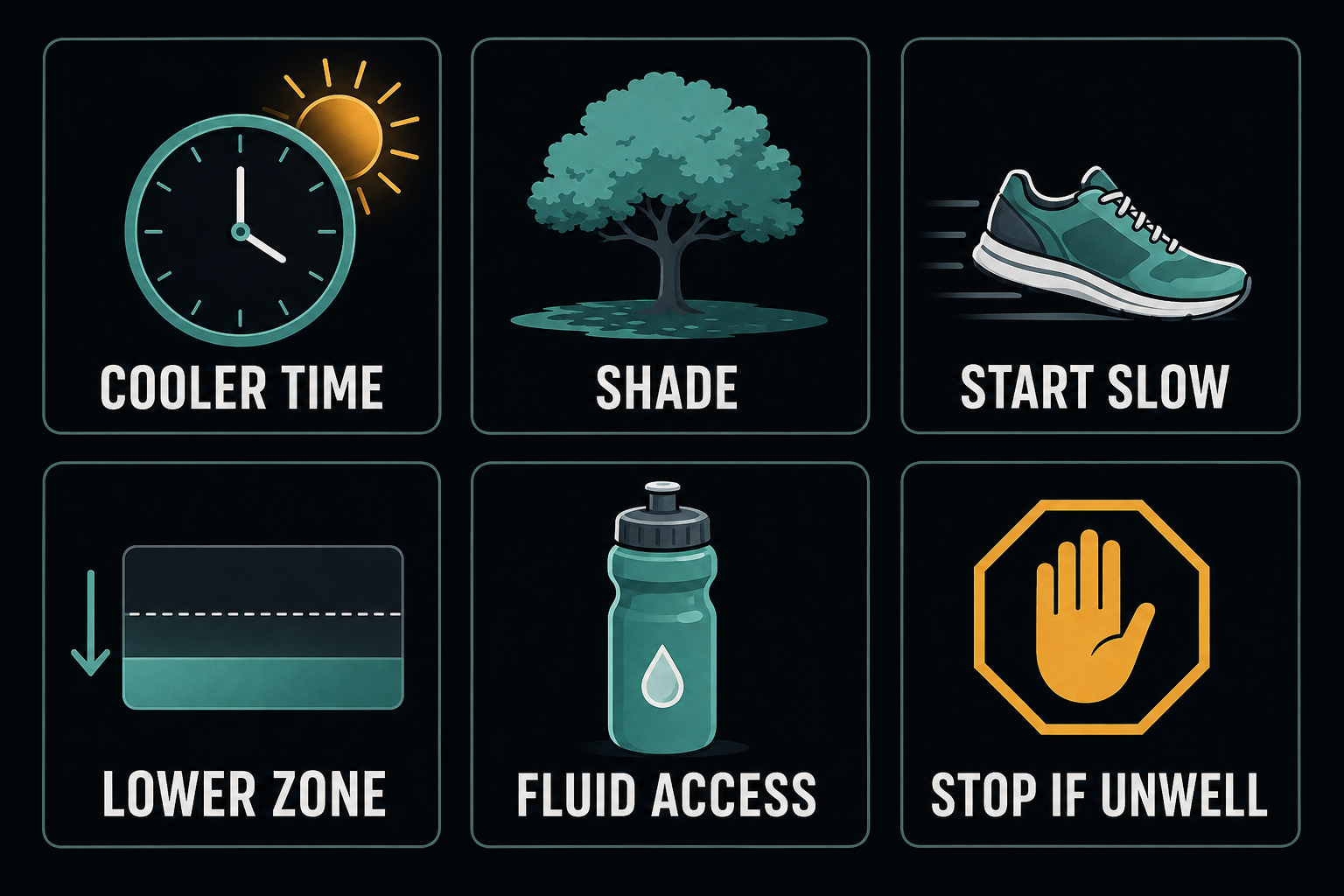
- Safety and symptoms: stop if you feel faint, weak, confused, unusually nauseated, or otherwise unwell.
- Breathing and effort: the session should remain controlled, with comfortable sentence-level speech.
- Heart-rate trend: watch whether the value stabilizes or continues to climb at the same workload.
- Pace or power: allow output to fall enough to preserve the first three.
The CDC advises athletes in hot conditions to schedule activity for cooler times, start slowly, drink more water than usual, and stop activity if they feel faint or weak (CDC Heat and Athletes). Those safety decisions take priority over completing a planned duration or zone target.
How Much Should You Slow Down?
There is no universal seconds-per-kilometer adjustment. Temperature, humidity, sun, wind, acclimation, body size, clothing, hydration, and route all interact. A fixed conversion can create false precision.
Use the opening 15 minutes to calibrate:
- Start below your normal easy pace.
- Keep the first 8 to 10 minutes deliberately light.
- Check breathing and perceived effort before chasing a heart-rate number.
- Let heart rate settle near the lower half of Zone 2.
- Hold pace for several minutes before making another change.
If heart rate rises toward the upper boundary while pace is unchanged, reduce speed or power by a small step. If it keeps rising, add a walk or easy-spin break, choose a shaded route, or end earlier.
On hills, control effort instead of pace. Walk steep grades if necessary. For cycling, reduce power and use airflow where possible. For a treadmill, a fan can materially change thermal strain even though the room temperature stays the same.
Use a Heart-Rate Cap With Flexibility
A cap near the upper end of your normal Zone 2 can prevent an easy day from becoming sustained moderate work. It should remain a guardrail, not a command to stop every time the display crosses by one beat.
Heart rate lags after changes in pace and fluctuates with sensor noise. Look for sustained trends over several minutes. Brief boundary crossings on a hill are less important than a steady climb that continues on flat ground.
Start in the lower half of the zone because drift leaves less room later. If your normal Zone 2 is 135–150 bpm, for example, you might settle near 138–143 early rather than immediately running at 149. These numbers illustrate the strategy; use your own validated boundaries.
Our guide to easy pace versus Zone 2 explains how to combine heart rate, pace, breathing, and terrain when the signals disagree.
Hydration Helps, but It Does Not Cancel Heat
Sweat loss can worsen cardiovascular strain, but drinking does not make a hot environment equivalent to a cool one. Fluid needs vary widely, and both underdrinking and excessive drinking can create problems.
Begin normally hydrated, make fluids available for longer sessions, and learn your own sweat loss across comparable conditions. Do not treat body-mass loss as a target to eliminate at any cost. Thirst, session length, access to fluid, and individual sweat rate all matter.
A controlled study found that hypohydration increased cardiovascular drift during steady cycling even when measured blood volume remained at euhydrated levels, showing that the response is more complex than one simple fluid explanation (Journal of Applied Physiology). Hydration can reduce avoidable strain, but pace, environment, and cooling remain important.
Heat Acclimation Changes the Baseline
Repeated, controlled exposure to exercise in heat can reduce physiological strain. A large quantitative review reported lower resting and end-exercise heart rate, lower core temperature, expanded plasma volume, and improved heat-exercise capacity across acclimation studies (Comprehensive Physiology). The average protocols in that review involved multiple exposures; one hot run was not acclimation.
Expect the first hot sessions of a season to feel disproportionately hard. Reduce duration and intensity, then progress as the response stabilizes. Acclimation does not remove risk, and adaptation fades when heat exposure stops.
For everyday training, you do not need an aggressive heat protocol. Consistent easy sessions at safer times, with conservative pacing and recovery, can provide exposure without turning every day into a heat challenge.
A Practical Hot-Weather Zone 2 Session
Use this structure for a normal aerobic day:
Before
- Check temperature, humidity, sun exposure, and air quality.
- Choose early morning, evening, shade, or an indoor alternative when conditions are severe.
- Begin normally hydrated and carry fluid when duration and conditions justify it.
- Wear light, breathable clothing.
Warm-up: 10–15 minutes
Start in Zone 1 or below your usual easy pace. Let skin temperature and heart rate rise gradually. Resist the urge to recover your normal pace in the first kilometer.
Steady block: 20–45 minutes
Settle in the lower to middle part of Zone 2. Check sentence-level speech. Reduce pace when heart rate trends upward at unchanged effort. Add short easy recoveries if needed.
Cool-down: 5–10 minutes
Finish very easily and move to a cooler area. Record conditions and how the second half compared with the first.
Shorten every block for beginners, early-season heat, poor recovery, or unusually harsh weather. The aerobic value comes from controlled accumulation, not completing a template at any cost.
How to Review the Workout
Compare the first and second halves after excluding the warm-up. Note:
- pace or power;
- average heart rate;
- heart-rate drift;
- perceived effort and talk test;
- temperature, humidity, sun, and wind;
- fluid access;
- symptoms and recovery afterward.
A slower second half at stable heart rate may show good intensity control. A stable pace with steadily rising heart rate and harder breathing shows increasing internal load. A lower heart rate after several similar hot sessions may reflect acclimation, but compare like conditions before drawing conclusions.
Use the method in how to analyze heart-rate zones after a workout to separate a few boundary crossings from a sustained shift in the session.
Common Mistakes
The first is chasing cool-weather pace. This changes an easy workout into a harder one.
The second is starting at the top of Zone 2. Normal drift leaves no room for the second half.
The third is treating hydration as complete protection. Fluids do not remove the thermal load.
The fourth is using heart rate while ignoring symptoms. A zone display cannot declare unsafe conditions safe.
The fifth is judging fitness from one hot run. Record the environment and compare trends across similar sessions.
Keep the Aerobic Purpose
Heat changes the relationship between pace and heart rate. Slow down early, leave room for drift, and use breathing and perceived effort to confirm that the session remains easy. Choose cooler conditions or an indoor alternative when the cost keeps rising. When running stays too demanding, walking can still count as Zone 2 training if it reaches a credible easy aerobic effort.
A hot-weather Zone 2 run may look slow in the training log and still be the right workout. The useful outcome is controlled aerobic time with manageable recovery, not a pace that belonged to a different day.

Our editorial approach & AI disclosure
We use AI to help research, organize, and draft some articles. Every article is reviewed by a human editor and aims to reflect current evidence-based training practices and scientific literature.
Read our editorial policy