

Workouts
Indoor Cycling and Heart Rate Zones
Indoor cycling can push heart rate higher at the same power because cooling, airflow, hydration, and session duration change the internal cost. Learn how to use heart rate zones indoors without overreacting to drift.

Introduction
Indoor cycling and heart rate zones work best when you remember one important rule: the zones may be the same, but the environment is not. A Zone 2 ride on the road and a Zone 2 ride on the trainer can feel very different because airflow, room temperature, sweat evaporation, hydration, boredom, and session duration all change the internal cost of the same watts. For the broader setup and workout framework, start with heart-rate-zone training for cyclists.
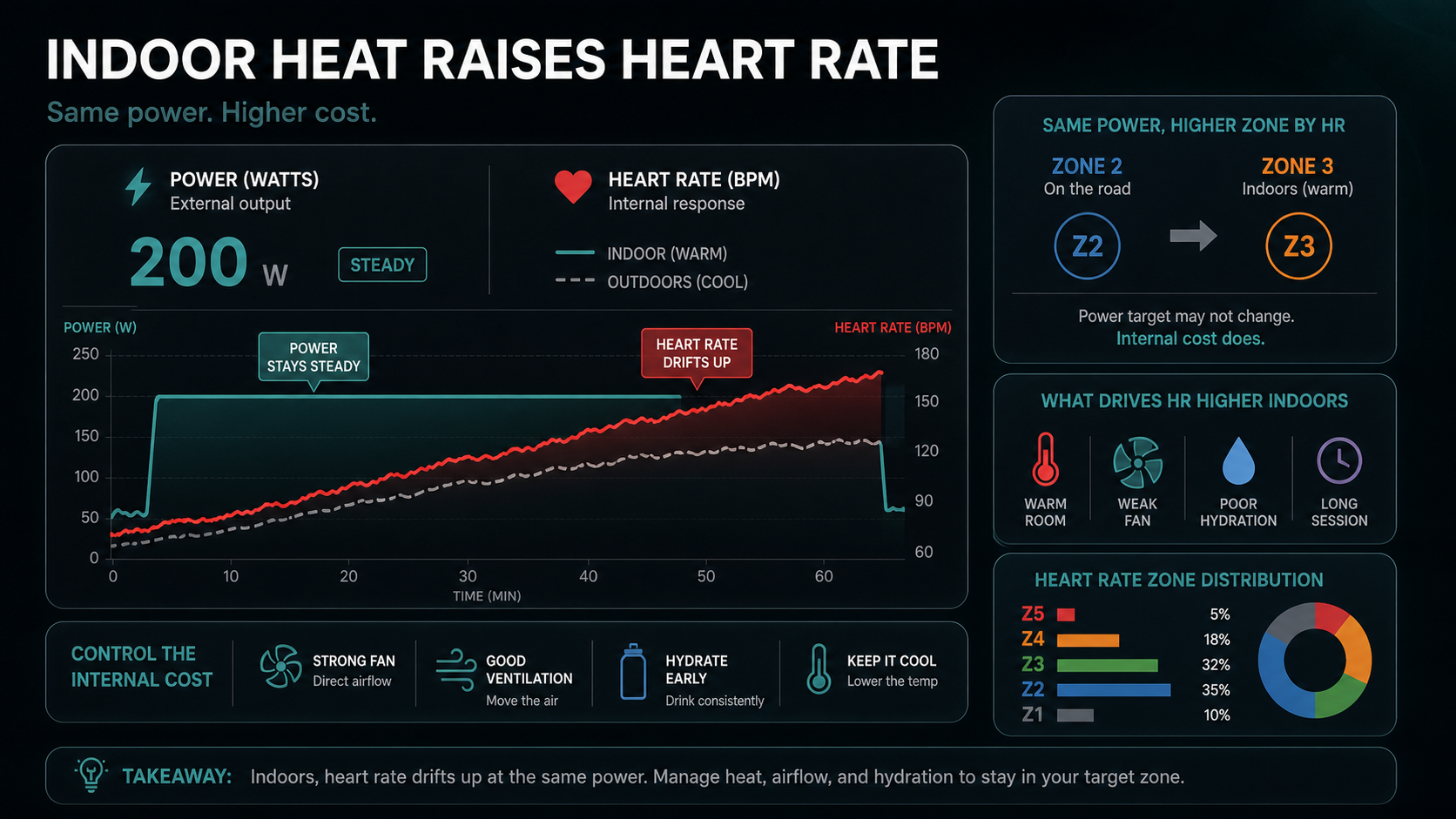
That is why many cyclists notice a familiar indoor pattern. The power target is steady. The cadence is steady. The trainer resistance is steady. But heart rate keeps creeping upward until an easy ride becomes Zone 3 by heart rate. The ride did not necessarily become a failed workout. It became a different physiological problem: managing heat, cooling, and drift while still respecting the purpose of the session.
Heart rate is useful indoors because it shows internal load. Power shows the work you are doing at the pedals. Heart rate shows how costly that work is today. Achten and Jeukendrup describe heart-rate monitoring as useful for exercise prescription and training control, while also noting that interpretation depends on context and physiological conditions (Sports Medicine). Indoor cycling is exactly the kind of context where that caution matters.
This guide explains why indoor heart rate behaves differently, how to use zones on the trainer, when to follow power instead, what to do when heart rate drifts upward, and how to review indoor rides in Zone Training Log.
Why Indoor Cycling Changes Heart Rate
Indoor cycling often raises heart rate at the same power because cooling is worse than outdoors. On the road, even moderate speed creates airflow across the skin. That airflow helps sweat evaporate and helps the body move heat away. Indoors, the bike is stationary. Unless fans and ventilation replace the missing airflow, heat builds around the rider.
As heat strain rises, heart rate can drift upward even if external work stays steady. Coyle and Gonzalez-Alonso reviewed cardiovascular drift during prolonged exercise and described how heart rate can rise over time as cardiovascular strain increases, especially with heat stress and dehydration (Exercise and Sport Sciences Reviews).
For indoor cyclists, the practical version is simple: same power does not always mean same internal load.
| Indoor factor | What it can do to heart rate |
|---|---|
| Weak fan or no fan | Raises heat stress and sweat rate |
| Warm room | Raises cardiovascular strain |
| Poor ventilation | Keeps hot, humid air around the rider |
| Long steady ride | Gives drift more time to appear |
| Low fluid intake | Can increase strain during longer sessions |
| Accumulated fatigue | Makes normal power feel more costly |
Hydration and heat are especially important during indoor sessions because sweat can be high while airflow is low. The American College of Sports Medicine position stand on exercise and fluid replacement describes how fluid deficits and heat stress can impair physiological function and increase strain during exercise (Medicine & Science in Sports & Exercise).
This does not mean every indoor ride requires a complicated hydration plan. It means the heart-rate graph should be read with the room in mind. A warm garage trainer session with one small fan is not the same physiological environment as a cool outdoor ride.
Use The Same Zones, But Interpret Them Differently
Most cyclists do not need separate indoor heart-rate zones. If your zones are based on a good cycling-specific heart-rate anchor, such as threshold heart rate or a reliable maximum heart rate, the zone ranges can stay the same. What changes is the likelihood that indoor conditions push you into higher zones at the same output.
That distinction matters. If your Zone 2 heart-rate range is 130 to 145 bpm, it is still 130 to 145 bpm indoors. But a power target that normally keeps you at 138 bpm outside may produce 148 bpm indoors after 45 minutes. The zone did not change. The cost of the session changed.
Use the Heart Rate Zone Calculator if your zones are still rough estimates. Use cycling-specific values when possible. Running heart-rate zones may not transfer cleanly to cycling because posture, muscle recruitment, local fatigue, and cooling differ by sport. Age-predicted maximum heart-rate formulas are also only broad estimates. Tanaka, Monahan, and Seals proposed a revised age-based equation, but age formulas still describe populations better than individuals (Journal of the American College of Cardiology).
Once your zones are reasonable, the main indoor question becomes: does the heart-rate zone match the purpose of the ride?
If the session is a recovery spin, heart rate should stay low. If the session is an easy aerobic ride, most of the work should remain controlled. If the session is a planned tempo or threshold workout, higher zones are not a problem because they are part of the design.
How To Ride Zone 1 And Zone 2 Indoors
Zone 1 and Zone 2 indoor rides are harder than they look because the trainer removes many natural brakes. There are no traffic lights, descents, coasting moments, corners, or changes in terrain. That makes the workout controlled, but it also makes it easier to accumulate uninterrupted strain.
For Zone 1 recovery rides, heart rate and perceived effort should lead the decision. The goal is low internal load. If heart rate rises into Zone 3 during a ride that was supposed to restore you, reduce resistance, add cooling, shorten the session, or stop. A recovery ride is not more successful because it produced more watts.
For Zone 2 endurance rides, use heart rate, power, and feel together. Power can keep the ride honest. Heart rate can keep it aerobic. Perceived effort can catch days when the numbers do not tell the whole story.
A simple indoor Zone 2 setup looks like this:
| Setup choice | Practical target |
|---|---|
| Fan | Strong airflow to torso and face |
| Room | Cool enough that sweating is manageable |
| Warmup | 10 to 15 minutes before judging zones |
| Drink | Easy access before the ride starts |
| Power | Smooth, not surge-heavy |
| Review | Compare first half and second half heart rate |
If heart rate drifts late but still feels controlled, the ride may be acceptable. If heart rate climbs early, breathing changes, and Zone 2 power feels like tempo, the ride is no longer easy for your body.
Tempo, Threshold, And VO2 Workouts Indoors
Indoor cycling is excellent for structured workouts because power is repeatable. The trainer makes it easy to hold a target without wind, traffic, or terrain. That is useful for tempo, sweet spot, threshold, and VO2 max sessions.
For these workouts, power usually leads execution. Heart rate lags behind changes in effort, so it is not ideal for pacing the first minutes of an interval. If a 3-minute interval is prescribed by power, do not chase heart rate from the start. By the time heart rate reaches the expected zone, the interval may already be halfway over.
Use heart rate as a review signal instead:
| Workout | Use power for | Use heart rate for |
|---|---|---|
| Tempo | Holding steady pressure | Checking whether the cost is normal |
| Threshold | Pacing the interval | Watching accumulated strain |
| VO2 max | Hitting repeat intensity | Confirming high internal load later |
| Sprint work | Execution and recovery | Limited value during the effort |
This power-plus-heart-rate approach matches the broader training-load principle that external work and internal response are different but complementary. Bourdon and colleagues describe why athletes and coaches monitor both external and internal load to understand training stress more clearly (International Journal of Sports Physiology and Performance).
Indoors, this matters because a workout can be perfectly executed by power and still be more stressful than expected if the room is hot, the fan is weak, or fatigue is high.
What To Do When Indoor Zone 2 Becomes Zone 3
If an indoor Zone 2 ride becomes Zone 3 by heart rate, start with context before judging the ride.
Ask these questions:
| Question | Why it matters |
|---|---|
| Did heart rate rise gradually? | Gradual rise suggests drift |
| Did power stay steady? | Steady power plus rising HR points to internal cost |
| Was the room warm? | Heat can raise cardiovascular strain |
| Was airflow strong enough? | Weak airflow is common indoors |
| Did you drink enough? | Fluid loss can worsen strain |
| Was the ride meant to be easy? | Purpose decides whether Zone 3 matters |
If the ride was meant to be easy and Zone 3 appeared early, lower the target. If Zone 3 appeared only late, consider shortening future rides, improving cooling, or splitting the session into blocks. If the ride was meant to include tempo, Zone 3 may be exactly what you planned.
Do not overcorrect from one ride. Heart rate can be noisy. Sensor fit, fatigue, caffeine, sleep, and stress can all change the graph. But if the same indoor workout repeatedly produces higher heart rate than outdoors, treat that as useful feedback. Your setup may need stronger cooling, or your indoor power target may need to be lower for easy days.
Practical Indoor Zone Scenarios
Imagine a 75-minute endurance ride where the first 35 minutes sit in Zone 2 by power and Zone 2 by heart rate. Then power stays the same, but heart rate climbs into Zone 3 for the final 25 minutes. That is not automatically a bad ride, but it is not identical to a clean Zone 2 session either. If the goal was low-stress aerobic work, the better next step is usually stronger cooling, more fluid access, a slightly lower power ceiling, or a shorter indoor version of the ride.
Now imagine a threshold workout with 4 x 8 minutes at a clear power target. Heart rate may start below the expected zone during each interval and rise as the work accumulates. That is normal. If you try to force heart rate into the target zone in the first minute, you may overshoot power and make the workout harder than intended. For structured work, execute the interval by power and perceived effort, then use heart rate afterward to judge whether the cost was typical.
Finally, imagine a recovery spin where the planned effort is very easy, but heart rate is elevated from the first 10 minutes. The power is low, but the body is not responding like it is recovered. In that case, heart rate and feel should matter more than finishing the file. Reduce the load, improve cooling, or stop early. The purpose of the session is recovery, not proving that you can complete an arbitrary duration.
These examples all point to the same habit: compare the heart-rate zone with the workout's purpose. Indoor cycling gives you control, but control is only useful when the session still creates the intended stress.
How To Review Indoor Rides By Zone
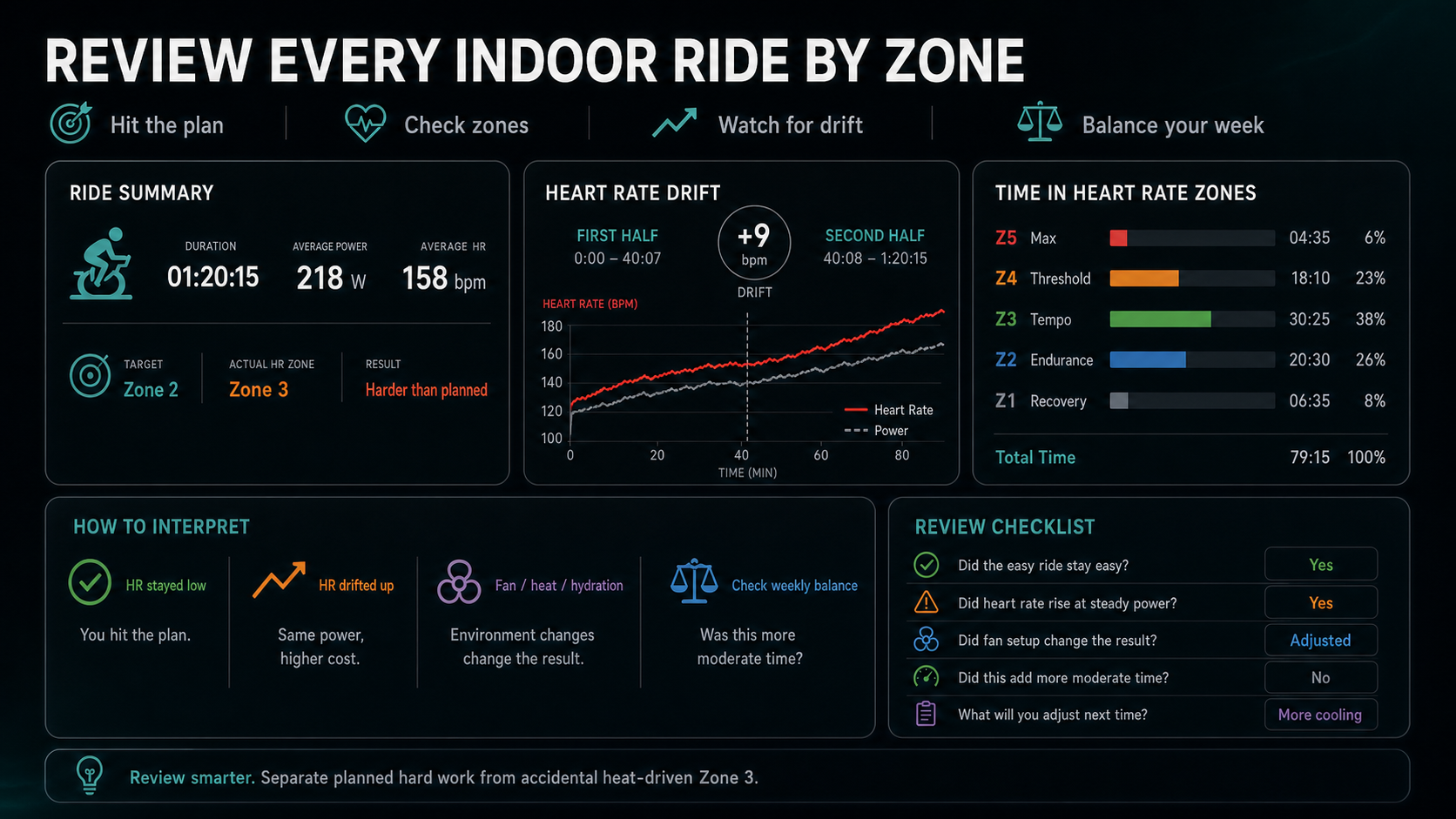
After an indoor ride, do not only ask whether the workout hit the target watts. Ask whether the heart-rate zones matched the purpose of the workout.
In Zone Training Log, a useful indoor review starts with four checks:
| Review check | What to look for |
|---|---|
| Target match | Did the planned easy, tempo, or hard work happen? |
| Time in zones | Did the ride spend too much time in Zone 3? |
| Drift | Did heart rate rise at steady power? |
| Weekly balance | Did this ride change the week's intensity mix? |
This matters because indoor rides can quietly create more moderate intensity than planned. A 60-minute endurance ride that becomes Zone 3 for the final 25 minutes is not the same as a clean low-intensity ride. It may still be useful, but it should be counted honestly.
Endurance training research does not give every cyclist one perfect zone distribution, but it does support being intentional with intensity. Seiler's review discusses the common pattern of substantial low-intensity volume and carefully placed higher-intensity work in successful endurance training (International Journal of Sports Physiology and Performance).
For indoor cycling, the takeaway is practical: do not let heat-driven Zone 3 replace planned easy volume without noticing.
Use RPE Alongside Heart Rate
RPE means rating of perceived exertion. It is your subjective sense of how hard the ride feels. Indoors, RPE is especially useful because heat and monotony can make a ride feel harder than the power target suggests.
Foster's work on session RPE helped popularize a simple way to monitor training load by combining session duration with perceived effort (Journal of Strength and Conditioning Research). You do not need to turn every ride into a formal scoring exercise, but you should write down the pattern when it matters.
For example:
| Data pattern | Possible interpretation |
|---|---|
| Power normal, HR normal, RPE normal | Workout likely matched plan |
| Power normal, HR high, RPE high | Heat, fatigue, hydration, or illness may be involved |
| Power low, HR high, RPE high | Consider recovery or easier training |
| Power high, HR low, RPE controlled | Fitness, freshness, or sensor issue to verify |
RPE also protects you from blindly trusting a bad sensor. If the heart-rate trace jumps suddenly, locks to cadence, or shows impossible values, perceived effort and power can help you avoid false conclusions.
Indoor Setup Rules For Better Zone Control
Small setup changes can make indoor zones much easier to control.
Use at least one strong fan. Aim airflow at the torso and face, not just the front wheel. If possible, use a second fan from the side. Open a window or door if the room becomes humid. Put bottles, towel, remote, and nutrition within reach before the ride starts so you are not forced to choose between stopping and ignoring basic needs.
Warm up before judging the ride. Heart rate can be unstable in the first few minutes. Let the body settle, then decide whether the target is right.
Avoid racing every indoor ride. Smart trainers and virtual platforms can make easy sessions competitive. That is fine when the plan calls for intensity, but it can ruin recovery days and base rides. The best indoor setup is not the one that makes every ride harder. It is the one that helps each ride do its job.
Conclusion
Indoor cycling heart rate zones are not fundamentally different from outdoor zones. The environment is different. Because airflow is lower and heat can build quickly, heart rate often rises at the same power indoors. That can turn an easy ride into a moderate internal-load session if you do not manage cooling, hydration, pacing, and duration.
Use power to control structured indoor work. Use heart rate to understand internal cost. Use perceived effort to sanity-check both. For easy rides, keep the internal load easy. For hard rides, let power guide the interval and review heart rate afterward. After each trainer session, look at time in zones, drift, and weekly balance so indoor training supports the plan instead of quietly changing it.

Our editorial approach & AI disclosure
We use AI to help research, organize, and draft some articles. Every article is reviewed by a human editor and aims to reflect current evidence-based training practices and scientific literature.
Read our editorial policy