

Heart Rate Zones
WHOOP vs Chest Strap
Compare WHOOP optical heart rate with an electrical chest strap, including wrist versus upper-arm placement, rapid transitions, Strain, recovery metrics, and workout decisions.

Introduction
WHOOP is designed for continuous optical measurement, while a chest strap is designed primarily to capture exercise heart rate responsively. WHOOP can be useful for all-day trends, sleep, recovery context, and many steady workouts. A chest strap is usually the clearer reference for rapid changes and precise interval analysis.
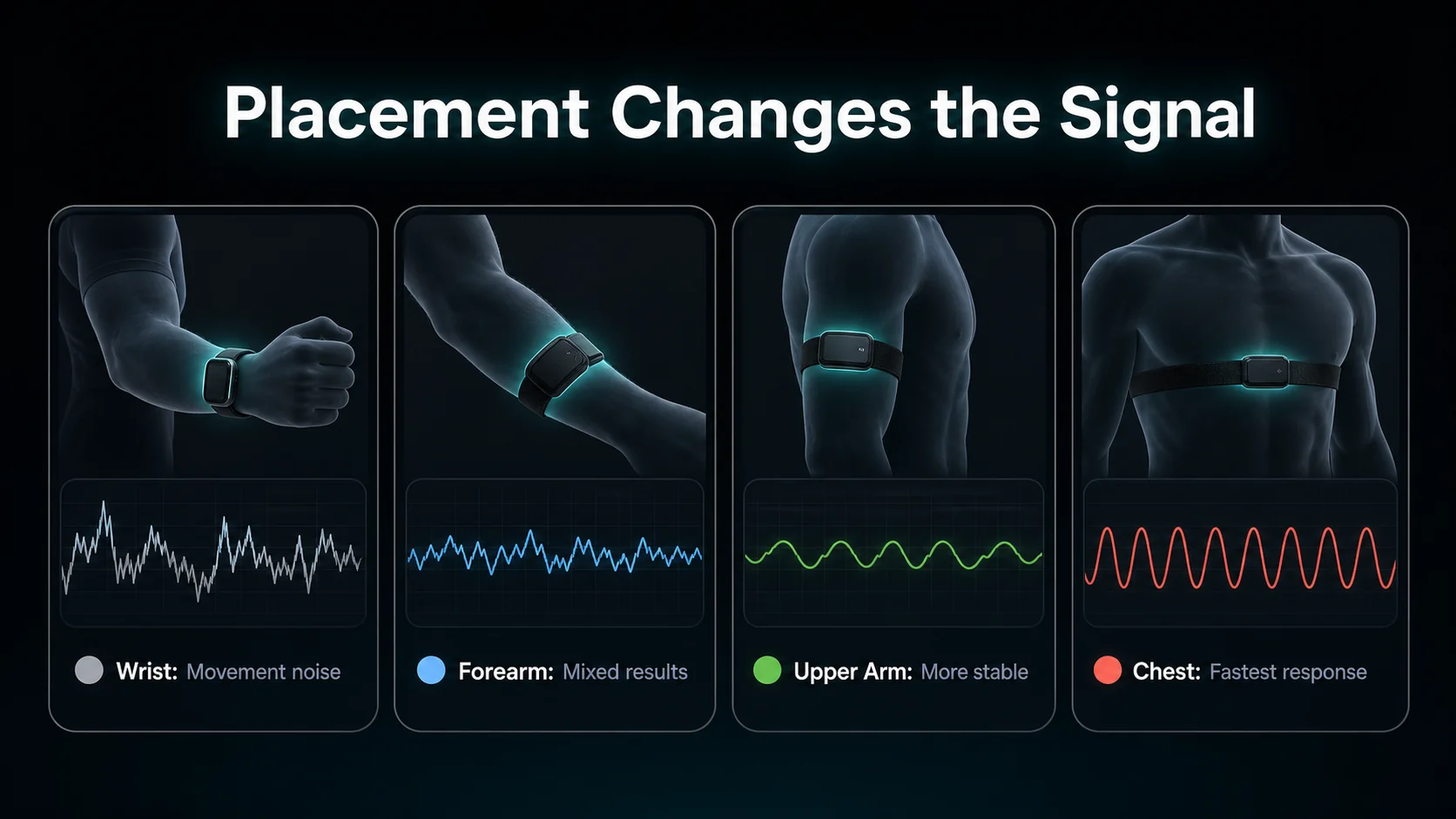
Placement makes this comparison unusual. WHOOP can be worn at the wrist or in compatible alternate locations, including the upper arm. Independent research suggests upper-arm placement can materially improve exercise heart-rate agreement compared with wrist placement in some activities.
The right question is therefore not simply “WHOOP or chest strap?” It is which placement and measurement source is good enough for the downstream metric or training decision.
What Each Device Measures
WHOOP uses photoplethysmography: optical sensors estimate pulse from blood-volume changes beneath the skin. Its algorithms filter motion and convert the signal into heart rate. WHOOP explains that fast wrist movement, fit, skin characteristics, cold, light, sweat, and sensor cleanliness can influence optical readings (WHOOP accuracy guidance).
A chest strap detects electrical cardiac activity through electrodes against the torso. It is normally closer to beat timing and less affected by wrist movement. Poor contact, dry electrodes, battery problems, and wireless dropouts remain possible.
WHOOP’s advantage is continuity. The same device follows sleep, resting heart rate, HRV context, and training. The strap’s advantage is exercise responsiveness. You do not need one sensor to win every context.
Why Heart-Rate Error Matters More in WHOOP
Heart rate feeds downstream WHOOP concepts such as Strain and time in heart-rate zones. If the optical trace misses a high-intensity rise or records movement as a false elevation, the error may affect more than the workout graph.
WHOOP itself describes heart rate as foundational to Strain and other interpretations, and notes that algorithm updates can change downstream results (WHOOP algorithm overview). This does not make the derived metrics invalid. It means the quality of the input deserves attention when a session looks surprising.
Do not assume a single bad minute invalidates daily Strain, and do not assume a plausible daily score proves every interval was captured. Inspect the layer relevant to your decision.
What Independent Validation Shows
A recent placement study compared WHOOP 4.0 worn at the wrist, forearm, and upper arm with Polar H10 during rest, warm-up, burpees, and graded treadmill exercise. Accuracy was excellent at rest across devices, then worsened as movement intensified. WHOOP on the upper arm generally agreed more closely than WHOOP at the wrist or forearm, although errors and proportional bias still appeared in demanding conditions (placement study).
Another study comparing commercial wearables against 12-lead ECG during rest, walking, and rapid transitions found WHOOP 4.0 acceptable in steady states but less accurate during transitions. All tested wrist devices struggled more when heart rate changed quickly (transient-state study).
These studies do not validate every WHOOP generation or activity. They do support two transferable conclusions: optical accuracy depends on movement, and moving the sensor away from the wrist can improve the signal for some athletes.
Steady Endurance Training
For an easy run, hike, or steady ride, WHOOP can provide a useful average and time-in-zone estimate when the sensor fits correctly. Heart rate changes gradually, giving the algorithm more opportunity to distinguish pulse from motion.
Inspect the curve rather than only the summary. A steady aerobic workout should produce a plausible warm-up rise, relatively smooth middle, and gradual decline. Sudden plateaus, implausible spikes, or a trace matching cadence suggest caution.
If wrist data repeatedly looks noisy, test upper-arm placement before abandoning optical measurement. Keep the placement consistent across comparable workouts; changing position can change the measurement characteristics and make longitudinal comparisons harder.
Intervals, Functional Fitness, and Lifting
Short intervals create a race between physiology and smoothing. Heart rate may rise after the work begins and continue rising as the repetition ends. Optical filtering can add more delay. Use pace, power, or perceived effort to control short repetitions, then use heart rate as supporting evidence.
Burpees, kettlebells, lifting, boxing, and similar activities combine forceful wrist motion with gripping and flexion. WHOOP recommends alternate placements for activities with rapid wrist movement (WHOOP accuracy guidance). The upper arm can reduce wrist artifact, but it remains optical rather than electrical.
If exact peaks, recovery slopes, or zone minutes determine the workout review, record a chest strap in parallel. If the goal is a consistent broad workload estimate, upper-arm WHOOP may be the better compromise between accuracy and continuous wear.
Recovery Metrics Are a Different Question
Chest straps are excellent for short, controlled resting HRV recordings when paired with validated software. WHOOP is designed around consistent overnight collection and its own processing. These are not interchangeable protocols.
Do not compare a WHOOP nightly HRV value directly with a five-minute strap reading and conclude one sensor is wrong. Measurement timing, posture, artifact correction, and the exact statistic can differ. Compare each metric with its own baseline.
If your concern is workout heart rate, test the workout trace. If your concern is recovery, assess repeatability under the same overnight or morning protocol. Separating these questions prevents a noisy lifting session from undermining an otherwise useful recovery baseline.
How to Run a Personal Comparison
Wear WHOOP in your normal position and record the same workout with a chest strap on another compatible device. Keep clocks aligned and use sessions with clear stages.
- Begin with ten minutes of easy steady work.
- Add three longer progressive stages.
- Include short changes only after comparing the steady signal.
- Compare averages, stage plateaus, response lag, peaks, recovery, and dropouts.
- Repeat with upper-arm WHOOP if wrist disagreement is meaningful.
Focus on repeatable discrepancies that change Strain interpretation or time in zone. A two-beat difference during an easy hour is rarely important. Missing every hard repetition is.
Which Source Should Guide Training?
Use WHOOP for continuous context, steady workouts, and consistency across days. Prefer upper-arm placement when wrist movement is a known problem. Use a chest strap for precise interval heart rate, threshold testing, cycling power comparisons, and any benchmark where response timing matters.
Document the source in your training log. A shift from wrist WHOOP to upper-arm WHOOP or a chest strap can create a discontinuity that looks like a physiological change.
Audit a Surprising Strain Result
When Strain looks inconsistent with the workout, work backward rather than assuming the final score is right or wrong.
- Inspect the raw heart-rate curve and workout boundaries.
- Find sustained plateaus, missing peaks, or motion-related spikes.
- Compare the suspicious period with pace, power, exercise type, and perceived effort.
- Confirm where WHOOP was worn and whether the band moved.
- Repeat a similar session with improved placement or a parallel strap recording.
A brief optical error may have little effect on a long session. A thirty-minute false elevation during lifting can matter much more. The duration and direction of the error determine whether the downstream interpretation changes.
Avoid manually editing the interpretation to match how hard you expected the workout to be. Preserve the original record, add context, and look for a repeated pattern.
Wrist, Biceps, or Chest: A Placement Ladder
Use wrist placement when it is comfortable and the activity produces stable data. Move WHOOP to the upper arm when wrist flexion, gripping, or impact repeatedly causes noise. Move to an electrical chest strap when response speed and beat timing remain essential.
The upper arm often has better contact and less local movement, but it is not guaranteed to outperform the wrist for every person. Fit, anatomy, tattoo placement, clothing, and activity still matter. Run the same progressive test in each position before choosing a permanent setup.
Do not alternate positions casually between comparable benchmark sessions. Placement changes can create a step change in the data even if the workout and fitness are unchanged.
Example Decisions
- Easy endurance ride: WHOOP wrist and strap show similar stage averages. Continue using WHOOP for convenience.
- Functional fitness: Wrist readings spike during kettlebell work; upper-arm placement removes most spikes. Use the upper arm for this activity.
- Short running intervals: Both wrist and upper arm lag the strap enough to miss peaks. Use pace to execute and the strap to review.
- Overnight recovery: WHOOP’s overnight trend is stable while a morning strap app reports a different absolute HRV. Compare each protocol with its own baseline.
- Unexpected high Strain: The graph shows a long heart-rate plateau close to repetitive arm cadence. Retest placement before treating it as real cardiovascular load.
Do Not Confuse Continuous Coverage With Medical Monitoring
Continuous wear provides rich context, but consumer wearables are not a substitute for clinical evaluation. A chest strap comparison also cannot determine whether an unusual rhythm is benign. Stop exercise and seek appropriate care for chest pain, fainting, severe unexplained breathlessness, or persistent palpitations.
For ordinary training questions, focus on repeatability and decision impact. For health questions, the right comparison is not WHOOP versus a sports strap; it is consumer data interpreted by a qualified clinician when warranted.
Conclusion
WHOOP and a chest strap solve related but different problems. WHOOP prioritizes continuous optical context; a chest strap prioritizes responsive electrical workout data. Alternate WHOOP placement can close part of the gap, especially when wrist movement is the main source of noise.
Use the simplest source that supports the decision, and escalate to a strap when the disagreement changes the workout. Read Apple Watch vs Chest Strap for the underlying sensor comparison and use the Zone 2 Heart Rate Calculator when reconciling zone boundaries.

Our editorial approach & AI disclosure
We use AI to help research, organize, and draft some articles. Every article is reviewed by a human editor and aims to reflect current evidence-based training practices and scientific literature.
Read our editorial policy