

Heart Rate Zones
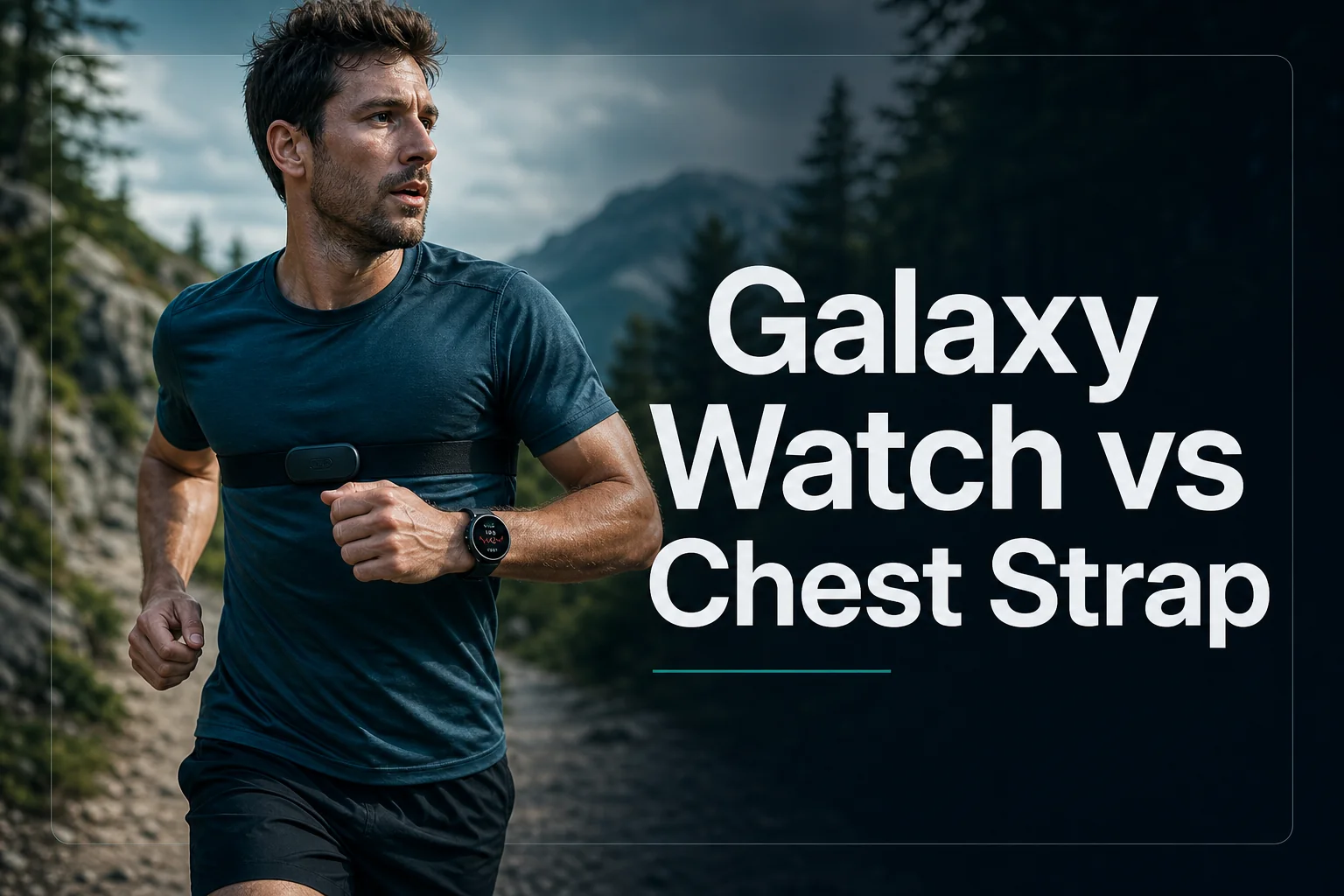
Galaxy Watch vs Chest Strap
Compare Samsung Galaxy Watch wrist heart rate with a chest strap across steady running, maximal exercise, cycling, intervals, and personalized heart-rate zones.
Introduction
A Samsung Galaxy Watch can provide useful heart-rate data for steady running, walking, and general fitness tracking. A chest strap remains preferable when exact response speed, interval peaks, or narrow zone boundaries determine the workout.
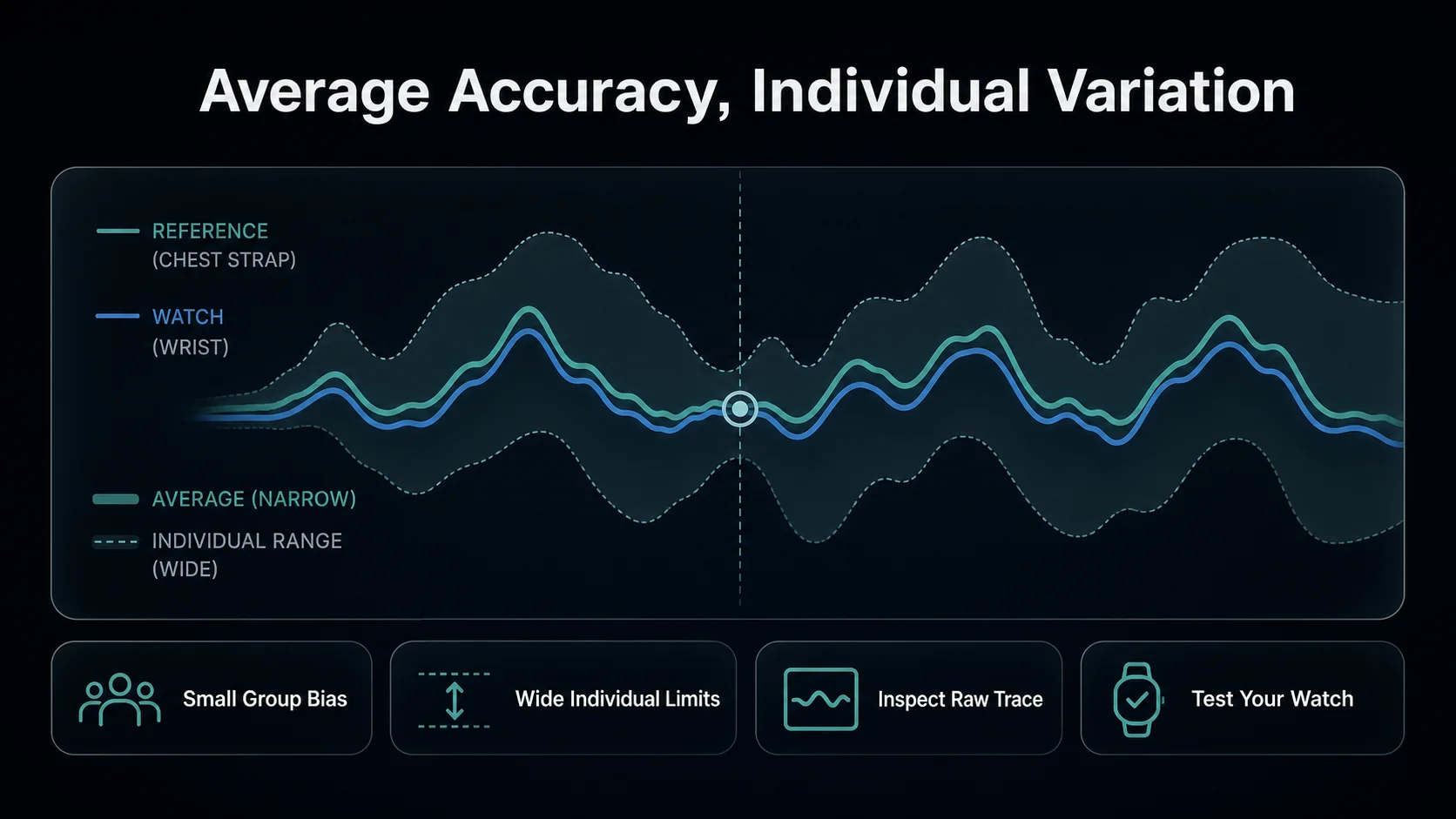
Independent studies of Galaxy Watch models have produced encouraging averages alongside meaningful individual variation. That combination is easy to misread. A device can perform well across a group and still have a wide error for one athlete, activity, or minute.
This guide explains what the available research does—and does not—show, how personalized zones differ from sensor accuracy, and how to decide whether your own Galaxy Watch trace is adequate.
Wrist Optical Heart Rate and Electrical Measurement
Galaxy Watches estimate heart rate optically at the wrist. Light enters the skin and reflected changes are processed into pulse estimates. A chest strap detects electrical activity through skin electrodes and normally responds more directly to each beat.
Optical sensors are convenient but vulnerable to movement, fit, ambient light, wrist flexion, reduced circulation, sweat, and individual anatomy. Software filters noise, and that filtering can create delay when heart rate changes rapidly.
Electrical straps can also misread. Poorly moistened electrodes, loose contact, fabric wear, static, battery problems, or wireless dropouts can produce implausible spikes. Compare signal quality, not merely product category.
What Samsung’s Zones Add
Samsung’s current watch materials advertise five personalized heart-rate zones and workout guidance around them (Samsung Galaxy Watch comparison). A displayed zone combines at least two layers:
- the watch’s estimated beats per minute;
- the boundaries Samsung or the user assigns to each zone.
Two devices can agree on 150 bpm yet label it differently. Before changing training because Samsung shows Zone 4 while another app shows Zone 3, compare the actual boundary settings. Sensor accuracy and zone-model accuracy are separate questions.
What Validation Studies Found
A recent Galaxy Watch 6 study compared the watch with Polar H10 during a graded maximal treadmill test in 55 healthy adults. Median absolute error was around one to three beats per minute across the predefined intensity zones, but the watch underestimated overall and the limits of agreement were wide enough to show substantial individual variability (Inoue and colleagues).
Another study comparing Galaxy Watch 6, Polar Pacer Pro, Polar Verity Sense, and Apple Watch SE against Polar H10 found device differences across treadmill intensities. The Galaxy Watch did not lead the comparison, reinforcing that good group-level performance does not guarantee it is the best source for every athlete (2026 comparison study).
Older research on Galaxy Watch Active2 found overall error below a commonly used 10% threshold, with performance varying greatly by task. It did better than Fitbit Charge 4 in some active stages and worse in several resting stages (device evaluation). These results belong to the tested model and protocol; firmware and hardware changes limit direct transfer to newer watches.
Steady Running and Walking
Steady locomotion is a reasonable use case for Galaxy Watch heart rate. After the warm-up, the signal should rise gradually and form a smooth trace that broadly agrees with breathing and effort.
Fit is the first troubleshooting step. Wear the case above the wrist bone, keep full sensor contact, and prevent sliding without overtightening. Give the watch a few minutes to establish a stable signal before using it to cap an easy session.
Judge ranges, not single seconds. If heart rate is mostly stable around an aerobic value and occasionally moves by a few beats, the data may be fully adequate. If it jumps to running cadence, stays unchanged through a hill, or drops while effort rises, the affected segment should not drive a training decision.
Intervals and Maximal Exercise
The recent treadmill study suggests Galaxy Watch 6 can perform well during graded maximal exercise, but a graded ramp is not the same as repeated short intervals outdoors. Rapid starts, recoveries, turns, and arm movement create more transitions for the algorithm to follow.
For repetitions under a few minutes, lead with pace, power, breathing, and perceived effort. Use heart rate mainly to see whether recovery is accumulating. A chest strap is better when the goal is to measure peak response or compare recovery slopes.
Long threshold intervals give the wrist sensor time to settle. Compare the stable middle of the interval and check whether the recorded curve follows the expected shape. Do not accelerate sharply in the opening minute merely because the optical display has not caught up.
Cycling, Rowing, and Strength Work
Handlebar pressure and wrist angle can change optical contact during cycling. Vibration adds noise, while relatively quiet arm movement gives the algorithm fewer obvious movement patterns to separate. A strap is useful for indoor-bike intervals and for comparing heart rate with power.
Rowing and strength training repeatedly flex the wrist and engage the forearm. That is a difficult setting for a wrist optical sensor. Research across brands finds larger errors in resistance training than in treadmill activity (systematic review and meta-analysis). Use Galaxy Watch data from these sessions as a broad trace unless you have verified it against a more responsive source.
Test Your Own Watch Without Overfitting
Choose a strap and recording method that can produce a separate timestamped file. Run three comparisons:
- A 40-minute easy session on flat terrain.
- A progressive workout with three long stages.
- The activity where you most often distrust the watch.
Compare the graphs after aligning start times. Focus on sustained differences, delayed transitions, dropouts, and changes that cross your important zone boundaries. Repeat any surprising result before changing equipment or zones.
Do not declare the chest strap correct merely because its graph is different. A sudden isolated spike above plausible maximum heart rate may be a strap contact problem. The credible trace should fit the workout structure, subjective effort, and expected physiological response.
A Practical Decision Rule
Use Galaxy Watch wrist heart rate when convenience matters, the workout is steady, and the signal behaves plausibly. Use a chest strap when you prescribe training by precise heart-rate thresholds, perform short intervals, compare cycling power with heart rate, or consistently see errors that change time in zone.
For most recreational athletes, there is no need to wear a chest strap all day. It is a workout instrument. The watch remains more useful for continuous trends and sessions where slight lag does not affect the decision.
Keep the source consistent for benchmark sessions. A change from wrist to chest measurement can look like a fitness change in your training log unless it is documented.
Interpret Wide Limits of Agreement Correctly
Validation studies often report a small average bias and much wider limits of agreement. These statistics answer different questions. Small average bias means positive and negative errors may balance across participants or time. Wide limits mean an individual reading can still differ materially.
That is why the Galaxy Watch 6 treadmill findings are encouraging without proving that every athlete can prescribe training from every second of wrist data. Group accuracy supports general usefulness. Personal repeatability determines whether the watch is suitable for your threshold test.
Do not convert a published group mean into a correction factor. If a study reports average underestimation, adding a fixed number of beats to your watch will not solve activity-specific or individual error.
Common Galaxy Watch Disagreement Patterns
Good average, missed transitions
The watch may finish close to the strap’s session average even while it lags each interval. Compare the curve, not just the summary card.
Correct beats, different zones
Align maximum heart rate and zone settings. Personalized zones can classify the same raw measurement differently from a third-party app.
A high plateau during running
Compare the plateau with cadence and perceived effort. Improve fit and repeat the route. If it recurs near cadence, use a strap to confirm.
Drops while cycling
Relax the wrist briefly, move the case higher, and check band tension. If gripping or handlebar pressure reliably causes drops, a strap is more practical than adjusting throughout the ride.
Strap spikes at the start
Wet the electrodes and allow a gradual warm-up. Static or poor contact can make the supposed reference less credible than the watch.
Example Decisions
- Thirty-minute steady run: Watch and strap differ by three beats on average, remain in the same zone, and show matching trends. Use the watch.
- Five-by-five-minute threshold: The watch settles after the first minute and matches the middle of each block. It may be adequate, but keep the source consistent between tests.
- Thirty-second hill sprints: Wrist peaks arrive during recovery. Use pace and perceived effort for execution and a strap if peak response matters.
- Indoor ride: Power-to-heart-rate decoupling changes depending on wrist position. Use the strap.
- Health concern: A consumer workout comparison cannot diagnose an arrhythmia or cardiovascular condition. Concerning symptoms or repeated unusual readings deserve medical evaluation regardless of which device looks more plausible.
Preserve the Measurement Context
Record the watch model, firmware period, wrist, band fit, activity, and whether an external sensor was used. These notes help explain discontinuities after an upgrade or settings change.
When comparing months, use similar workout structures and conditions. Heat, dehydration, fatigue, and terrain can legitimately change heart rate at a given pace. Sensor comparison is most informative when the physiological context is controlled.
Conclusion
Galaxy Watch heart rate can be quite good during structured treadmill exercise and steady sessions, but individual error and activity-specific limitations still matter. A chest strap provides a more responsive signal when exact timing and zone placement are important.
Start by checking beats per minute, then zone boundaries, then the training consequence. For a broader explanation, compare Apple Watch vs Chest Strap and Fitbit vs Chest Strap, then use the Zone 2 Heart Rate Calculator to compare equivalent boundaries.
Our editorial approach & AI disclosure
We use AI to help research, organize, and draft some articles. Every article is reviewed by a human editor and aims to reflect current evidence-based training practices and scientific literature.
Read our editorial policy