
Training Load
How Do You Know If You Trained Too Hard This Week?
You trained too hard this week if load rose faster than recovery could absorb it. Learn the warning signs, what to check in your training log, and how to decide whether to repeat, reduce, or redistribute next week.

Introduction
You probably trained too hard this week if your training load rose faster than your recovery could absorb it. The clearest sign is not one tired day. It is a pattern: easy sessions felt unusually hard, performance dropped at normal effort, soreness lasted longer than usual, sleep or mood worsened, motivation fell, and the next workout did not rebound after normal recovery.
That distinction matters because hard weeks are not automatically bad. Endurance athletes need stress to adapt. A build week, race week, long ride, hill block, or threshold-focused week can feel hard and still be productive. The problem starts when the load was higher than planned, intensity was poorly placed, or life stress reduced recovery enough that your body could not catch up.
Training-load research separates the work performed from the athlete's response. Bourdon and colleagues describe training-load monitoring as a way to understand both the load and the response to that load (Bourdon et al., 2017). Impellizzeri, Marcora, and Coutts also emphasize that external load and internal load are different concepts (Impellizzeri et al., 2019). This is why a weekly review should not only ask what you did. It should ask what it cost you. The comparison of acute versus chronic training load shows how recent stress and the longer training base can frame that question without turning one ratio into a verdict.
For a runner, "too hard" might mean too much mileage, too many hills, too much Zone 3, or a long run that became a race. For a cyclist, it might mean too many group-ride surges, too much threshold work, too much climbing, or not enough easy riding around intensity. For any endurance athlete, it can also mean normal training placed on top of poor sleep, stress, illness, under-fueling, or pain.
The goal of this review is simple: decide whether next week should progress, repeat, reduce, or redistribute.
The Short Answer: Look For A Pattern
You likely trained too hard this week if several signals worsened together:
- Easy sessions felt harder than usual.
- Pace, power, or speed dropped at normal effort.
- Soreness lasted longer than normal.
- You could not hit planned workout targets.
- Sleep, mood, or motivation declined.
- Resting heart rate, HRV, or heart-rate response looked unusual for you.
- Pain appeared, worsened, or changed your mechanics.
- Fatigue did not improve after one or two easier days.
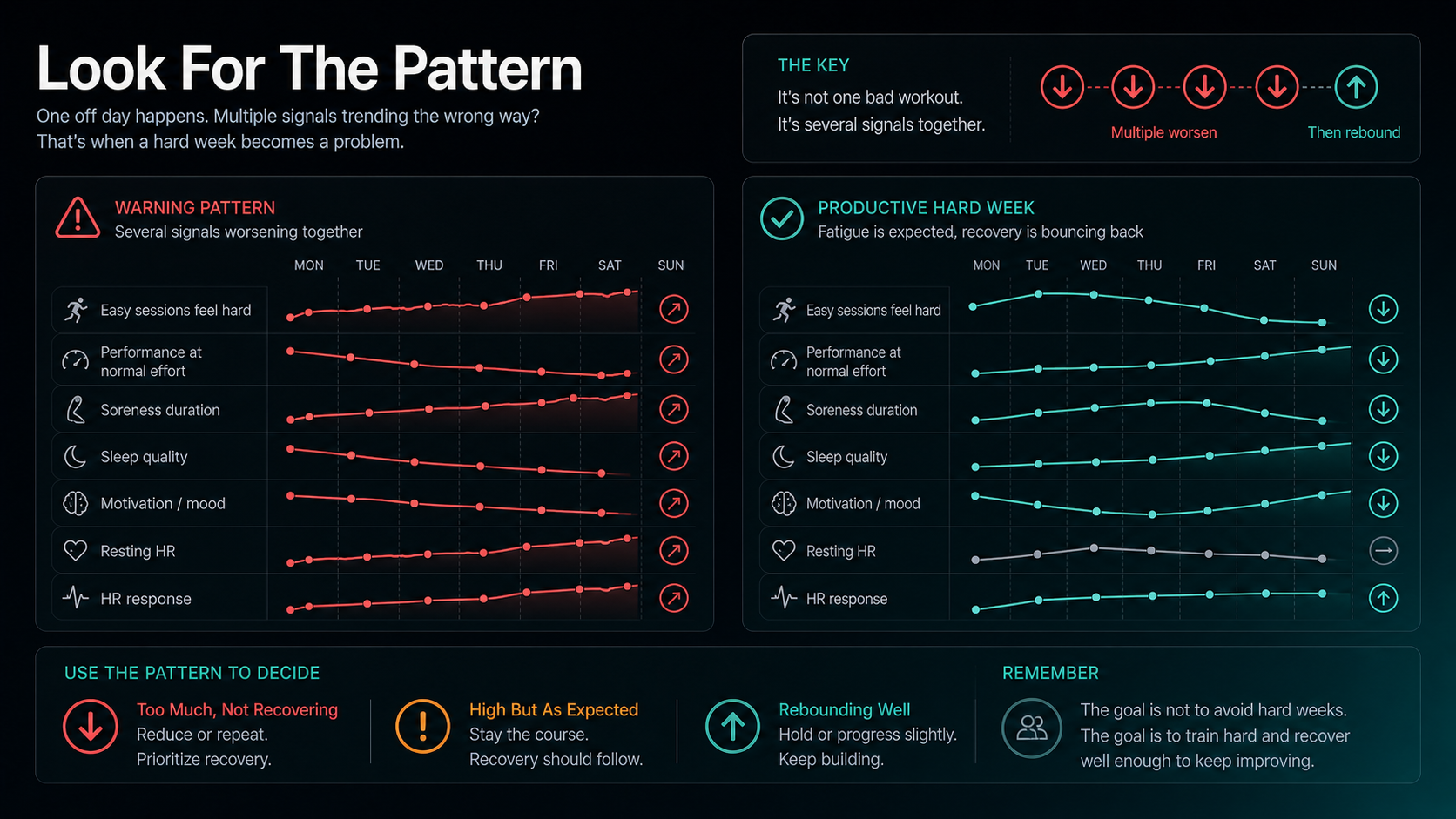
One bad workout is not enough. Everyone has flat days. The key is whether multiple signals changed in the same direction and stayed changed.
A hard week can be productive if fatigue is expected and recovery starts to rebound. It becomes a problem when the week was harder than planned and recovery markers keep sliding.
What "Too Hard" Actually Means
"Too hard" does not always mean overtraining syndrome. True overtraining syndrome is a more serious and persistent state of performance decline and maladaptation. The ECSS and ACSM joint consensus statement on overtraining describes a spectrum that includes functional overreaching, nonfunctional overreaching, and overtraining syndrome (Meeusen et al., 2013).
For most everyday athletes reviewing one week, the issue is usually simpler: acute load exceeded recovery. You may have overreached for a few days, under-recovered, or stacked too many stressors together. That is still worth correcting, but it is different from diagnosing yourself with overtraining.
Functional overreaching can be planned. You deliberately train hard for a short period, then recover and improve. Nonfunctional overreaching is different. Performance and well-being decline, and recovery takes longer than expected. Overtraining syndrome is more prolonged and should be handled with professional support.
The weekly question is therefore practical:
Did this week create useful fatigue, or did it create a recovery problem?Useful fatigue has a direction. It follows a planned load, sits in a sensible training phase, and starts to improve when you back off. A recovery problem feels different. The week leaves you worse across several signals, and normal easy training no longer feels easy.
Normal Fatigue vs A Week That Was Too Hard
Normal training fatigue usually makes sense when you look at the plan. You did a long run, a hard ride, a race, a big hike, or a threshold workout, and the next day you feel tired. That does not automatically mean the week was too hard. It means the session created stress.
A week was more likely too hard when fatigue is out of proportion to the plan or when it does not start to resolve. The context matters more than any single symptom.
| Signal | Normal Hard Week | Too Hard This Week |
|---|---|---|
| Easy effort | Slightly heavy, then improves | Easy feels hard for several days |
| Performance | Temporarily flat after key work | Repeated drop at normal effort |
| Soreness | Predictable and improving | Lingering, worsening, or changing movement |
| Mood | Tired but engaged | Irritable, flat, or unusually unmotivated |
| Sleep | Maybe one disrupted night | Several poor nights or restless sleep |
| Training response | Rebounds after easy work | Does not rebound after backing off |
This table is not a diagnosis tool. It is a pattern check. If one row looks bad, adjust lightly. If several rows look bad at the same time, treat the week as a recovery problem.
The timing also matters. Feeling tired the day after a long session is normal. Feeling worse three days later after two easy days is more concerning. Struggling through the last interval of a hard workout is normal. Struggling to jog or ride easily the next day at a familiar effort is a stronger signal.
You should also compare the fatigue with the training phase. During a planned build, some heaviness is expected. During a deload, taper, or recovery week, heaviness should usually decrease. If your recovery week feels like another build week, the previous load may still be sitting in your legs.
Compare The Week With The Plan
Start with the plan, not your feelings.
What was this week supposed to be? A base week, build week, deload, taper, race week, or return-from-break week should not be judged the same way. A hard build week may feel demanding by design. A recovery week that feels demanding is a warning sign.
Look at what actually happened:
- Total duration.
- Distance or weekly volume.
- Long-session duration.
- Time in heart rate, pace, or power zones.
- Hard-session count.
- Strength, hills, strides, or sprints.
- Elevation, terrain, heat, wind, or altitude.
- Missed recovery days.
- Unplanned group intensity.
The International Olympic Committee consensus statement on load in sport emphasizes that load can include training, competition, psychological stress, travel, and rapid changes in load, and that load management should consider athlete well-being and injury monitoring (Soligard et al., 2016). That broad view matters for weekly reviews. Your body does not only respond to workouts. It responds to the whole week.
Many athletes find that the week was not too hard because of one workout. It was too hard because easy days drifted moderate, a long session ran long, a group ride added surges, sleep was poor, and the next hard workout stayed on the calendar anyway.
If the completed week matched the plan and fatigue is improving, you probably did not train too hard. If the completed week exceeded the plan and several recovery signals worsened, the week likely crossed the line.
Check Internal Response, Not Just Load
External load tells you what you did. Internal response tells you how it landed.
Halson's review on training-load monitoring argues that fatigue is best understood by looking at training load and the athlete's response to that load (Halson, 2014). That is why your weekly review should include more than mileage, hours, or zones.
Useful internal-response checks include:
- Session RPE.
- Overall fatigue.
- Soreness.
- Mood.
- Motivation.
- Sleep quality.
- Appetite.
- Resting heart rate.
- Heart rate variability, if measured consistently.
- Easy pace or power at normal heart rate.
- Pain or tightness.
Subjective signals deserve serious attention. Saw, Main, and Gastin systematically reviewed athlete-monitoring studies and found that subjective self-reported measures often reflected acute and chronic training loads with better sensitivity and consistency than many objective measures (Saw et al., 2016). In plain terms, how you feel is not worthless data.
Session RPE is one of the simplest tools. Foster and colleagues described a method that multiplies session duration by perceived exertion to estimate session load (Foster et al., 2001). It is not perfect, but it captures a useful reality: a 60-minute run rated 3 out of 10 is not the same load as a 60-minute run rated 8 out of 10.
The best review combines both sides. If training load rose and internal response stayed stable, you may be adapting. If training load looked normal but internal response worsened, the week may still have been too hard for your current recovery capacity.
Warning Signs You Crossed The Line
The first warning sign is that easy work stopped feeling easy. If recovery runs, endurance rides, or low-zone sessions repeatedly feel like work, your body may not be absorbing the week.
The second warning sign is a performance drop at normal effort. You might run slower at the same heart rate, produce less power at the same perceived effort, or struggle to complete intervals you normally handle. One failed session is noise. Several poor sessions in a row are a signal.
The third warning sign is lingering soreness. Normal soreness improves as the week unfolds. Problem soreness hangs around, changes movement, or gets worse after easy sessions. Pain that changes mechanics is not just fatigue.
The fourth warning sign is mood and motivation decline. Irritability, low motivation, unusual heaviness before training, or a strong desire to skip sessions can all matter when they appear with other fatigue markers.
The fifth warning sign is disrupted sleep. Hard training can temporarily affect sleep, but poor sleep also reduces recovery. A review on sleep and athletic performance reports that sleep loss can affect exercise performance and physiological and cognitive responses to exercise (Fullagar et al., 2015).
The sixth warning sign is unusual heart-rate behavior. Resting heart rate, HRV, and exercise heart rate can be useful when measured consistently, but they should not be interpreted alone. Heat, dehydration, caffeine, stress, and illness can all shift them. Treat these metrics as context, not verdicts.
The seventh warning sign is that fatigue does not improve after easier days. A demanding workout may require a day or two. A demanding week may require several days. But if you reduce load and still keep sliding, the plan needs a bigger correction.
Red Flags That Are Not Just Training Fatigue
Most weekly fatigue can be handled by reducing load, sleeping more, fueling better, and making easy days easier. Some signals deserve a different response.
Pain that changes your movement is one of them. If you are limping, protecting one side, changing your pedal stroke, avoiding normal stride length, or altering posture to get through a session, the issue has moved beyond ordinary soreness. Continuing to train through altered mechanics can shift stress elsewhere and make the problem harder to interpret.
Illness symptoms are another. A sore throat, fever, chest symptoms, unusual shortness of breath, dizziness, or a strong "something is wrong" feeling should not be treated as a motivation problem. Training is not the priority when health is the limiter. Rest, monitor symptoms, and seek appropriate medical care when symptoms are significant, unusual, or persistent.
Sharp pain, swelling, pain that worsens during a session, or pain that is still worse the next morning deserves caution. For endurance athletes, the temptation is often to "just do easy volume." But easy volume is still load, and mechanical pain can worsen under repeated low-intensity stress.
The same applies to fatigue that feels unfamiliar. If you are unusually exhausted, unusually breathless, repeatedly waking at night, or unable to complete daily tasks normally, do not reduce the problem to training load alone. Training may be one contributor, but illness, medication changes, energy deficiency, life stress, and other health issues can also show up as poor training response.
The practical rule is simple: if the signal affects health, movement quality, or normal daily function, choose health first and training second.
How To Decide What To Do Next
Once you identify the pattern, do not ask, "How do I make up the work?" Ask, "What choice protects the next good block?"
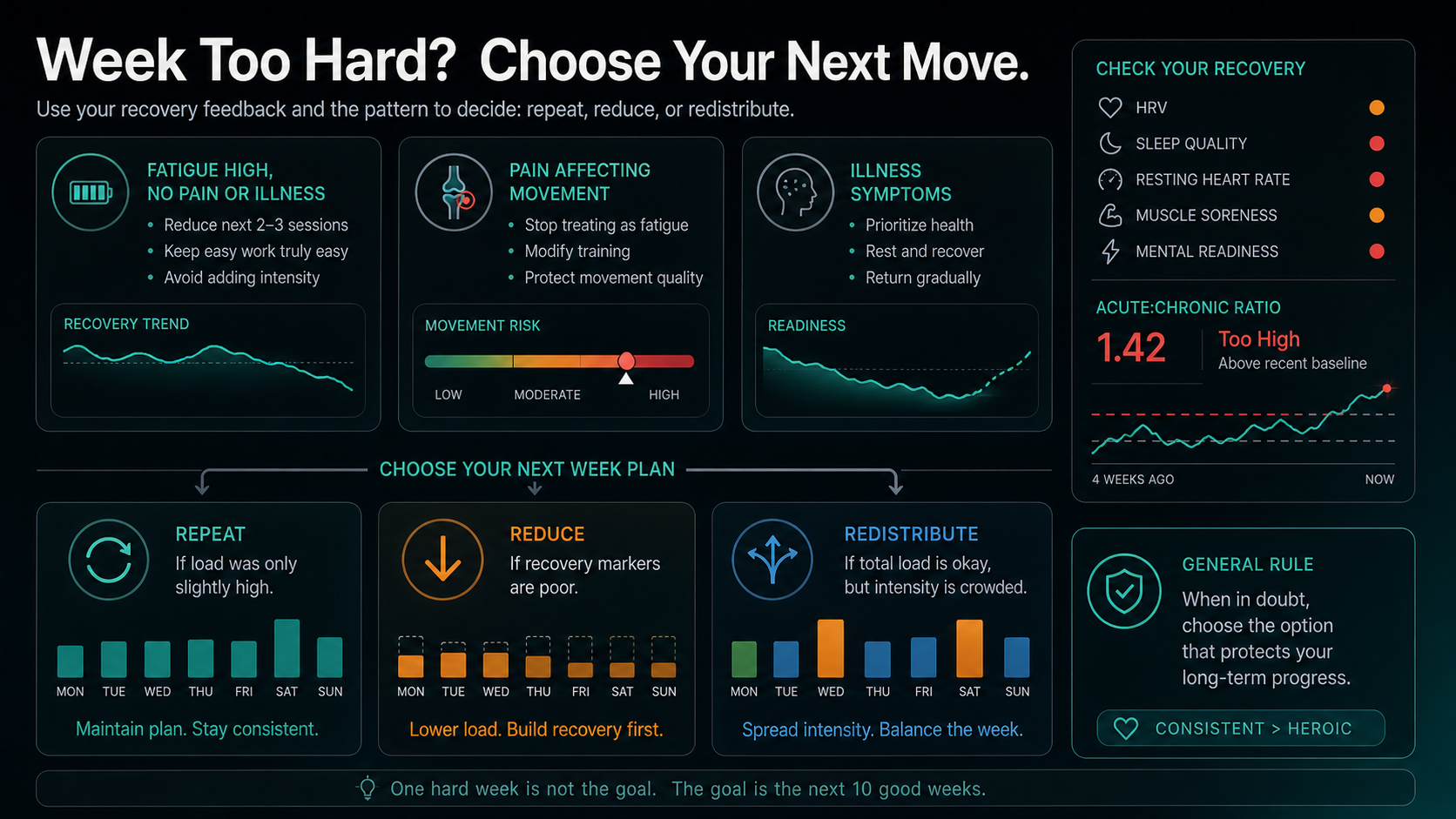
Use this decision table:
| What You See | What It Means | Next Move |
|---|---|---|
| Hard week, fatigue expected, recovery rebounding | Productive overload | Hold or progress slightly |
| Load slightly high, no pain, fatigue manageable | Too much but not severe | Repeat the week or reduce slightly |
| Load high and recovery markers poor | Under-recovered | Reduce the next 2-3 sessions |
| Total load fine, intensity crowded | Poor distribution | Spread hard work out |
| Easy sessions feel hard for several days | Recovery gap | Keep easy work truly easy |
| Pain changes movement | Injury risk signal | Modify training and seek help if needed |
| Illness symptoms appear | Health issue, not training challenge | Rest and return gradually |
If fatigue is high but there is no pain or illness, reduce the next two or three sessions. Keep them easy. Remove intensity first. Do not add a workout to prove you are tough.
If total load was okay but intensity was poorly placed, redistribute. Move hard sessions farther apart. Make easy days easier. Avoid turning every session into moderate work.
If pain affected movement, stop treating it as normal soreness. Modify the session, reduce mechanical stress, and consider professional help if pain persists, worsens, or changes your gait or position.
If illness symptoms are present, prioritize health. Do not chase missed training while sick. Return gradually once symptoms resolve.
A Simple Weekly Review Checklist
Use this five-part checklist at the end of the week:
- Did the completed load match the plan?
- Did easy days stay easy?
- Did hard sessions land where they were supposed to?
- Did recovery markers improve, hold, or decline?
- What is the one best adjustment for next week?
Then score the week:
- Green: hard but controlled, recovery normal.
- Yellow: load high or recovery slightly off, repeat or adjust.
- Red: multiple warning signs, reduce before progressing.
This does not need to be complicated. A good training log should help you see whether the problem was too much volume, too much intensity, poor hard-day spacing, under-fueling, poor sleep, illness, pain, or life stress.
Kellmann and colleagues describe recovery as part of the training process, not something separate from performance (Kellmann et al., 2018). That is the mindset for weekly review. Recovery is not a reward for finishing hard work. It is how hard work becomes useful.
How To Prevent The Same Problem Next Week
The best fix is usually not a dramatic reset. It is a cleaner training week.
First, protect easy days. Most weeks go wrong when easy sessions become moderate sessions. A runner pushes the pace because the legs feel good on Tuesday, then struggles on Thursday. A cyclist turns a recovery spin into a group ride. A long session finishes harder than planned. None of these choices looks reckless alone, but together they can turn a reasonable week into a crowded one.
Second, separate hard work. If you place hard workouts too close together, you may never see whether the first one was absorbed. Put enough easy training between demanding sessions that the next quality workout has a fair chance to succeed. If the plan says two quality sessions, those sessions should be clear. The days between them should support the work, not compete with it.
Third, progress one major stressor at a time. Do not increase volume, add hills, add threshold work, extend the long run, and reduce sleep in the same week. Some stressors are not fully under your control, such as work, travel, heat, or family demands. That makes the controllable training stress even more important.
Fourth, fuel the hard work. Under-fueling can make a normal week feel like a bad training decision. Long sessions, threshold workouts, VO2 max sessions, and heavy strength work all land differently when carbohydrate, hydration, and total energy intake are too low.
Fifth, review trends instead of reacting emotionally. If one hard day went poorly but the week is otherwise stable, you may only need a small adjustment. If three weeks show rising fatigue, rising soreness, and declining motivation, the next step should be more conservative.
The goal is not to create a fragile plan that avoids difficulty. The goal is to make stress deliberate. Hard days should be hard for a reason. Easy days should be easy enough to let the hard days work.
Practical Examples
A runner planned a base week but ended with two faster easy runs, one hill session, and a long run that finished at tempo effort. Mileage rose only slightly, but time in moderate zones jumped. By Sunday, easy pace feels hard and soreness is lingering. The problem is not just volume. It is intensity drift. Next week should protect easy days and remove one quality session.
A cyclist planned 8 hours, completed 8 hours, and thinks the week was fine. The log shows three group rides with repeated surges, one threshold session, and poor sleep after late workouts. Average weekly duration hides the real issue. The next step is to redistribute intensity and make the next two rides genuinely easy.
A runner completes a demanding but planned race week. Fatigue is high the day after the race, but sleep is good, soreness improves over two days, and easy movement feels better by midweek. That is not necessarily too hard. It may be normal race fatigue being absorbed.
An athlete repeats a familiar easy route and sees a higher heart rate, higher RPE, worse mood, and poor sleep. The external load is normal, but the internal response is abnormal. The right move is not to force the next workout. It is to reduce load and check for illness, stress, under-fueling, or accumulated fatigue.
Conclusion
You know you trained too hard this week when several signals point in the same direction: load was higher than planned, easy sessions stopped feeling easy, performance dropped at normal effort, soreness lingered, sleep or mood worsened, and recovery did not rebound after easier days.
Do not judge the week from one bad workout or one device metric. Review the pattern. Compare the plan with what actually happened. Compare external load with internal response. Then choose the next move: progress, repeat, reduce, or redistribute.
The goal is not to avoid hard weeks. The goal is to train hard enough to improve and recover well enough to keep improving.

Our editorial approach & AI disclosure
We use AI to help research, organize, and draft some articles. Every article is reviewed by a human editor and aims to reflect current evidence-based training practices and scientific literature.
Read our editorial policy