


Strength Training for Endurance Athletes
A research-backed guide to strength training for runners, cyclists, swimmers, triathletes, hikers, and other endurance athletes, including exercises, sets, reps, scheduling, progression, and in-season maintenance.
Aug 6, 202626 min read

Introduction
Strength training belongs in an endurance program because it develops qualities that more mileage alone may not: maximal force, power, movement economy, and the ability to produce a given submaximal output with a smaller fraction of your available strength. The goal is not to turn a runner, cyclist, swimmer, triathlete, rower, skier, or hiker into a powerlifter. It is to make the athlete stronger without damaging the consistency and specificity of endurance training.
For most healthy endurance athletes, a useful starting point is two full-body strength sessions per week during a development phase and one or two shorter sessions during the competitive season. Center those sessions on a squat, hip hinge, single-leg exercise, calf or ankle exercise, upper-body push and pull, and trunk work. Use challenging loads, low-to-moderate repetition ranges, good technique, and enough recovery to keep key endurance sessions productive.
Heavy lifting, explosive work, plyometrics, and muscular-endurance circuits are not interchangeable. A session that looks reasonable alone can be too costly beside hill repeats, long intervals, or a long run. Sport, training age, injury history, equipment, and race calendar all change the best plan.
What Strength Training Means for an Endurance Athlete
Strength training asks muscles to produce force against resistance. Free weights, machines, cables, bands, body weight, carries, jumps, and medicine-ball throws can all qualify.
Endurance athletes usually need four overlapping strength qualities:
- Maximal strength: the greatest force you can produce, developed with relatively heavy resistance.
- Power: the ability to produce force quickly, developed with fast intent, jumps, throws, or explosive lifts.
- Reactive strength: the ability to use the stretch-shortening cycle efficiently, trained with appropriate plyometrics such as hops and bounds.
- Local tissue capacity: the ability of a muscle-tendon unit or movement pattern to tolerate repeated loading, trained through targeted resistance work and progressive sport exposure.
These qualities support endurance; they do not replace it. A cyclist still needs bike-specific aerobic work. A runner still needs running. A swimmer still needs efficient technique in the water. Strength creates more physical capacity, while sport-specific training teaches the athlete to express it economically for hours.
Endless light repetitions are not automatically “more specific.” The sport already supplies repeated low-force contractions. The gym can provide a different signal: higher force, faster force development, larger ranges of motion, or loading in directions the sport underuses.
What the Research Actually Shows
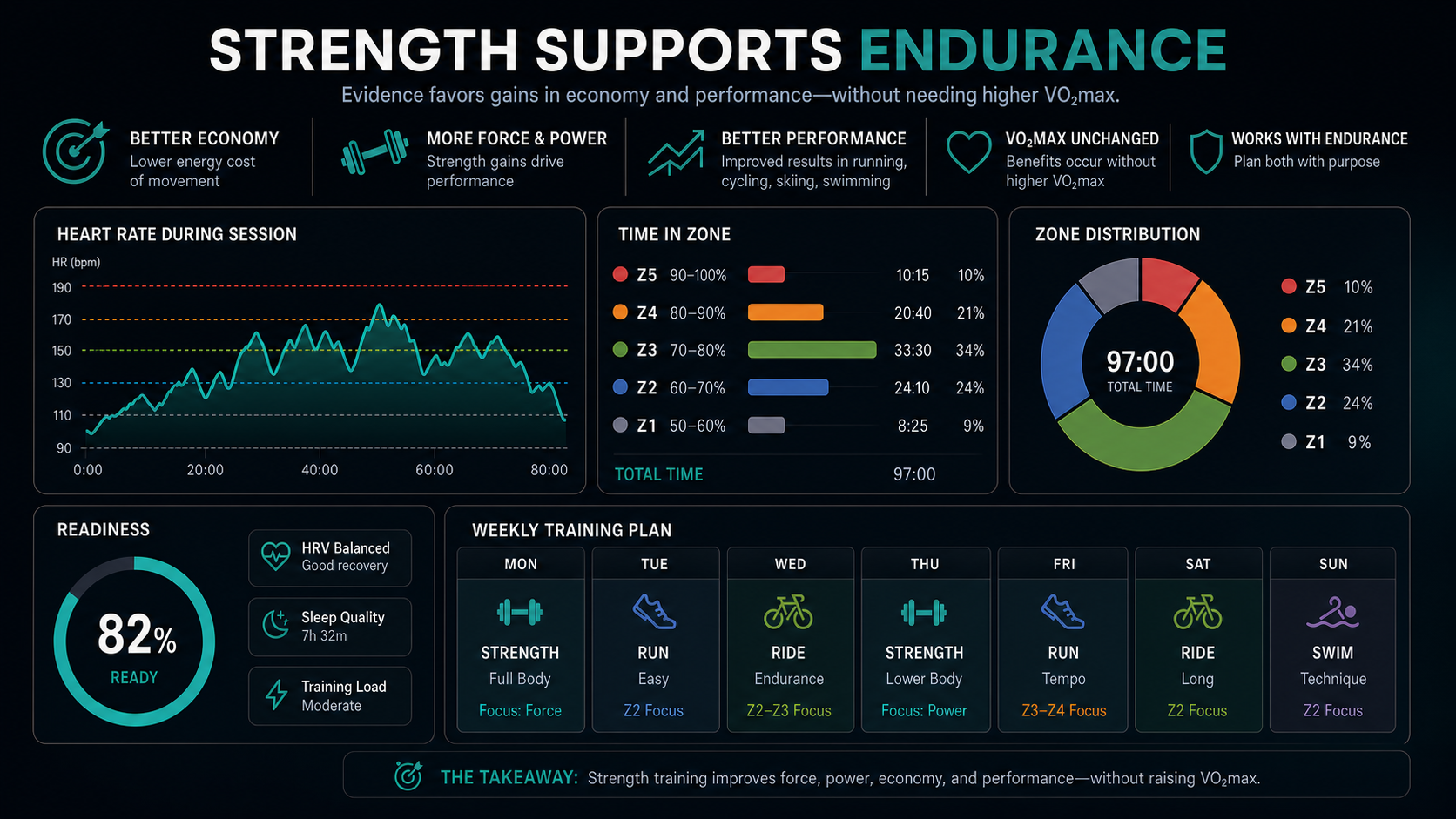
The broad answer is encouraging: adding well-designed strength training can improve endurance performance and economy without reducing aerobic capacity. The size and certainty of the effect vary by sport, training status, program, and outcome.
A meta-analysis covering running, cycling, cross-country skiing, and swimming associated a strength-training block with moderate improvements in middle- and long-distance performance. The changes were linked primarily to better energy cost of locomotion, maximal force, and power rather than a higher maximal oxygen uptake (Berryman and colleagues).
A 2025 umbrella review reached a similar overall conclusion: strength training improved endurance performance and running economy, while the included meta-analyses did not show meaningful increases in VO₂max. The authors also judged confidence in many underlying reviews to be low or critically low, so the direction of benefit is more convincing than any universal effect size (Ramos-Campo and colleagues).
For runners, the evidence is strongest for running economy—the oxygen or energy cost of sustaining a submaximal speed. A 2024 meta-analysis found small improvements from high-load training and moderate improvements from programs combining strength methods. Submaximal-load and isometric-only approaches did not show clear benefits in that analysis (Llanos-Lagos and colleagues). Earlier work also found beneficial effects from heavy and explosive strength training (Denadai and colleagues).
For cyclists, a 2025 meta-analysis reported improvements in cycling efficiency, anaerobic power, and performance after heavy strength training, without clear changes in VO₂max or several other aerobic determinants. The authors rated the evidence as low certainty, and the 17 included studies contained far fewer women than men (Llanos-Lagos and colleagues).
Swimming is less straightforward because force must transfer through water and technique has an unusually large influence. A systematic review of 27 studies found that combined swimming and strength programs generally outperformed swim-only training, but no single dry-land or in-water strength method was clearly superior (Fone and van den Tillaar).
The practical conclusion is not that every endurance athlete will get faster after eight weeks of lifting. It is that strength training can improve force, power, economy, and performance without needing to raise VO₂max. Transfer is most likely when the athlete chooses an appropriate method, keeps endurance training specific, progresses long enough to adapt, and manages fatigue.
Why More Strength Can Improve Endurance Performance
The same output uses less of your available force
Imagine two cyclists both producing 250 watts or two runners both holding the same pace. If one athlete can produce more maximal force, each pedal stroke or ground contact may represent a smaller percentage of that athlete's maximum. This does not make the aerobic demand disappear, but it can improve neuromuscular efficiency and delay the point at which force production becomes limiting.
Late in long events, an athlete with more force reserve may preserve technique or output longer. Research rarely measures “durability” in one standardized way, so treat this as a useful model rather than a guaranteed outcome.
Economy can improve without VO₂max changing
VO₂max describes a ceiling. Economy describes the oxygen or energy required below that ceiling. Strength training may improve muscle recruitment, tendon behavior, rate of force development, and coordination, allowing the athlete to move at the same submaximal output at a lower cost.
This is why a strength block can be successful even when a laboratory VO₂max number stays flat. Endurance performance depends on more than the size of the aerobic engine; it also depends on how economically the athlete converts capacity into motion.
Power protects decisive moments
Many endurance events contain short demands above steady-state intensity: a climb, acceleration, surge, start, passing move, technical obstacle, or finishing sprint. Maximal strength gives power a foundation. Explosive and reactive work then teaches the athlete to express force quickly.
A small number of high-quality jumps or throws can train power. Turning them into a breathless circuit changes the stimulus and lowers movement quality.
Strength expands options outside the main movement pattern
Endurance sports repeat a narrow set of motions thousands of times. Resistance training can load the hip through a larger range, train lateral control, strengthen the upper body, and expose muscles and tendons to progressive forces that the sport does not provide consistently.
That expanded capacity is valuable, but “stronger” should not be translated automatically into “injury-proof.” A 2024 systematic review of exercise-based injury-prevention programs in endurance runners found no significant reduction in pooled injury risk or injury rate. A post hoc analysis of supervised programs was more favorable, but most included studies had quality limitations (Wu and colleagues). Strength training can address capacity and rehabilitation goals; it cannot control every injury driver, including sudden load changes, sleep, fueling, prior injury, terrain, equipment, and chance.
Choose the Strength Method That Matches the Goal
Heavy resistance training
Heavy resistance training uses loads that limit the number of technically sound repetitions. Current guidance for healthy adults from the American College of Sports Medicine emphasizes loads around or above 80% of one-repetition maximum for strength, commonly for two or three sets per exercise (ACSM's 2026 position-stand summary). Endurance studies often use sets in approximately the four-to-eight-repetition range, although protocols vary.
Heavy does not mean maximal. An endurance athlete rarely needs frequent one-repetition-maximum attempts. A load you can move for four to six clean repetitions with one to three repetitions still available is heavy enough to develop strength while limiting unnecessary fatigue.
This method has a strong evidence base for running economy and cycling performance. It is also time-efficient: a few focused work sets can deliver a distinct stimulus without reproducing the high-repetition fatigue already present in endurance training.
Explosive strength training
Explosive training uses lighter or moderate resistance moved with maximal safe intent. Examples include medicine-ball throws, loaded jumps, kettlebell swings for an athlete who performs them well, and fast concentric repetitions on selected exercises.
The set should stop when speed or technique clearly deteriorates. Power training is not meant to feel like grinding strength work. Long rest and low repetition counts preserve the quality that creates the adaptation.
Plyometric training
Plyometrics include jumps, hops, bounds, and drop-jump variations. They train the rapid transition from landing to takeoff and can improve reactive strength. They are especially relevant to running but may also support athletes who need acceleration, stiffness, or general power.
Plyometrics are mechanically demanding. Start with landing control, low-amplitude pogo hops, skips, or small jumps before progressing to bounds, single-leg hops, or depth jumps. Count contacts, not minutes, and avoid placing a new plyometric program beside the hardest running week of the year.
A meta-analysis comparing heavy resistance and plyometric training in distance runners found a clearer pooled effect on running economy from heavy resistance work, although both methods can be useful and study designs differed (Eihara and colleagues). Beginners do not need to choose the most advanced option. They need the method they can execute and recover from consistently.
High-repetition circuits
Circuits of 15–30 repetitions feel familiar to endurance athletes because heart rate rises and local fatigue builds. They can be useful for general conditioning, limited-equipment sessions, rehabilitation goals, or specific muscular endurance. They are not automatically the best method for increasing maximal strength or economy.
A meta-analysis of competitive endurance athletes did not find a clear performance advantage from high-repetition strength training over control or lower-repetition strength training across the included short interventions (Nugent and colleagues). If the program already contains many hours of aerobic work, use the gym primarily to supply a strength or power stimulus that the sport is missing.
Isometric training
Isometrics produce force without visible joint movement. Calf holds, split-squat holds, wall sits, and mid-thigh pulls can be useful when dynamic loading is poorly tolerated or when a sport-specific joint angle matters. They are tools, not a complete default program. The running-economy evidence for isometric-only programs is less convincing than for heavy or combined methods.
Build the Session Around Movement Patterns
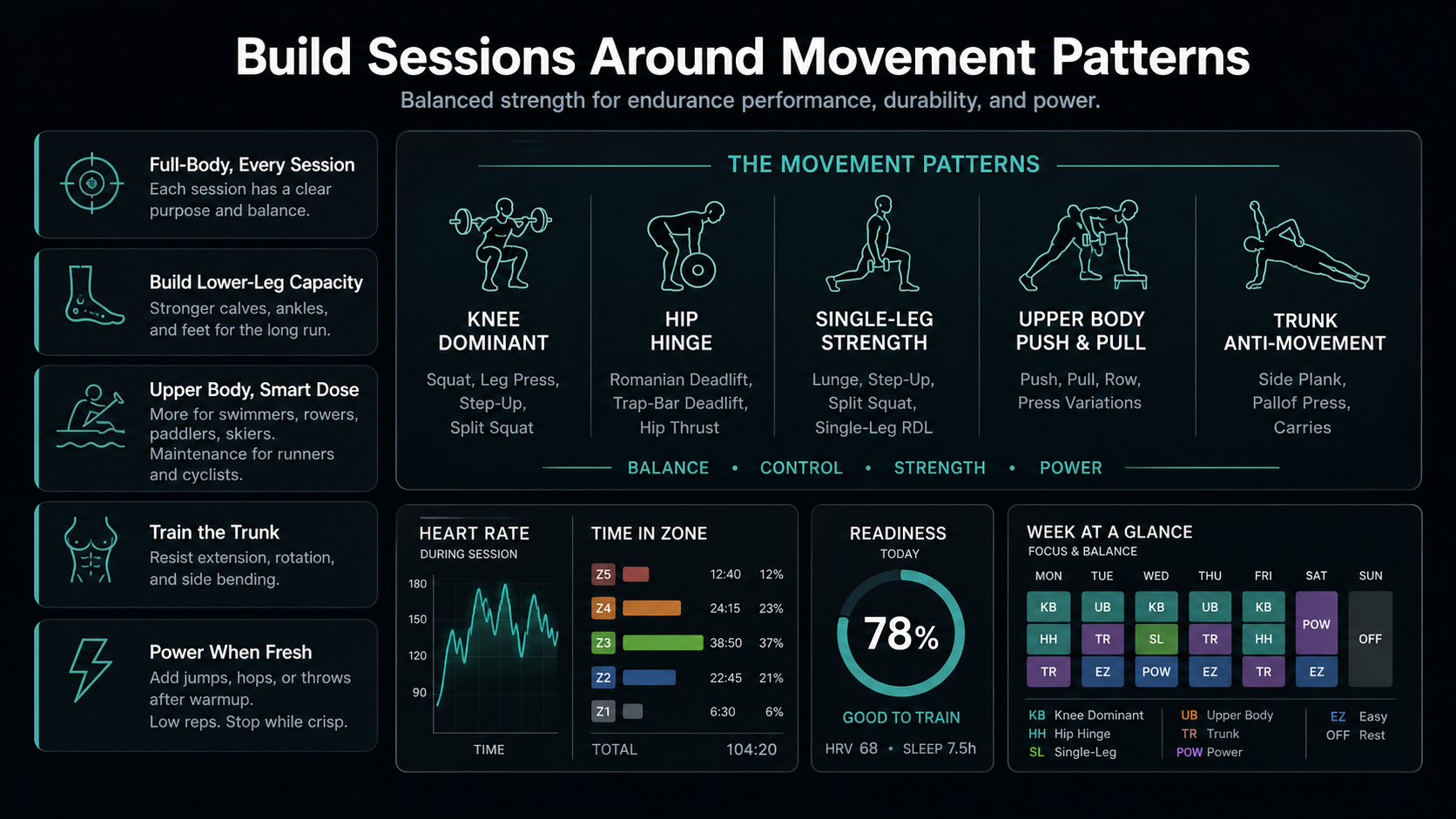
Endurance athletes do not need a bodybuilding split with a separate day for every muscle group. A full-body structure gives each session a clear purpose and allows one missed day without losing an entire movement category.
1. Squat or knee-dominant pattern
Choose a squat, front squat, goblet squat, leg press, step-up, or split squat. The aim is to train the hips and knees through a useful range with stable technique. The best choice is the one the athlete can load progressively without pain or excessive coordination cost.
2. Hip hinge
Use a Romanian deadlift, trap-bar deadlift, conventional deadlift, hip thrust, cable pull-through, or another well-controlled hinge. This pattern develops the posterior chain and exposes the hip to high force outside the shortened ranges common in cycling and sitting.
3. Single-leg strength
Split squats, rear-foot-elevated split squats, step-ups, single-leg presses, and single-leg Romanian deadlifts reveal side-to-side control and load each limb with less total weight. They are valuable for runners and hikers, but bilateral exercises remain useful because they are stable and easy to load heavily. Use both rather than turning exercise selection into a debate about which is “more functional.”
4. Calf, ankle, and foot capacity
Runners, hikers, and field-based endurance athletes benefit from straight-knee and bent-knee calf work because the gastrocnemius and soleus contribute differently across joint positions. Raise and lower through a controlled range. Add heavier loading before adding endless repetitions.
Cyclists and swimmers may use less calf volume unless their sport, history, or secondary activities demand it. Exercise selection should follow the athlete, not a universal checklist.
5. Upper-body push and pull
Rows, pull-downs, pull-ups, presses, and push-ups maintain a balanced full-body plan. Swimmers, rowers, paddlers, and skiers need more deliberate upper-body programming because propulsion depends on it. Runners and cyclists may need only a small maintenance dose.
Shoulder symptoms require individual assessment. More pulling is not a diagnosis, and generic “prehab” should not replace a clinician's plan.
6. Trunk and carry work
The trunk transfers force between the upper and lower body. Use exercises that resist extension, rotation, or side bending: dead bugs, side planks, Pallof presses, cable lifts, farmer carries, and suitcase carries. A few deliberate sets are usually more useful than a long circuit of random abdominal exercises.
7. Optional power exercise
Place jumps, hops, or medicine-ball throws near the start, after the warmup and before heavy fatigue. Use two to four sets of two to five repetitions with full control. Power work is optional for new lifters; competent strength training already provides a large new stimulus.
Sets, Reps, Load, and Rest
A good endurance strength prescription is specific enough to guide the session but flexible enough to absorb changes in sport training.
| Goal | Typical prescription | Rest | Execution |
|---|---|---|---|
| Learn the movement | 2–3 sets of 6–10 reps | 1–3 minutes | Controlled, several reps in reserve |
| Build maximal strength | 2–4 sets of 3–6 reps | 2–4 minutes | Heavy, clean, no grinding |
| Build general strength | 2–3 sets of 6–8 reps | 2–3 minutes | Challenging, stable technique |
| Develop power | 2–4 sets of 2–5 reps | 2–4 minutes | Fast intent, stop as speed falls |
| Accessory or tissue capacity | 2–3 sets of 8–15 reps | 1–2 minutes | Controlled full range |
| Plyometrics | 2–4 sets of 3–8 contacts | 2–3 minutes | Crisp landings and contacts |
These are starting ranges, not laws. A novice may progress with two work sets, while an experienced athlete may need more load or another set. High-volume endurance athletes often need less gym volume.
Use repetitions in reserve to control effort. Finishing most compound sets with roughly one to three possible repetitions remaining keeps the load challenging without making every session a test. A meta-analysis found no overall strength or hypertrophy advantage to reaching momentary muscular failure, while a recovery review notes that failure can lengthen recovery (Grgic and colleagues; Sousa and colleagues). For endurance athletes, the extra fatigue usually has a higher opportunity cost than the final repetition has benefit.
Rest long enough to repeat the intended quality. Heavy and power sets often need two to four minutes. Shortening rest to keep heart rate high turns the session toward conditioning. That may be appropriate occasionally, but it is not a free upgrade.
How to Progress Without Wrecking Endurance Training
Progress one variable at a time. Add a repetition, add a small amount of load, improve range of motion, or move with better control. Do not increase exercise count, sets, load, and plyometric contacts in the same week.
A simple double-progression method works well:
- Choose a repetition range, such as four to six.
- Start with a load you can perform for all sets at the low end with two or three repetitions in reserve.
- Add repetitions across sessions while keeping technique and effort stable.
- When every set reaches the top of the range, add a small amount of load.
- Return to the lower end of the range and repeat.
Judge progression by more than the weight on the bar. A technically cleaner split squat with the same load is progress. Completing the planned session without harming tomorrow's intervals is progress. Maintaining strength during peak endurance volume is progress.
Expect some soreness when starting, especially after unfamiliar eccentric loading. Minimize it by beginning with fewer sets, avoiding failure, and repeating a small exercise menu instead of changing exercises every week. Severe soreness is not proof of an effective session. It is a sign that the dose exceeded what the athlete was prepared to absorb.
After three to five loading weeks, consider a lighter week if fatigue is accumulating. Reduce sets by roughly one-third to one-half while keeping familiar movement patterns. Deloading does not need to follow a rigid calendar; it should respond to the combined endurance and strength load.
A 12-Week Strength Plan for Endurance Athletes
This template is for a healthy adult who is new to structured resistance training or returning after a long break. It is educational, not a substitute for coaching, rehabilitation, or medical care.
Weeks 1–3: Learn and tolerate
Train twice per week with at least one day between sessions. Use two work sets for most exercises, six to ten repetitions, and an effort around 6–7 out of 10. Finish with at least three good repetitions available. The goal is to leave the gym feeling as though more was possible.
Session A
- Goblet squat: 2 × 6–10
- Romanian deadlift: 2 × 6–10
- Step-up: 2 × 6–8 per side
- Row: 2 × 8–12
- Standing calf raise: 2 × 8–12
- Side plank: 2 × 20–40 seconds per side
Session B
- Trap-bar deadlift or leg press: 2 × 5–8
- Split squat: 2 × 6–8 per side
- Hip thrust: 2 × 8–10
- Push-up or dumbbell press: 2 × 6–12
- Bent-knee calf raise: 2 × 8–12
- Suitcase carry: 2 × 20–40 meters per side
Weeks 4–8: Build strength
Keep two weekly sessions. Increase the main squat or hinge to three sets of four to six repetitions at approximately 7–8 out of 10 effort. Keep secondary exercises at two or three sets of six to ten. Add a small power exercise only if landings and technique are competent.
At this stage, Session A might begin with three sets of three low pogo hops or countermovement jumps. Session B might begin with three sets of three medicine-ball throws. Stop each set while it still looks fast.
Do not chase personal records during the hardest endurance weeks. If interval pace, power, or technique falls for several sessions, hold the strength load steady or remove a set.
Weeks 9–11: Consolidate and specialize
Continue adding small loads to the main exercises when all repetitions are controlled. Shift one accessory toward the athlete's event demands:
- Runners can add carefully progressed hops or heavier soleus work.
- Cyclists can emphasize knee- and hip-extension strength.
- Swimmers can add a second pull and a controlled pressing movement.
- Hikers and fastpackers can emphasize step-ups, split squats, calf work, and carries.
- Skiers and rowers can increase upper-body pulling and trunk force transfer.
The word “specific” should not justify mimicking the sport poorly under load. A strength exercise needs to be safe, loadable, and repeatable; the sport itself supplies the most specific practice.
Week 12: Absorb the work
Reduce strength volume by about half. Keep the same exercises and moderate loads, but stop every set well before fatigue. This week should reveal adaptation, not create another wave of soreness.
At the end of the block, review outcomes that matter: load used with consistent technique, jump quality if relevant, submaximal pace or power at a similar heart rate, late-session form, and the athlete's ability to complete key endurance workouts. A larger squat number is useful only if the endurance program remains healthy.
Schedule Strength Around Key Endurance Sessions
Concurrent training means developing strength and endurance within the same training period. The feared “interference effect” is real in some circumstances but is often oversimplified.
An updated meta-analysis found that concurrent aerobic and strength training did not meaningfully compromise maximal strength or muscle growth overall, although explosive-strength gains were smaller, especially when both modes occurred in the same session (Schumann and colleagues). Another meta-analysis found that trained people experienced more lower-body strength interference when strength and endurance were performed in the same session rather than separate sessions (Petré and colleagues).
The planning priority is straightforward: protect the workouts most important to the current goal.
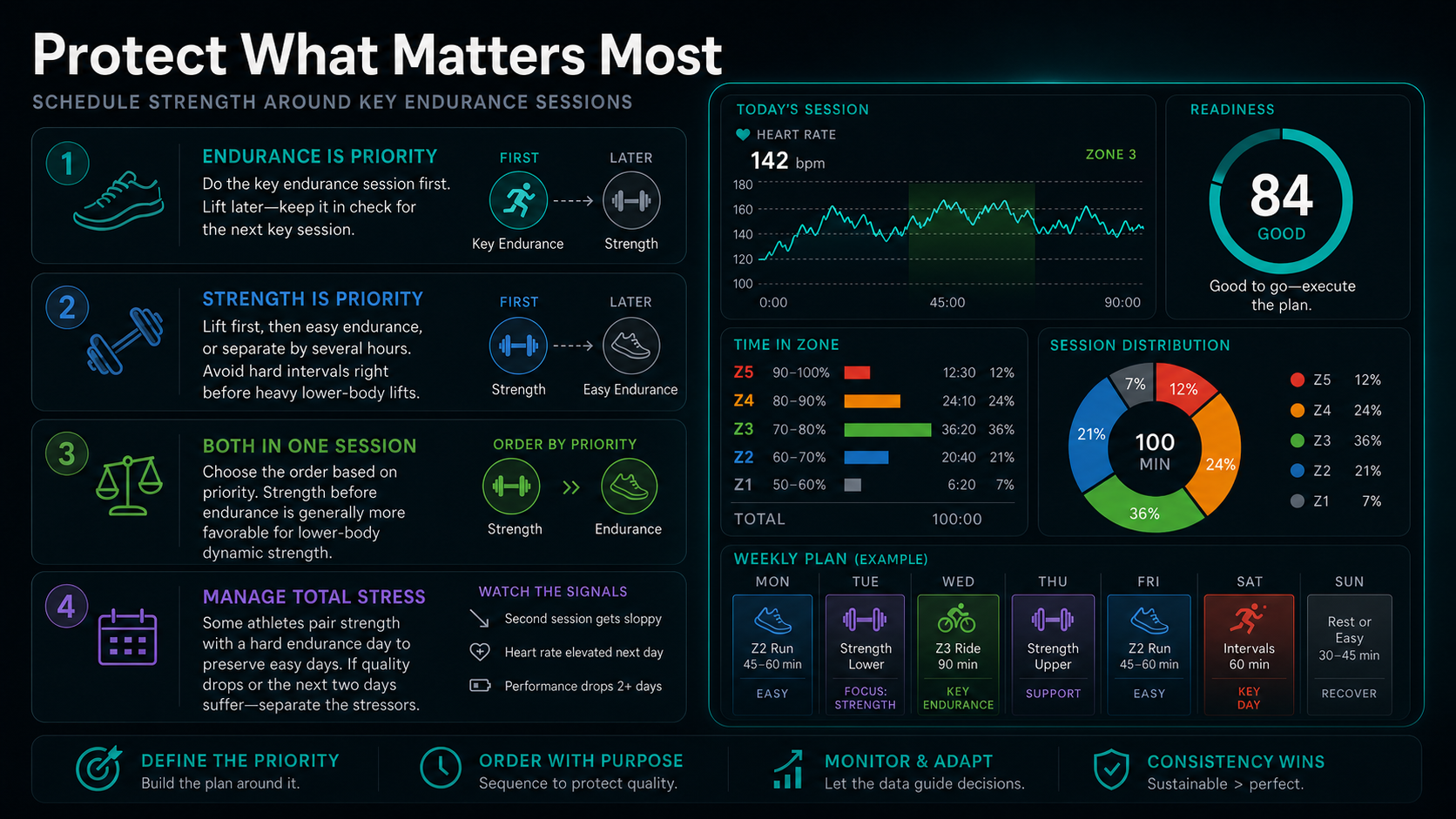
If strength is the priority
Lift first while coordination and force production are fresh. Perform easy endurance afterward, or separate the sessions by at least several hours. Avoid hard intervals immediately before heavy lower-body lifting.
If the endurance session is the priority
Complete the key run, ride, swim, row, or ski first. Lift later that day or the next day with a dose that does not compromise the following key session. One day of slightly reduced lifting quality may be acceptable when race-specific endurance is the main goal.
If both must happen in one session
Choose the order based on priority. Evidence comparing same-session sequence suggests that strength before endurance is more favorable for lower-body dynamic strength, while aerobic outcomes are less sensitive to order (Eddens and colleagues). Keep the second component short and avoid combining heavy leg work with a long or high-intensity endurance workout.
Put stress beside stress, but use judgment
Some athletes group strength with a hard endurance day to preserve truly easy days. For example, a runner may perform intervals in the morning and a short strength session later. This “high-low” pattern can work when sessions are separated and the athlete already tolerates the combination.
It is not automatically best for beginners, masters athletes, or anyone with limited recovery. If the second session becomes sloppy or the next two days deteriorate, separate the stressors.
Sample Weekly Schedules
The examples below show structure, not mandatory weekdays. Move sessions to fit work, sleep, facilities, and sport access.
Runner training five days per week
| Day | Training |
|---|---|
| Monday | Easy run + Strength A |
| Tuesday | Intervals |
| Wednesday | Recovery run or rest |
| Thursday | Tempo run + short Strength B later |
| Friday | Rest or easy cross-training |
| Saturday | Long run |
| Sunday | Easy run |
If Thursday lifting affects the long run, move Strength B to Wednesday or reduce it.
Cyclist training six days per week
| Day | Training |
|---|---|
| Monday | Rest + Strength A |
| Tuesday | VO₂ or high-intensity bike intervals |
| Wednesday | Easy endurance ride |
| Thursday | Threshold ride + short Strength B later |
| Friday | Easy spin |
| Saturday | Long ride |
| Sunday | Endurance or group ride |
Keep Monday controlled after a demanding weekend and Thursday small enough to protect Saturday.
Triathlete balancing three sports
| Day | Training |
|---|---|
| Monday | Easy swim + Strength A |
| Tuesday | Bike intervals + short transition run |
| Wednesday | Easy run + technique swim |
| Thursday | Run intervals + Strength B later |
| Friday | Easy swim or rest |
| Saturday | Long bike |
| Sunday | Long run |
Two compact full-body workouts are usually more sustainable for triathletes than separate upper- and lower-body days. Reduce volume during race-specific phases.
Adjust the Plan to the Sport
Distance running and trail running
Prioritize lower-body maximal strength, calf and soleus capacity, single-leg control, and a modest amount of plyometric work when appropriate. Trail runners and mountain athletes should also prepare for eccentric downhill loading and large ranges of hip and knee motion, but strength training cannot reproduce the technical decisions and repeated impacts of descending.
Keep new heavy or plyometric sessions away from important speed work at first. Running economy may take several weeks or months to improve; do not judge the plan by the first sore week.
Road cycling, gravel, and mountain biking
Use squat, leg press, split squat, and hip-hinge patterns to develop knee and hip extension. Heavy off-bike training has a larger evidence base than low-cadence work, though both may have a place. In a randomized trial of well-trained male cyclists, a high-resistance on-bike protocol was an effective alternative to matched off-bike squats for improving cycling performance, strength, and power (Barranco-Gil and colleagues).
Mountain bikers may place more value on upper-body pulling, pressing, grip, trunk control, and short power. Long-course road riders may use a smaller upper-body dose.
Swimming
Maintain full-body strength but allocate more work to upper-body pulling, pressing, and trunk control. Choose shoulder-friendly ranges and movements the athlete can perform without symptoms. Dry-land strength must coexist with large in-water pulling volume, so more exercises are not necessarily better.
Starts and turns depend on lower-body power. Swimmers should not remove leg strength simply because propulsion happens mainly in water.
Triathlon
Triathletes need the minimum effective dose because swim, bike, and run already compete for time and recovery. Full-body sessions built around four to six exercises work well. Keep the program broad enough to support all three sports, then emphasize the most limiting discipline during selected blocks.
Hiking and fastpacking
Use step-ups, split squats, squats, hip hinges, calf work, trunk training, and loaded carries. Progress pack weight mainly through hiking, not through making every gym exercise pack-specific. Prepare for descents with progressive eccentric strength and actual downhill exposure.
Rowing, paddling, and cross-country skiing
These athletes need more upper-body and trunk force than runners or road cyclists. Pulling volume, pressing balance, hip extension, and leg drive should reflect the exact discipline. Skiing techniques, boat setup, and stroke mechanics still require sport coaching; the gym develops capacity rather than technique.
Periodize Strength Across the Year
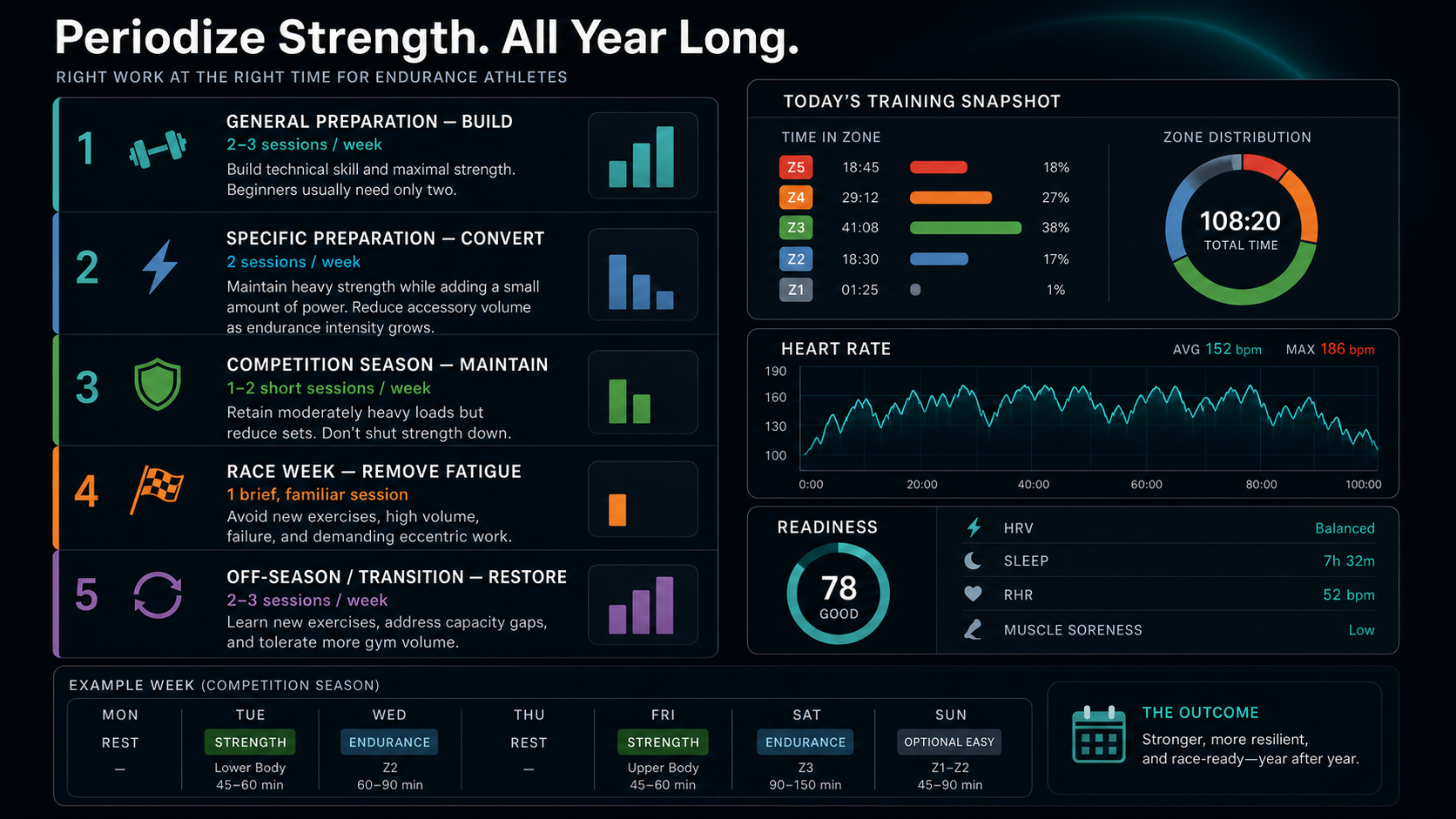
General preparation: build
Use two or three weekly sessions when endurance intensity is relatively low and strength is a major development goal. Beginners usually need only two. Build technical skill, maximal strength, and a foundation for later power work.
Specific preparation: convert
Maintain heavy strength while adding a small amount of power or reactive work relevant to the sport. As endurance intensity grows, reduce accessory volume. Keep the exercises familiar so strength sessions do not create novelty soreness.
Competition season: maintain
Use one or two shorter sessions per week. Retain moderately heavy loads but reduce sets. Strength is more likely to persist when some high-force exposure remains. In a small study of elite cyclists, several performance-related gains declined during eight weeks without strength training after a long heavy-strength phase (Rønnestad and colleagues). The sample was tiny, so it does not prove one maintenance formula, but it supports avoiding an automatic months-long shutdown.
Race week: remove fatigue, not every signal
Early in race week, an experienced athlete may perform a brief familiar session with one or two low-fatigue sets. Avoid new exercises, high volume, failure, and demanding eccentric work. Athletes who reliably feel flat or sore after lifting can stop earlier. The race matters more than preserving one gym session.
Off-season or transition: restore
Use the off-season to learn new exercises, address large capacity gaps, and tolerate more gym volume. Do not use it to create soreness so severe that all enjoyable endurance movement stops. Consistency across months matters more than one heroic block.
Recover From Both Types of Training
Strength training adds load even when the workout is short. Recovery must account for the whole week, not separate “cardio” and “gym” silos.
Eat enough to adapt
Chronic underfueling makes it harder to absorb both endurance and strength work. Preserve carbohydrate availability for important endurance sessions and consume enough total energy. Protein supports repair and adaptation; an International Society of Sports Nutrition position stand gives a broad range of 1.4–2.0 grams per kilogram per day for most exercising people, preferably distributed across the day (Jäger and colleagues). Individual needs vary, and athletes with medical or dietary constraints should seek qualified guidance.
Sleep is part of the program
When sleep falls, do not assume the written plan still represents the correct dose. Reduce accessory work, avoid failure, or move the session. The purpose of the plan is adaptation, not compliance at any cost.
Track soreness and performance, not soreness alone
Mild local soreness after a new exercise can be normal. Pain that changes gait, stroke, or pedaling mechanics is a different signal. So is a repeated drop in interval quality, loss of coordination, or fatigue that grows across weeks.
Use a simple readiness check:
- Did the warmup feel normal?
- Is movement symmetrical and technically stable?
- Is pain absent or within a clinician-approved range?
- Can the athlete produce normal submaximal force?
- Is tomorrow's key endurance session protected?
If several answers are no, reduce the dose or stop. One modified session is cheaper than a lost training week.
Remember bone health and energy availability
Cyclists and swimmers receive less impact loading than runners, and some endurance athletes have low bone mineral density, especially when high energy expenditure combines with inadequate intake. A clinical review describes bone-health concerns across running, cycling, swimming, and triathlon (Scofield and Hecht). Resistance training may be one useful loading strategy, but low bone density, recurrent bone stress injury, menstrual disruption, or other signs of low energy availability require professional assessment rather than a generic lifting plan.
How Zone Training Log Helps
Strength work becomes easier to manage when it lives beside endurance training rather than in a separate mental ledger. Zone Training Log can bring workouts from Apple Health or Health Connect into one timeline, helping you see strength days alongside easy, moderate, and hard endurance sessions.
Use a consistent title such as Strength A, Strength B, Heavy Lower, or In-Season Maintenance. Add notes for the details the sensor cannot infer:
- Main exercises, sets, repetitions, and load
- Repetitions in reserve or session RPE
- New exercises or unusually high eccentric work
- Soreness the next morning
- Whether a key endurance session was affected
- The current phase: foundation, build, specific, maintenance, or taper
Heart-rate zones are not the main way to evaluate strength training. A heavy set may be productive even if average heart rate is low, while a circuit may generate a high heart rate without providing a strong maximal-strength stimulus. Use the training log to understand placement and recovery: Was lifting performed before intervals? Did Zone 2 pace or power change the next day? Did the long session remain controlled?
Review trends across several weeks. If strength loads rise while key endurance work stays stable, the plan is likely integrating well. If every gym improvement arrives beside worse intervals, skipped long sessions, or persistent soreness, the total dose is wrong even if the lifting numbers look impressive.
Common Strength-Training Mistakes
Copying a bodybuilder's volume
Endurance athletes need strength, but they already carry a large weekly workload. High volumes of isolation work may add fatigue without improving the qualities that limit performance. Start with fewer exercises and earn more volume only when recovery and results justify it.
Turning every session into cardio
Short rests and constant circuits make the workout feel athletic. They also reduce the load and speed available for strength and power. Let endurance training train endurance. Rest between heavy sets.
Lifting to failure
Failure is not required for strength and creates avoidable fatigue. Stop most compound sets with clean repetitions available.
Changing exercises every week
Constant novelty prevents technical learning and repeatedly causes soreness. Keep the main movement patterns stable for several weeks.
Adding too much too quickly
A new strength plan, new plyometrics, more hill work, and higher endurance volume should not start together. Introduce one major stressor, observe the response, then progress.
Protecting gym numbers instead of endurance performance
The gym is support work. A small reduction in lifting load during a race-specific block is not failure. It is prioritization.
Assuming strength prevents every injury
Strength can improve capacity, but injury is multifactorial. Training load, prior injury, technique, terrain, equipment, sleep, nutrition, and health all matter. Persistent or focal pain needs assessment, not another generic exercise.
Frequently Asked Questions
How many times per week should endurance athletes strength train?
Two sessions per week is a practical development dose for most athletes. One or two shorter sessions can maintain strength during busy competition periods. New lifters and high-volume endurance athletes should start at the lower end of volume.
Should endurance athletes lift heavy?
Usually, yes—after learning the movements and building tolerance. Heavy, technically sound sets with one to three repetitions in reserve provide a distinct maximal-strength stimulus. Heavy does not mean testing a one-repetition maximum or grinding every set.
What are the best strength exercises for runners and cyclists?
There is no single mandatory list. Build around a knee-dominant exercise, hip hinge, single-leg exercise, and trunk work. Runners often add calf work and plyometrics; cyclists often emphasize squat or leg-press and hip-extension strength. Choose movements that are loadable, tolerated, and appropriate to the athlete.
Is bodyweight training enough?
It can be enough for a beginner and remains useful for jumps, push-ups, trunk work, and travel. Lower-body strength eventually requires progressive overload; add resistance or choose a harder variation when sets become very long.
Should I lift before or after running or cycling?
Do the priority session first. If strength development is the main goal, lift first or separate sessions. If the endurance workout is race-specific and most important, complete it first. When possible, leave several hours between demanding sessions.
Will strength training make an endurance athlete bulky?
Meaningful hypertrophy requires sufficient training volume, nutrition, and time. Endurance-focused plans usually use modest volume, and runner-focused reviews have not found harmful body-composition changes from properly designed strength interventions (Blagrove and colleagues). Some muscle gain may occur, especially in beginners, but large unwanted gains are not an automatic result of two compact weekly sessions.
How sore should I be?
Soreness is not a target. Mild soreness can occur after a new exercise, but it should not repeatedly change endurance mechanics or destroy key sessions. Reduce sets, avoid failure, and progress more slowly if soreness persists.
When should I stop strength training before a race?
Do not introduce new or damaging work in race week. Experienced athletes may keep a very small familiar stimulus early in the week; soreness-prone athletes may stop earlier. During the broader season, reduce volume and maintain some load instead of abandoning strength for months.
Can an injured athlete follow this plan?
Not automatically. Pain, recent surgery, bone stress injury, cardiovascular conditions, pregnancy, and other health factors can change what is safe. Use a qualified clinician or coach who can assess the individual and coordinate loading with the endurance plan.
Conclusion
Strength training for endurance athletes should be simple, progressive, and subordinate to the sport. Two weekly full-body sessions can build strength through a squat, hinge, single-leg movement, calf or ankle work, upper-body push and pull, and trunk exercise. Use challenging loads, moderate volume, long enough rest, and stop before failure.
Heavy resistance and carefully chosen explosive work have the strongest performance case. Circuits, isometrics, and plyometrics are tools for particular goals, not universal requirements. Schedule lifting so it does not consume the quality of key intervals, long sessions, or technical practice. Build in the preparation phase, maintain with less volume during competition, and remove fatigue around races.
Most importantly, judge the program by the complete athlete. More weight on the bar matters only when endurance performance, health, and training consistency remain intact.