

Endurance Training
Zone Training for Triathletes
Zone training helps triathletes manage swim, bike, and run intensity without turning every workout into moderate fatigue. Learn how to set sport-specific zones, structure the week, handle bricks, and review training load.

Introduction
Zone training for triathletes means using intensity ranges to make swim, bike, and run workouts fit together as one training system. The goal is not to make every session perfectly controlled. The goal is to know which workouts are easy, which are moderate, which are hard, and whether the total week still matches the plan.
That matters more in triathlon than in a single-sport plan because training stress arrives from three directions. A runner can look at run mileage, run pace, and run intensity. A triathlete has swim technique work, bike endurance, run durability, brick workouts, strength training, race simulation, and life stress all competing for recovery. Without zones, many age-group athletes drift into the same mistake: every session becomes a little too hard to be easy, but not specific enough to be a true key workout.
The short answer is this: use separate sport-specific zones, keep most training controlled, place hard work deliberately, and review the whole week instead of judging each workout alone.
Heart rate zones can help, but heart rate is not equally useful in all three sports. Swim heart rate is harder to measure and often less practical in real time. Bike intensity is often best controlled by power, with heart rate used as internal-load context. Run training can use pace, heart rate, and perceived effort together, but running after cycling has its own fatigue pattern. Achten and Jeukendrup's review describes heart-rate monitoring as useful for training control while emphasizing the need to interpret it with context and known limitations (Sports Medicine).
This guide explains how triathletes should use zones across swim, bike, and run, how to build a week by zone, how to review bricks, how race distance changes the emphasis, and how Zone Training Log can help turn messy multi-sport data into useful decisions.
The Big Difference: Triathlon Zones Are Not One Chart
The biggest mistake in triathlon zone training is treating one zone chart as if it explains every sport. The same athlete can have different sustainable intensities, heart-rate responses, muscular limits, and pacing cues in swim, bike, and run. A Zone 2 swim does not feel like a Zone 2 ride. A Zone 2 run after a hard bike does not feel like a fresh Zone 2 run. A cycling threshold heart rate may not equal a running threshold heart rate.
That does not mean the five-zone language is useless. It means the zone labels should be shared while the anchors are sport-specific.
| Zone | Shared training meaning | Triathlon interpretation |
|---|---|---|
| Zone 1 | Recovery | Easy technique, warmups, cooldowns, recovery spins, very easy jogs |
| Zone 2 | Endurance | Aerobic base work that can be repeated often |
| Zone 3 | Tempo | Controlled moderate work, race-specific blocks, steady pressure |
| Zone 4 | Threshold | Hard sustainable intervals near threshold intensity |
| Zone 5 | VO2 max or very hard | Short hard repeats, race surges, high-intensity work |
The names are shared. The numbers should not be copied blindly. A triathlete might use threshold swim pace, bike FTP, cycling threshold heart rate, run threshold pace, and running threshold heart rate. That is not overcomplication. It is the minimum needed to avoid comparing unlike signals.
Millet, Vleck, and Bentley reviewed physiological differences between cycling and running and emphasized that triathletes cannot assume identical responses across the two modes (Sports Medicine). The practical lesson is clear: if cycling and running differ enough to affect physiology and performance, your training zones should respect those differences.
Use Separate Zone Anchors For Swim, Bike, And Run
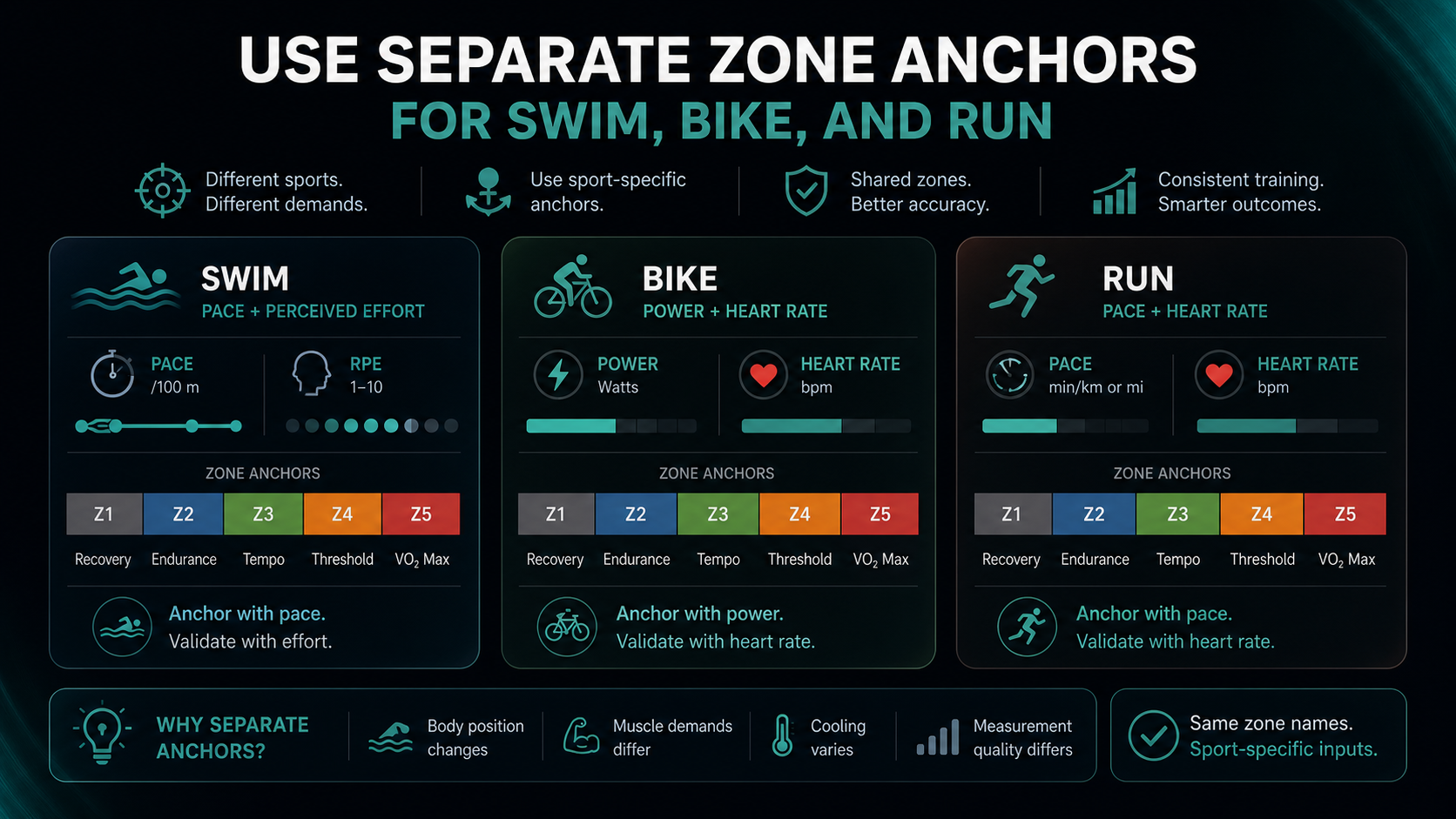
Triathletes should not force one heart-rate zone chart to explain all three sports. Swim, bike, and run have different mechanics, body positions, muscle demands, cooling conditions, and measurement quality. A practical triathlon system uses sport-specific anchors: swim pace and perceived effort, bike power plus heart rate, and run pace plus heart rate. The zone labels may be shared, but the inputs should be sport-specific.
For swimming, pace and perceived effort are usually more practical than heart rate. Pool pace, repeat times, stroke count, rest intervals, and technique quality often tell you more than a delayed heart-rate value. Open-water swimming adds drafting, sighting, water temperature, wetsuits, and navigation, so a clean heart-rate target is even harder to use as the main control.
For cycling, power is often the best execution metric when available. Power reacts immediately to surges, climbs, and intervals. Heart rate then tells you how costly that output is. A 200-watt endurance ride can be relaxed on a cool day and stressful in heat or after poor sleep. Power describes the external load. Heart rate describes internal response.
For running, pace, heart rate, and perceived effort all matter. Pace gives external output, heart rate shows internal cost, and perceived effort catches fatigue, heat, terrain, and form changes. Running also carries more impact stress than cycling or swimming, so a run that is only moderately hard by heart rate can still carry musculoskeletal cost.
The Five Zones For Triathletes
Zone 1 is recovery and skill. In swim training, Zone 1 might be easy drills, relaxed aerobic swimming, or technique-focused sets with plenty of rest. On the bike, it is very easy spinning, warmups, cooldowns, or recovery rides. In running, it is easy jogging or short recovery mileage. Zone 1 should leave you fresher, not secretly add stress.
Zone 2 is endurance. This is the backbone of most triathlon preparation because it allows volume to accumulate without requiring constant recovery debt. Zone 2 helps triathletes build durability across all three sports. A Zone 2 bike ride should usually be repeatable. A Zone 2 run should not damage the next key session. A Zone 2 swim should support technical consistency rather than survival.
Zone 3 is tempo or moderate work. This is useful, but it needs intent. For sprint and Olympic-distance triathletes, some Zone 3 work can be race-specific. For half-distance and long-course athletes, controlled Zone 3 blocks may appear in longer race-pace sessions. The problem is accidental Zone 3: every bike ride becomes steady pressure, every run becomes medium-hard, and the athlete loses truly easy volume.
Zone 4 is threshold. Threshold work is hard, focused, and recoverable only in planned doses. In swimming, this may look like controlled hard intervals around threshold pace. On the bike, it may be intervals near FTP or a threshold power target. On the run, it may be tempo intervals, cruise intervals, or sustained threshold work.
Zone 5 is very hard. These efforts are short, demanding, and potent. They can support VO2 max, speed, neuromuscular sharpness, and race surges. Laursen and Jenkins' review of high-intensity interval training describes the value of intense interval work for trained endurance athletes while making clear that it must be programmed carefully (Sports Medicine). For triathletes, the key word is carefully. A hard bike session can compromise the next run. A hard run can compromise the next swim, ride, and long run.
Why Most Triathletes Need More Easy Training Than They Think
Triathlon rewards consistency. Consistency requires recovery. That is why zone training often starts by protecting easy work, not by adding more hard sessions.
Endurance research does not prescribe one perfect percentage for every athlete, but it does support the idea that intensity distribution matters. Seiler's review describes how successful endurance athletes often accumulate substantial low-intensity volume while placing smaller amounts of high-intensity work deliberately (International Journal of Sports Physiology and Performance).
That idea matters for age-group triathletes because the sport invites too much moderate work. You may swim with a lane that is a little too fast, ride with a group that surges, run off the bike too hard, and add a weekend long run that drifts into tempo. None of those workouts looks reckless alone. Together they can create a week with too much Zone 3 and not enough recovery.
Easy training is not wasted training. In triathlon, easy sessions do several jobs:
| Easy session job | Why it matters |
|---|---|
| Builds aerobic volume | Lets you practice endurance without constant fatigue |
| Supports technique | Helps swim form, bike cadence, and run mechanics stay controlled |
| Preserves recovery | Keeps key sessions higher quality |
| Develops durability | Adds frequency across three sports |
| Reduces injury risk | Especially important for run progression |
This does not mean hard training is optional. It means hard training works better when easy training is actually easy.
Hard Work Still Matters
Zone training can be misread as "stay easy forever." That is not the point. Triathletes need hard work, but it should be placed where it gives the best return.
A sprint-distance triathlete may need more high-intensity work because the race is short and aggressive. An Olympic-distance athlete needs strong threshold and tempo ability. A half-distance athlete needs durable race-specific pressure. A long-course athlete needs patience, fueling practice, and the ability to keep internal load controlled for hours. All of them can use intensity, but the shape differs.
The best hard workout is not always the hardest workout. It is the workout that supports the next race demand without stealing from the rest of the week.
For many age-group athletes, one or two genuinely hard sessions per week is enough during normal training. Sometimes that is a hard bike and a hard run. Sometimes it is a hard swim and a hard bike. During a race-specific block, a long ride with race-pace work may count as a key session even if it never reaches Zone 5.
Neal and colleagues compared polarized and threshold-oriented training in trained cyclists and found performance benefits from the polarized approach in that study (International Journal of Sports Physiology and Performance). That does not automatically settle the ideal triathlon plan, but it reinforces a practical warning: if too much training sits in the middle, athletes may lose the contrast between easy development and hard stimulus.
Build The Week Around Zone Balance
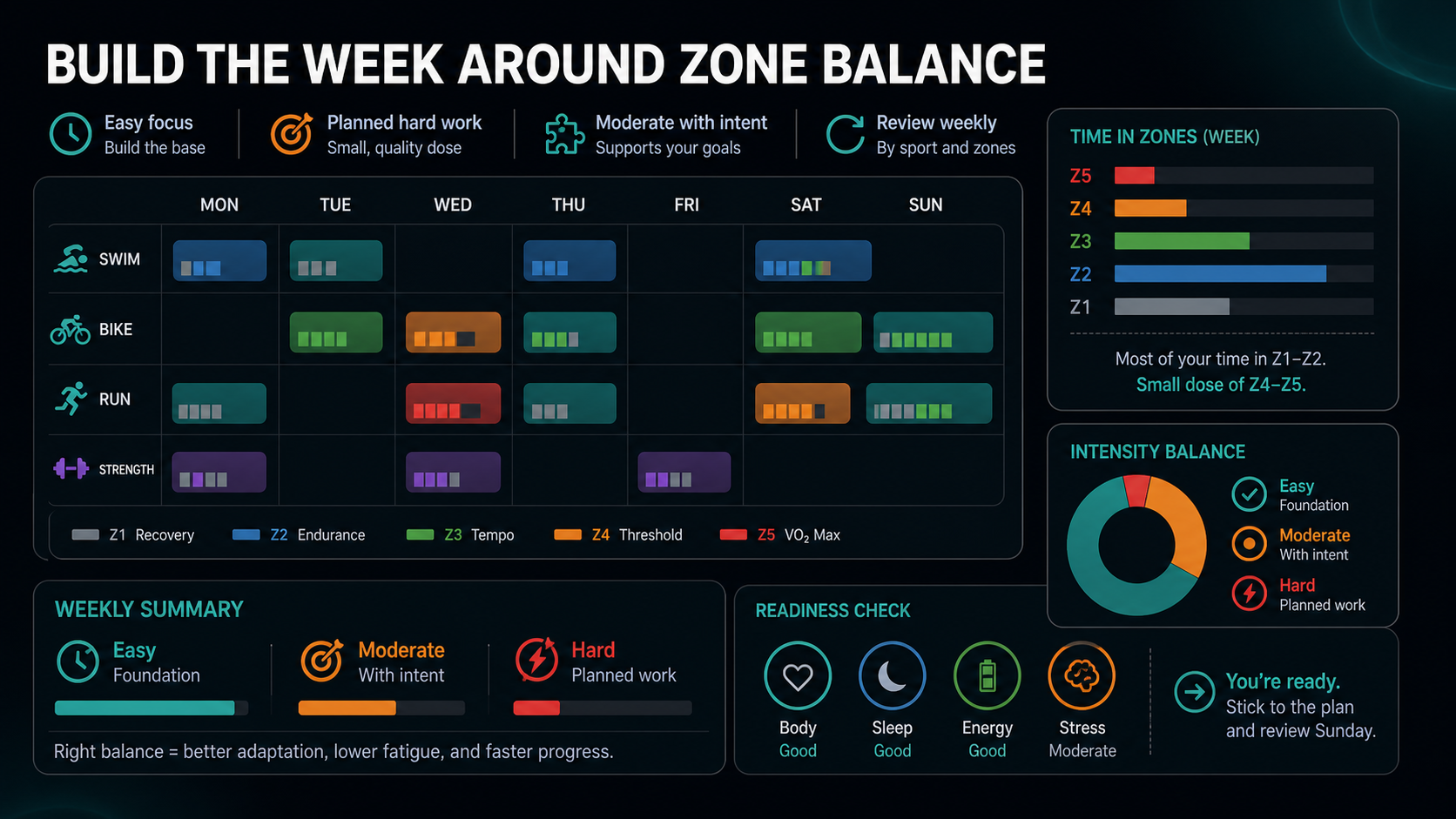
Triathlon zone training is not only about individual workouts. The week matters because swim, bike, run, strength, and life stress all add up. Most age-group triathletes need enough low-intensity time to absorb the workload, a small amount of deliberate high-intensity work, and carefully placed moderate work that matches race goals. Review the whole week by sport and by zone instead of judging each workout in isolation.
Start by labeling the purpose of each key session:
| Session type | Primary zone target | What to protect |
|---|---|---|
| Recovery swim | Zone 1 | Technique and looseness |
| Aerobic ride | Zone 2 | Low internal load |
| Long run | Zone 2, sometimes late Zone 3 | Durability without excess fatigue |
| Tempo bike | Zone 3 | Controlled race-specific pressure |
| Threshold swim | Zone 4 | Repeat quality and form |
| VO2 run | Zone 5 | Short high-quality work |
| Brick | Depends on goal | Bike cost and run response |
Then look at the whole week. If every sport has a "moderate" day, the week may be harder than it appears. If the long ride includes race-pace blocks, the next day's run may need to be easier. If the run intervals were hard, the next swim may be technique-focused rather than another threshold set.
Bourdon and colleagues' consensus statement on training-load monitoring emphasizes the value of looking at both external load and internal load rather than treating one number as complete (International Journal of Sports Physiology and Performance). For triathletes, this is essential. Distance, pace, watts, heart rate, and perceived effort each tell part of the story.
A Simple Weekly Zone Framework
A useful beginner-to-intermediate framework is to choose two or three key sessions, then make the rest of the week support them. The exact number depends on training history, race distance, injury risk, work schedule, sleep, and recovery capacity.
For example, a balanced base week might include:
| Day | Session | Zone purpose |
|---|---|---|
| Monday | Easy swim or rest | Recovery and technique |
| Tuesday | Bike intervals | Planned Zone 4 or Zone 5 |
| Wednesday | Easy run and swim drills | Zone 1 to Zone 2 |
| Thursday | Steady swim or run tempo | Controlled Zone 3 or Zone 4 |
| Friday | Easy spin or rest | Recovery |
| Saturday | Long ride with optional race-pace blocks | Mostly Zone 2, optional Zone 3 |
| Sunday | Long run or brick run | Mostly Zone 2 |
This is not a prescription. It is a logic pattern. Hard work is deliberate. Easy work supports it. Moderate work has a reason. The long sessions are not automatically races.
For a newer triathlete, the safest version may have only one hard session per week, especially if running injury risk is high. For an experienced athlete, there may be more intensity, but the principle does not change: each hard session needs a reason and a recovery plan.
Swim Zones: Pace, Form, And RPE First
Swimming is the sport where heart-rate zones are often least useful during the workout. Heart-rate data may be delayed, inconvenient to read, or less reliable depending on device and environment. Pool pace, repeat structure, rest interval, stroke quality, and perceived effort usually matter more.
A simple swim-zone system can use:
| Swim signal | Best use |
|---|---|
| Repeat pace | Controls threshold and endurance sets |
| Rest interval | Changes difficulty without changing pace |
| Stroke count | Helps monitor efficiency |
| RPE | Captures effort when pace is distorted |
| Heart rate | Useful after the set, not always during it |
For easy swims, the goal is relaxed aerobic work and technical quality. If form falls apart, the set is no longer truly easy even if heart rate looks low. For threshold swims, use repeat times and rest intervals. For short hard swim work, heart rate may not be fast enough to guide each repetition.
Triathletes also need to separate swim fitness from swim skill. A hard swim can raise fitness, but if it reinforces poor mechanics, the gain may not transfer well. Zone training should support better swimming, not just harder swimming.
Bike Zones: Power Controls, Heart Rate Explains
The bike is often the easiest sport to control with zones because power is widely available and the environment can be structured. If you have a power meter or smart trainer, use power for execution and heart rate for context.
Power answers, "What am I doing?" Heart rate answers, "What is it costing?" That distinction is especially useful for triathletes because the bike sets up the run. A bike ride can look impressive by power and still be too costly for the race or brick that follows.
For bike endurance, keep power smooth and watch whether heart rate drifts. If the same power produces rising heart rate late in the ride, heat, dehydration, fueling, fatigue, or duration may be increasing internal load. Coyle and Gonzalez-Alonso reviewed cardiovascular drift and the way heart rate can rise during prolonged exercise, especially with heat stress and dehydration (Exercise and Sport Sciences Reviews).
For bike intervals, let power lead. Heart rate lags behind short efforts. If you chase heart rate during the first minute of a VO2 interval, you may overshoot badly. Review heart rate after the set to understand cost, but execute with power, cadence, and perceived effort.
For long-course triathletes, the bike is often less about maximum bike fitness and more about controlled output. The question is not only, "Can I hold this power?" It is, "Can I hold this power and still run well?"
Run Zones: Keep Easy Runs Easy
Run training is where many triathletes get into trouble. Running has more impact stress than swimming or cycling, and run fatigue can linger. That makes accidental Zone 3 especially costly.
Use run zones to protect three things:
| Run training need | Zone implication |
|---|---|
| Durability | Most running should be controlled enough to repeat |
| Speed or threshold | Hard running should be planned and limited |
| Injury risk | Avoid turning every run into moderate stress |
Heart rate can help keep easy runs easy, but it needs context. Heat, hills, terrain, fatigue, dehydration, and cardiac drift can raise heart rate. Age-based max heart-rate estimates can also be misleading for individuals. Tanaka, Monahan, and Seals proposed a revised age-predicted maximum-heart-rate equation, but age formulas are population estimates rather than precise individual tests (Journal of the American College of Cardiology).
If your zones come from a rough estimate and every easy run appears too high, verify the inputs before changing the whole plan. If your zones are good and every easy run still becomes Zone 3, the issue is probably pacing, terrain, heat, fatigue, or insufficient recovery.
For triathletes, the safest default is conservative running. Build run frequency and consistency before chasing hard sessions. Use Zone 2 to develop durability. Use Zone 3 and Zone 4 when they have a clear role. Use Zone 5 sparingly unless the athlete has the history to absorb it.
Brick Workouts Need Their Own Zone Review
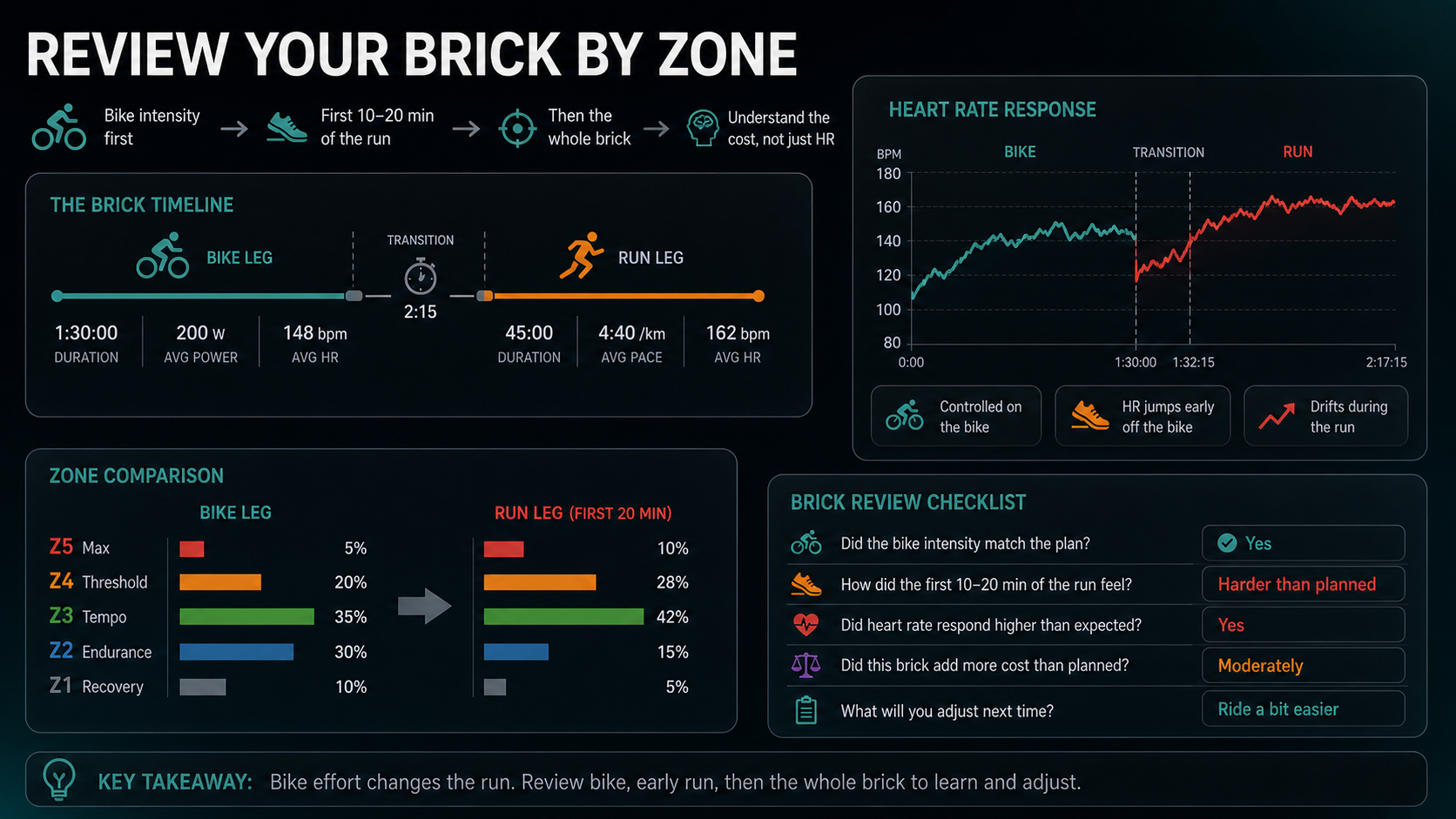
A brick workout connects the bike and run so a triathlete can practice the transition and learn how the run feels after cycling. The run off the bike often starts with strange legs, altered pacing, and a heart-rate response that does not match a fresh run. Review the bike intensity first, then the first 10 to 20 minutes of the run, then the whole brick. The goal is not to turn every brick into a hard session; the goal is to understand whether bike effort made the run more costly than planned.
Brick workouts are useful because race day is not a fresh run. The problem is that bricks are easy to overdo. A hard bike followed by a hard run may be race-specific, but it is also expensive. It should count as a key session, not as a casual add-on.
A practical brick review asks:
| Review question | Why it matters |
|---|---|
| Was bike intensity controlled? | The bike determines much of the run cost |
| Did heart rate rise early on the run? | Shows internal load after transition |
| Did run pace match the plan? | Prevents overpacing off the bike |
| Did the brick change the weekly zone balance? | Hard bricks can distort the week |
| Was recovery planned afterward? | Bricks combine two stressors |
Millet, Vleck, and Bentley's triathlon-focused review of cycling and running differences is relevant here because the bike-run transition is not just two workouts placed next to each other; the first mode can change the second (Sports Medicine). The practical takeaway: review bricks as combined sessions, not as separate files that happen to be adjacent.
Race Distance Changes Zone Priorities
Zone training should reflect the race you are preparing for. A sprint triathlon and an Iron-distance race are not the same physiological problem.
For sprint triathlon, intensity is high relative to longer races. Athletes may need more threshold and VO2 work, especially on the bike and run, while still maintaining enough easy training to recover. Zone 4 and Zone 5 can matter more, but they should still be placed deliberately.
For Olympic distance, threshold and controlled tempo become important. The athlete needs enough speed to race hard, but enough endurance to avoid fading. Zone 3 and Zone 4 work may be more race-specific than in longer events.
For half-distance racing, the center shifts toward durability and sustained control. Zone 2 volume, race-pace Zone 3 blocks, fueling practice, and long brick awareness matter. The key is not simply riding hard. It is riding at an intensity that lets the run happen.
For long-course racing, discipline becomes the performance skill. Many athletes do not fail because they lack Zone 5 speed. They fail because the early swim or bike creates too much internal cost. Zone 2 and controlled race-specific work become central, with hard sessions used carefully to maintain fitness without overwhelming recovery.
| Race type | Zone emphasis |
|---|---|
| Sprint | More threshold, VO2, and speed; still protect recovery |
| Olympic | Threshold, tempo, and controlled endurance |
| Half-distance | Durable Zone 2 plus race-specific Zone 3 |
| Long-course | Controlled intensity, fueling practice, low drift |
The mistake is copying the same week for every race distance. The zone language may be the same, but the balance changes.
How To Use RPE With Triathlon Zones
RPE means rating of perceived exertion. It is not a backup metric for athletes without devices. It is a primary training signal, especially in triathlon.
Heart rate can lag. Power meters can be miscalibrated. GPS pace can be distorted by terrain. Swim pace can be affected by turns, drafting, pool length, or open-water conditions. RPE helps interpret what the athlete actually experienced.
Foster's work on session RPE helped popularize a simple way to monitor training load by combining duration and perceived effort (Journal of Strength and Conditioning Research). For triathletes, this is useful because a week can include many small stressors that do not look dramatic alone.
After each key session, ask:
| Question | Useful answer |
|---|---|
| Did this feel easier, normal, or harder than expected? | Helps spot fatigue |
| Did the zone match the purpose? | Confirms execution |
| Did the session affect the next sport? | Catches multi-sport cost |
| Would I repeat this tomorrow? | Reveals whether it was truly easy |
If power, heart rate, pace, and RPE agree, interpretation is easier. If they disagree, do not ignore the disagreement. It is often the useful part of the data.
Fueling, Heat, And Zone Drift
Long triathlon sessions often drift. Heart rate rises at the same power or pace. Perceived effort climbs. The athlete feels fine early and strained late. Sometimes that is normal duration cost. Sometimes it is a warning that heat, hydration, or fueling is limiting the session.
The American College of Sports Medicine position stand on exercise and fluid replacement describes how fluid deficits and heat stress can increase physiological strain during exercise (Medicine & Science in Sports & Exercise). For triathletes, this matters during long rides, long runs, indoor trainer sessions, hot races, and brick workouts.
Zone drift is not only a fitness issue. It can be a setup issue. An indoor ride without enough airflow may show higher heart rate at the same power. A long run without adequate fluid or carbohydrate may climb from Zone 2 into Zone 3. A hot race simulation may require lower power or pace to keep internal load under control.
Use drift as a question, not a verdict:
| Drift pattern | Possible explanation |
|---|---|
| Late HR rise at steady bike power | Heat, dehydration, duration, fatigue |
| Early HR rise on easy run | Poor recovery, heat, wrong zones, pacing |
| High HR after transition | Bike cost carried into run |
| Low HR with high RPE | Fatigue, sensor issue, accumulated stress |
The goal is not to eliminate all drift. The goal is to know when drift is expected, when it is excessive, and how it affects the next session.
Common Mistakes In Triathlon Zone Training
The first mistake is using running zones for cycling. Running heart rate and cycling heart rate can differ. Bike-specific anchors are better when available.
The second mistake is using heart rate as the main control metric for short bike intervals. Heart rate responds too slowly. Use power or effort to execute the interval, then review heart rate afterward.
The third mistake is treating swim heart rate as more precise than it is. Swimming is technical, and pace, rest, stroke quality, and RPE often matter more than a watch reading.
The fourth mistake is letting every run drift into Zone 3. This is common because triathletes often run on tired legs. If the run was meant to be easy, protect the easy purpose.
The fifth mistake is undercounting bricks. A brick is not just a bike plus a short run. It is a combined stressor, especially if the bike includes intensity or the run starts too fast.
The sixth mistake is ignoring the week. One tempo ride is fine. One tempo run is fine. One steady swim is fine. All of them in the same week, plus a long ride and long run, may become too much moderate load.
The seventh mistake is changing zones too often. Bad zones are a problem, but constant edits make trends impossible to read. Use reliable anchors, then watch patterns over several weeks before making major changes.
How Zone Training Log Helps Triathletes
Zone Training Log is useful for triathletes because it turns multi-sport training into patterns you can review. The point is not just seeing a zone chart after one workout. The point is comparing the week.
Use it to ask:
| Weekly review question | Why it matters |
|---|---|
| How much total time was easy? | Shows whether recovery work was protected |
| How much time landed in Zone 3? | Catches accidental moderate training |
| Which sport created the most hard load? | Helps place recovery |
| Did brick runs show higher heart rate? | Reveals bike-run cost |
| Did long sessions drift late? | Flags durability, fueling, or heat issues |
This kind of review is especially helpful for age-group athletes because the calendar is rarely perfect. Work, family, travel, sleep, and stress all affect training. A clean zone review helps you adjust the plan without guessing.
The best use is weekly: review swim, bike, and run together, then decide what the next week needs. Sometimes the answer is more Zone 2. Sometimes it is a sharper interval session. Sometimes it is rest.
A Practical Start For Age-Group Triathletes
If you are starting from scratch, do not try to perfect every zone on day one. Build a usable system and refine it.
Start with these steps:
- Set separate swim, bike, and run anchors.
- Label every workout by purpose before you start.
- Keep easy sessions easy enough to repeat.
- Put hard work on the calendar intentionally.
- Review the whole week by zone.
- Adjust one variable at a time.
For swim, start with pace and RPE. For bike, use power if you have it, and heart rate as context. For run, use pace, heart rate, and RPE together. For bricks, review bike cost and run response as one combined session.
If you do not know your zones, use conservative estimates and adjust with real training feedback. Threshold concepts are useful, but they vary by method. Faude, Kindermann, and Meyer reviewed lactate-threshold concepts and noted that different definitions and methods can produce different threshold values (Sports Medicine). Treat any threshold test as an anchor from a specific method, not a universal truth.
The goal is not a perfect spreadsheet. The goal is better decisions.
When To Adjust Your Zones
Zones should be stable enough to make trends meaningful, but not so fixed that they ignore progress. Triathletes should adjust zones when there is a clear reason, not every time one workout feels unusual.
Good reasons to revisit zones include a recent field test, a race result that clearly shows changed fitness, several weeks of workouts that no longer match the expected effort, or a major training block that changes sport-specific ability. For example, if your bike power has improved after a focused cycling block, old bike zones may understate your current output. If you have spent months rebuilding run durability after injury, old run pace zones may be too aggressive.
Bad reasons to change zones include one hot run, one stressful week, one poor night's sleep, or one sensor artifact. A single outlier is usually a reason to add context, not rewrite the system. Heart rate can be affected by heat, hydration, fatigue, caffeine, illness, and emotional stress. GPS pace can be distorted by terrain. Swim pace can be distorted by drafting, turns, pool length, open-water sighting, and wetsuit use.
Use a pattern-based rule. If the same mismatch appears across several comparable sessions, investigate. If easy bike rides are always low power but high heart rate, check cooling, fatigue, and cycling threshold heart rate. If easy runs always feel harder than the zone says, check terrain, pace discipline, and whether the run zones were copied from a different sport. If swim threshold pace no longer matches repeat performance, retest in the pool.
When you do adjust zones, update one sport at a time. Do not change swim, bike, and run zones together unless you completed a planned testing block. Triathlon training is already noisy. Changing everything at once makes it harder to know whether better results came from fitness, better zones, easier conditions, or simple randomness.
The best zone system is not the one with the most decimal places. It is the one that makes training decisions clearer from week to week.
Conclusion
Zone training for triathletes works when it respects the reality of the sport. Swim, bike, and run are not interchangeable. They need separate anchors, different execution cues, and one shared weekly review.
Use zones to protect easy training, place hard work deliberately, and prevent accidental moderate fatigue from taking over the week. Use swim pace and RPE for the pool. Use bike power to control output and heart rate to understand cost. Use run pace, heart rate, and perceived effort together, especially when running on tired legs. Review bricks as combined sessions. Match the zone balance to the race distance.
The most important habit is simple: do not ask whether one workout looked good in isolation. Ask whether the whole swim-bike-run week matched the plan and left you ready to adapt.

Our editorial approach & AI disclosure
We use AI to help research, organize, and draft some articles. Every article is reviewed by a human editor and aims to reflect current evidence-based training practices and scientific literature.
Read our editorial policy