

Returning to Training After Illness or Injury
A practical, evidence-backed guide for endurance athletes returning to training after illness or injury, with red flags, load progression, zone guidance, and decision rules for safer rebuilding.
Sep 17, 202622 min read
Introduction
Returning to training after illness or injury should be treated as a rebuild, not a test. The goal is not to prove that fitness is still there on day one. The goal is to re-establish consistent training without turning a short interruption into a longer setback.
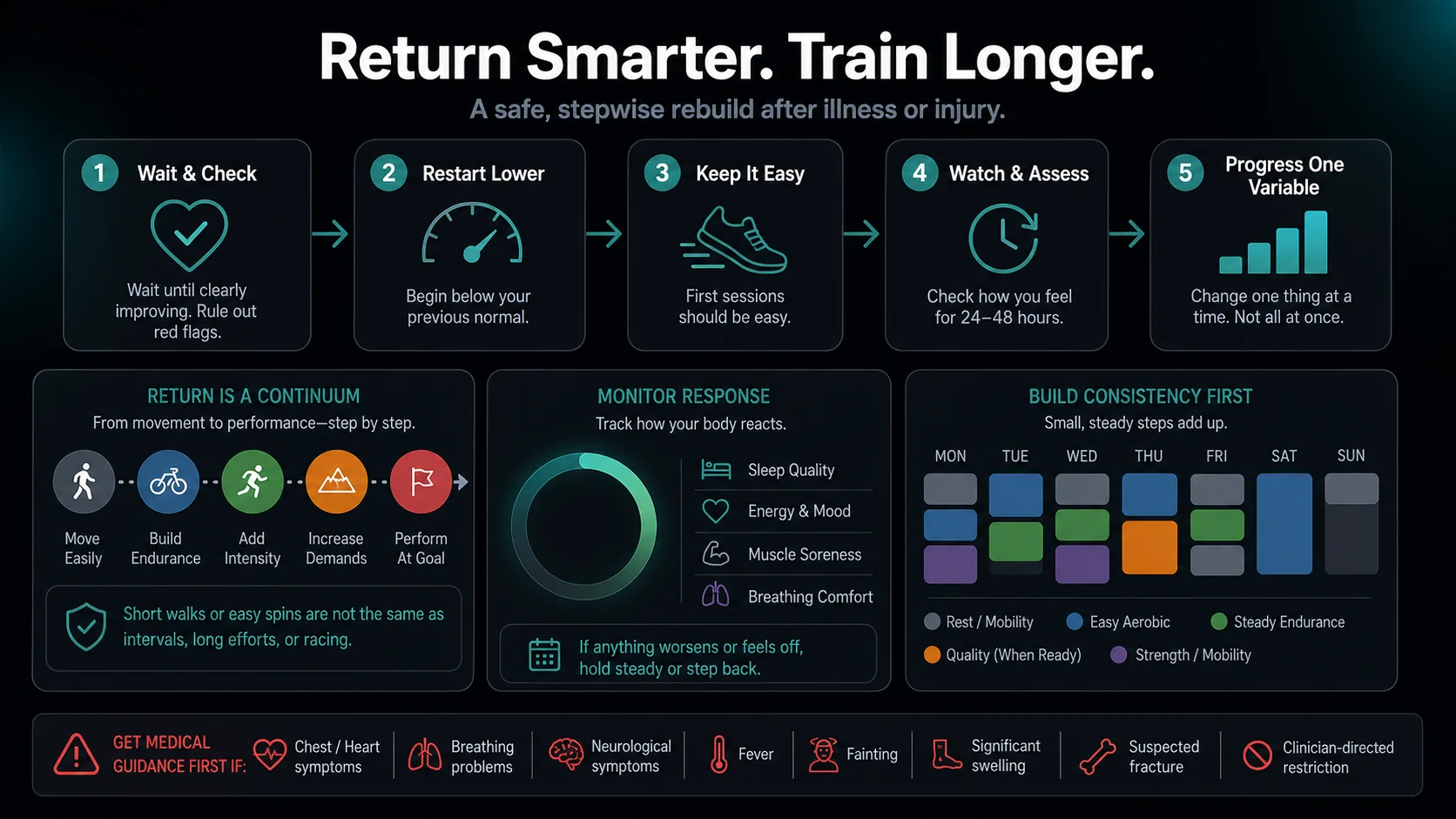
For most endurance athletes, the safest useful pattern is: wait until the acute problem is clearly improving, rule out red flags, restart below your previous normal, keep the first sessions easy, watch the response for 24 to 48 hours, then progress one variable at a time. That variable might be duration, frequency, intensity, terrain, strength load, or sport-specific impact. It should not be all of them at once.
Return-to-sport researchers describe return as a continuum rather than a single event. The 2016 consensus statement from the First World Congress in Sports Physical Therapy separates return to participation, return to sport, and return to performance (Ardern and colleagues). That distinction is useful for everyday athletes too. A short walk, an easy spin, or a pain-free mobility session is not the same as being ready for intervals, a long run, a race, or a hard climb.
This guide is written for runners, cyclists, hikers, fastpackers, triathletes, and other endurance athletes who want a practical framework. It cannot replace medical advice for a specific diagnosis. If symptoms are severe, unusual, worsening, or involve the chest, heart, breathing, neurological signs, fever, fainting, significant swelling, suspected fracture, or a clinician-directed restriction, get medical guidance before training.
First: Decide Whether Training Is Even Appropriate
The first return-to-training question is not “How much fitness did I lose?” It is “Is it safe to train today?”
After illness, avoid training while you have fever, chest pain, shortness of breath at rest, fainting, dizziness, unexplained heart palpitations, severe fatigue, symptoms below the neck that are worsening, or a systemic infection that has not clearly resolved. Reviews on return after acute infectious disease in athletes emphasize that return decisions should consider the type and severity of infection, systemic symptoms, possible cardiac involvement, and the risk of complications (Scharhag and Meyer).
COVID-19 deserves special caution when symptoms are cardiopulmonary. The American College of Cardiology's 2022 expert consensus pathway includes return-to-play guidance for adults after COVID-19 and emphasizes evaluation when symptoms suggest myocarditis or other cardiac involvement (Gluckman and colleagues). More broadly, myocarditis is one of the conditions where exercise restriction and clinician-guided return are essential, not optional. A 2024 review on exercise after acute myocarditis discusses staged return only after appropriate diagnosis, recovery, and medical assessment (Bryde and colleagues).
After injury, do not train through suspected fracture, major swelling, deformity, instability, rapidly worsening pain, numbness, weakness, altered sensation, inability to bear weight, night pain that is new or progressive, or pain that changes your movement pattern. These are not “push through it” signals. They are reasons to stop and get assessed.
Some conditions also have sport-specific risks. Infectious mononucleosis, for example, is associated with concern for splenic enlargement and rare splenic rupture; return-to-play recommendations are more conservative than for a routine cold and should be individualized (Becker and Smith; Sylvester and colleagues).
If you are unsure whether a symptom is a red flag, treat uncertainty as a reason to pause. The cost of missing one easy workout is low. The cost of training through a serious cardiac, infectious, bone, neurological, or structural problem can be high.
Return Is a Risk Decision, Not a Calendar Date
Athletes often ask, “How many days until I can train normally?” The better question is, “What is my current risk, and what level of training is reasonable today?”
The Strategic Assessment of Risk and Risk Tolerance framework, often called StARRT, describes return-to-play decision-making as a combination of tissue health, sport risk, and acceptable risk tolerance (Shrier). In practical terms, the same symptom can mean different things depending on the athlete, diagnosis, session, event timing, consequences of recurrence, and available medical support.
For an endurance athlete, risk tolerance should usually be lower in training than in a championship race. There is rarely a good reason to gamble on a Tuesday easy run. If a workout is optional, the risk has to be justified by the benefit. Early in a return, the benefit of hard training is usually small because the body is still proving tolerance.
This matters after both illness and injury. A mild cold that has clearly resolved may allow a quick return to easy aerobic work. A fever, chest symptoms, or unusual fatigue changes the decision. A mild tendon flare may tolerate cycling or flat walking before running. A bone stress injury, major sprain, post-surgical restriction, or recurrent pain pattern needs a more structured plan.
The return decision should include:
- What was the illness or injury?
- Are red flags absent?
- Are symptoms improving, stable, or worsening?
- What did the last training attempt do over the next 24 to 48 hours?
- Does the next session add duration, intensity, impact, hills, or strength load?
- What is the downside if symptoms return?
Calendar time matters, but response matters more.
The First Session Back Should Feel Too Easy
The first session back is a systems check. It should feel almost too easy if the goal is to rebuild consistently.
After illness, that may mean a short walk, easy spin, light mobility session, or very easy jog. After injury, it may mean a pain-free cross-training option, a walk-run progression, a flat route, reduced resistance, or a strength session with lower load and range of motion. The first session is not the time for hills, intervals, heavy lifting, speed work, technical descents, or a long route far from home.
The main metric is not pace. It is response. Did symptoms return during the session? Did effort feel strangely high? Did heart rate behave unusually for the workload? Did pain alter mechanics? Did fatigue spike afterward? Did sleep worsen? Did the next morning feel normal, worse, or clearly improved?
If the first session creates a symptom rebound, the right move is usually to step back, not negotiate. A return plan is a feedback loop. The body gives information; the training plan changes.
This is where a training log is useful. Record the session, the symptom baseline, the response later that day, and the response the next morning. A note such as “20 min easy spin, no symptoms during, tired that evening but normal next morning” is more useful than pace alone.
Use Zones Differently During the Rebuild
Heart-rate zones are useful during return, but they should be interpreted with caution.
After illness, heart rate may be higher than usual at an easy pace because of residual fatigue, dehydration, poor sleep, medication effects, heat, stress, or incomplete recovery. After injury, heart rate may look controlled while the injured tissue is the limiting factor. In both cases, zones should support judgment rather than replace it.
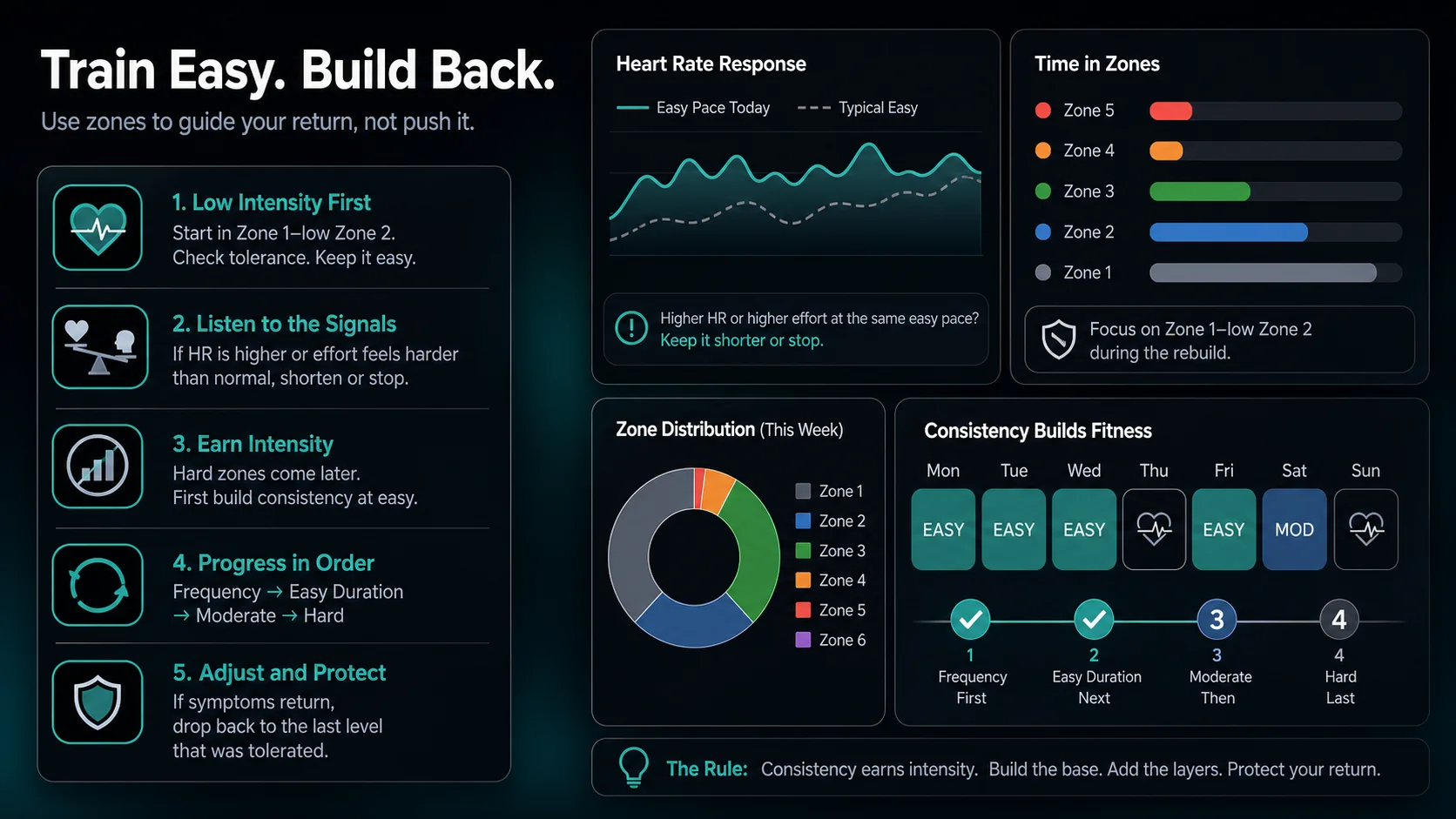
For the first phase back, the default should be low intensity. Easy aerobic training, often Zone 1 to low Zone 2 depending on your system, lets you check tolerance without stacking stress. If heart rate is unusually high for the same easy output, or if perceived effort is much higher than normal, keep the session shorter or stop.
Hard zones should wait. Zone 3 steady work, threshold intervals, VO₂max sessions, hill repeats, and long climbs create bigger demands on breathing, cardiovascular strain, muscle-tendon load, glycogen use, and recovery. Those sessions should return only after easy sessions are repeatable and symptom-free.
The practical zone rule is: earn intensity with consistency. First restore frequency. Then restore easy duration. Then add moderate work. Then add hard work. If symptoms return, drop back to the last level that was tolerated.
Progress One Variable at a Time
Most return mistakes happen because athletes progress several variables at once. They add frequency, duration, intensity, hills, strength training, and technical terrain in the same week. When symptoms return, they cannot tell what caused the problem.
A safer approach is to change one main variable at a time. If you increase duration, keep intensity easy. If you add a second session, keep both short. If you add hills, reduce duration. If you return to running after cycling, respect the added impact. If you reintroduce strength work, avoid pairing heavy lower-body lifting with a major run progression.
Workload research supports the general idea that training load, injury, illness, and soreness are related, although no simple metric perfectly predicts risk. A systematic and literature review by Drew and Finch found that relationships between training load and injury or illness are complex and vary by sport, measure, and context (Drew and Finch). Their work and later load-management discussions are useful because they discourage simplistic rules.
The practical lesson is not “never increase load.” Training requires load. The lesson is to avoid abrupt spikes and to make increases visible. Gabbett and Whiteley describe training-load paradoxes: athletes need enough preparation to tolerate sport, but poorly managed load can contribute to injury risk (Gabbett and Whiteley). Returning athletes need the same balance. Too little load does not rebuild capacity. Too much too soon can restart the problem.
For most endurance athletes, a good return week is one that looks almost boring: a few easy sessions, predictable recovery, no symptom rebound, and no sudden jump in total stress.
Pain Is Information, Not a Simple Stoplight
Pain during injury recovery is not always a perfect measure of tissue damage. Some conditions tolerate a small amount of discomfort during rehabilitation. Others should not be provoked. The difference depends on diagnosis.
For example, many tendinopathy plans use carefully dosed loading rather than complete rest forever. But suspected bone stress injury, acute ligament injury, joint swelling, neurological symptoms, or pain that changes mechanics needs a different threshold. The same pain score can mean different risk depending on location and history.
Use these practical rules unless a clinician gives you more specific guidance:
- Pain that is sharp, worsening, or changes your form is a stop signal.
- Pain that increases as the session continues is a warning sign.
- Pain that is worse the next morning means the load was too high.
- Swelling, instability, locking, numbness, or weakness needs assessment.
- Mild, stable discomfort during a clinician-guided rehab exercise may be acceptable for some diagnoses, but do not generalize that to every injury.
This is where return-to-sport continuum thinking helps. You may be ready for return to participation before return to performance. You may be ready to bike before you run. You may be ready to run flat before you run downhill. You may be ready for strength rehab before plyometrics. The question is not “am I injured or not injured?” The question is “what level of load is appropriate now?”
Illness Return: Above-the-Neck Is Not Enough
Many athletes have heard a simple rule: if symptoms are only above the neck, easy exercise may be okay; if symptoms are below the neck, rest. That rule is memorable, but it is too crude to be the whole decision.
Mild nasal congestion with no fever, no chest symptoms, normal energy, and improving symptoms is different from fever, deep cough, chest tightness, body aches, unusual fatigue, gastrointestinal illness, or symptoms that are getting worse. Return after acute infectious disease should consider systemic involvement and the specific illness, not just symptom location (Scharhag and Meyer).
A conservative illness return looks like this:
- No fever.
- Symptoms clearly improving.
- Normal daily activities feel manageable.
- No chest pain, unusual shortness of breath, fainting, or palpitations.
- No severe fatigue or worsening symptoms.
- First session is short and easy.
- Training increases only if symptoms do not rebound.
Do not try to “sweat it out.” Hard exercise during an active systemic illness can add stress when the body is already dealing with infection. Even when the risk of serious complication is low, the benefit of one hard session during illness is usually negligible.
After COVID-19 or any infection with cardiopulmonary symptoms, be more cautious. Reviews of respiratory complications after COVID-19 in athletic populations describe the need to consider persistent respiratory symptoms and appropriate evaluation when symptoms do not resolve normally (Williams and Hull). If chest symptoms, palpitations, fainting, or abnormal breathlessness occur, stop training and seek medical advice.
Injury Return: Capacity Before Specificity
After injury, the early goal is to restore capacity before full specificity. Capacity means the injured area can tolerate basic loading, daily activity, and simple training without a symptom rebound. Specificity means the exact demands of your sport: running impact, cycling torque, climbing, descending, technical terrain, speed, plyometrics, or race pace.
Runners often need a slower return than cyclists because running adds impact and eccentric loading. A runner may tolerate cycling well before run volume is safe. Hikers may tolerate flat walking before steep descents. Cyclists may tolerate easy spinning before high-torque climbs. Triathletes may use swimming or cycling to maintain aerobic rhythm while gradually restoring running.
The safest progression usually moves from low load to high load:
- Daily activity without symptom rebound.
- Mobility and basic strength.
- Low-impact aerobic work.
- Short sport-specific sessions.
- Longer easy sport-specific sessions.
- Terrain, hills, or resistance.
- Moderate intensity.
- Hard intensity and race-specific work.
Do not skip steps because fitness feels good. Aerobic fitness often returns faster than tissue capacity. That mismatch is a common reason athletes feel ready before the injured structure is ready.
Missed Fitness Comes Back Faster Than You Think
Fear of losing fitness drives many bad return decisions. The athlete misses a week or two, then tries to compress the lost training into the next week. That usually creates more risk than benefit.
Endurance fitness is not a fragile glass object. A short interruption may reduce rhythm, confidence, and sharpness, but the best way to regain them is consistent training. A single heroic workout does not restore the missed block. It often delays the next useful workout.
This is where return-to-performance language is helpful. You may return to participation quickly. You may return to normal training after a few controlled steps. Returning to peak performance may take longer. Those are different milestones. The consensus return-to-sport continuum explicitly recognizes that return to sport and return to performance are not identical (Ardern and colleagues).
Your training log should reflect that. The first week back is not judged by whether you hit old paces. It is judged by whether you restarted the system: routine, easy volume, symptom control, sleep, appetite, and confidence.
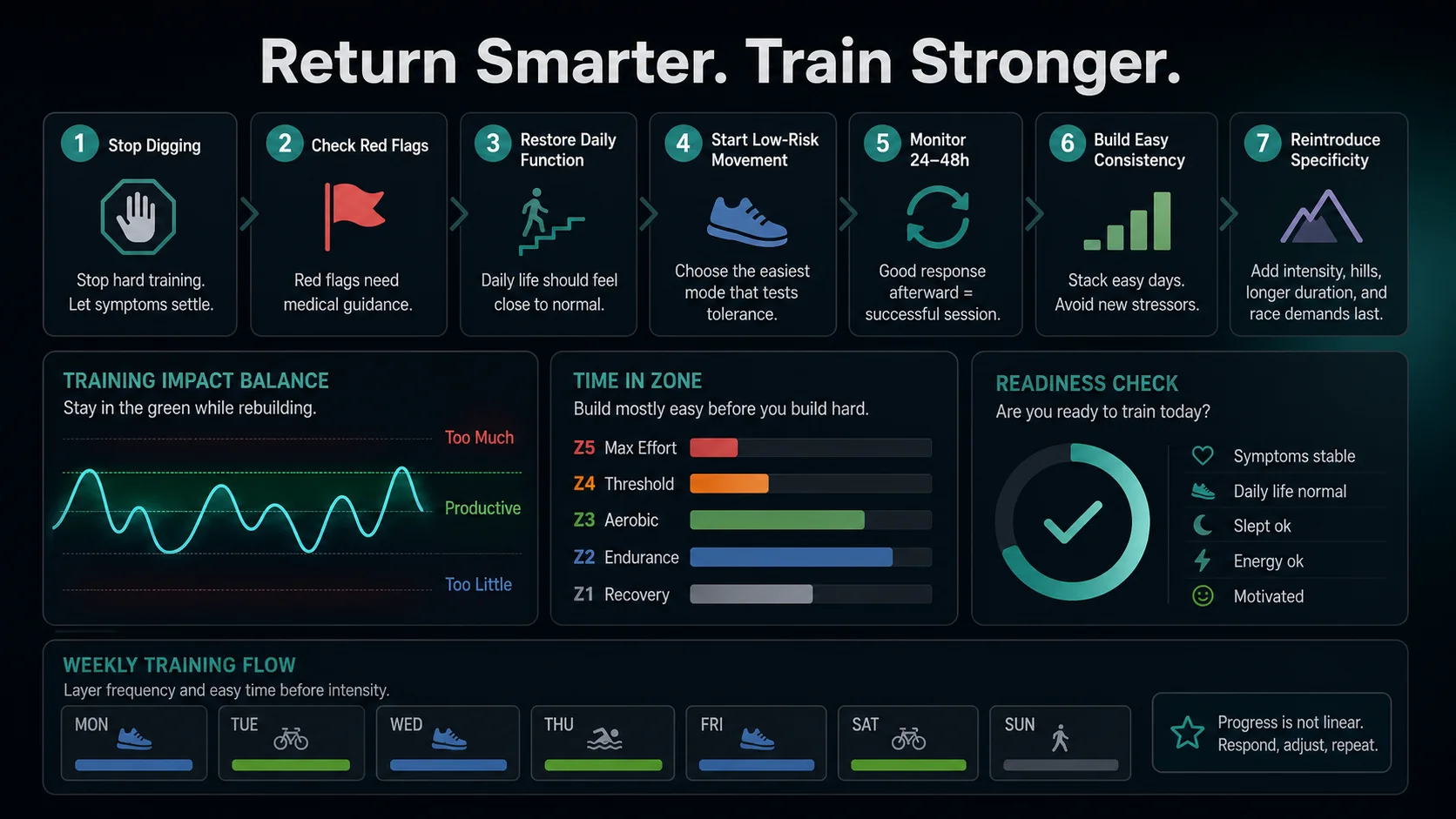
A Practical Seven-Step Return Framework
This framework is not a medical protocol. It is a decision structure for common endurance interruptions. Diagnosis-specific plans from a clinician should override it.
Step one: stop digging. Do not keep adding hard training while symptoms are worsening. If you are sick, rest. If pain is changing mechanics, stop the aggravating load.
Step two: identify red flags. Chest pain, fainting, palpitations, severe breathlessness, fever, neurological symptoms, suspected fracture, major swelling, instability, or clinician restrictions require medical guidance.
Step three: restore normal daily function. Before training, daily activities should feel close to normal. If walking around the house, climbing stairs, or doing normal work drains you, training is probably premature.
Step four: restart with low-risk movement. Choose the easiest mode that tests tolerance without adding unnecessary risk: walking, easy cycling, easy swimming, mobility, or a short flat jog depending on the issue.
Step five: monitor the 24- to 48-hour response. The session is not successful until the body responds well afterward. Same-day and next-morning feedback matter.
Step six: rebuild frequency and easy duration. Get consistent easy sessions before adding hard ones. Avoid stacking new stressors.
Step seven: reintroduce specificity. Add hills, speed, long duration, strength load, race pace, technical terrain, and competition only after the easier layers are stable.
When to Add Intensity Back
Intensity should return after easy training is boringly stable. That means several sessions with no symptom rebound, normal recovery, and no unusual heart-rate or effort response.
The first intensity should usually be mild and short. Strides may come before intervals for runners. A few short cadence pickups may come before threshold cycling. Rolling terrain may come before steep climbs. A controlled steady segment may come before VO₂max work. Heavy lower-body strength may come after basic strength and easy sport-specific work are tolerated.
Avoid reintroducing intensity and long duration in the same session. A 20-minute easy run with a few relaxed strides is a different risk than a 90-minute run with hill surges. A short trainer ride with a few low-stress pickups is different from a hard group ride. A controlled strength session is different from heavy lifting followed by a long run.
A good intensity reintroduction follows three rules:
- Keep the first dose small.
- Keep the rest of the session easy.
- Check the next-day response before progressing.
If symptoms return, the plan is not ruined. It just provided information. Drop back to the last tolerated level and rebuild from there.
Watch Recovery Metrics, But Do Not Outsource Judgment
Heart-rate variability, resting heart rate, sleep, subjective readiness, and wearable recovery scores can be useful during return. They can also mislead.
After illness, elevated resting heart rate, depressed HRV, poor sleep, and high perceived fatigue may suggest the body is not ready for hard work. After injury, metrics may look fine even though local tissue is not ready. A wearable cannot see tendon irritability, bone stress, joint swelling, or pain-related movement changes.
Use recovery metrics as context:
- If symptoms and metrics both look poor, reduce training.
- If symptoms are good but metrics are poor, keep the session easy and reassess.
- If metrics are good but pain is worsening, respect the pain.
- If effort feels unusually high for an easy zone, shorten the session.
The most useful return metric is repeatability. Can you train easy, recover, and do it again? If yes, the plan is working. If every session creates a rebound, the plan is too aggressive or the underlying issue needs attention.
Fueling, Sleep, and Energy Availability Matter More Than Usual
Returning athletes often focus only on training load. Recovery inputs matter too.
After illness, the immune system and normal physiology may still be recovering. After injury, tissue repair requires energy, protein, micronutrients, and sleep. A return plan built on low sleep, low energy intake, high stress, and aggressive training is fragile.
Low energy availability is especially relevant for endurance athletes. The 2023 IOC consensus statement on Relative Energy Deficiency in Sport describes RED-S as a syndrome affecting health and performance across multiple body systems when energy availability is too low (Mountjoy and colleagues). During a return from injury, chronic under-fueling can be a hidden reason healing and adaptation lag.
Practical recovery priorities:
- Sleep enough to support healing and immune function.
- Eat enough total energy.
- Include protein across the day.
- Do not restrict carbohydrate around key rebuild sessions.
- Avoid using injury or illness downtime as a crash-diet opportunity.
- Manage life stress where possible.
The goal is to make the body more prepared for load, not less.
How to Use Cross-Training Without Fooling Yourself
Cross-training is useful when it preserves aerobic routine without aggravating the illness or injury. Cycling, swimming, deep-water running, elliptical work, hiking, ski erg, rowing, and walking can all help depending on the problem.
But cross-training has two traps.
The first trap is assuming all aerobic work is equal. A cyclist returning to running may have strong cardiovascular fitness but reduced impact tolerance. A runner who maintained fitness on the bike still needs a gradual running progression. The heart may be ready before the bones, tendons, and muscles are.
The second trap is turning cross-training into hidden overload. If an injured runner replaces every run with hard cycling intervals and then adds running back on top, total stress may be higher than before. Cross-training should support the return, not become a second training plan.
Use cross-training to maintain rhythm and mood, but log it honestly. Time, intensity, and fatigue still count.
Common Return Mistakes
The first mistake is testing fitness too early. A hard session can tell you that you are not ready, but it can also create a setback. Easy training gives information at lower cost.
The second mistake is chasing old pace. After illness, pace may be temporarily slower at the same heart rate. After injury, pace may tempt you into mechanics the tissue cannot yet tolerate. Use effort, zones, and symptom response before pace.
The third mistake is adding hills too soon. Hills increase force demand. Downhills add eccentric load. Technical trails add coordination and stabilizing demand. Terrain is training load.
The fourth mistake is skipping strength rehab when pain disappears. Pain reduction is not the same as restored capacity. Basic strength, mobility, balance, and sport-specific preparation often need to continue after symptoms improve.
The fifth mistake is ignoring the next morning. A session that feels fine during training but creates next-day pain, swelling, deep fatigue, or symptom rebound was too much.
The sixth mistake is returning to group workouts too early. Groups add pace pressure, surges, ego, and route inflexibility. Early return sessions should be easy to stop.
What to Track in Zone Training Log
A return-to-training log should capture more than distance and pace.
Track the training basics: duration, sport, intensity, zone distribution, terrain, elevation, and perceived effort. Then add return-specific notes: symptom baseline before the session, symptoms during, symptoms after, next-morning response, sleep, unusual heart-rate response, and any medication or life stress that may affect interpretation.
For injury, note pain location, pain quality, whether mechanics changed, and whether symptoms were worse later or the next day. For illness, note energy, cough, breathing, fever history, chest symptoms, and fatigue. For both, note whether the session made you more confident or more concerned.
The goal is pattern recognition. If every attempt at 40 minutes creates a rebound, 40 minutes is currently too much. If flat easy runs are fine but hills trigger pain, terrain is the variable. If heart rate is high and effort is poor after illness, intensity should wait. If cross-training is fine but running hurts, impact tolerance is the limiter.
The best return plans are boring because they are responsive.
A Simple Return Week Template
Use this template only when red flags are absent and the illness or injury is minor or already medically cleared. Adjust it to diagnosis, sport, and history.
Day one can be rest, walking, mobility, or a very easy short session. The goal is to check normal function.
Day two can be rest or another short easy session if day one had no rebound.
Day three can extend duration slightly or repeat the same dose. Repeating is often smarter than increasing.
Day four can be rest, mobility, rehab strength, or easy cross-training.
Day five can add a small duration increase if symptoms remain quiet.
Day six can repeat the best-tolerated session.
Day seven can review the week. If everything was stable, the next week can add a little more. If symptoms returned, reduce the dose and identify the trigger.
This is intentionally conservative. For a mild interruption, you may move faster. For a significant illness or injury, you may need to move much slower. The point is not the exact schedule. The point is the logic: expose, observe, adapt.
Advance, Hold, or Step Back
A return plan needs simple decision rules. Without them, every session becomes a negotiation between fear and impatience.
Advance when the current level is repeatable. That means symptoms are absent or clearly acceptable for the diagnosis, effort feels normal for the zone, sleep and fatigue are stable, and the next-morning response is good. Advancement should still be modest. Add a little duration, one extra easy session, a small amount of terrain, or a short controlled pickup. Do not add all of them together.
Hold when the response is unclear. If effort felt slightly high, sleep was poor, pain was mild but not worse, or illness symptoms are nearly gone but energy is still inconsistent, repeat the same level. Repeating is not failure. It is how you confirm tolerance.
Step back when the body gives a clear negative response. That includes symptom rebound, worsening pain, swelling, altered mechanics, unusually high effort at easy intensity, abnormal breathlessness, or next-day deterioration. Step back to the last known tolerated dose, or stop and get assessed if the symptom is a red flag.
This decision model keeps emotion out of the plan. You do not need to decide whether you are “tough enough.” You need to decide which category the last response fits.
Sport-Specific Return Notes
Runners should respect impact. Even if the cardiovascular system feels ready, the musculoskeletal system may not be ready for continuous running. Walk-run progressions, flat routes, softer surfaces, and short loops are useful because they reduce consequence and make stopping easy. Downhills, speed work, and long runs should return later because they add force, eccentric load, and fatigue.
Cyclists should respect torque and position. Easy spinning may be tolerated before high-torque climbing, sprinting, standing efforts, or aggressive aero positions. After illness, indoor riding can feel deceptively controlled but still become stressful if ventilation is poor and heat builds. After injury, check whether the position itself aggravates the issue.
Hikers and fastpackers should respect terrain and pack weight. A flat walk without a pack is not the same as a steep descent with poles, rocks, and load. Reintroduce distance, elevation gain, descent, technical footing, and pack weight separately when possible.
Triathletes should avoid hiding load inside variety. Swimming, biking, and running distribute stress, but they still add total training load. Returning to all three sports at once can look moderate in each discipline while being aggressive overall.
Strength training should return as controlled capacity work before maximal work. Start with familiar movements, lower loads, controlled tempo, and clean technique. Plyometrics, heavy eccentrics, max lifts, and fatigue circuits should wait until basic loading is stable.
Returning After a Race Was Missed
Missed races create a specific psychological trap. The athlete is healthy enough to train again but frustrated by the event that was lost. That frustration often pushes the next block too hard.
If the race is gone, do not try to race the missed race in training. Rebuild first. Then decide whether to choose a new event, extend the base phase, or shift the season goal. The right answer depends on how long the interruption was, what caused it, and how much risk remains.
If another race is soon, be honest about the difference between participating and performing. The return-to-sport continuum is useful here: you may be able to start an event without being ready to express peak performance (Ardern and colleagues). That is not automatically wrong, but it changes pacing, goals, and risk tolerance.
For many recreational athletes, the smarter goal after an interrupted build is to finish comfortably, practice fueling, enjoy the event, or use it as a supported long session. Turning it into an all-out performance attempt may not match the preparation you actually completed.
The Mental Side of Coming Back
Returning after illness or injury is not only physical. Athletes often feel anxious, behind, guilty, or suspicious of every sensation. Those reactions are normal, but they can distort decisions.
Fear can make the athlete avoid all load long after it is appropriate to rebuild. Impatience can make the athlete ignore warning signs. Data can help, but it can also become compulsive if every readiness score or heart-rate change feels like a verdict.
The solution is a clear plan with low-stakes checkpoints. Choose the next session before the emotional moment. Define what counts as success. Define what would make you stop. Keep early routes short and flexible. Train alone or with a patient partner before returning to group pressure. Write down the next-morning response so you are not relying on memory.
Confidence comes from repeatable evidence. One hard workout may feel reassuring for a day. Five easy sessions with no rebound are more useful.
When to Get Professional Help
Get medical or qualified clinical help if symptoms are severe, unusual, recurrent, or not improving. Also seek guidance if you have chest pain, fainting, palpitations, unexplained shortness of breath, fever that persists, neurological symptoms, suspected fracture, bone stress injury risk, significant swelling, instability, post-surgical restrictions, recurrent injuries, or a history of RED-S, eating disorder, menstrual disruption, or low bone density.
Professional help is not a failure of discipline. It is risk management. Return-to-sport decisions are inherently about balancing tissue health, sport demands, and acceptable risk. That is the core idea behind risk-based return frameworks such as StARRT (Shrier).
For competitive athletes, involve the coach and clinician in the same plan. Conflicting messages create bad decisions: the clinician says rest, the coach writes intervals, and the athlete tries to satisfy both. A shared progression is safer.
Conclusion
Returning to training after illness or injury is a progression from safety to consistency to performance. It is not a single workout that proves you are back.
Start by ruling out red flags. Respect diagnosis-specific restrictions. Make the first session easy. Progress one variable at a time. Use zones to keep intensity honest, but do not ignore symptoms. Watch the 24- to 48-hour response. Rebuild frequency and easy duration before intensity. Fuel, sleep, and recover like the return matters.
The best outcome is not the fastest first workout back. It is the fewest setbacks on the way to normal training.