

Data Diagnostics
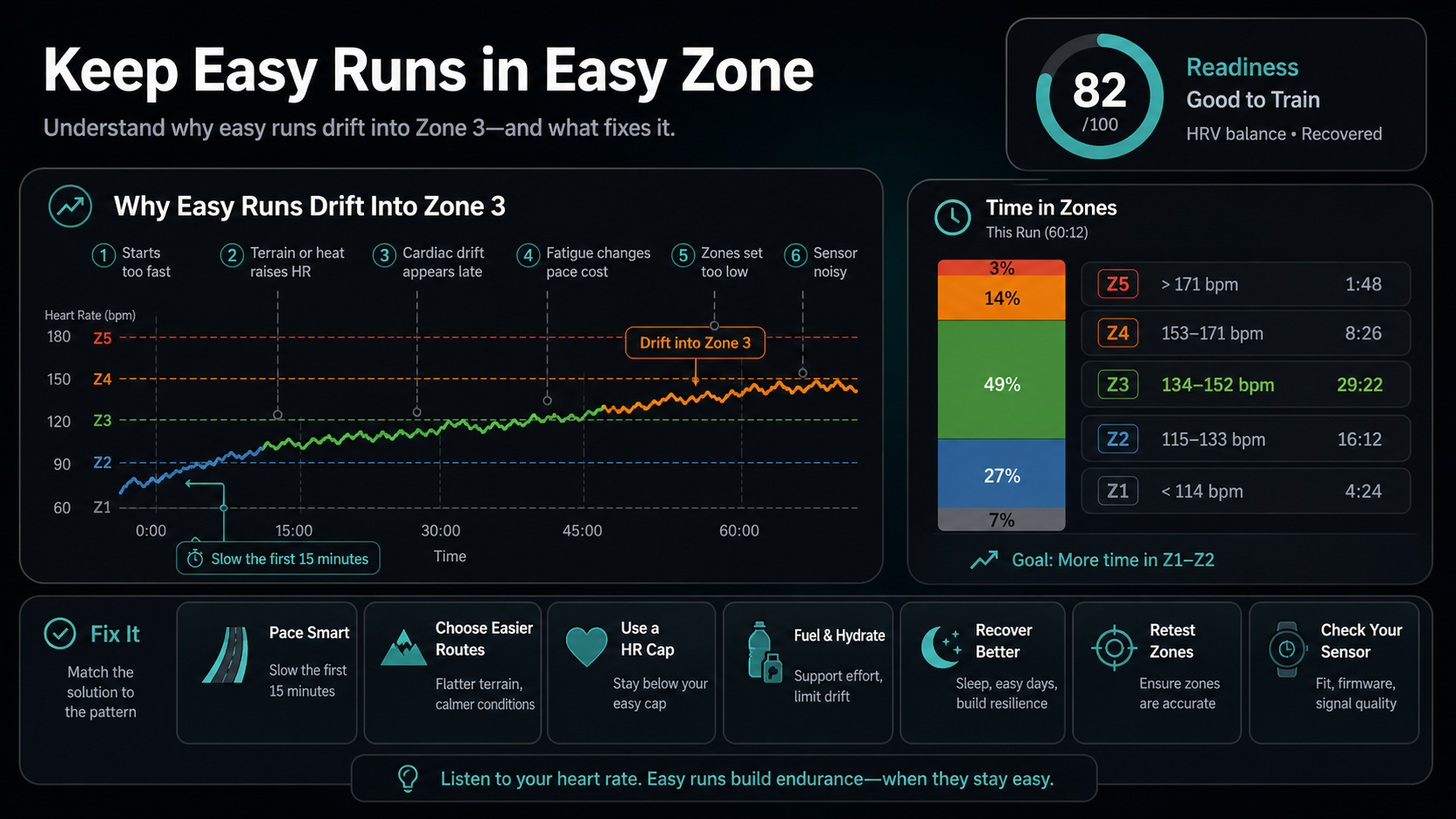
Why Easy Runs Become Zone 3
Easy runs become Zone 3 when pace, hills, heat, cardiac drift, fatigue, sensor noise, or inaccurate zone settings turn a relaxed session into moderate work. Learn how to read the pattern and fix it.

Introduction
Easy runs usually become Zone 3 for one of two broad reasons: either the run is no longer physiologically easy, or the heart-rate data needs context. The pace may be a little too ambitious. The route may be hillier than you think. Heat, dehydration, poor sleep, accumulated fatigue, or late-run cardiac drift may raise heart rate even when pace stays steady. Your zones may also be set too low, or your wrist sensor may be reading poorly.
That is why the first useful answer is simple but not simplistic: Zone 3 on an easy run means "investigate the pattern," not "panic" and not "ignore it."
Zone 3 is not bad. Runners use it for tempo work, steady-state runs, marathon-specific blocks, progression runs, hilly long runs, and controlled race-pace practice. The problem is accidental Zone 3. If a workout was meant to build low-stress aerobic volume but turns into moderate effort, it may cost more recovery than planned while giving you a less specific training stimulus than a true workout day.
Endurance research does not prove that every runner needs the same exact zone split, but it does support the idea that intensity distribution matters. Seiler and Kjerland reported that elite junior cross-country skiers completed most training below the first ventilatory threshold, with much less time in the middle intensity range (Scandinavian Journal of Medicine & Science in Sports). Esteve-Lanao, Foster, Seiler, and Lucia found that trained runners performed better when a larger share of training was kept at lower intensity compared with more threshold-heavy distribution (Journal of Strength and Conditioning Research). Those studies are not a rulebook for every recreational runner, but they make the practical lesson clear: easy days should usually stay easy unless you intentionally choose otherwise.
The rest of this article explains why easy runs drift into Zone 3, how to decide whether that matters, how to use a Zone 3 calculator to check the week, and what to change before your next run.
What Zone 3 Means On An Easy Run
In a five-zone heart-rate model, Zone 3 usually sits between easy aerobic running and harder threshold-style work. For many runners, Zone 1 and Zone 2 feel relaxed, conversational, and repeatable. Zone 3 feels steady. You can still control it, but breathing is more noticeable, talking becomes less natural, and the run starts to demand attention.
The exact boundary depends on the zone system. Some apps use percentages of maximum heart rate. Others use heart-rate reserve, lactate-threshold heart rate, critical power, ventilatory thresholds, or manually edited ranges. Achten and Jeukendrup's review of heart-rate monitoring describes heart rate as useful for exercise prescription and training control, while also emphasizing that interpretation depends on context, individual physiology, and the limitations of the method (Sports Medicine). In plain running terms: the number is useful, but it is not the whole story.
That matters because two runners can both see "Zone 3" and be experiencing different things.
One runner may be working too hard for the planned day. Their breathing is no longer easy, their pace is creeping upward, and they are turning a recovery run into steady moderate work. Another runner may be jogging comfortably on a hot, rolling route while an automatic zone model underestimates their actual maximum heart rate. The first runner needs to slow down. The second may need to adjust zones, choose a better comparison route, or inspect sensor quality before changing training.
The best question is not "Is Zone 3 bad?" It is "Does this Zone 3 match the purpose of the run?"
If the purpose was easy aerobic volume, most of the run should feel easy enough that you could repeat the session tomorrow without stealing from the next workout. If the purpose was a controlled tempo or race-specific run, Zone 3 may be exactly where you wanted to spend time.
Why Easy Runs Drift Into Zone 3
The most common reason is pacing. Easy runs often start too fast because the first few minutes feel comfortable. Fresh legs, music, group energy, downhill starts, a watch pace target, or the desire to make an easy run "count" can push you into a pace that is only sustainable as moderate work. The heart rate may not reveal the mistake immediately because heart rate lags behind effort. By the time the screen shows Zone 3, you may already have spent 10 or 15 minutes building momentum.
The second reason is terrain. Running is not a laboratory test. A route with small hills, uneven pavement, trail surfaces, traffic stops, stairs, wind exposure, or cambered roads can raise the cost of a pace that looks easy on paper. If you try to hold the same minutes-per-mile pace uphill that you hold on the flat, heart rate will usually climb. The run did not mysteriously become Zone 3. The route asked for more work.
Heat is another major driver. When the body is trying to cool itself, heart rate can rise even if pace stays the same. Coyle and Gonzalez-Alonso reviewed cardiovascular drift during prolonged exercise, including the way heart rate can increase over time as cardiovascular strain rises during longer efforts (Exercise and Sport Sciences Reviews). That is why an easy summer run may start in Zone 2 and end in Zone 3 without any intentional acceleration.
Fueling and hydration can make the late-run climb stronger. Fluid loss, heat strain, and long duration can increase cardiovascular stress; the American College of Sports Medicine position stand on exercise and fluid replacement describes how dehydration can impair physiological function and performance during exercise (Medicine & Science in Sports & Exercise). You do not need to overcomplicate every short jog, but if longer easy runs keep drifting upward late, basic cooling, drinking, and carbohydrate availability may be part of the answer.
Fatigue is another common reason easy pace becomes Zone 3. A pace that is normally relaxed may cost more after a poor night of sleep, heavy lifting, a stressful work week, illness, travel, low calorie intake, or a hard workout too close to the easy day. Training load is not just mileage. It is the combination of external work and internal response. Bourdon and colleagues describe the value of monitoring both external load and internal load because the same workout can create different stress in different situations (International Journal of Sports Physiology and Performance).
Your zone settings may also be wrong. If your estimated maximum heart rate is too low, ordinary running can appear too high in the zone chart. Age-predicted max heart-rate formulas are convenient but imprecise for individuals. Tanaka, Monahan, and Seals proposed a revised age-predicted maximum heart-rate equation, but the point for runners is that even improved formulas are population estimates, not personal tests (Journal of the American College of Cardiology01054-8)). If your true maximum is higher than your watch assumes, your Zone 3 boundary may be set too low.
Finally, the sensor can be wrong. Wrist optical heart-rate sensors can be useful, but readings may vary with fit, movement, skin contact, temperature, cadence lock, tattoos, skin characteristics, and the device itself. In a study comparing wrist-worn devices during exercise, Wang and colleagues found variable accuracy across devices and activities (JAMA Cardiology). If the graph shows sudden jumps, impossible spikes, or a heart rate that matches cadence more than effort, do not build a training conclusion on that run alone.
Use The Zone 3 Calculator To Check The Week
One run can be noisy. A week is harder to dismiss. If one easy run touches Zone 3 during hills or heat, that may be normal. If every easy run spends a large block in Zone 3, and your weekly easy share is shrinking, the training plan has changed whether you meant it to or not.
Use the Zone 3 calculator below to enter your weekly minutes in Zones 1 through 5. It will estimate your easy share, Zone 3 share, hard share, and total time above Zone 2. The readout is not a prescription, but it helps you see whether Zone 3 is a deliberate tempo dose or a moderate-intensity habit. You can also open the standalone Zone 3 Training Balance Checker when you want to review a week outside this article.
The most useful way to use the checker is to compare the result with your plan.
If the week included a planned tempo run, some Zone 3 may be exactly right. If the week was supposed to be a recovery week, the same Zone 3 minutes may be too much. If your long run had 15 minutes of Zone 3 on rolling hills, that is different from five "easy" runs where the middle 30 minutes quietly became moderate.
The checker uses guardrails because training is not a single universal percentage. A race-specific marathon block may include more steady Zone 3 than a base week. A newer runner may see heart rate rise quickly because easy aerobic durability is still developing. Trail runners may accumulate more Zone 3 because route grade keeps changing. The point is to make the tradeoff visible. Once you can see the week, you can decide whether the Zone 3 was planned, useful, and recoverable.
How To Tell Whether Zone 3 Is A Problem
Start with effort. Could you talk in full sentences? Did the run feel relaxed enough that you could repeat it tomorrow? Did breathing stay controlled? The CDC's talk-test guidance describes moderate intensity as the level where a person can talk but not sing, while vigorous intensity makes it difficult to say more than a few words without pausing (CDC). For an easy run, many runners should be below the point where conversation becomes clipped.
Then check timing. Zone 3 late in a long run is not the same as Zone 3 in the first 10 minutes. A gradual late climb may be cardiac drift, heat, fatigue, or fueling. An early jump often points to a pace that was not easy from the start, a zone boundary that is too low, or a sensor problem during the warmup.
Next, check route and conditions. Was it hot, humid, windy, hilly, muddy, icy, or more technical than normal? Did you run with a group that pulled the pace up? Did you compare today's heart rate with an easier route from a cooler day? If context changed, the heart-rate chart should change too.
Look at recovery. Accidental Zone 3 matters more when it repeats alongside signs that the week is becoming too hard. Halson's review of monitoring training load and fatigue emphasizes that performance, perceived exertion, mood, sleep, and other markers can help interpret training stress (Sports Medicine). You do not need a complicated dashboard to apply that idea. If easy runs become Zone 3 and your legs feel flat, sleep is worse, motivation is low, or hard workouts are fading, take the pattern seriously.
Finally, compare planned intensity with accidental intensity. A tempo run that spends 25 minutes in Zone 3 is a workout doing its job. A recovery run that spends 25 minutes in Zone 3 is a mismatch. Same zone, different meaning.
What The Zone 3 Pattern Usually Means
The most helpful clue is not the highest heart rate you touched. It is the shape of the run and the way the same pattern repeats across similar days.
If Zone 3 appears early and stays there, the run was probably not easy enough for the target. This is the classic pacing problem. You may have started at a pace that feels normal but currently costs too much, or you may be using an easy pace from a cooler season, a lighter training week, or a flatter route. The fix is usually not complicated: start slower, use an effort ceiling, and let pace be lower until the heart-rate response becomes stable.
If Zone 3 appears only on hills, the problem may be pace discipline rather than overall fitness. Many runners keep pace steady uphill because the watch pace looks familiar, but the body is doing more work. For an easy run, grade should change pace. If you want to keep the run easy, shorten the stride, reduce effort, or walk steeper sections. The uphill split may look slower, but the workout will match its purpose.
If Zone 3 appears late while pace stays steady, think about drift. Late drift can be normal during longer runs, especially in heat, humidity, or when you are under-fueled. The question is whether the drift is mild and occasional or large and repeated. A small late climb during a long run may simply be part of the session. A large climb every time may mean you are starting too fast, running too long for your current aerobic durability, or underestimating heat and fueling needs.
If Zone 3 appears on days after hard training, fatigue may be the message. The same route, same pace, and same conditions should not always feel harder, but recovery status changes the cost of running. If your easy run becomes Zone 3 the day after intervals, heavy lifting, travel, or poor sleep, the next move may be recovery, not fitness testing.
If Zone 3 appears even when the run feels genuinely relaxed, compare the data source with the body signal. Easy breathing, stable pace, normal recovery, and repeated "too high" zone charts may point to zone settings or measurement quality. That does not mean the watch is useless. It means you should verify the setup before treating the chart as a training problem.
| Pattern | Most likely meaning | First adjustment |
|---|---|---|
| Zone 3 in the first 10 minutes | Started too fast, zones too low, or warmup artifact | Slow the first mile and compare again |
| Zone 3 mainly on climbs | Effort is not staying easy uphill | Let pace drop or walk short hills |
| Zone 3 late at steady pace | Cardiac drift, heat, fatigue, or fueling | Start easier and adjust for conditions |
| Zone 3 after hard days | Recovery is not complete | Shorten, slow, or replace with recovery |
| Zone 3 despite easy breathing | Zone settings or sensor quality may be off | Review zones and compare sensor data |
Use this table as a starting point, not a diagnosis. The same runner can have different causes in different weeks. A hot long run, a hilly recovery route, and a loose watch can all create Zone 3 time, but they call for different decisions.
How To Keep Easy Runs Easy
The simplest fix is to start slower. Treat the first 10 to 15 minutes as a controlled warmup, not as proof of fitness. Many runners need to begin at a pace that feels almost too slow. That early restraint often makes the whole run smoother, because you are not paying back an intensity debt for the next 40 minutes.
Use heart rate as a ceiling, not a pace target. If the purpose is easy aerobic work, choose an upper limit for the run and respond before you sit above it for several minutes. Slow down on hills. Shorten your stride. Walk short climbs if needed. Let pace be the output instead of the assignment.
Choose easier routes for easy days. A hilly route can be useful, but it may not be the best route for a controlled low-zone day. If your easy runs keep becoming Zone 3 on a favorite loop, try a flatter loop, a softer effort target, or a route where you do not feel pulled into racing familiar segments.
Adjust for weather. In heat and humidity, the pace that keeps you in Zone 2 may be slower than your cool-weather pace. That is not failure. It is the cost of the conditions. Run earlier, run shaded routes, shorten the session, carry fluid when appropriate, or accept slower pace.
Fuel longer easy runs enough to keep effort steady. You do not need race nutrition for every short run, but low glycogen, skipped meals, or poor hydration can make a long easy session feel harder than planned. If the final third always climbs into Zone 3, review duration, heat, fueling, and the pace you chose at the start.
Protect recovery days. If a run is meant to help you absorb training, the target is not pace. The target is leaving the session better, looser, and ready for the next meaningful workout. When heart rate climbs early and effort feels wrong, it is reasonable to shorten the run, turn it into a walk-jog, or move the workout.
Retest or edit zones when reality and numbers disagree. If you can truly run comfortably, talk easily, and repeat the session, but the watch always says high Zone 3, review your zone model. Consider a more personal anchor, such as a tested max heart rate, lactate-threshold estimate, heart-rate reserve method, or coach-set ranges. Keep changes deliberate. If you edit zones after every odd run, you lose the ability to compare weeks.
Check sensor setup before assuming a fitness problem. Tighten the watch enough for stable contact, wear it slightly higher on the wrist, warm up gradually in cold weather, and compare with a chest strap if accuracy matters. If one chart has obvious dropouts or spikes, mark it as low-confidence and avoid changing training based on that run.
When Zone 3 Is Actually Useful
Zone 3 becomes a problem when it replaces easy work without intent. It can be useful when it is planned.
Runners often use Zone 3 for steady tempo runs, marathon-pace blocks, progression runs, hilly aerobic-strength sessions, and race-specific endurance. In those sessions, the goal is not to avoid Zone 3. The goal is to use it at the right time, in the right amount, with enough easy running around it.
This distinction is important because some runners react to Zone 3 as if it is forbidden. That can create unnecessary anxiety and overly rigid training. A small amount of Zone 3 on hills, during a progression finish, or in a specific tempo workout may be productive. The more important risk is letting every run settle into the same moderate place. That "always kind of hard" pattern can make training feel productive in the moment while reducing the contrast between easy days and quality days.
Think of Zone 3 as a tool, not a default. Use it when the workout asks for it. Step away from it when the workout was supposed to be easy.
How Zone Training Log Helps
Zone Training Log is built around the idea that one workout rarely tells the whole story. A single easy run that becomes Zone 3 may have a simple explanation: heat, hills, poor sleep, or a bad sensor reading. The weekly view is where the pattern becomes clearer.
When you review workouts by zone, you can separate three questions that often get mixed together.
First, did the individual run match its purpose? An easy run with mostly Zone 1 and Zone 2 probably did. A recovery run with a long Zone 3 block may not have.
Second, did the week match the plan? A week with one tempo workout and several easy runs may have a healthy amount of Zone 3. A week where every run contributes moderate minutes may show intensity creep.
Third, did the data match how the workout felt? If your notes say "relaxed, conversational, cool weather" but the chart says half the run was Zone 3, inspect zones and sensor quality. If your notes say "pushed the pace, breathing hard," the chart probably caught the truth.
Use tags, titles, notes, and weekly zone totals to make that review practical. Label easy runs, tempo runs, long runs, races, and recovery days. Then compare the intended purpose with the actual zone distribution. That habit turns Zone 3 from a vague worry into a concrete weekly question: was this moderate work planned, or did easy running drift?
Common Mistakes
The first mistake is judging the run only by average heart rate. Average heart rate can hide the shape of the session. A run that starts in Zone 1, spends 30 minutes in Zone 2, and drifts into Zone 3 late can have the same average as a run that sits steadily in Zone 3 from the start. The training meaning is different.
The second mistake is using pace as the only definition of easy. Pace is useful, but it is affected by terrain, weather, fatigue, and fitness changes. If a pace that was easy last month now creates Zone 3 every time, the body is giving you information. You may need more recovery, a slower easy pace, or a zone review.
The third mistake is treating one weird file as a trend. One run can be affected by a loose watch, a hot day, a caffeine-heavy morning, a poor night's sleep, or a hard climb. Look for repeated patterns before making major changes.
The fourth mistake is changing zones too often. If you edit thresholds after every confusing workout, your historical charts stop meaning the same thing. Change zones when you have better evidence, then keep them stable long enough to compare.
The fifth mistake is assuming all Zone 3 is wasted. Zone 3 can build useful steady endurance when placed deliberately. The issue is not the zone itself. The issue is using it accidentally on days that were supposed to be low stress.
The sixth mistake is ignoring symptoms. Heart-rate zones are training tools, not medical diagnostics. If you experience chest pain, fainting, unusual shortness of breath, a new irregular heartbeat, or unexplained severe fatigue, stop interpreting the chart as a training puzzle and seek appropriate medical care.
A Practical Checklist For Your Next Easy Run
Before the run, decide the purpose in one sentence: "This is an easy aerobic run," "This is recovery," or "This is a steady workout." If the purpose is easy, choose a route and pace that support that purpose.
During the first 15 minutes, keep effort noticeably restrained. If heart rate rises faster than expected, slow down early instead of trying to rescue the run later. If the first hill pushes you into Zone 3, walk or shorten the stride before the zone becomes the pattern.
During the middle of the run, cross-check heart rate with breathing. If you can speak comfortably and the route is hilly or hot, avoid overreacting to a brief Zone 3 touch. If breathing feels moderate and you are bargaining with the pace, call it moderate and adjust.
Late in the run, look for drift. If pace is steady but heart rate climbs into Zone 3, ask whether duration, heat, dehydration, fueling, or fatigue explains it. If it happens often, start slower next time and compare.
After the run, add a short note. Was it hot? Were you tired? Was the route hilly? Did the watch feel loose? Did the run feel easy or steady? Those notes make the weekly chart much more useful.
At the end of the week, use the Zone 3 calculator to check distribution. The goal is not perfection. The goal is to keep easy running from turning into moderate running by accident.
Related Zone and Sensor Guides
- Understand what Zone 2 training means and how to find it
- Compare Zone 2 heart-rate targets for running and cycling
- Check whether Apple Watch heart-rate zones are accurate enough for the workout
- Calculate and check your heart-rate-zone boundaries
- Review heart-rate zones after a workout
- Explore the Heart Rate Zones guide hub
Conclusion
Easy runs become Zone 3 when the cost of the run is higher than the label suggests. Sometimes that cost comes from pace. Sometimes it comes from heat, hills, cardiac drift, fatigue, fueling, hydration, inaccurate zones, or sensor noise. The fix depends on the pattern.
Do not overreact to one Zone 3 segment. Do not ignore a repeated trend either. If easy runs keep turning moderate, start slower, cap effort earlier, choose easier routes, adjust for heat, protect recovery, review your zone settings, and check sensor quality.
Zone 3 belongs in running. It just needs a job. When it shows up in tempo work, marathon-specific training, or controlled progression runs, it may be useful. When it quietly takes over easy days, it changes the week. Use the weekly Zone 3 calculator, your notes, and your next workout quality to decide which one you are seeing.
A Simple Decision for Your Next Run
Use one change at a time so the result is interpretable.
- Check whether your zone range is plausible with the Zone 2 Heart Rate Calculator.
- Choose a flat, familiar route and start more slowly than usual.
- Use full-sentence conversation as the primary early check.
- Walk short hills or use planned run-walk intervals before breathing becomes strained.
- Note heat, wind, sleep, fatigue, and sensor fit.
- Review the whole distribution afterward with the Zone 3 Training Balance Checker.
Do not change your zones because of one frustrating run. If the same controlled route repeatedly feels conversational while the watch reports sustained Zone 3, investigate sensor quality and zone settings. If breathing and perceived effort also rise, reduce the workload rather than arguing with the display.

Our editorial approach & AI disclosure
We use AI to help research, organize, and draft some articles. Every article is reviewed by a human editor and aims to reflect current evidence-based training practices and scientific literature.
Read our editorial policy