


How Do You Add Intervals Without Ruining Your Aerobic Base?
Add intervals by replacing a small piece of easy volume, not stacking hard work on top. Learn how to choose a first interval session, protect easy training, and progress without losing your aerobic base.
Jun 17, 202613 min read

Introduction
The safest way to add intervals is to replace a small amount of easy training with one controlled quality session, not to stack hard work on top of the week you already do. Keep most weekly minutes easy, protect the long easy session, cap the total hard minutes, and repeat the dose before making it bigger.
That answer sounds simple, but it is where many endurance plans go wrong. A runner finishes a month of consistent Zone 2 work and adds hill repeats, a tempo run, and a fast group workout in the same week. A cyclist builds a steady aerobic block and then drops three hard rides into the calendar because fitness feels good. The first week may feel exciting. The second week often feels flat. By the third or fourth week, the easy days are no longer easy, the long day shrinks, soreness lingers, and the aerobic base that made the intervals possible starts to erode.
Intervals are not the enemy of base training. Well-placed intensity can improve performance, raise your ceiling, and make training more complete. Reviews of high-intensity interval training show that interval blocks can improve performance in trained athletes, especially when the dose is targeted and not treated as a replacement for aerobic development (Laursen, 2010). The problem is not intervals. The problem is adding too much intensity before the base can absorb it.
Think of intervals as a signal. You need enough signal to tell the body to adapt. You do not need so much signal that it drowns out the easy volume, recovery, and consistency that build the aerobic engine. The best first interval workout is usually the smallest one you can repeat next week with normal easy training around it.
Why Aerobic Base Still Comes First
Aerobic base is not just a phase for beginners. It is the training foundation that lets you tolerate volume, recover between harder efforts, hold good form late in a session, and turn hard workouts into useful adaptation instead of random fatigue.
Stephen Seiler's review of endurance training intensity distribution described a common pattern among successful endurance athletes: a large majority of training is performed at low intensity, with a much smaller share at high intensity (Seiler, 2010). That does not mean every athlete needs to copy an exact 80/20 split. It does mean that endurance performance usually depends on a lot of controlled work that feels almost too easy to be impressive on a single day.
Easy training creates the context for intervals. It increases the amount of work you can do without excessive stress. It improves durability. It gives you more chances to practice relaxed mechanics. It also gives hard sessions somewhere to fit. If every run or ride already feels moderate, there is no room left for true quality without pushing the whole week into a recovery debt.
This is why the first question is not "What is the hardest interval workout I can survive?" The better question is "What interval dose can I add while keeping the rest of the week easy enough to repeat?"
The Base-Safe Rule
A base-safe interval plan follows four rules:
- Keep at least 90% of weekly minutes easy when you are first adding intensity.
- Cap hard minutes at a small share of the week, usually about 4-10% depending on training history.
- Start with one interval day, not two or three.
- Protect the longest easy session and the easy day after the interval workout.
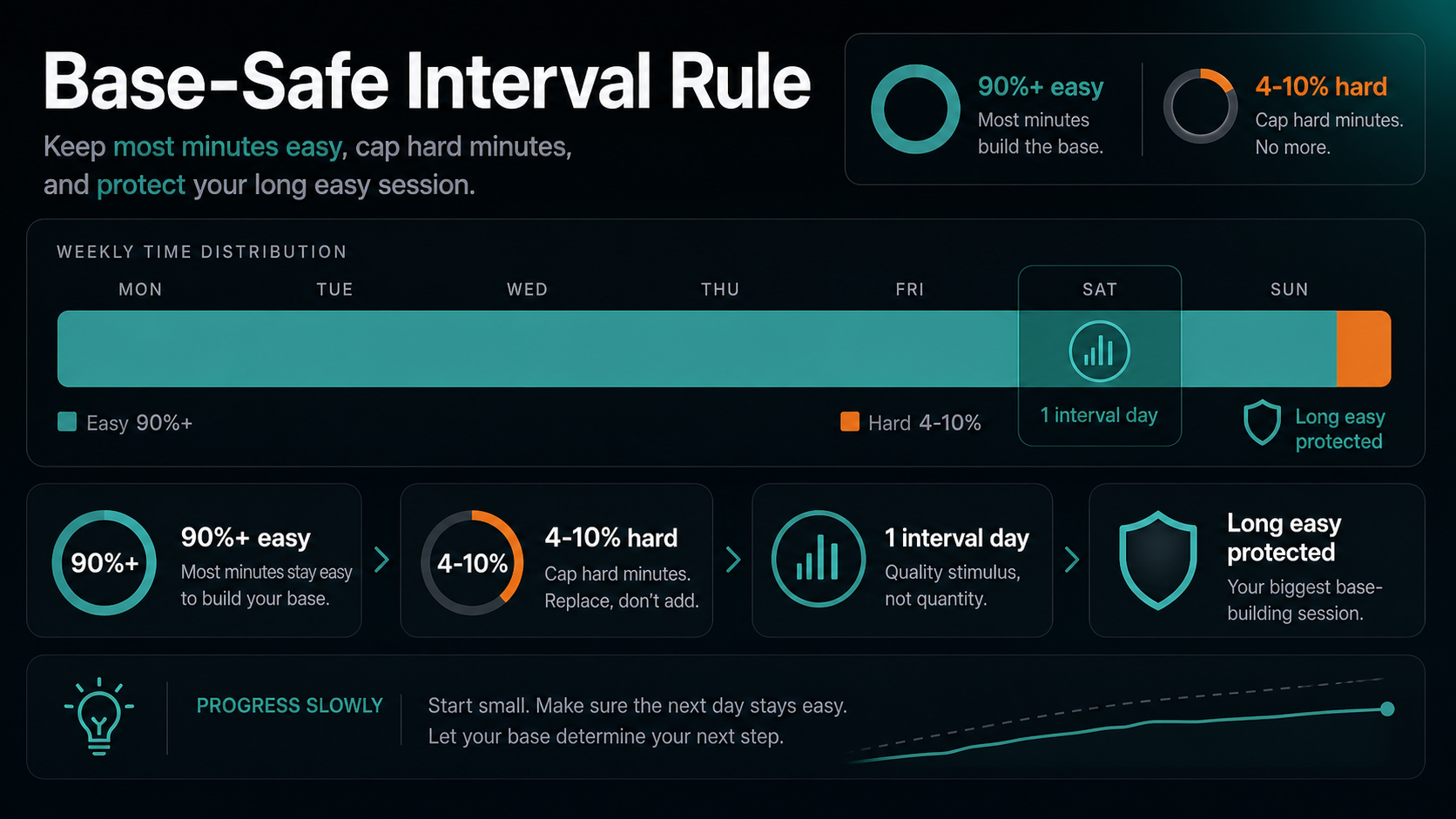
The exact percentage does not need to be perfect. Training distribution research often groups sessions or minutes differently, and a runner doing four sessions per week will not look identical to a cyclist doing nine rides. The useful principle is that the hard dose should be small enough that it does not crowd out the aerobic work.
This is also why you should count all hard minutes, not just the planned intervals. A local group ride with repeated surges counts. A race counts. A long climb ridden near threshold counts. A progression run that finishes hard counts. If those efforts already exist, the safest interval workout may be no new interval workout at all.
Rapid jumps in training load are a common risk pattern. Gabbett's training-load work argues that high training loads are not automatically bad, but rapid and excessive increases can raise injury risk, while well-developed load capacity can be protective (Gabbett, 2016). Applied to intervals, the message is practical: earn the harder work by adding it gradually and letting the base catch up.
Use The Interval Generator
The calculator below takes a mostly easy sample week and adds one interval workout only if your current aerobic base can support it. Enter weekly aerobic minutes, the number of easy sessions, current hard minutes, consistency, longest easy session, and whether your base feels fragile, building, or solid. It then recommends a small workout and shows how much easy training remains after the interval day.
You can also open the standalone Base-Safe Interval Workout Generator when you want to adjust the week separately from the article.
Treat the output as planning guidance, not a command. If the tool says "starter dose" but your calves are sore, sleep has been poor, or your easy heart rate is unusually high, choose the smaller option. If it says you are ready for threshold work, repeat the first workout before progressing. The goal is not to prove toughness. The goal is to build a week you can repeat.
Match The Interval To Your Aerobic Base
Not every base deserves the same interval workout. A fragile base may need strides or spin-ups, not threshold repeats. A building base may handle short intervals with generous recovery. A solid base may be ready for controlled threshold intervals. A robust base can usually handle a slightly larger dose, but it still needs easy days around the workout.
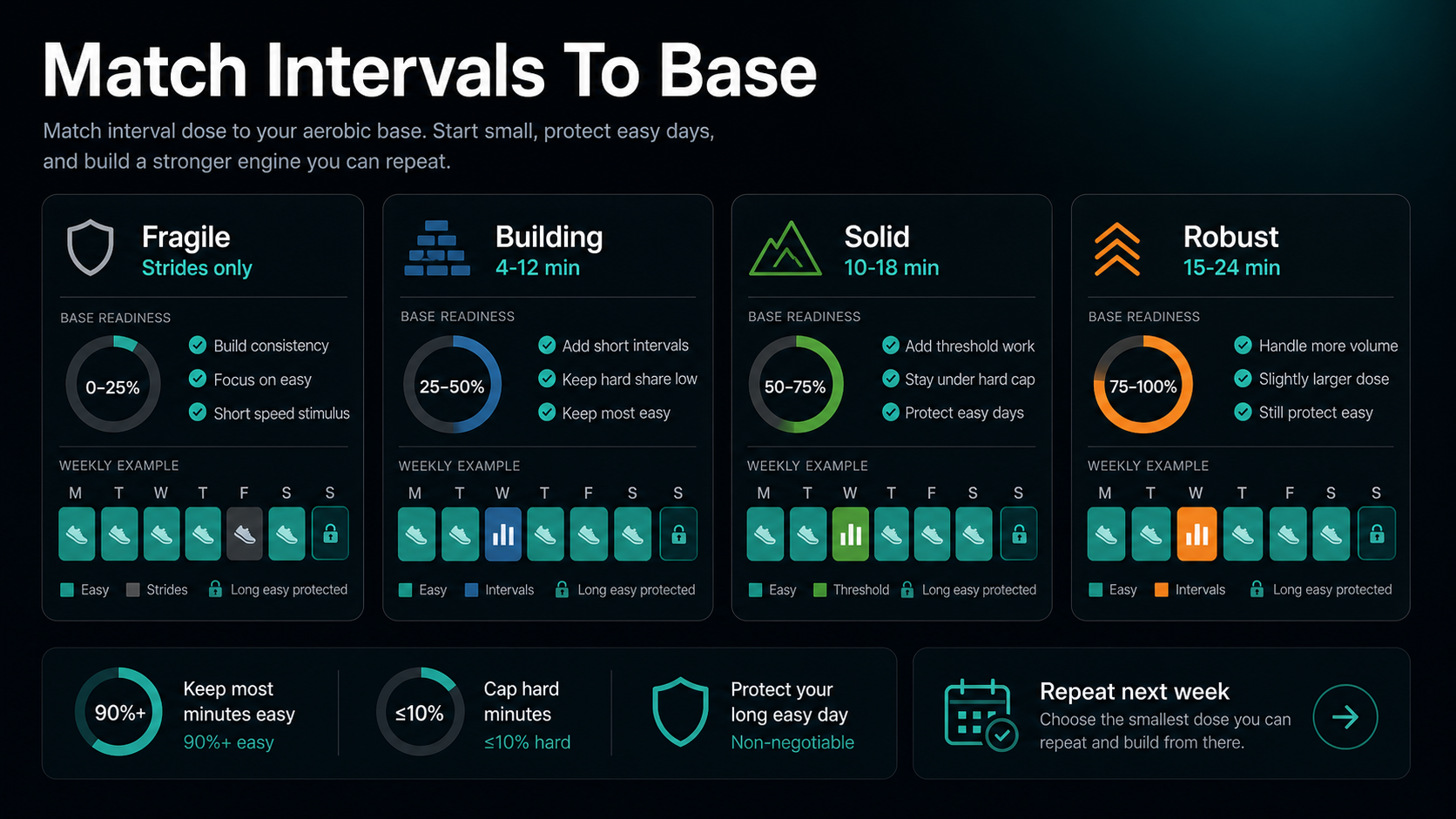
Use these categories as a reality check.
A fragile base means your easy days are not consistently easy yet. Heart rate drifts quickly, soreness lingers, your week changes often, or you have not held the same volume for at least a few weeks. The best interval is usually relaxed speed: 6-8 short strides for runners or short cadence spin-ups for cyclists. These teach rhythm without creating a large metabolic load.
A building base means you have some consistency, but your volume or durability is still developing. Start with short reps and stop while the workout still feels controlled. For example, a runner might do 8 x 30 seconds quick with easy jogging between reps. A cyclist might do 6 x 1 minute hard but controlled with long easy recoveries. The point is exposure, not exhaustion.
A solid base means you can repeat easy volume, keep the long session controlled, and recover normally. This is where threshold intervals become more useful. A first session might be 3 x 6 minutes at controlled threshold or 2 x 8 minutes if you are more experienced. It should feel hard steady, not like a time trial.
A robust base means you have months of consistency, a stable long session, and good recovery signals. You can use a slightly larger threshold dose or short VO2-style work, but you still do not need multiple hard workouts immediately. Build from one interval day. If the week remains stable, then consider progression.
What Type Of Interval Should You Add First?
The best first interval depends on what your base is missing.
If you feel aerobically fit but flat and slow, start with gentle speed. Strides, hill strides, or spin-ups add neuromuscular sharpness without much weekly stress. Keep the reps relaxed. A stride is not a sprint. A spin-up is not a maximal attack. You should finish feeling better coordinated, not drained.
If you have consistent easy volume and want to improve hard steady output, start with threshold intervals. Threshold is useful because it creates a strong aerobic pressure without the same recovery cost as all-out efforts. Research on high-intensity interval programming emphasizes that interval outcomes depend on many variables: intensity, duration, recovery, number of repetitions, and how the session fits the rest of the plan (Buchheit and Laursen, 2013 Part I, Part II). For base protection, the first variables to keep conservative are total work time and recovery.
If you already race, do fast group workouts, or have a strong threshold base, short VO2-style intervals can help. But VO2 work is easy to overdose because the session feels productive and the fatigue arrives later. Keep the total hard work small at first. A few controlled reps are enough for a first exposure.
Most athletes should avoid starting with a workout they saw from a fitter athlete. A 6 x 3 minute VO2 workout, 5 x 1 mile threshold workout, or 2 x 20 minute cycling threshold workout may be reasonable later. It does not need to be week one.
How To Place Intervals In The Week
Placement matters almost as much as the workout itself. A small interval session can become too expensive if it is squeezed between a long day, a gym session, and a moderately hard group workout.
A simple first week might look like this:
- Monday: Easy aerobic.
- Tuesday: Interval workout.
- Wednesday: Easy or rest.
- Thursday: Easy aerobic.
- Friday: Easy aerobic with optional mobility or strength.
- Saturday: Long easy session.
- Sunday: Recovery easy or rest.
That layout is not magic. The important pattern is hard day, easy day, easy volume, long easy protected. If your long session is Sunday, place intervals Tuesday or Wednesday. If your group ride is already hard on Saturday, do not add a second hard workout on Thursday until the group ride becomes controlled or your base is clearly robust.
For runners, avoid placing the first interval workout the day after heavy lower-body strength training. Tendons, calves, hamstrings, and hip flexors often care about total mechanical stress, not just heart-rate zones. For cyclists, watch the combination of intervals, strength, and long climbs. A workout may be low impact compared with running, but it still creates muscular and nervous-system fatigue.
The day after intervals should tell you whether the dose was right. If easy pace or power is normal, breathing is controlled, and legs loosen after the warm-up, the dose probably fit. If the next day feels like a forced march, reduce the next interval session before increasing anything.
Protect Easy Training After The Workout
Adding intervals should make one day harder and leave most days clearly easy. If every other day shifts from easy to moderate, the plan has failed even if the interval session looked perfect.
This is the hidden way athletes ruin their base. They add intervals, then unconsciously push easy days because fitness is improving or because moderate training feels satisfying. Heart rate drifts higher, recovery costs rise, and the weekly distribution turns into a gray zone. The athlete is no longer doing enough easy work to build base or enough fresh hard work to improve quality.
The fix is boring and effective: put a ceiling on easy days. Use conversation, breathing, heart rate, pace, power, or rating of perceived exertion. The exact tool matters less than the behavior. If the day is easy, keep it easy.
Do not sacrifice the long easy session to make room for intervals unless you are intentionally reducing volume for recovery. The long easy session is often the biggest base-building stimulus of the week. If interval fatigue makes you shorten it every weekend, the interval dose is too large or placed too close to the long day.
Progress With Repetition Before Volume
The first progression is not more reps. The first progression is repeating the same workout and having it feel more controlled.
Use a four-week pattern:
- Week 1: Add the smallest interval dose that fits the base.
- Week 2: Repeat the same dose.
- Week 3: Add a small amount only if easy days stayed easy.
- Week 4: Hold or reduce the dose to absorb the block.
For example, a runner with a solid base might start with 3 x 6 minutes at threshold. Week 2 repeats 3 x 6. Week 3 becomes 3 x 7 or 4 x 5, not 6 x 6. Week 4 returns to 3 x 6 or uses only strides. A cyclist might start with 6 x 1 minute VO2-style work, repeat it, then move to 7-8 reps only if the rest of the week stayed stable.
Small progressions work because they preserve the total system. You are not trying to win one workout. You are trying to raise performance while keeping training frequency, long aerobic work, and recovery intact.
Polarized-style approaches have performed well in some endurance studies compared with programs dominated by threshold or moderate intensity, including a controlled intervention by Stoggl and Sperlich (Stoggl and Sperlich, 2014). That does not mean threshold is bad. It means the overall blend matters. Hard work is useful when it is surrounded by enough low-intensity training.
Warning Signs You Added Too Much
Intervals should create a clear stimulus and then fade into recovery. If the hard day keeps echoing through the whole week, reduce the dose.
Common warning signs include:
- Easy heart rate is higher than normal for the same pace or power.
- Breathing feels strained on sessions that should be conversational.
- The long easy session becomes shorter, harder, or skipped.
- Soreness lasts more than 48 hours.
- Sleep, mood, or appetite changes noticeably after the workout.
- You need to bargain with yourself to start easy days.
- The interval workout gets slower or more ragged each week.
One bad day is information, not a crisis. Heat, stress, poor sleep, travel, and life load all affect training. The issue is a pattern. If the pattern says the interval day is making the whole week worse, the workout is too big for the current base.
The cleanest adjustment is to reduce total hard minutes before reducing easy volume. Keep the base. Trim the intervals. You can also switch from VO2 to threshold, from threshold to strides, or from intervals to a steady aerobic week.
Common Mistakes
The first mistake is adding intensity and volume at the same time. If weekly minutes are already rising, hold intervals very small. If intervals are new, keep weekly volume steady. Changing both makes it hard to know what caused fatigue.
The second mistake is counting workouts instead of minutes. One interval day can contain 8 hard minutes or 40 hard minutes. The body notices the dose. Track total hard work, not just the label on the calendar.
The third mistake is letting the warm-up become hard. A rushed warm-up pushes the whole session higher. Start easy. Let heart rate and breathing rise gradually. The first rep should not feel like a shock.
The fourth mistake is racing the recoveries. Recovery is part of the workout design. If recoveries are too hard, threshold intervals become race efforts and VO2 reps become survival work.
The fifth mistake is using intervals to fix inconsistency. If you are missing easy sessions, intervals are not the first solution. Build the repeatable week first, then add intensity.
A Practical Starting Point
If you are unsure, use this rule: one interval day, 4-6% hard minutes, and no change to the long easy session.
For a 180-minute week, that means roughly 7-11 hard minutes. That could be 8 x 30 seconds quick, 6 x 1 minute controlled hard, or 3 x 3 minutes near threshold depending on your base and sport. For a 300-minute week, 4-6% gives 12-18 hard minutes, enough for a controlled threshold starter session. For a 450-minute week with a robust base, 20-30 hard minutes may fit, but only if the easy days stay easy.
This may look too small on paper. That is the point. A good first interval workout should leave you with the feeling that you could have done more. Save that extra work for next week. Repeatability is the proof that the dose belongs in your plan.
Conclusion
You add intervals without ruining your aerobic base by making the base the constraint. Keep most minutes easy. Replace a small part of easy volume with one quality session. Count all hard work. Protect the long easy day. Repeat the same dose before progressing.
Intervals work best when they are supported by the training around them. The aerobic base gives you the durability to absorb intensity. The interval workout gives the base a sharper performance signal. When both pieces are balanced, you can build speed, threshold, or VO2 capacity without turning every week into a fatigue experiment.
Start smaller than your ambition. Let the next easy day tell you whether the workout fit. Then build from the smallest dose you can repeat.
Related