
Heart Rate Zones
Polar Watch vs H10
Compare Polar wrist optical heart rate with the Polar H10 electrical chest strap across running, cycling, swimming, intervals, HRV, and everyday training.
Introduction
A Polar watch and Polar H10 can belong in the same training system without being interchangeable sensors. The watch’s optical measurement is convenient for daily wear and many steady sessions. The H10’s electrical measurement is the stronger choice for fast changes, precise zones, interval response, and beat-to-beat analysis.
Because Polar makes both products, this comparison is unusually clear. Polar’s own documentation describes the wrist method as optical and the H10 as an electrical chest sensor, and recommends the strap when vigorous arm motion, cold, or fast heart-rate changes challenge wrist readings (Polar measurement comparison).
The best choice still depends on the workout and decision, not merely which product is marketed as more accurate.
Optical Pulse Versus Electrical Beat Timing
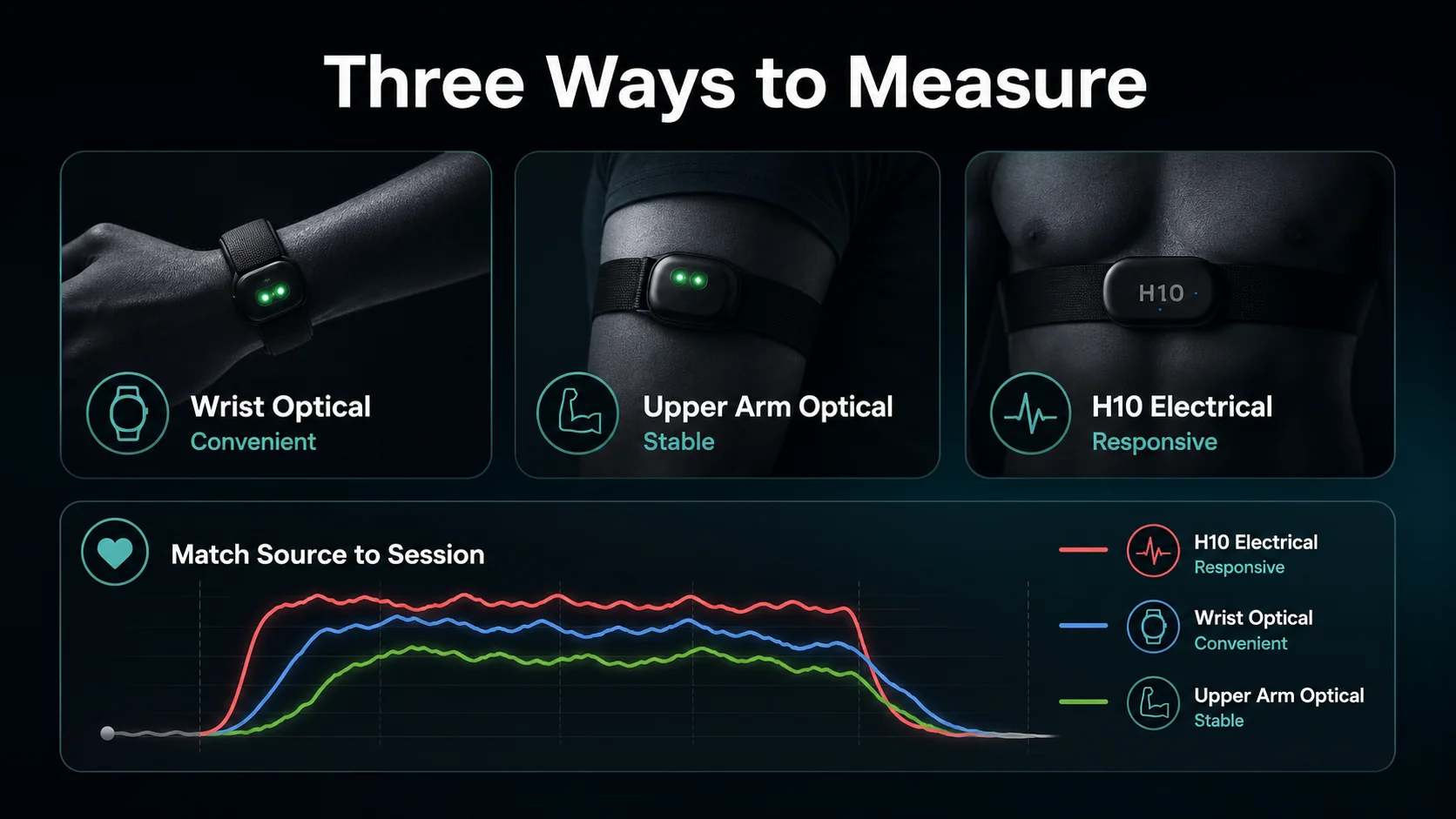
Polar watches illuminate tissue at the wrist and estimate pulse from changes in reflected light. The algorithm must reject motion while maintaining contact with the skin. Watch fit, wrist anatomy, temperature, tattoos, water, and the activity all matter.
The H10 uses chest electrodes to detect electrical cardiac activity. Polar describes it as its most accurate sensor and supports Bluetooth and ANT+ connections (Polar H10 product information). Electrical sensing is normally more responsive to rapid changes and suitable for RR-interval collection.
The H10 can still produce bad data. Moisten the electrodes, tighten the strap, keep it clean, replace worn fabric, and check the battery. A clean-looking wrist graph can occasionally be more credible than a chest trace full of contact spikes.
How Strong Is the H10 Reference?
Independent validation compared H10 with ECG during resting and incremental exercise. Heart rate and linear HRV measures showed strong agreement and small bias, supporting H10 as a practical reference for those outcomes (Gilgen-Ammann and colleagues).
That does not make every derived HRV metric equally valid. The same study found greater uncertainty for DFA alpha 1 at higher intensity. “Accurate sensor” does not guarantee that every algorithm applied to its intervals is equally stable.
The H10’s strength is capturing beat timing. Your training zones may still be wrong if maximum heart rate, threshold, or zone formulas are poorly chosen.
What Research Says About Polar Wrist Devices
A study of Polar Vantage V, Garmin fēnix 5, Fitbit Versa, and Apple Watch Series 4 found the Vantage produced relatively low heart-rate error across the tested light-to-vigorous activities, behind Apple Watch but ahead of the Garmin and Fitbit models in that protocol (Düking and colleagues).
More recent testing of Polar Vantage V2 and Verity Sense against H10 found the upper-arm optical sensor highly accurate across most activities, while wrist Vantage accuracy varied more by activity (device validation study). Another current comparison found Polar Verity Sense and Apple Watch SE lower in error than Polar Pacer Pro and Galaxy Watch 6 during some treadmill intensities (2026 comparison).
These are model- and protocol-specific results. They suggest placement can matter as much as the brand printed on the device.
Easy Running and Long Aerobic Sessions
For steady running, a Polar watch can be sufficient. The pulse changes gradually and rhythmic movement is easier to filter than lifting or racket sports. Wear the watch at least a finger above the wrist bone and firmly enough to prevent movement; Polar gives similar fit guidance for reliable optical measurement (Polar wrist measurement guide).
Use the trace as a range. A smooth curve that agrees with conversation and effort is more informative than a few seconds at the edge of a zone. If the watch locks near cadence or reacts implausibly to hills, use H10 for the next comparable session.
Long-term consistency may matter more than the theoretical best sensor. A consistently worn watch can reveal stable within-person trends, while occasional H10 benchmark sessions can confirm that the workout signal remains credible.
Intervals and Threshold Testing
H10 is the stronger choice for intervals. It follows fast rises and recoveries without the same optical smoothing delay, making it easier to study whether heart rate reaches the intended range and how recovery changes across repetitions.
Even with H10, do not control very short repetitions by chasing heart rate. Physiology itself lags behind work rate. Use pace, power, or perceived effort for execution, then review H10 response afterward.
For field threshold tests, source consistency is essential. Use the same H10 setup each time, verify contact before starting, and avoid mixing wrist-derived and H10-derived results in one trend without marking the source change.
Cycling, Strength Training, and Swimming
Cycling can alter wrist contact through gripping and wrist angle. H10 usually gives the cleaner signal for power-to-heart-rate comparisons, indoor intervals, and aerobic decoupling analysis.
Strength work combines gripping, wrist flexion, and rapid local motion. Wrist PPG error is generally larger in resistance exercise than in steady treadmill activity (systematic review). Use H10 if exercise heart rate is genuinely important, while remembering that heart rate alone is a limited measure of strength-training load.
Swimming is more complicated. A study of Polar M600 wrist measurement, OH1 at the temple, and H10 found poor-to-good wrist agreement and better optical performance at the temple, with wide limits still present (swimming validation). Water, transmission, device compatibility, and stroke movement all matter. Follow the exact watch-and-sensor instructions rather than assuming a dry-land setup works underwater.
HRV and Recovery Measurements
H10 is useful for controlled short HRV recordings because it captures RR intervals. Use a validated app, consistent posture, consistent time, and a stable protocol. Do not compare a morning H10 RMSSD value directly with a watch’s overnight recovery score without understanding the different window and processing.
For trends, repeatability matters. If a Polar watch provides a consistent overnight metric, keep interpreting it against its own baseline. Use H10 when you need a controlled spot measurement or a beat-level record.
A Simple Source Decision
Choose the Polar watch alone for steady everyday workouts, continuous trends, and sessions where convenience improves adherence. Add H10 for intervals, threshold tests, cycling analysis, cold weather, arm-heavy exercise, or repeated wrist errors.
Consider an upper-arm optical sensor when you dislike chest straps but need more stable placement than the wrist. It is a middle option, not automatically identical to electrical sensing.
Maintain the H10 as a Reference
The H10 only serves as a useful reference when the strap is maintained.
- Wet the electrode areas before exercise, especially in dry or cold conditions.
- Tighten the textile strap so it remains stable without restricting breathing.
- Detach the transmitter after use and rinse or wash the strap according to Polar’s instructions.
- Replace a stretched or damaged strap rather than blaming every dropout on Bluetooth.
- Check battery condition when spikes or disconnections begin unexpectedly.
During a comparison, verify that the watch is actually using H10 rather than silently falling back to wrist measurement. Check the sensor connection before starting and preserve the original files when possible.
Diagnose Polar Watch and H10 Disagreements
Wrist is slow but H10 is smooth
Optical lag or motion artifact is likely. Use H10 for this workout type and retain wrist measurement for steady sessions.
H10 shows isolated impossible spikes
Improve electrode contact, inspect the strap, and repeat. Electrical sensing is not immune to artifacts.
Both show the same heart rate but different zones
The sensor is not the problem. Align maximum heart rate, threshold, and zone models across the platforms.
Overnight and morning HRV disagree
Check metric, posture, time window, artifact handling, and breathing protocol. Compare like with like instead of forcing two different methods to match.
Swimming data is incomplete
Check compatibility, recording mode, and how data is stored or transferred underwater. Radio behavior and placement can matter independently of sensor accuracy.
Example Decisions
- Easy run: Polar watch and H10 remain within the same zone and follow the same hills. The watch is enough.
- Threshold field test: A few beats alter the estimated threshold and the test will be repeated later. Use H10 consistently.
- Cycling endurance: Wrist contact changes on the bars, while H10 is stable. Use H10 for decoupling analysis.
- Track intervals: H10 shows the expected rise and recovery; wrist peaks are delayed. Execute by pace and review with H10.
- Morning HRV: A validated H10 protocol is repeatable. Keep posture, duration, app, and time of day unchanged.
Do Not Let Better Measurement Create False Precision
H10 can improve the heart-rate signal, but training decisions still face biological variability. Heat, dehydration, sleep, caffeine, accumulated fatigue, and normal daily variation can change heart rate at the same pace.
Use repeated sessions and meaningful ranges. A one-beat difference is not a new threshold. A consistently different response across standardized tests may justify further investigation.
Keep an explicit sensor note beside important tests. Record whether the watch used wrist optics, H10, or an upper-arm sensor, and note any device or firmware change. Review future tests with the same source and similar environmental conditions. This small habit prevents a cleaner measurement system from being mistaken for a sudden physiological improvement.
Finally, separate performance monitoring from health assessment. Neither a Polar watch nor H10 can diagnose the cause of chest pain, fainting, persistent palpitations, or unusual breathlessness. Those symptoms deserve appropriate medical evaluation even when both consumer devices display a normal-looking average.
Conclusion
The Polar watch is the convenient default; the H10 is the stronger exercise reference. They agree often enough that many steady sessions do not require a strap, but the H10 becomes valuable when rapid response or precise classification changes the decision.
Read Apple Watch vs Chest Strap for the broader technology comparison, and use the Zone 2 Heart Rate Calculator to separate sensor differences from zone-setting differences.

Our editorial approach & AI disclosure
We use AI to help research, organize, and draft some articles. Every article is reviewed by a human editor and aims to reflect current evidence-based training practices and scientific literature.
Read our editorial policy