

Heart Rate Zones
Lactate Threshold vs Max Heart Rate: Which Zones Should You Use?
Maximum-heart-rate zones are simple; lactate-threshold zones can be more sport-specific. Compare the methods, inputs, testing demands, and signs that one fits your training better.

Choose the Method That Matches Your Best Input
Use maximum-heart-rate zones when you need a simple, stable starting point and have a credible maximum heart rate. Use lactate-threshold-heart-rate zones when you have a well-conducted, sport-specific threshold test and want boundaries tied more closely to sustained performance.
Neither method is automatically accurate. Max-heart-rate zones become misleading when the maximum is estimated poorly. Threshold zones become misleading when the test is paced badly, the sensor is noisy, or a short hard effort is mistaken for a sustainable threshold.
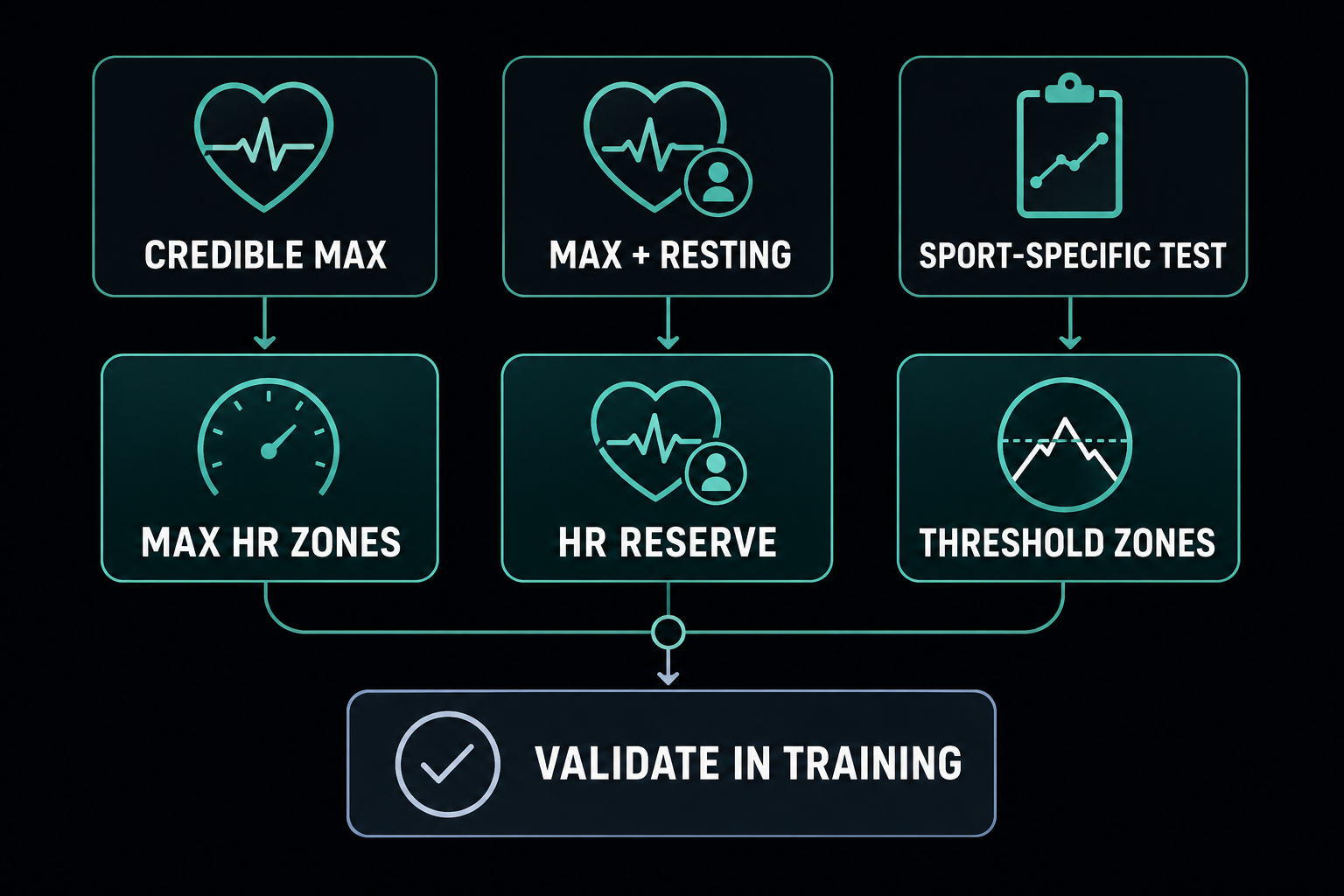
The best system is the one built from defensible inputs, validated against breathing and perceived effort, and used consistently. Do not switch methods because one chart gives you more flattering Zone 2 time.
How Maximum-Heart-Rate Zones Work
A maximum-heart-rate system expresses zone boundaries as percentages of maximum heart rate. If maximum heart rate is 190 bpm, a boundary at 70% is:
190 × 0.70 = 133 bpm
The method is simple and easy to reproduce across devices. It requires only one input and changes little over time.
The weakness is the input. Age-predicted maximum heart rate describes an average relationship across a population. Tanaka, Monahan, and Seals proposed 208 − 0.7 × age from a large analysis, but individual variation remains meaningful (Journal of the American College of Cardiology). An estimate can be useful for initialization without being a precise personal maximum.
A measured maximum is also easy to misuse. The highest value in a normal week may sit well below true maximum. An isolated optical-sensor spike may sit above it. A hard test should use reliable measurement, a suitable protocol, and appropriate medical judgment.
How Lactate-Threshold-Heart-Rate Zones Work
Lactate threshold is an intensity near the transition to a more rapidly accumulating metabolic disturbance. The terminology is not perfectly uniform: first and second lactate thresholds, maximal lactate steady state, anaerobic threshold, and functional threshold are related concepts but not interchangeable measurements.
For zone setting, “lactate-threshold heart rate” usually means the heart rate associated with a tested threshold or a sustained field effort intended to estimate it. A zone system then places boundaries above and below that heart rate.
Threshold-based prescription can reduce some of the individual variability created by fixed percentages of peak effort. A 2025 review found greater variation in acute physiological responses when intensity was prescribed from percentages of peak heart rate or oxygen uptake than when it was tied to ventilatory or lactate thresholds (Sports Medicine). That supports the logic of threshold-based zones when the threshold itself is measured well.
The limitation is that threshold is not one timeless number. Training status, fatigue, test protocol, environment, and sport influence the result. Running and cycling threshold heart rates may differ, so each sport may need its own test and boundaries.
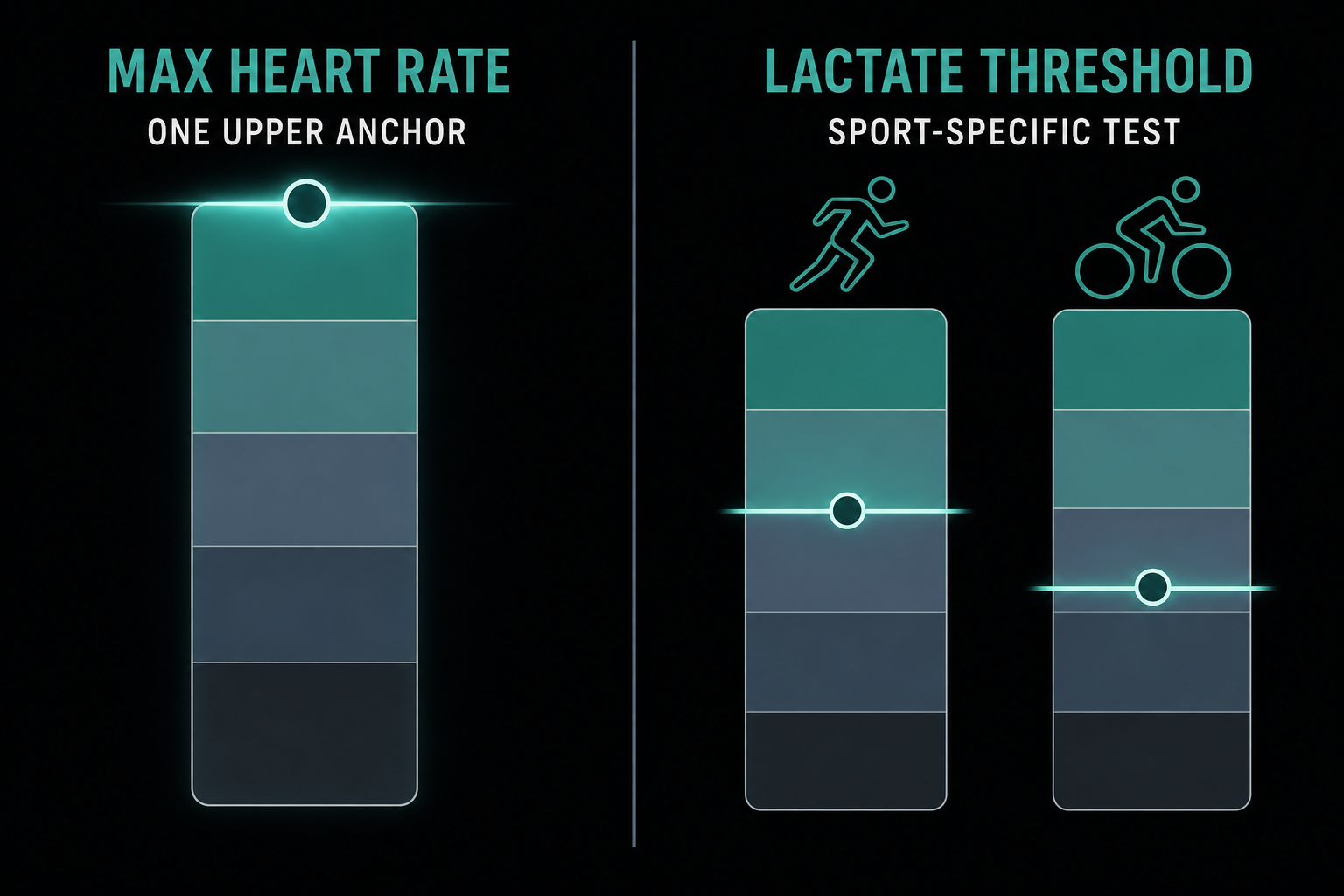
Max Heart Rate, Heart-Rate Reserve, and Threshold Are Different
Many devices offer a third method: percentage of heart-rate reserve. Heart-rate reserve is maximum heart rate minus resting heart rate. A target percentage is applied to that reserve, then resting heart rate is added back:
Target HR = resting HR + ((maximum HR − resting HR) × percentage)
Research by Swain and Leutholtz found that percentage of heart-rate reserve corresponded more closely to percentage of oxygen-uptake reserve than to percentage of maximum oxygen uptake in laboratory cycling (Medicine & Science in Sports & Exercise).
Reserve-based zones can personalize a max-based system by including resting heart rate. They still depend on a credible maximum and should not be described as threshold-measured zones.
Keep the three approaches distinct:
| Method | Main inputs | Main strength | Main weakness |
|---|---|---|---|
| % maximum HR | Maximum heart rate | Simple and stable | Generic percentages vary by person |
| % heart-rate reserve | Maximum and resting heart rate | Accounts for resting HR | Still estimate-based |
| % lactate-threshold HR | Tested threshold HR | Sport-specific and performance-linked | Test quality and maintenance matter |
When Maximum-Heart-Rate Zones Are the Better Choice
Choose max-based zones when:
- you are starting heart-rate training and need understandable boundaries;
- you know a credible maximum from a reliable test or repeated hard efforts;
- your main goal is broad separation of easy, moderate, and hard training;
- you use several sports and do not have valid thresholds for each;
- stable cross-season comparison matters more than frequent fine-tuning.
A simple system can be better than a sophisticated system built on weak data. If the boundaries agree with breathing, perceived effort, and repeated workouts, keep them.
Use the heart-rate zone calculator to compare percentage-of-maximum and heart-rate-reserve outputs. Enter realistic values and save the resulting BPM limits rather than remembering only the percentages.
When Lactate-Threshold Zones Are the Better Choice
Choose threshold-based zones when:
- a laboratory test or repeatable field protocol produced a credible value;
- you train primarily for running or cycling performance;
- workouts are prescribed around threshold, tempo, and sub-threshold intensity;
- generic max-based zones consistently disagree with sustainable effort;
- your platform supports sport-specific boundaries;
- you are willing to retest when fitness changes.
Threshold zones are particularly useful for distinguishing intensities close to sustained race-like work. They are not guaranteed to define low-intensity Zone 2 perfectly. First threshold, second threshold, and a five-zone threshold system use different anchors. A recent study of Zone 2 markers found substantial individual variability and stronger alignment between first ventilatory threshold and maximal fat oxidation than between several fixed-percentage markers (Translational Sports Medicine).
Know which threshold your test estimated before applying a percentage table.
How to Get a Credible Threshold Heart Rate
Laboratory testing
A graded test with blood lactate or respiratory-gas measurement can identify physiological transitions under controlled conditions. It also makes the method and protocol explicit. Results still require interpretation, and treadmill and cycling values should not be treated as identical.
Field testing
A hard, evenly paced sustained effort can estimate threshold heart rate for experienced athletes. The result depends on motivation, pacing, terrain, temperature, duration, and the definition used by the chosen zone system. Use a chest strap or another signal you have validated.
Do not use the first minutes of the effort, when heart rate is still rising. Do not use one short peak. The estimate should come from a sustained section that matches the protocol.
Device detection
Some watches estimate threshold automatically from workouts. Treat the detected value as a hypothesis. Compare it with the trace, effort, recent performances, and previous tests before allowing it to rewrite every zone.
Our lactate-threshold calculator can translate a credible threshold input into training ranges. The article on what lactate threshold means explains the physiology and terminology in more depth.
A Practical Validation Checklist
Whatever method you choose, test it against three types of training.
Easy steady session
The intended easy range should support comfortable speech and controlled breathing after the warm-up. If every relaxed session is classified as moderate or hard, verify inputs and boundaries.
Long aerobic session
Watch how heart rate changes at stable pace or power. Some drift is normal. A useful Zone 2 range leaves room for that rise without forcing an artificially slow opening.
Threshold-oriented session
A threshold range should describe a demanding but controlled sustained effort. If the target can only be held for a few minutes, the estimated threshold may be too high or the workout may target a different intensity.
Should Running and Cycling Use the Same Method?
They can use the same calculation method while using different values. A runner may have a different threshold heart rate on the bike because posture, muscle recruitment, testing mode, and familiarity change the response.
If you have credible sport-specific tests, store separate running and cycling boundaries. If your platform allows only one global set, prioritize the sport that drives most training decisions and interpret the other with pace, power, breathing, and perceived effort.
Avoid changing methods between individual workouts. Weekly distribution becomes hard to interpret when the meaning of each zone keeps moving.
When to Recalculate
Maximum-heart-rate zones need review when the input was only an age estimate, a reliable new maximum appears, medication changes, or the boundaries repeatedly fail validation.
Threshold-based zones need review after a meaningful training block, a long interruption, a major fitness change, or repeated evidence that threshold workouts no longer match the expected effort. Retest under comparable conditions when possible.
Document the effective date. Historical workouts may retain the zone definitions used when they were processed, so comparisons across a boundary change should rely on raw heart rate, pace, power, and notes.
Common Mistakes
The first is comparing percentages across different anchors. Seventy percent of maximum heart rate is not seventy percent of threshold heart rate.
The second is calling an age estimate a measured maximum. It is an estimate until tested.
The third is treating every high value as maximum heart rate. Sensor spikes and short surges are weak evidence.
The fourth is using a poorly paced field test as a precise threshold. Repeatability matters.
The fifth is updating zones after one surprising workout. Heat, fatigue, dehydration, hills, and drift change heart rate without proving the system wrong.
Use One Consistent Reference
Maximum-heart-rate zones are accessible and stable. Lactate-threshold zones can be more individual and sport-specific when the test is credible. Heart-rate-reserve zones sit between them by adding resting heart rate to a max-based framework.
Choose the method supported by your best data. Validate it in easy, long, and threshold sessions, record the BPM boundaries, and use one reference for weekly review. Precision comes from good inputs and consistent interpretation, not from choosing the most technical label. If Apple Watch, Garmin, and Strava assign different labels to the same trace, compare their actual heart-rate-zone boundaries before changing your training method.

Our editorial approach & AI disclosure
We use AI to help research, organize, and draft some articles. Every article is reviewed by a human editor and aims to reflect current evidence-based training practices and scientific literature.
Read our editorial policy