


How Do You Review a Week of Endurance Training?
Review a week of endurance training by comparing the plan, completed load, intensity distribution, body response, recovery context, and the one adjustment that should shape next week.
Jun 20, 202614 min read

Introduction
Review a week of endurance training by comparing the plan, the work you actually completed, how hard that work was, how your body responded, and what should change next week.
That is the whole point of a weekly review. It is not a judgment session. It is not a search for one perfect score. It is a short decision-making routine that helps you avoid two common mistakes: reacting emotionally to one bad workout, and ignoring a pattern that has been building for several days.
For runners and cyclists, a good review should take 10-15 minutes. You look at the week as a whole: total time, distance, elevation, long-session size, workout quality, time in zones, perceived effort, sleep, soreness, mood, pain, fueling, missed sessions, and how the week fit the goal of the current training block.
The reason this matters is that training is not only what is written on the plan. Training load includes both external load, such as distance, duration, speed, elevation, or power, and internal load, such as heart rate, perceived effort, fatigue, soreness, and mood. A consensus statement on training-load monitoring makes this external/internal distinction central to understanding athlete response (Bourdon et al., 2017). Impellizzeri, Marcora, and Coutts later emphasized that external and internal training load answer different questions and should not be treated as the same thing (Impellizzeri et al., 2019).
So the weekly review is where those pieces meet. You are asking: did the training stimulus match the plan, did the athlete absorb it, and what is the most sensible next step?
The Short Answer: Review Five Questions
A weekly endurance training review should answer five questions:
- Did you complete the plan?
- How much load did the week create?
- Where did the intensity go?
- How did your body respond?
- What should change next week?
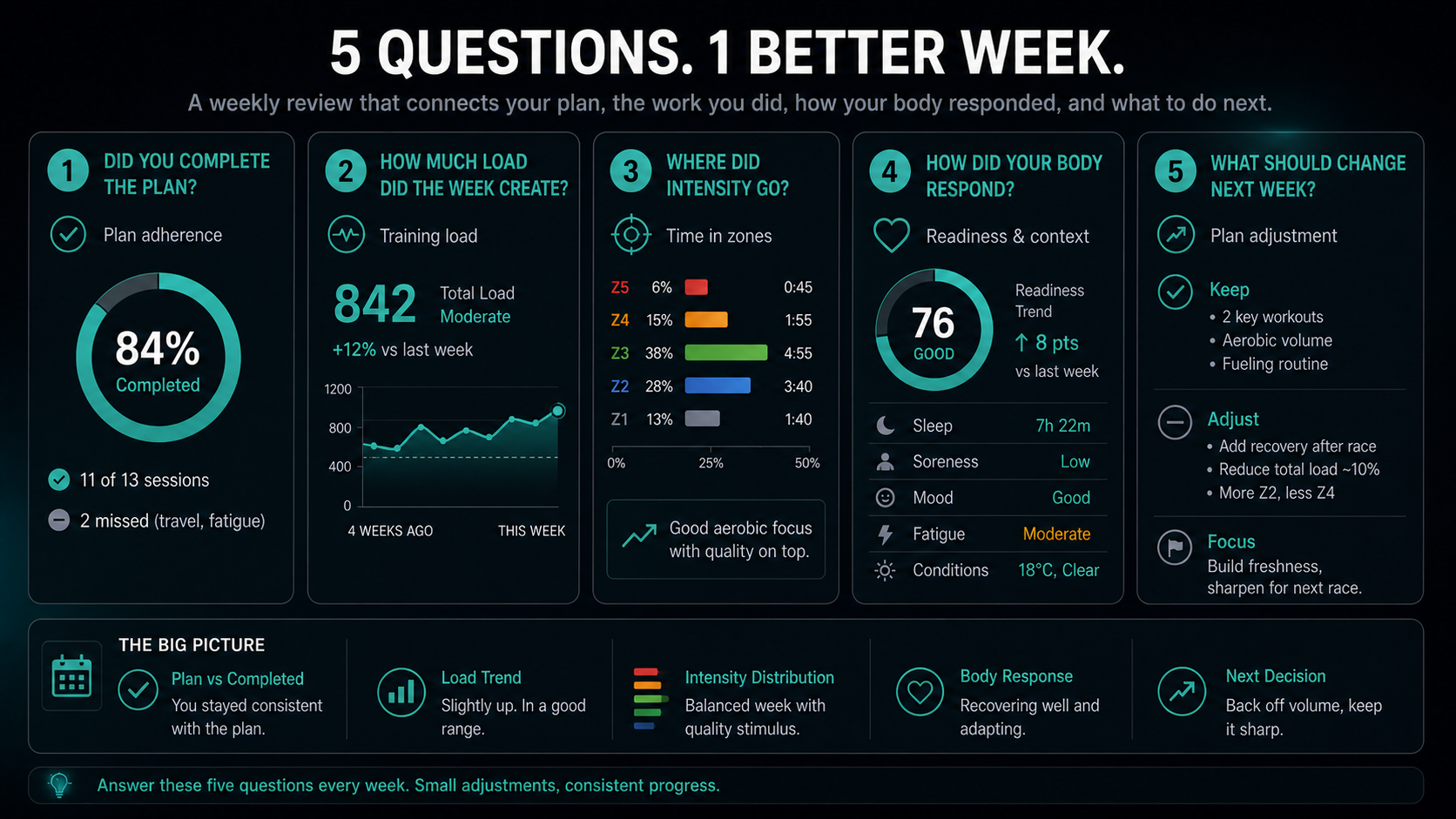
If you answer those five questions honestly, you will usually know whether to progress, repeat, reduce, redistribute intensity, or protect recovery.
The review should be simple enough to repeat every week. You do not need a long report. You need a clear summary of the week and one decision that improves the next one.
Review The Week, Not Just The Last Workout
Daily training data can be noisy. One bad run may be caused by poor sleep, heat, a stressful day, heavy legs from strength training, or simply normal variation. One great ride may be the result of tailwind, group dynamics, extra caffeine, or a light day before it.
Weekly review gives the data enough time to form a pattern. Halson's review on monitoring training load argues that fatigue is best understood by combining the work performed with the athlete's response to that work (Halson, 2014). That is easier over a week than inside a single session.
The weekly lens also protects you from overcorrecting. If one workout goes poorly but the rest of the week looks stable, you may simply need to move on. If three easy days all felt too hard, sleep was poor, and soreness rose, you probably need to adjust.
Think of the review as a filter. It separates noise from signal.
When To Do The Weekly Review
Do the weekly review at the same point each week, ideally after the last meaningful session and before the next week begins. For many athletes, Sunday evening or Monday morning works well. The exact day matters less than the rhythm.
The review should happen when you are calm enough to interpret the week, but close enough to remember the details. If you review immediately after a bad workout, emotion may dominate. If you wait two weeks, the useful context gets blurry.
Keep the process short. A useful weekly review can be done in this order:
- Look at the planned week.
- Look at the completed week.
- Check total load and intensity distribution.
- Check recovery, soreness, pain, sleep, and mood.
- Write one decision for the next week.
This routine should feel like training hygiene, not homework. If the review takes 45 minutes every week, it is probably too complex. If it takes two minutes and only says "good week," it is probably too shallow.
The best rhythm is a quick weekly review plus a deeper monthly review. The weekly review keeps the plan responsive. The monthly review asks larger questions: is the block working, are you progressing toward the goal, are recurring issues appearing, and does the next phase still make sense?
Weekly reviews should also respect the training phase. In base training, you may focus on consistency, aerobic volume, easy-day discipline, long-session tolerance, and recovery. In build training, you may look more closely at workout execution, intensity placement, and whether hard sessions are being absorbed. In taper weeks, the review is less about building more load and more about arriving fresh with confidence.
The point is to review the week in context. A heavy week during a build block may be appropriate. The same week during a recovery phase may be excessive.
Step 1: Compare Planned vs Completed Training
Start with the simplest question: what was planned, and what actually happened?
This step should include completed sessions, missed sessions, modified workouts, moved workouts, shortened sessions, extra training, and strength or cross-training that affected fatigue. Do not only count what went right. The gap between plan and reality is useful information.
Ask:
- How many sessions were planned?
- How many were completed?
- Which sessions were modified or skipped?
- Why did changes happen?
- Did easy days stay easy?
- Did hard sessions happen on the intended days?
- Did extra training sneak in?
The reason matters more than the raw completion percentage. Missing a recovery run because of travel is different from missing a key workout because fatigue was too high. Cutting a long run short because of a small pain signal is different from cutting it short because you started too fast.
A good weekly review does not use the plan as a moral scoreboard. It uses the plan as a reference point. If the same kind of session is missed every week, the plan may not fit your current life or recovery capacity. If the plan is completed but every session feels harder than expected, the week may still be too demanding.
Step 2: Review Total Volume And Training Load
Next, review the size of the week.
For runners, that usually means total time, distance, elevation gain, long-run duration, number of running days, and strength or cross-training. For cyclists, it may mean total hours, total distance, elevation gain, kilojoules, power-based training stress, long-ride duration, and number of ride days.
Do not look only at the weekly total. Look at where the load came from. A 7-hour cycling week with one 4-hour ride is different from a 7-hour week spread evenly across five rides. A 40-mile running week with a 17-mile long run is different from a 40-mile week with a smaller long run and more even distribution.
The review should also compare the week to recent history:
- Was total volume up, down, or stable?
- Was the long session larger than usual?
- Did elevation or terrain increase?
- Did strength work add meaningful fatigue?
- Did load rise while recovery markers fell?
- Did the week fit the phase: base, build, deload, taper, or race week?
Gabbett's training-injury prevention paper argues that athletes need enough preparation for the demands they face, but that poorly managed workload spikes can create problems (Gabbett, 2016). For a weekly review, the practical takeaway is not "avoid training hard." It is "look at how quickly load changed and whether the athlete absorbed it."
If the load increased and the athlete responded well, progression may be appropriate. If load increased and fatigue, soreness, or pain also increased, the next week may need to repeat or reduce.
Step 3: Review Intensity Distribution
After volume, look at intensity. This is where many endurance plans drift.
The question is not only "Did I do my workouts?" It is also "Where did the week actually sit across easy, moderate, and hard work?"
Useful checks include:
- Time in heart rate zones.
- Time in power zones.
- Number of hard sessions.
- Total interval volume.
- How much work happened around threshold.
- Whether easy sessions were truly easy.
- Whether hard days were separated by enough recovery.
- Whether moderate intensity filled too much of the week.
Seiler's review of endurance training intensity distribution reported that many successful endurance athletes perform a large share of training at low intensity, with smaller amounts of higher-intensity work placed carefully (Seiler, 2010). That does not mean every athlete needs an exact universal split. It does mean the weekly review should protect easy training from becoming hidden moderate training.
For runners, intensity drift often looks like easy runs getting too fast, long runs becoming races, or threshold workouts turning into VO2 max efforts. For cyclists, it may look like endurance rides creeping into tempo, group rides replacing controlled work, or too many climbs becoming hard efforts.
The fix is not always to train less. Sometimes it is to redistribute stress. Make easy days easier. Put quality sessions farther apart. Keep one focused hard workout instead of three blurry moderate ones. Let the week have a shape.
Step 4: Review Body Response And Recovery
Now ask how your body responded to the week.
This step should include objective and subjective information. Objective markers might include resting heart rate, heart rate variability, heart rate drift, sleep duration, or pace/power at a given heart rate. Subjective markers include soreness, fatigue, mood, motivation, stress, perceived effort, and sleep quality.
Subjective measures are not second-class data. A systematic review by Saw, Main, and Gastin found that subjective self-reported measures often reflected athlete well-being at least as well as, and sometimes better than, commonly used objective measures (Saw et al., 2016). The best weekly reviews use both.
Ask:
- Did easy sessions feel normal?
- Did RPE match the workout type?
- Was sleep stable?
- Did soreness rise or clear?
- Was mood or motivation unusually low?
- Did stress outside training affect workouts?
- Did fueling support key sessions?
- Did any illness symptoms appear?
Recovery is not just "rest days." A recovery consensus statement emphasizes that recovery is multidimensional and should be considered alongside training stress rather than treated as a separate afterthought (Kellmann et al., 2018). A weekly review should reflect that. If work stress, poor sleep, travel, heat, or under-fueling shaped the week, write that down.
The body response step is where you decide whether the completed work was absorbed. A week can look perfect on paper and still be too expensive. Another week can look modest but produce a strong positive response.
Step 5: Review Outcomes And Warning Signs
The next step is to connect training to outcomes.
Outcomes can be performance-related: a good threshold workout, improved pace at easy heart rate, stable power on a long ride, better climbing, a personal best, or a controlled race. Outcomes can also be risk-related: pain, missed sessions, unusually high fatigue, poor mood, or an inability to complete normal training.
Track both. A weekly review that only celebrates performance can miss early warning signs. A review that only hunts for problems can make training feel fragile.
Useful outcome questions include:
- What improved this week?
- What felt easier than before?
- What was the best session, and why?
- What was the weakest session, and why?
- Did pain appear, increase, or move?
- Did any issue repeat from last week?
- Did the week support the current goal?
Pain notes should be specific. "Left Achilles 2/10 for first 10 minutes, then gone" is more useful than "ankle weird." "Knee pain after downhill long run" is more useful than "knee sore." Patterns often show up before major problems.
Do not turn every week into a fitness test. The point is not to prove improvement every seven days. The point is to notice whether the training process is moving in the right direction.
Know The Difference Between A Bad Day And A Red Flag
Weekly review is useful because it helps you avoid overreacting to normal variation and underreacting to real patterns.
A bad day is isolated. You slept poorly, the weather was hot, work was stressful, or the workout simply did not click. The rest of the week looks normal. Easy sessions feel normal again. Soreness clears. Motivation returns. In that case, the best decision may be to keep the plan steady.
A red flag repeats or clusters. One warning sign by itself may not mean much, but several together should change the next week. Examples include:
- Easy sessions feel hard for several days.
- Resting fatigue rises while motivation falls.
- Soreness does not clear between sessions.
- Pain appears in the same place more than once.
- Heart rate is unusually high at normal easy pace or power.
- Sleep quality drops during a load increase.
- You miss sessions because you cannot recover, not because life got busy.
The weekly review should name these patterns without panic. "Fatigue is rising and easy runs are harder" is a useful observation. "I am losing fitness" is usually an emotional interpretation. "Left calf pain appeared after both faster sessions" is useful. "My leg is broken" may not be.
This is also where subjective notes matter. Devices can show training load, heart rate, sleep estimates, and readiness scores, but they may not know that you were traveling, under-fueled, stressed, or running on a new surface. Your written notes connect the numbers to real life.
When a red flag appears, choose the smallest adjustment that has a good chance of solving the problem. That might mean moving a hard workout, shortening the long session, reducing intensity, adding a rest day, or repeating the same week instead of progressing.
If pain is sharp, worsening, changing your mechanics, or not settling with sensible load reduction, do not use a weekly review as a substitute for professional care. The log helps you describe the pattern. It does not diagnose the problem.
Turn The Review Into Next Week's Plan
A weekly review should end with one clear decision.
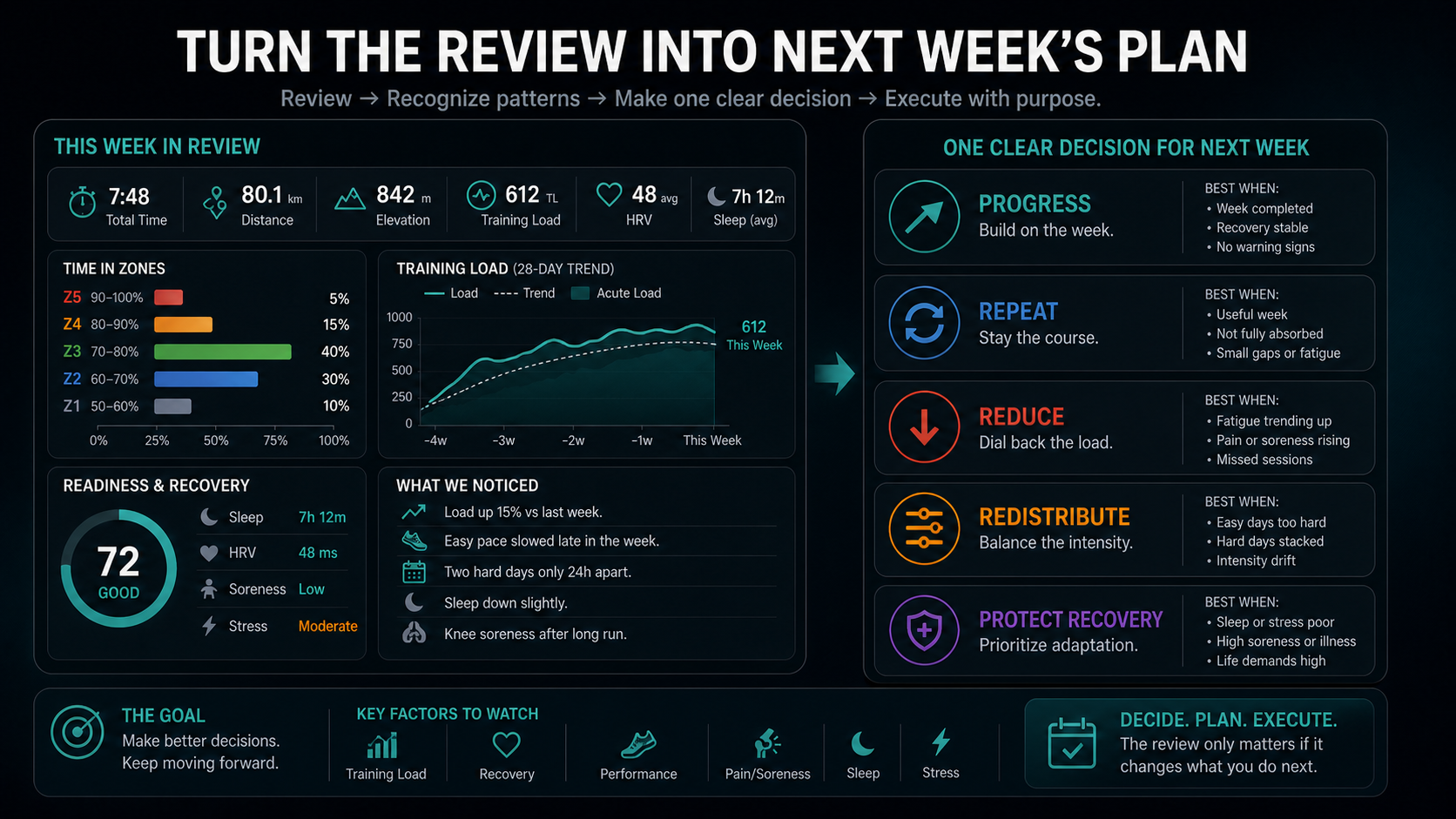
The five most useful decisions are:
- Progress: increase load or specificity slightly because the week was completed and absorbed.
- Repeat: hold the same load because the week was useful but not fully consolidated.
- Reduce: cut volume, intensity, or long-session size because fatigue, pain, or missed sessions rose.
- Redistribute: keep similar total training but change where intensity sits.
- Protect recovery: prioritize sleep, fueling, rest, easy training, or life-stress management.
Progress should be boring. A small increase in volume, a slightly longer long run, one more interval, or a more specific workout is usually enough. If a week went well, the answer is not always to leap forward.
Repeating is underrated. If you barely completed a week, repeating it may produce more adaptation than forcing progression. Consistency is often built by absorbing a level before raising it.
Reducing is not failure. It is how you keep a small problem from becoming a larger interruption. If fatigue, pain, or missed sessions are trending up, a lighter week may protect the next month of training.
Redistributing is useful when the total load is fine but the shape is wrong. For example, keep the weekly hours similar but make the easy days truly easy, separate hard sessions, or reduce hidden tempo.
Protecting recovery is the right decision when the limiting factor is not fitness. Poor sleep, illness, high work stress, or travel may mean the best training decision is to preserve adaptation rather than add stress.
A Simple Weekly Review Template
Here is a practical template you can use in a training log.
| Review Area | Question | Example Answer |
|---|---|---|
| Plan | Did I complete the week? | 5 of 6 sessions, skipped recovery ride due to travel |
| Load | How big was the week? | 7h 40m, up 8%, long run stable |
| Intensity | Where did effort go? | 78% easy, 12% threshold, 10% hard |
| Response | How did I absorb it? | Sleep good, soreness moderate, mood stable |
| Outcomes | What changed? | Best tempo of block, mild calf tightness after hills |
| Decision | What changes next week? | Repeat volume, move hills later, add recovery day |
For a runner, a weekly review note might look like this:
Completed 4 of 5 runs. Total 38 miles, long run 12 miles, one threshold workout. Easy runs felt normal except Sunday. Sleep poor midweek. Left calf 2/10 after hills, gone next day. Next week: repeat mileage, keep threshold, skip hill sprints.
For a cyclist:
Completed 8h 15m. Two quality rides, one long endurance ride. Z2 volume good, but group ride became too hard. HR higher in heat. Legs recovered by Monday. Next week: keep hours similar, replace group ride with controlled endurance.
The best review notes are short, specific, and decision-oriented.
Common Weekly Review Mistakes
The first mistake is reviewing only totals. Total miles, hours, or training stress matter, but they do not explain the week by themselves. You also need intensity distribution, session placement, recovery, and outcomes.
The second mistake is judging the week emotionally. A missed workout may be a problem, or it may be a smart adjustment. A hard session may be a breakthrough, or it may be too expensive. The review should explain the week, not dramatize it.
The third mistake is ignoring life stress. Training load is not the only load. Poor sleep, travel, work deadlines, family stress, heat, and under-fueling all affect adaptation.
The fourth mistake is changing too much. If every weekly review leads to a new plan, new workouts, new goals, and new metrics, the review is creating noise. Make one or two adjustments.
The fifth mistake is never acting on the review. Data that does not change decisions becomes decoration.
Conclusion
To review a week of endurance training, answer five questions: did you complete the plan, how much load did the week create, where did intensity go, how did your body respond, and what should change next week?
The best weekly review is not complicated. It compares external load with internal response, looks at recovery context, checks outcomes and warning signs, and ends with one clear decision.
Progress when the week was absorbed. Repeat when the work was useful but not fully stable. Reduce when fatigue or pain is rising. Redistribute intensity when the week lost its shape. Protect recovery when life stress is limiting adaptation.
That is how a training log becomes more than a record. It becomes a feedback loop.