


Base Training vs Build Training
Base training builds the aerobic platform. Build training turns that platform into event-specific fitness. Learn how the phases differ, when to switch, and how to add intensity without losing your base.
Jun 19, 202617 min read

Introduction
Base training and build training are two different answers to the same question: what kind of fitness are you trying to create right now?
Base training is the phase where you make the aerobic system more durable. The main goals are consistency, easy volume, long-session tolerance, tissue resilience, and better recovery from normal training. It is the phase where a runner learns to handle more weekly miles without turning every run into a workout, or where a cyclist learns to stack regular aerobic hours without needing several days to recover.
Build training is the phase where you use that base to prepare for a more specific goal. The easy volume usually stays, but the stress becomes more focused. Threshold work, VO2 max intervals, hill sessions, race-pace blocks, and event-specific long workouts become more important. The athlete is no longer just expanding capacity. They are sharpening the fitness they want to express on race day or during a target event.
The mistake is treating base and build as opposites. Base training is not lazy. Build training is not just "more hard workouts." They overlap. A good build phase still contains plenty of easy training. A good base phase can still include small doses of strides, hills, or controlled tempo. The difference is emphasis.
Sports scientists often describe training planning as periodization: organizing training stress across time so the athlete can adapt, recover, and perform when it matters. But periodization should not be a rigid template. Kiely's review of periodization argued for responsive training systems that adapt to the athlete rather than forcing every athlete into one rule-based model (Kiely, 2012). For everyday runners and cyclists, that is the key point. Base and build are useful labels only if they help you make better training decisions.
The Short Answer: Base vs Build Training
Base training builds what you can handle. Build training sharpens what you can express.
During base training, the main training signal comes from repeated aerobic work. Most sessions are easy. Weekly training becomes more consistent. Long sessions become less costly. The athlete learns to recover from normal training instead of being disrupted by it. If you track heart rate, pace, power, and perceived effort, base training should gradually make easy work look and feel more stable.
During build training, the main training signal shifts toward specificity. You still need easy work, but now harder sessions carry more of the purpose. A 10K runner might add threshold intervals, VO2 max reps, and race-pace work. A cyclist preparing for a hilly sportive might add climbing repeats, sweet spot or threshold work, and long rides with sustained pressure. A marathon runner might keep high easy volume but add marathon-pace blocks and longer progression runs.
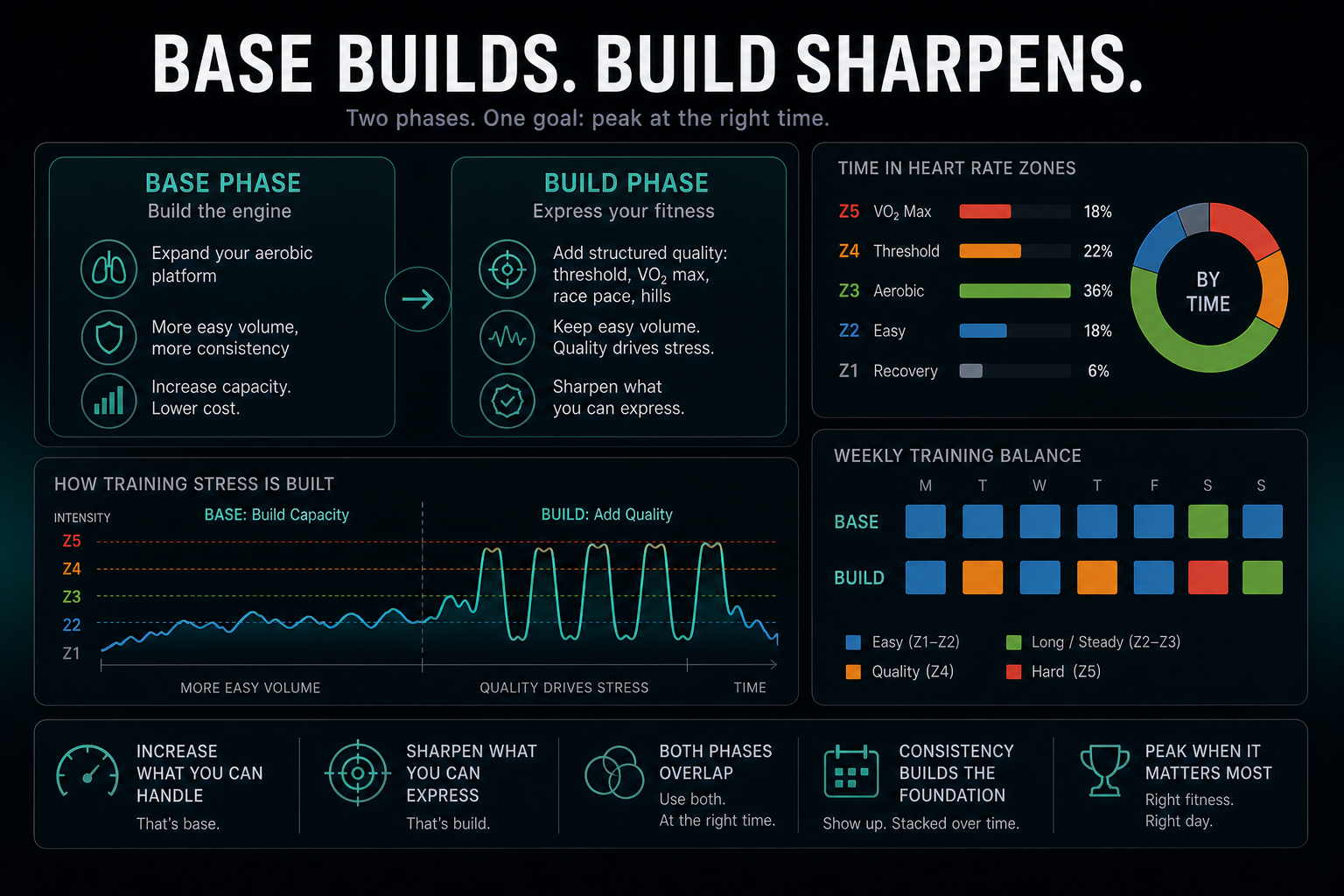
The simplest distinction is this:
| Question | Base Training | Build Training |
|---|---|---|
| Main purpose | Increase capacity | Convert capacity into performance |
| Main stress | Easy volume and consistency | Structured quality and specificity |
| Hard workouts | Small, controlled doses | More important and more specific |
| Long sessions | Build durability | Match event demands |
| Recovery goal | Adapt to more regular work | Absorb higher-intensity stress |
| Best sign it is working | Easy work feels easier | Goal-pace or goal-power work improves |
This does not mean base training has no speed or build training has no easy volume. It means the center of gravity changes.
What Base Training Actually Means
Base training is the period where you build an aerobic platform. That platform is not one single metric. It includes cardiovascular fitness, muscular endurance, connective tissue tolerance, skill efficiency, fuel use, and the habit of training consistently.
For a runner, base training may mean running four to six days per week, keeping most runs conversational, adding a gradually longer weekend run, and using strides or short hills to keep the legs responsive. For a cyclist, it may mean steady Zone 2 rides, one longer ride, easy recovery spins, cadence work, and enough strength or mobility work to support volume.
The defining feature is not that every session is slow. The defining feature is that most of the weekly stress is aerobic and repeatable. Seiler's review of endurance training intensity distribution reported that many successful endurance athletes perform a large share of training at low intensity, with a smaller share of high-intensity work added carefully across the training cycle (Seiler, 2010). That does not prove every recreational athlete needs an exact 80/20 split, but it supports the principle that easy volume is not filler. It is a major part of endurance preparation.
Base training also gives the athlete room to improve without constantly chasing peak form. If every week is loaded with race-specific workouts, fatigue rises quickly and the signal becomes noisy. Easy aerobic work is less glamorous, but it is easier to repeat. Repetition is what turns training into adaptation.
That is why base training is especially valuable after time off, after a race season, before a demanding build block, or when an athlete has been stuck in a cycle of hard workouts and inconsistent recovery. The base phase lowers the emotional drama of training. You show up, build routine, extend the long session, and let the aerobic system accumulate work.
Base training should still have structure. A random collection of easy sessions is better than nothing, but a planned base block usually progresses one or two variables at a time:
- Add one training day.
- Extend the longest session.
- Increase total weekly time gradually.
- Add short strides or relaxed cadence work.
- Improve consistency before adding intensity.
The key is that each change should make the next week more manageable, not more fragile.
What Build Training Actually Means
Build training is the phase where you make training more specific to the goal. If base training asks, "Can you handle consistent aerobic work?" build training asks, "Can you express that fitness at the intensity, terrain, and duration your goal requires?"
For a runner, build training might include threshold intervals, VO2 max intervals, race-pace repetitions, hill workouts, longer progression runs, or marathon-pace blocks. For a cyclist, it might include sweet spot work, threshold intervals, VO2 max repeats, over-unders, climbing efforts, group-ride simulation, or long rides with sustained tempo.
The build phase usually increases the importance of quality sessions. That does not always mean higher total volume. In fact, many athletes should hold volume steady or reduce it slightly when adding more intensity. If you try to raise mileage, add intervals, extend the long run, and increase strength work at the same time, the phase becomes hard to absorb.
Interval training can be a powerful tool when used at the right time. MacInnis and Gibala reviewed interval-training adaptations and reported that interval training can improve aerobic capacity and skeletal-muscle oxidative adaptations, while also noting that intensity, duration, and frequency interact in ways that still require careful interpretation (MacInnis and Gibala, 2017). In practical terms, intervals work because they are a strong signal. They also fail when the signal is too strong for the athlete's current recovery capacity.
Build training should feel more demanding than base training, but it should not feel chaotic. The hard days have a purpose. The easy days are protected. The long session becomes more specific. The athlete starts asking, "What does my goal require?" rather than simply, "How much can I do?"
For example:
- A 5K runner may build with VO2 max intervals, race-pace reps, hills, and controlled threshold work.
- A half-marathon runner may build with threshold intervals, tempo blocks, and long runs with steady sections.
- A marathon runner may build with long runs, marathon-pace work, fueling practice, and careful threshold support.
- A gravel cyclist may build with long endurance rides, sustained climbs, tempo blocks, and repeated surges.
- A time-trial cyclist may build with threshold work, aero-position practice, and race-power intervals.
The common theme is specificity. Build training points the base toward a target.
Why Base Usually Comes Before Build
Base usually comes first because harder training is easier to absorb when the athlete is already consistent, durable, and aerobically prepared. The base phase does not guarantee a perfect build. It gives the build phase a better chance.
A useful analogy is not a pyramid, because that can make base training sound passive and permanent. A better image is a bank account. Base training deposits aerobic capacity, durability, and recovery tolerance. Build training spends some of that capacity on more expensive workouts. If the account is too small, the athlete can still do the hard sessions, but the cost is higher.
Training research supports this idea at the level of principles. Laursen reviewed high-intensity and high-volume training for intense endurance performance and noted that short blocks of high-intensity interval training can improve performance in trained athletes, while also warning that the importance of high-volume training should not be downplayed (Laursen, 2010). High-intensity work matters, but it does not make the aerobic platform irrelevant.
Stoggl and Sperlich compared different intensity distributions in endurance athletes and reported that a polarized approach had a greater impact on several endurance variables than threshold, high-intensity, or high-volume approaches in their study (Stoggl and Sperlich, 2014). The practical takeaway is not that one model wins forever. It is that hard work is most useful when it sits inside a broader structure that preserves low-intensity training.
Base training also helps protect the build phase from false positives. A hard workout can feel productive even when it is too much. A base block gives you reference points: your normal easy pace or power, your normal long-session recovery, your normal heart-rate response, your normal mood and sleep around training. When build training begins, those reference points tell you whether the added intensity is being absorbed.
Without that baseline, athletes often mistake fatigue for fitness. They complete big workouts, but easy days get slower, resting fatigue rises, and consistency breaks. The build phase becomes a series of impressive isolated sessions instead of a coherent training block.
What Changes When You Move Into Build Training
Moving from base to build does not mean replacing easy training with hard training. It means changing the source of the key stress.
In base training, the long run or long ride may be mostly easy. In build training, that long session may include specific blocks: marathon pace, tempo climbs, late-ride surges, or steady race-like sections. In base training, intensity may come from strides, short hills, or light tempo. In build training, intensity becomes longer, more structured, and more connected to the goal.
The weekly pattern also changes. A base week may have one light quality touch and one long session. A build week may have one demanding interval or threshold day, one event-specific long session, and several easy days placed deliberately around them.
Here is a simple comparison for a runner:
| Training Element | Base Phase | Build Phase |
|---|---|---|
| Easy runs | Most of the week | Still most of the week |
| Long run | Extend duration gradually | Add goal-specific blocks |
| Speed | Strides or short hills | Intervals or race-pace reps |
| Threshold | Optional, controlled | More structured and purposeful |
| Recovery | Build routine | Protect hard-day quality |
For a cyclist:
| Training Element | Base Phase | Build Phase |
|---|---|---|
| Easy riding | Builds aerobic time | Maintains aerobic support |
| Long ride | Increase duration | Add climbs, tempo, fueling practice |
| Intensity | Cadence, short openers, light tempo | Threshold, VO2 max, over-unders |
| Group rides | Optional and controlled | More specific if they match the event |
| Recovery | Adapt to volume | Absorb quality sessions |
The biggest mistake is changing everything at once. If the build phase starts with more volume, more intensity, harder long sessions, and more racing, the athlete has no idea which stress caused the response. A better transition is controlled: keep the base structure, add one clear quality session, observe recovery, then progress.
When To Move From Base To Build
Move from base training to build training when the base is doing its job. That means you are consistent, your easy work is genuinely easy, your long session no longer disrupts the week, and your recovery markers are stable enough to tolerate more specific stress.
You do not need to feel invincible. You do need to feel repeatable. A good base phase makes normal training feel normal.
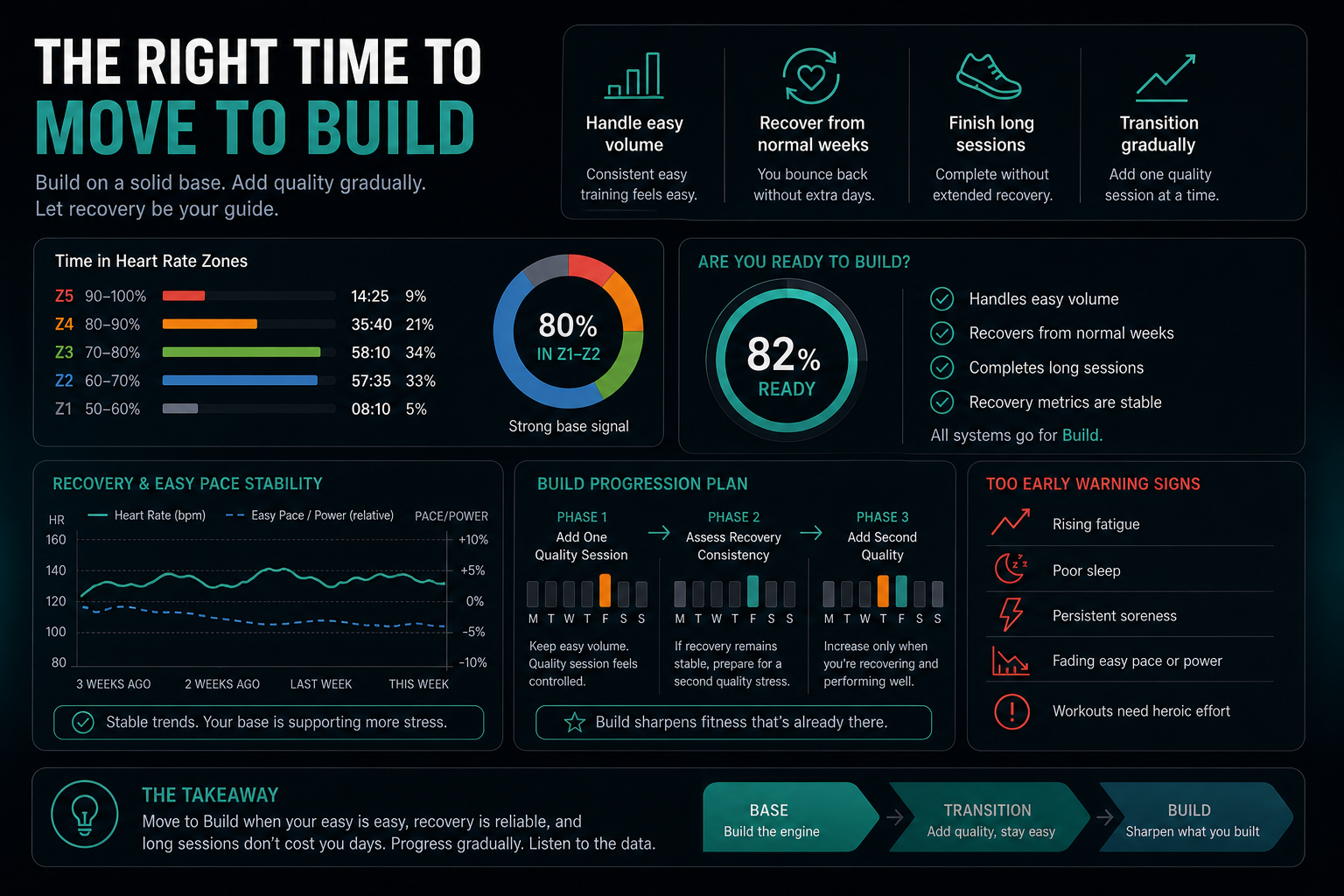
Practical signs you are ready to move into build:
- You have trained consistently for several weeks.
- Your easy pace or power is stable at a normal effort.
- Long sessions no longer require several recovery days.
- You can add small intensity touches without soreness lasting all week.
- Sleep, mood, motivation, and appetite are not trending down.
- You know what goal the build phase is preparing you for.
Practical signs you should extend base training:
- You miss sessions because normal training already feels too costly.
- Easy workouts drift into moderate effort just to hit a number.
- Long sessions leave you flat for three or more days.
- You are adding intensity because you are bored, not because the goal requires it.
- You have no clear event, race, route, or performance target.
- Your recent training has been inconsistent.
The transition also depends on the calendar. If your goal event is eight to twelve weeks away, you may need to start building even if the base is not perfect. In that case, keep the build conservative. Add one quality day, not three. Keep easy days easy. Choose workouts that match the goal without pretending you can compress months of base training into two weeks.
Gabbett's training-injury prevention model argues that training itself is not the problem; inappropriate programming and rapid workload increases are the bigger concern (Gabbett, 2016). That fits the base-to-build transition well. The goal is not to avoid hard training. The goal is to earn it and grade it.
How Long Should Each Phase Last?
There is no universal base length or build length. The right answer depends on training history, the goal event, injury background, available time, and how much fitness you are trying to change.
For many recreational endurance athletes, an 8-12 week base phase followed by an 8-10 week build phase is a workable starting point. Newer athletes may benefit from a longer base phase because consistency itself is the main adaptation. Experienced athletes may need a shorter base phase if they already maintain aerobic volume year-round. Athletes returning from injury may need a base phase that is defined less by calendar weeks and more by tolerance: can the body handle the training rhythm again?
Periodization reviews are useful here because they discourage rigid thinking. Mujika and colleagues described periodization as an integrated process that can include training, recovery, nutrition, psychological skills, and skill acquisition, not just a spreadsheet of workouts (Mujika et al., 2018). For everyday athletes, this means the phase should match real life. Work stress, sleep, travel, family load, and weather all change how much training you can absorb.
A simple structure for a 20-week goal might look like this:
- Weeks 1-8: base training with consistent easy volume and a gradually longer session.
- Weeks 9-10: transition with one structured quality session per week.
- Weeks 11-17: build training with event-specific workouts.
- Weeks 18-19: sharpen and reduce fatigue.
- Week 20: race or goal event.
For a 12-week goal, the split may be shorter:
- Weeks 1-4: base emphasis.
- Weeks 5-9: build emphasis.
- Weeks 10-11: sharpen and reduce fatigue.
- Week 12: race or goal event.
The shorter the timeline, the more disciplined the plan needs to be. You cannot do everything. Choose the highest-value stress for the goal and keep enough easy training to absorb it.
Sample Base Weeks and Build Weeks
These examples are templates, not prescriptions. Adjust volume, days, and intensity to your current ability.
A simple base week for a runner:
- Monday: rest or easy mobility.
- Tuesday: easy run plus 4-6 relaxed strides.
- Wednesday: easy run.
- Thursday: easy run with short hills, controlled.
- Friday: rest or very easy jog.
- Saturday: long easy run.
- Sunday: recovery run or cross-training.
The purpose is rhythm. There is no major workout, but the week still develops the athlete: frequency, long-session tolerance, mechanics, and easy aerobic volume.
A simple build week for a runner:
- Monday: rest or very easy.
- Tuesday: threshold intervals or hills.
- Wednesday: easy run.
- Thursday: easy run plus strides.
- Friday: rest or short recovery run.
- Saturday: long run with goal-specific blocks.
- Sunday: recovery run.
The shape is similar, but the stress has changed. Tuesday and Saturday now carry more of the training signal. Wednesday, Thursday, Friday, and Sunday must be easy enough to protect those sessions.
A simple base week for a cyclist:
- Monday: rest.
- Tuesday: easy endurance ride with cadence work.
- Wednesday: Zone 2 ride.
- Thursday: easy ride or short tempo touch.
- Friday: rest or recovery spin.
- Saturday: long endurance ride.
- Sunday: easy aerobic ride.
A simple build week for a cyclist:
- Monday: rest.
- Tuesday: threshold, VO2 max, or over-under session.
- Wednesday: recovery ride.
- Thursday: endurance ride.
- Friday: easy spin or rest.
- Saturday: long ride with climbs, tempo, or event-specific surges.
- Sunday: easy aerobic ride.
The best build week is not the hardest-looking week. It is the week you can repeat and progress. Smith's training-process framework emphasizes that elite performance emerges from many interacting factors, including training load, recovery, individual response, and timing (Smith, 2003). Recreational athletes do not need elite complexity, but they do need the same principle: the week must fit the person.
How To Keep Your Base During Build Training
Build training should not erase the base. It should use it.
The easiest way to keep your base is to protect easy volume. When intensity rises, many athletes accidentally turn easy days into moderate days because they feel fitter. That is backwards. The harder the key sessions become, the more important the easy sessions are. Easy training maintains aerobic continuity without adding unnecessary cost.
The second way is to keep one longer aerobic session. In a build phase, the long session may become more specific, but it should not become a weekly survival test. If the long run or ride includes quality, reduce the total duration or keep the rest truly easy. If the long session is already very long, avoid adding too much intensity inside it.
The third way is to monitor drift. If easy heart rate is higher than normal, if pace or power is falling at the same effort, or if your long-session recovery is getting worse, the build phase may be spending more base than it is maintaining. This is where a training log matters. One bad day is noise. A two- or three-week trend is information.
The fourth way is to keep strength and mobility realistic. A build phase is rarely the right time to add a large new strength program. Maintain the minimum effective dose that keeps you moving well. If strength work makes key endurance sessions worse, reduce the strength load before blaming the endurance plan.
The fifth way is to schedule recovery before you are desperate for it. Many athletes wait until fatigue forces a down week. A better build phase plans reduced-load weeks before quality collapses.
Common Mistakes In Base Training
The first base-training mistake is making every easy session too hard. If base training always sits in a moderate gray zone, it may feel productive while still being too costly to build real consistency. Easy should usually feel easy.
The second mistake is removing all speed. Base training does not need frequent hard intervals, but runners can often benefit from relaxed strides or short hills, and cyclists can use cadence work or brief openers. These touches maintain coordination without turning the block into race prep.
The third mistake is increasing volume too quickly. More training is only useful if you can adapt to it. Rapid jumps often look fine for one or two weeks, then show up as soreness, stale legs, poor sleep, or missed sessions.
The fourth mistake is judging base training only by pace or power. Sometimes base progress is less dramatic: fewer aches, lower heart rate at the same easy output, better mood after long sessions, or more stable weekly rhythm. Those are real wins.
The fifth mistake is staying in base forever because hard training feels risky. Base training is preparation. If you have a goal that requires intensity, hills, race pace, or event-specific work, eventually you need a build phase.
Common Mistakes In Build Training
The first build-training mistake is adding too much intensity too soon. One structured session may be enough at the start. Let the body prove it can recover before adding another.
The second mistake is keeping base-phase volume unchanged while adding hard workouts. Some athletes can handle that. Many cannot. If quality rises, total volume may need to hold steady or dip slightly.
The third mistake is making every hard workout race-specific. A build phase should become more specific over time, but early build work can still be general: threshold, hills, or controlled intervals. Save the most race-like sessions for when you can absorb them.
The fourth mistake is ignoring the goal. A 5K build, marathon build, hilly cycling build, and time-trial build should not look the same. The build phase has to answer the event's demands.
The fifth mistake is letting the build phase become a confidence hunt. Athletes often chase bigger workouts because they want proof they are fit. The better proof is repeatability: key sessions improve, easy days stay easy, and fatigue does not accumulate faster than fitness.
How To Decide What You Need Right Now
Ask four questions.
First, can you train consistently? If the answer is no, you probably need base training. Consistency comes before sophistication.
Second, can you recover from your current week? If the answer is no, adding build workouts is unlikely to help. Improve the rhythm first.
Third, do you have a clear goal? If the answer is no, base training is usually the better default. Build training works best when it has something to build toward.
Fourth, what is currently limiting you? If you lack durability, frequency, long-session tolerance, or easy aerobic stability, choose base. If you already handle consistent training but struggle at threshold, hills, surges, race pace, or goal-specific duration, choose build.
This is where base training vs build training becomes practical. It is not about naming the phase. It is about choosing the next useful stress.
Conclusion
Base training and build training are not competing philosophies. They are different phases with different jobs.
Base training builds the aerobic platform: consistency, easy volume, durability, long-session tolerance, and recovery capacity. Build training uses that platform: structured quality, event-specific sessions, and workouts that prepare you for the demands of the goal.
Move from base to build when normal training feels repeatable, long sessions no longer disrupt the week, and recovery is stable enough to tolerate harder work. Keep easy training in the build phase, add intensity gradually, and let the goal decide which workouts matter.
The cleanest summary is still the simplest: base increases what you can handle. Build sharpens what you can express.