

Why Is My Resting Heart Rate Higher Than Usual?
A higher-than-usual resting heart rate can reflect training stress, poor sleep, dehydration, heat, caffeine, alcohol, illness, fever, medication effects, or measurement noise. Learn how to compare it with your baseline and decide what to do next.
Jun 25, 202612 min read

Introduction
A higher-than-usual resting heart rate usually means your body is under more stress than normal. That stress may come from hard training, poor sleep, dehydration, heat, alcohol, caffeine, emotional stress, illness, fever, medication effects, or simply measuring at a different time or position.
For endurance athletes, the useful question is not "Why was one number high today?" The useful question is "Is my resting heart rate trending above my personal baseline, and does it appear with other signs that recovery is lagging?"
The American Heart Association describes adult resting heart rate as commonly falling between 60 and 100 beats per minute, while noting that physically active people may have lower resting rates (American Heart Association). That range is useful context, but your personal baseline is usually more useful for training decisions. A runner whose usual morning resting heart rate is 47 bpm may notice a meaningful change at 57 bpm, even though 57 bpm is still inside the typical adult range.
This article explains the common reasons resting heart rate rises, how to measure it consistently, how to use the resting HR calculator, and when a higher reading should shift from "training signal" to "medical caution."
The Short Answer: A Higher Resting Heart Rate Is A Signal, Not A Diagnosis
A higher resting heart rate can mean your body is working harder to maintain normal function. In training terms, that can happen when you are not fully recovered. In health terms, it can also happen with illness, fever, dehydration, medication effects, anxiety, pain, or other causes.
Do not diagnose the cause from one reading. Look for a pattern:
- Is the reading higher than your usual baseline?
- Has it been elevated for more than one morning?
- Did training load, stress, heat, travel, alcohol, caffeine, or poor sleep change?
- Are you also seeing fatigue, higher perceived effort, soreness, worse mood, poor sleep, lower performance, or illness symptoms?
- Does the number rebound after one to three easier days?
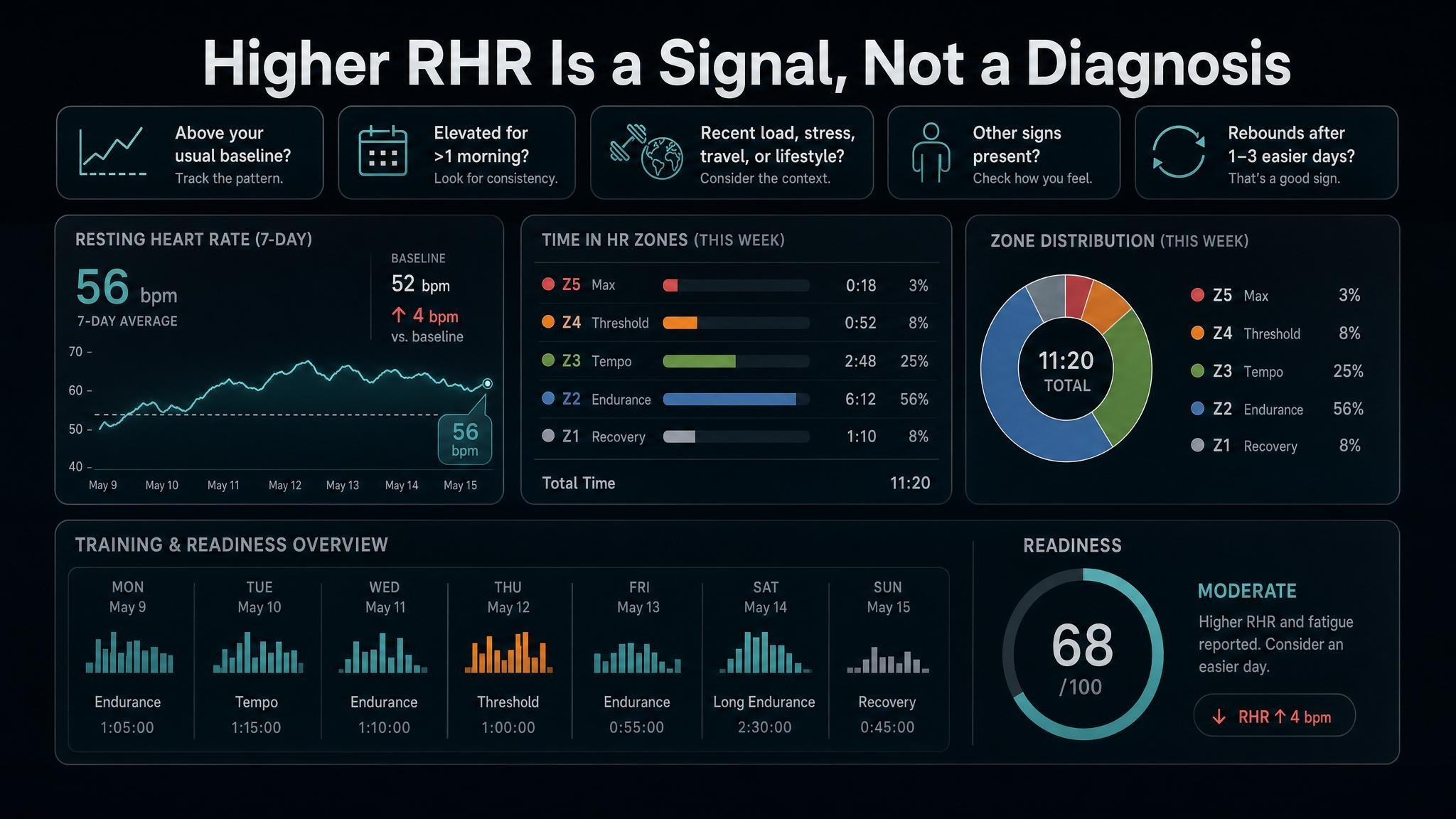
The best response depends on the pattern. A one-day increase after bad sleep may just be noise. A 5-10 bpm rise that persists for several days and appears with heavy legs, poor sleep, or illness symptoms should change the next training decision.
Use The Resting HR Calculator
The calculator below compares your usual morning resting heart rate with today's reading. It also asks how long the reading has been elevated, what context might explain it, and whether symptoms are present.
Use it as a decision helper, not a diagnosis. If the increase is small and isolated, recheck tomorrow. If the increase is meaningful and appears with fatigue, poor sleep, illness symptoms, or hard training, reduce training stress and look for a rebound. If there are red-flag symptoms such as chest pain, fainting, severe shortness of breath, or a new irregular heartbeat, seek medical care instead of using training math to make the decision.
You can also open the standalone Resting Heart Rate Calculator if you want to use it outside this article.
What Counts As Higher Than Usual?
For endurance training, "higher than usual" means higher than your own baseline, not higher than someone else's number.
The cleanest baseline is a 7-14 day morning average measured under similar conditions. Measure after waking, before caffeine, before training, and before scrolling or moving around much. MedlinePlus explains that pulse rate can be measured after resting and that many factors can affect it, including activity, illness, injury, emotions, and medications (MedlinePlus).
Small day-to-day changes are normal. Devices also add noise. A wrist sensor may differ from a chest strap or manual pulse count. Position matters too: lying down, sitting, and standing can all produce different readings. That is why the trend is stronger than one number.
For many athletes, a rise of 3 bpm may be normal variation. A rise of 5-10 bpm becomes more interesting when it persists or appears with other signs. A larger jump deserves more caution, especially if it is new, unexplained, or paired with symptoms.
Use this simple hierarchy:
| Pattern | How to interpret it | What to do |
|---|---|---|
| Up 1-3 bpm for one day | Normal variation or measurement noise | Recheck tomorrow |
| Up 4-7 bpm for one day | Mild stress signal | Keep the next session flexible |
| Up 5-10 bpm for several days | Possible recovery or illness signal | Reduce load and watch for rebound |
| Up 10+ bpm with fatigue or poor sleep | Stronger under-recovery signal | Remove intensity for 1-3 days |
| Resting HR near or above 100 bpm | Outside typical adult resting range | Use medical caution if new or persistent |
| High resting HR with red-flag symptoms | Not a training problem | Seek urgent medical care |
The numbers are not universal rules. They are practical guardrails. An athlete with a very low baseline may notice smaller meaningful changes. An athlete whose baseline is already high should use the calculator carefully and consider whether a clinician should review the pattern.
How To Measure Resting Heart Rate So The Trend Means Something
Resting heart rate is easy to measure badly. A noisy measurement can make a normal morning look like a recovery problem.
The best method is boring and repeatable. Measure at roughly the same time each morning, before caffeine, before training, before a hot shower, and before you spend time walking around. Use the same device and the same body position. If you normally measure while lying down, keep doing that. If you normally measure seated, keep doing that. Do not mix a calm lying-down reading with a rushed standing reading and treat the difference as physiology.
Use a baseline, not a single "ideal" number. A 7-14 day average is usually enough for a practical training baseline, as long as those days reflect normal health and normal training. If you are sick, traveling, tapering, racing, or sleeping badly, do not use that period to define your usual resting heart rate.
Be careful with device summaries. Some watches estimate resting heart rate from overnight data. Others show the lowest sustained value, a daily average, or a manually recorded value. Those can all be useful, but they are not identical. Compare like with like.
Also check the reading if it surprises you. If the number is much higher than expected, sit quietly and retake it. Look for a loose sensor, cold hands, poor optical contact, recent movement, caffeine, or stress. If the number remains high and you feel unwell, treat that as real context rather than a device problem.
The point is not to make the measurement perfect. The point is to make it consistent enough that a change from baseline means something.
How Resting Heart Rate Fits With HRV And Readiness Scores
Resting heart rate is one recovery signal. HRV, or heart rate variability, is another. They are related, but they do not always move in a clean opposite pattern.
In simple terms, a higher resting heart rate can suggest that your body is under more strain. Lower or unstable HRV can suggest a change in autonomic nervous system balance. Plews and colleagues described HRV as a potentially useful endurance-monitoring tool when interpreted against the athlete's own pattern (Sports Medicine, 2013). Buchheit's review on heart-rate measures also warns that different HR-based monitoring paths do not always give the same answer (Frontiers in Physiology, 2014).
That is why readiness scores should be treated as summaries, not verdicts. A device may combine resting heart rate, HRV, sleep, recent training, and proprietary weighting. That can be useful for noticing a trend, but it cannot fully understand your symptoms, pain, medication context, race schedule, or whether today is supposed to be a hard session or a recovery day.
When signals agree, confidence goes up. Resting heart rate is up, HRV is down, sleep is poor, and easy training feels hard? Reduce stress. Resting heart rate is up one day, HRV is normal, you slept fine, and you feel good? Recheck before changing the whole plan.
Common Non-Training Reasons Resting Heart Rate Rises
Training is only one possible explanation. Resting heart rate reflects total stress, not just workouts.
Poor sleep is a common reason. Sleep loss can affect exercise performance and physiological or cognitive responses to exercise, according to a review on sleep and athletic performance. If you slept poorly, woke often, or went to bed much later than usual, a higher morning heart rate is not surprising.
Dehydration and heat can also push heart rate up. When fluid balance and thermal stress are worse, the cardiovascular system may need to work harder. That does not mean every hot day is dangerous. It means you should interpret the number against yesterday's temperature, sweat loss, fluid intake, and session timing.
Alcohol is another common driver. It can disrupt sleep, affect hydration, and raise overnight physiological stress. Caffeine and other stimulants can matter too, especially if the measurement happens after coffee, pre-workout, medication, or a stressful morning.
Emotional stress can raise resting heart rate even when training has not changed. Work pressure, travel, family stress, poor recovery routines, and anxiety can all show up in the number. This is one reason athletes should avoid interpreting resting heart rate as a pure fitness metric.
Illness is a major possibility. Fever, infection, inflammation, and immune stress can all raise resting heart rate. If your resting heart rate is higher than usual and you also have a sore throat, feverish feeling, chills, unusual fatigue, gastrointestinal symptoms, or swollen glands, treat it as a health signal first and a training signal second.
Training And Recovery Reasons Resting Heart Rate Rises
For endurance athletes, a higher resting heart rate often shows up after a harder-than-usual block. That can be normal after a race, long ride, hard interval day, hot-weather session, or strength workout. The question is whether the body rebounds.
Training load research separates the work performed from the body's response to that work. A consensus statement on monitoring athlete training loads frames monitoring as a way to connect training, competition, fatigue, adaptation, injury, and illness risk. Resting heart rate belongs on the response side. It does not tell you only what you did. It tells you something about how you are handling it.
Halson's review on monitoring training load to understand fatigue makes a similar practical point: fatigue is multifactorial. It can reflect training, sleep, nutrition, travel, illness, psychological stress, and environmental demands. A higher resting heart rate after hard training may therefore mean the session was costly, but it may also mean the session landed on top of poor sleep, heat, dehydration, or life stress.
Look for these training-related patterns:
- Your easy pace feels harder at the same heart rate.
- Your resting heart rate is up for several mornings.
- HRV is lower or less stable than normal.
- You feel flat, irritable, or unusually unmotivated.
- Soreness does not clear between sessions.
- You need longer than usual to feel normal after workouts.
- A normal workout feels like a race effort.
Saw, Main, and Gastin found that subjective self-reported measures often tracked training response with strong sensitivity and consistency compared with many objective measures (British Journal of Sports Medicine, 2016). In practice, that means you should not ignore how you feel just because a wearable gives you a clean-looking score.
When A Higher Resting Heart Rate Is More Concerning
There is a difference between "my recovery may be off" and "this may need medical attention."
Mayo Clinic describes tachycardia as a heart rate over 100 beats per minute, and lists symptoms that can include chest pain, fainting, lightheadedness, rapid pulse, shortness of breath, and heart palpitations (Mayo Clinic). A high resting heart rate with those symptoms is not something to solve with a deload week.
Seek urgent medical care if you have chest pain, fainting, severe shortness of breath, a new irregular heartbeat, or symptoms that feel severe or unusual for you. Contact a clinician if your resting heart rate is repeatedly near or above 100 bpm at true rest, if the increase is new and unexplained, or if it persists despite easier training and better sleep.
This is especially important if you are taking medication that can affect heart rate, recently had an illness, have known heart or thyroid issues, are pregnant, or have symptoms that do not match your usual training fatigue. The calculator can help you organize context. It cannot rule out medical causes.
What To Do Today If Resting Heart Rate Is Higher
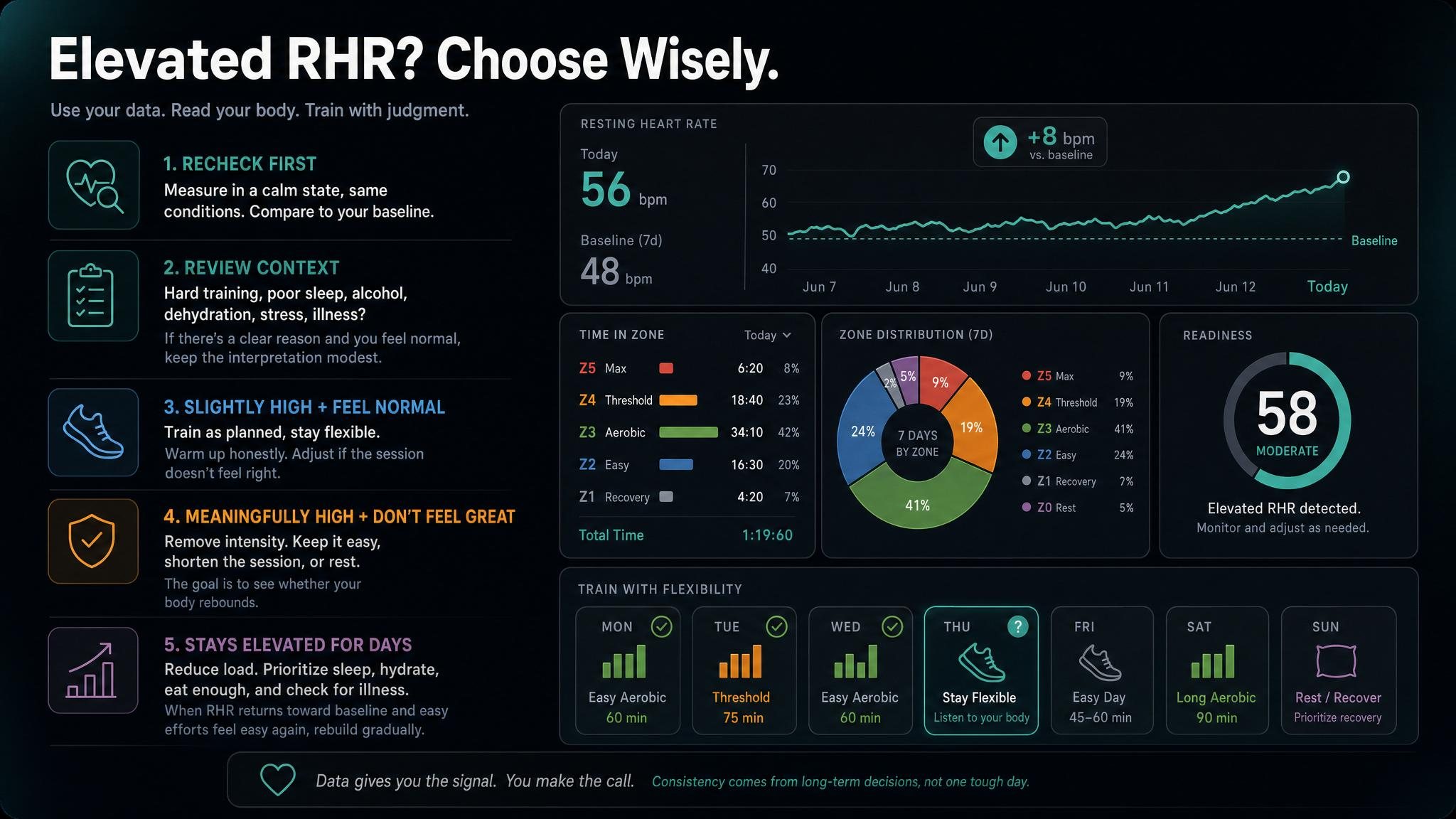
Start by rechecking the measurement. Sit or lie quietly, breathe normally, and measure under the same conditions you normally use. If you already had caffeine, climbed stairs, checked stressful messages, or rushed out of bed, do not compare that number with a calm morning baseline.
Then review context. Did you train hard yesterday? Was the session long, hot, or under-fueled? Did you sleep poorly? Did you drink alcohol? Are you dehydrated? Are you getting sick? Did life stress spike? If there is an obvious reason and no symptoms, keep the interpretation modest.
If resting heart rate is only slightly higher and you feel normal, train as planned but stay flexible. Warm up honestly. If easy effort feels normal, continue. If the session feels wrong, adjust.
If resting heart rate is meaningfully higher and you also feel tired, sore, flat, stressed, or under the weather, remove intensity. Keep the day easy, shorten the session, or rest. The goal is not to prove toughness. The goal is to see whether your body rebounds.
If the reading stays elevated for several days, do not keep stacking hard work. Reduce load, prioritize sleep, hydrate, eat enough, and check for illness. When resting heart rate returns toward baseline and easy sessions feel easy again, rebuild gradually.
Common Mistakes
The first mistake is comparing your resting heart rate with someone else's. Resting heart rate is individual. Fitness, genetics, age, medications, sleep, hydration, body position, and measurement method all matter.
The second mistake is treating one number as a verdict. A single elevated reading can happen because of a bad night, a stressful morning, a sensor issue, or a late meal. Trends matter more.
The third mistake is ignoring symptoms. A high resting heart rate plus chest pain, fainting, severe breathlessness, or a new irregular rhythm is not a training-readiness question.
The fourth mistake is only looking at resting heart rate. Combine it with sleep, fatigue, soreness, mood, motivation, session RPE, HRV, performance, and illness symptoms. The Recovery and Performance in Sport consensus statement emphasizes that recovery depends on the balance between stress and restoration, not one isolated marker.
The fifth mistake is trying to "make up" missed workouts immediately after the number improves. If resting heart rate returns to baseline after a few easy days, restart with easy training first. Add intensity only after the trend and workout feel both normalize.
Conclusion
Your resting heart rate may be higher than usual because your body is under more stress than normal. Hard training, poor sleep, dehydration, heat, alcohol, caffeine, life stress, illness, fever, medication effects, and measurement changes can all contribute.
For endurance athletes, the best approach is baseline plus context. Compare today's value with your usual morning baseline, check how long it has been elevated, look for other recovery or illness signs, and use the result to adjust training. The Resting Heart Rate Calculator gives you a quick way to organize that decision.
If the increase is small and isolated, recheck. If it persists with fatigue or poor recovery, reduce load. If it appears with red-flag symptoms or a very high true resting heart rate, seek medical advice. Resting heart rate is useful because it can change the next decision, not because it explains everything by itself.