


VO2 Max, Lactate Threshold, and Economy
A deep dive into the three physiological levers behind endurance performance: how much oxygen you can use, how much of that capacity you can sustain, and how efficiently you turn it into speed or power.
Jun 15, 202631 min read

Introduction
VO2 max, lactate threshold, and economy are the three big physiological ideas behind endurance performance. VO2 max describes the ceiling: the maximum rate at which your body can take in, transport, and use oxygen during hard exercise. Lactate threshold describes the sustainable fraction: how much of that ceiling you can use before fatigue accelerates. Economy describes the cost: how much oxygen, energy, or mechanical work you need to move at a given pace or power.
The important point is that none of these numbers wins races alone. A high VO2 max is useful, but two athletes with the same VO2 max can perform very differently if one can sustain a higher fraction of it or run with a lower oxygen cost. A high threshold is useful, but it sits inside the ceiling created by VO2 max. Excellent economy is useful, but it only matters when it is paired with enough aerobic capacity and enough sustainable output. The classic integrated model of endurance performance is often described in exactly this three-part way: maximal oxygen uptake, the lactate threshold or sustainable fraction of VO2 max, and efficiency or economy combine to determine the speed or power an athlete can hold for a given duration, as reviewed by Joyner and Coyle in The Journal of Physiology.
For athletes, this matters because training gets much clearer when you stop asking only, "How do I raise my VO2 max?" and start asking, "Which limiter is actually holding back my performance right now?" A runner with a strong VO2 max but fading pace in long races may need more threshold durability and fatigue resistance. A cyclist with a good threshold but poor ability to surge may need VO2 max or high-intensity work. A runner whose heart rate is always high at easy paces may need more aerobic volume, better recovery, or improved movement economy.
This article treats the requested 6,000+ word range as a deep-dive format because the search intent is not just a definition. Readers looking for VO2 max, lactate threshold, and economy together usually want a complete framework: what each metric means, how the metrics interact, how to test them, what watch estimates can and cannot tell you, and how to turn the results into training choices.
The Three Numbers Describe One System
It is tempting to think of VO2 max, lactate threshold, and economy as separate scores. In real training, they are better understood as one system.
For running, a simplified way to think about the model is this:
- VO2 max sets the maximum oxygen-use ceiling.
- Lactate threshold determines the oxygen-use rate you can sustain for a long time.
- Running economy determines the pace you get for that sustainable oxygen-use rate.
For cycling, the same logic applies, but the output is power rather than pace. A cyclist's aerobic ceiling matters, the sustainable fraction of that ceiling matters, and the mechanical efficiency of turning metabolic energy into external power matters. In both sports, the practical question is not "Which number is best?" It is "How much usable speed or power can you produce before the cost becomes unsustainable?"
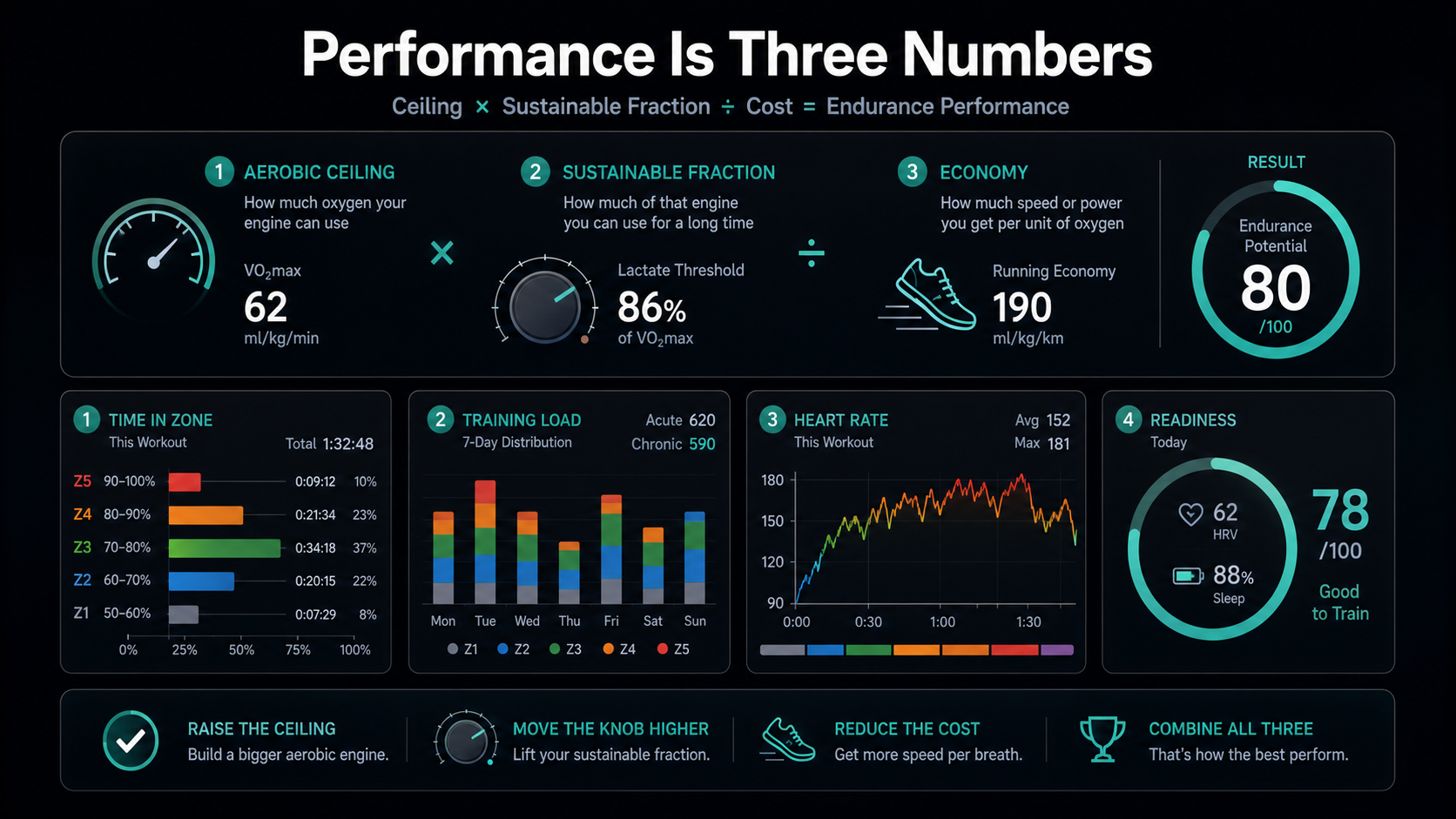
This is why endurance athletes can look confusing on paper. Athlete A may have a VO2 max of 72 ml/kg/min and Athlete B may have a VO2 max of 66 ml/kg/min, yet Athlete B may still run faster over 10K if B can sustain a higher percentage of VO2 max and spends less oxygen per kilometer. The same happens in cycling when two riders have similar peak aerobic values but different functional threshold power, durability, fueling, position, or gross efficiency.
Research reviews have described this interaction for decades. Bassett and Howley summarized VO2 max as a central determinant of endurance performance while also emphasizing that performance depends on more than VO2 max alone, including lactate threshold and economy or efficiency (Medicine and Science in Sports and Exercise). Jones and Carter likewise reviewed endurance training adaptations across VO2 max, lactate threshold, and economy, noting that training can shift multiple parameters of aerobic fitness rather than one isolated variable (Sports Medicine).
The model is useful because it avoids two common mistakes. The first mistake is treating VO2 max as an endurance IQ score. It is not. It is an important physiological capacity, but its predictive value gets weaker when you compare well-trained athletes who already sit in a similar range. The second mistake is treating threshold or economy as magic replacements for VO2 max. They are not. A very economical athlete with a low aerobic ceiling still has limited oxygen delivery. A high-threshold athlete still needs enough peak capacity above that threshold to race, surge, climb, and tolerate hard training.
The practical result is a hierarchy:
- Build the aerobic engine enough that your ceiling is not artificially low.
- Raise the fraction of that engine you can hold with controlled threshold and tempo work.
- Reduce the cost of movement through specific practice, strength, skill, and appropriate equipment.
- Protect the system with enough easy volume, fueling, and recovery that adaptations can accumulate.
The rest of the article walks through each piece in detail.
VO2 Max Is The Aerobic Ceiling
VO2 max is the maximum rate at which your body can use oxygen during intense exercise. It is usually reported in milliliters of oxygen per kilogram of body mass per minute, written as ml/kg/min. A lab can also report absolute VO2 max in liters per minute, which can be useful when comparing athletes of different body sizes or discussing sports where body mass is supported, such as cycling or rowing.
The physiology behind VO2 max starts with oxygen delivery and oxygen use. Your lungs bring oxygen into the blood. Your heart pumps that oxygen-rich blood. Your blood volume and hemoglobin help carry oxygen. Your blood vessels and capillaries distribute it to working muscle. Mitochondria inside muscle cells use oxygen to produce aerobic energy. A limitation at any major step can limit the final number, but in healthy trained athletes, oxygen delivery through the cardiovascular system is often considered a major limiting factor, a point emphasized in Bassett and Howley's review of maximum oxygen uptake (Medicine and Science in Sports and Exercise).
That does not mean the muscles are irrelevant. Endurance training increases mitochondrial enzyme activity, capillary density, oxygen extraction, plasma volume, and other peripheral adaptations. But if your heart, blood, and vascular system cannot deliver enough oxygen at high workloads, the muscles cannot use what never arrives. This is why VO2 max improves strongly when previously untrained or moderately trained athletes begin structured endurance training, then becomes harder to move once the athlete is already well developed.
What VO2 Max Does Well
VO2 max is most useful as a ceiling marker. It tells you something about your peak aerobic capacity. If two athletes are otherwise similar, the athlete with a higher VO2 max generally has more aerobic headroom. This headroom matters in events where athletes work near maximal aerobic demand, such as 3K to 5K running, hard cycling climbs, cross-country skiing, rowing, and repeated high-intensity efforts.
VO2 max also matters because it gives threshold a larger playground. If your threshold is 85% of VO2 max, then raising VO2 max can raise the absolute oxygen-use rate at threshold even if the percentage stays the same. For example, 85% of a VO2 max of 60 is lower than 85% of a VO2 max of 70. The fraction matters, but the ceiling still matters.
What VO2 Max Does Not Explain
VO2 max does not tell you how efficiently you move. It does not tell you how much of the ceiling you can hold for 30, 60, or 180 minutes. It does not tell you how your mechanics degrade late in a race. It does not tell you whether you fuel well, pace well, recover well, or tolerate heat.
This is why VO2 max can be a poor single predictor when athletes are already trained. Joyner and Coyle described endurance performance as the interaction of VO2 max, threshold, and efficiency, not VO2 max alone (The Journal of Physiology). Barnes and Kilding make the same practical point for running economy: among runners with similar VO2 max values, oxygen cost at a given running speed can meaningfully separate performance (Sports Medicine - Open).
How VO2 Max Is Measured
The most direct way to measure VO2 max is a graded exercise test with respiratory gas analysis. You run or cycle while workload increases step by step or continuously. The system measures oxygen uptake and carbon dioxide output from your breathing. The test usually continues until you reach exhaustion or a clear maximal effort.
There is nuance here. A true VO2 max test is not just "go hard while wearing a mask." Test protocol, exercise mode, stage length, motivation, calibration, and verification criteria all matter. Beltz and colleagues reviewed graded exercise testing protocols and highlighted the long-running debate around how to verify that VO2 max has really been reached, including the use of verification phases after a maximal test (Journal of Sports Medicine).
For athletes, the takeaway is simple: a high-quality lab test is useful, but the number is still protocol-dependent. A treadmill result may differ from a bike result. A hot room may change the outcome. Fatigue, illness, caffeine, recent training, and motivation can all affect the result. If you repeat a test, use the same mode, similar preparation, and similar protocol whenever possible.
How Watch VO2 Max Estimates Fit In
Most sports watches estimate VO2 max from pace or power, heart rate, personal data, and proprietary assumptions. These estimates can be useful for trends, but they are not the same as direct gas exchange. A watch cannot see ventilation, oxygen extraction, lactate, biomechanics, or heat stress directly. It infers fitness from external output and heart-rate response.
That means a watch estimate can move for reasons that are not purely VO2 max. If you run with better weather, lower fatigue, faster shoes, smoother terrain, or improved economy, the estimate may rise. If you run in heat, at altitude, on trails, under stress, or with cardiac drift, it may fall. Treat watch VO2 max as a trend indicator, not a diagnostic truth.
How To Train VO2 Max
VO2 max tends to respond to a combination of consistent aerobic volume and appropriately dosed high-intensity work. For newer athletes, simply training consistently can raise VO2 max because the starting point is far from the ceiling. For trained athletes, targeted intervals near or above the intensity associated with VO2 max are often needed to keep improving the ceiling.
High-intensity interval training can be effective for VO2 max improvements. A systematic review and meta-analysis by Milanovic, Sporis, and Weston found that high-intensity interval training and continuous endurance training both improved VO2 max, with high-intensity interval training often producing strong improvements across studied groups (Sports Medicine). Laursen also reviewed high-intensity versus high-volume approaches and argued that both matter: high-intensity work is potent, but high-volume training creates important metabolic adaptations and supports endurance performance (Scandinavian Journal of Medicine and Science in Sports).
Good VO2 max sessions are hard, but they should be controlled. Common examples include:
- 4 to 6 repeats of 3 to 5 minutes hard, with equal or slightly shorter easy recovery.
- 5 to 8 repeats of 2 to 3 minutes hard, with easy jogging or spinning between.
- Hill repeats that bring heart rate and breathing near maximal aerobic demand without all-out sprinting.
The goal is not to destroy yourself. The goal is to accumulate time at a high aerobic demand while preserving enough movement quality that the session remains trainable. If intensity turns every rep into a sprint, the limiting factor may become neuromuscular fatigue or anaerobic capacity rather than aerobic development.
Lactate Threshold Is The Sustainable Fraction
Lactate threshold is commonly described as the exercise intensity where blood lactate begins to rise more rapidly. That definition is useful, but it can mislead if taken too literally. Lactate is not simply a waste product, and there is not one universally agreed point where "the threshold" appears for every athlete, protocol, and sport.
Faude, Kindermann, and Meyer reviewed lactate-threshold concepts and concluded that many threshold methods exist, with different definitions and practical limitations (Sports Medicine). That is important for athletes because "threshold" can mean several different things depending on who is testing you. Some coaches mean the first rise above baseline lactate. Some mean a fixed 2 mmol/L or 4 mmol/L point. Some mean maximal lactate steady state. Some use ventilatory thresholds. Some use field-test estimates such as critical power, functional threshold power, or one-hour race pace.
These concepts overlap, but they are not identical.
Lactate Is Not The Enemy
Lactate is produced even at rest. During exercise, lactate production and lactate clearance are happening at the same time. As intensity rises, production increases. If production and related metabolic stress rise faster than the body can clear and manage them, the effort becomes progressively less stable.
The old phrase "lactic acid buildup" has made many athletes think lactate itself is the villain. The physiology is more complicated. Lactate is part of energy metabolism and can be used as fuel. Rising lactate is a useful marker that the metabolic environment is changing, but fatigue is caused by multiple interacting factors, including hydrogen ions, inorganic phosphate, glycogen availability, neuromuscular fatigue, heat strain, central drive, and other processes. That is why threshold should be understood as a practical marker of sustainable intensity, not a single chemical switch.
LT1, LT2, And MLSS
In endurance coaching, you will often hear three related terms:
- LT1 or aerobic threshold: the first noticeable rise in lactate above low-intensity baseline.
- LT2 or anaerobic threshold: a higher breakpoint where lactate accumulation becomes much more pronounced.
- MLSS, or maximal lactate steady state: the highest workload where blood lactate remains relatively stable over time.
Different labs define these differently. Fixed blood-lactate values can be convenient, but they may not match every athlete. A 4 mmol/L point can be close to a meaningful threshold for one athlete and misleading for another. Faude and colleagues' review is valuable precisely because it cautions against treating one threshold method as universally valid (Sports Medicine).
From a training perspective, you do not need to solve every terminology debate. You need to know what the test or field benchmark is estimating and how to use it consistently.
Why Threshold Matters
Threshold matters because endurance racing is usually about sustainable output, not peak output. A 10K runner, half-marathon runner, marathon runner, time-trial cyclist, triathlete, rower, or long-course skier rarely performs at VO2 max for the full event. They perform at some fraction of VO2 max. The higher that fraction can be while staying metabolically controlled, the better.
For a 5K runner, VO2 max and velocity at VO2 max may be very important because the race sits near high aerobic intensity. For a marathon runner, threshold, economy, durability, fueling, and heat management become more dominant because the race lasts much longer. For a cyclist, threshold power is central because race and training demands are often expressed in watts, but a rider still needs VO2 max headroom for attacks, climbs, and repeated surges.
The phrase "sustainable fraction" helps because it connects threshold back to VO2 max. A threshold of 85% of VO2 max is not just a percentage. It is the amount of your aerobic engine you can use without quickly tipping into a less stable state.
How Threshold Is Measured
The most direct threshold test uses blood lactate samples during an incremental exercise test. The tester increases intensity in stages, takes small blood samples, and plots blood lactate against workload. Depending on the method, the threshold may be identified as a first rise, a curve breakpoint, a fixed concentration, or another model-derived point.
Ventilatory threshold testing uses breathing responses instead of blood lactate. As intensity rises, ventilation and carbon dioxide output change in recognizable patterns. This can be useful when gas analysis is available.
Field tests are more accessible. For runners, a 30-minute time trial with average heart rate from the final 20 minutes is often used as a practical threshold-heart-rate estimate. Race results over 30 to 60 minutes can also provide useful anchors. For cyclists, functional threshold power is commonly estimated from longer tests, shorter tests with correction factors, or modeled power-duration data. These are not identical to lactate threshold, but they can be useful if you repeat them under consistent conditions.
The danger is false precision. If your threshold heart rate is estimated at 162 bpm, that does not mean 161 bpm is magic and 163 bpm is failure. Heart rate lags behind intensity, drifts with heat and dehydration, and changes with fatigue. Threshold pace and power also move with terrain, wind, temperature, surface, and freshness. Treat threshold as a zone or range, not a razor-thin line.
How To Train Threshold
Threshold training is controlled discomfort. It should feel strong, focused, and sustainable for repeated work, not like an all-out race. The goal is to accumulate meaningful time near the upper end of steady aerobic metabolism while avoiding the cost of constantly training too hard.
Common threshold sessions include:
- 2 to 4 repeats of 8 to 15 minutes at threshold effort with short easy recoveries.
- 20 to 40 minutes of continuous tempo below or near threshold.
- Progression runs or rides that finish at controlled threshold effort.
- Cruise intervals where recovery is short enough to maintain aerobic pressure but long enough to preserve quality.
Threshold work improves when supported by easy volume. If every easy day creeps upward, threshold sessions lose quality and recovery suffers. This is one reason many successful endurance programs spend a large share of time at low intensity. Seiler reviewed training-intensity distribution in endurance athletes and described a common pattern in which a high proportion of training is low intensity, with a smaller amount of high-intensity work (International Journal of Sports Physiology and Performance). That does not mean everyone must copy an elite 80/20 split exactly, but it does support the principle that easy volume is not filler. It is the foundation that lets harder work actually work.
Economy Is The Cost Of Moving
Economy is how much energy you spend to produce a given speed or power. In running, it is often measured as oxygen cost at a set speed, such as ml/kg/min at a given pace, or as oxygen cost per distance, such as ml/kg/km. Lower cost means better economy. In cycling, the related concept is efficiency: how much mechanical power you produce for a given metabolic cost.
Barnes and Kilding define running economy as a multifactorial concept involving metabolic, cardiorespiratory, biomechanical, and neuromuscular efficiency (Sports Medicine - Open). That broad definition matters. Economy is not just "good form." It includes tendon stiffness, muscle fiber characteristics, limb geometry, coordination, footwear, terrain, fatigue resistance, and the ability to relax at speed.
Saunders and colleagues reviewed factors affecting running economy in trained distance runners and discussed a wide range of contributors, including training, biomechanics, environment, fatigue, and equipment (Sports Medicine). The practical message is that economy is real, but it is not easily reduced to one cue such as cadence, foot strike, or posture.
Why Economy Can Beat A Bigger Engine
Imagine two runners working at the same sustainable oxygen uptake. Runner A uses 210 ml/kg/km to run a given speed. Runner B uses 190 ml/kg/km. Runner B gets more speed from the same oxygen budget. Over a race, that difference can be decisive.
This is why well-trained athletes with similar VO2 max values can perform differently. Economy changes the conversion rate between physiology and performance. It is the difference between owning a large engine and using fuel well.
Economy also helps explain why performance can improve even when VO2 max does not. An athlete may run faster because threshold improves, because economy improves, because fatigue resistance improves, or because pacing and fueling improve. If you judge all progress by VO2 max, you may miss the adaptation that actually made you faster.
How Economy Is Measured
A good running-economy test is usually submaximal. The athlete runs at controlled speeds while gas exchange is measured. The test must be long enough at each speed for oxygen uptake to stabilize, and conditions must be standardized. Shaw, Ingham, and Folland reviewed the valid measurement of running economy and emphasized that protocol choices affect whether the measure is meaningful (Medicine and Science in Sports and Exercise).
This is why economy is hard to infer from one workout. Heart rate at pace can suggest changes, but heart rate is affected by heat, fatigue, caffeine, hydration, stress, sleep, and cardiac drift. Pace at heart rate can be useful as a field benchmark, but it is not a pure economy test.
Field indicators of improving economy include:
- Faster pace at the same heart rate in similar conditions.
- Lower heart rate at the same pace in similar conditions.
- Less heart-rate drift during steady aerobic work.
- Better race pace without a clear change in VO2 max.
- Smoother mechanics late in long sessions.
These indicators are useful when tracked over weeks and months, not when overread from one run.
How Economy Improves
Economy can improve through several pathways. Specific endurance training improves coordination at the speeds and postures you use most. Easy volume builds relaxed repetition. Strides, hill sprints, and short neuromuscular work can maintain coordination and stiffness without heavy metabolic cost. Strength training and plyometrics can improve force production, tendon behavior, and neuromuscular qualities.
The strength-training evidence is strong enough to take seriously, but it should be applied carefully. Balsalobre-Fernandez, Santos-Concejero, and Grivas performed a systematic review and meta-analysis of controlled trials in highly trained runners and found a beneficial effect of strength training on running economy (Journal of Strength and Conditioning Research). The studies were not saying that endurance athletes should become bodybuilders. They supported low-to-moderate volume strength and plyometric work layered onto endurance training.
For most endurance athletes, economy work should not replace aerobic work. It should support it. Two short strength sessions per week, strides after easy runs, hill sprints with full recovery, technique awareness, and consistent practice often do more than dramatic form overhauls. Chasing a forced foot strike or artificially high cadence can increase tension and cost. Better economy usually comes from repeated, relaxed, specific movement under manageable fatigue.
Why The Best Endurance Athletes Combine All Three
The three-part model becomes clearer when you apply it to real performance scenarios.
A 5K runner needs a high aerobic ceiling because the race sits close to maximal aerobic demand. They also need a high sustainable fraction because they cannot spend the whole race above control. They need economy because any wasted oxygen at race pace raises the cost. A marathon runner needs the same ingredients but weighted differently: threshold, economy, fueling, durability, and heat control become more decisive as duration increases. A cyclist racing a time trial needs threshold power and aerodynamic position, but the rider still benefits from VO2 max headroom for training adaptation and course demands.
The event changes the emphasis. The model does not.
Coyle's review of physiological determinants of endurance exercise performance described endurance output as an integration of aerobic power, fractional utilization, and efficiency, along with substrate availability and environmental stress (Journal of Science and Medicine in Sport80172-8)). That integrated view is more useful than asking which single number matters most.
Example 1: High VO2 Max, Weak Threshold
This athlete can hit impressive intervals but struggles to hold pace in races longer than 20 to 30 minutes. They may have good peak capacity but poor sustainable fraction. Their training may include too much hard-but-random intensity and not enough controlled tempo, threshold development, or steady aerobic volume.
The fix is not necessarily more VO2 max work. It may be more disciplined easy volume, threshold intervals, progression work, and long aerobic sessions that teach the athlete to sustain output without constant surging.
Example 2: Good Threshold, Poor VO2 Max Headroom
This athlete can grind steadily but has little top-end aerobic reserve. Their threshold may sit at a high percentage of VO2 max, but the ceiling is modest. They may perform well in long steady events yet struggle with 5K racing, climbs, attacks, or hard group sessions.
The fix may include one carefully placed VO2 max session per week during a development block, supported by enough easy training to absorb it. The key is not to turn every week into a maximal-intensity experiment. VO2 max work is potent, so it needs recovery.
Example 3: Strong Engine, Expensive Movement
This runner has good lab numbers but does not translate them into race pace. They may overstride, tense up, bounce excessively, lack stiffness, or lose mechanics under fatigue. They may also be carrying unnecessary fatigue, using inappropriate footwear, or running too little at relaxed speeds.
The fix is not one magic form cue. It may include strides, hill sprints, strength work, gradual mileage, better pacing, and more practice at goal-specific rhythms. If the runner is injury-prone, the first economy intervention may be staying healthy enough to train consistently.
Example 4: Good Numbers, Poor Durability
Durability is the ability to preserve physiology and mechanics as duration accumulates. Two athletes may test similarly when fresh, but one may lose economy, cardiac stability, fueling control, or muscular resilience late in a long event. Traditional VO2 max and threshold tests may not fully capture this.
For this athlete, long easy sessions, race-specific fueling practice, steady aerobic volume, strength endurance, and pacing discipline may matter more than another lab-test improvement.
How To Measure And Track Without Fooling Yourself
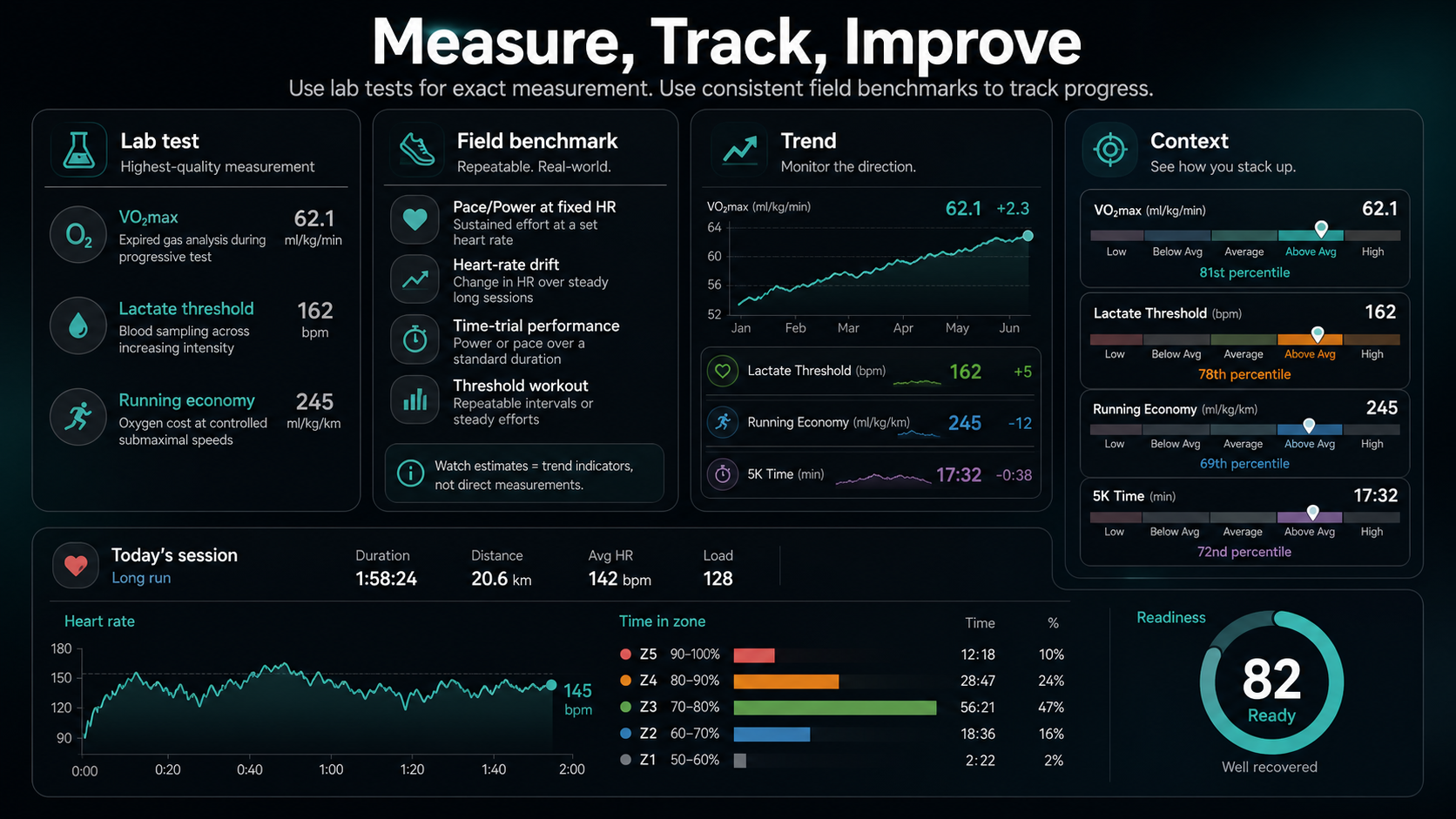
Testing is useful when it changes decisions. It is less useful when it creates false precision or anxiety. The best approach is to combine occasional high-quality tests with consistent field benchmarks and day-to-day training context.
Lab Tests: Best For Exact Measurement
Lab testing is most useful when you need direct measurement. A VO2 max test with gas exchange can quantify peak oxygen uptake. A lactate profile can estimate thresholds and show how lactate responds across intensities. A running-economy test can measure oxygen cost at specific speeds.
Use lab tests when:
- You want a baseline before a focused training block.
- You need accurate zones for a performance goal.
- You are comparing changes across a season.
- You have access to a qualified tester and repeatable protocols.
The main downside is that lab results can be expensive, protocol-dependent, and easy to overinterpret. A single test is a snapshot. It is not a complete athlete profile.
Field Benchmarks: Best For Practical Decisions
Field tests are less exact but often more useful for training. A 5K time trial, 20-minute cycling test, steady submaximal run, hill-repeat benchmark, or long aerobic drift test can reveal how fitness expresses itself outside the lab.
Good field tests share three qualities:
- They are repeatable.
- They match the sport and goal.
- They are interpreted with context.
For example, a 45-minute steady run at the same route, same time of day, similar weather, and similar fueling can tell you whether aerobic efficiency is improving. A 20-minute cycling test can help anchor training zones, but only if pacing, freshness, equipment, and environment are comparable.
Watch Estimates: Best For Trends
Watches and training platforms are useful because they collect lots of data. They can estimate VO2 max, threshold, training load, recovery, and race predictions. But algorithms rely on assumptions. They can be fooled by heat, hills, trails, fatigue, caffeine, sensor error, and changes in equipment.
Use watch estimates as "directional evidence." If your estimated VO2 max rises over months while your field benchmarks improve, that is useful. If it drops after a hot trail run, do not rewrite your training plan.
The Minimum Useful Dashboard
You do not need to track everything. A practical endurance dashboard can include:
- Peak benchmark: recent 3K/5K time, ramp test, or VO2-style interval performance.
- Threshold benchmark: 30- to 60-minute pace or power, threshold heart rate, or controlled tempo performance.
- Economy benchmark: pace or power at fixed heart rate in similar conditions.
- Durability benchmark: heart-rate drift, late-session pace, long-run fade, or fueling tolerance.
- Recovery context: sleep, soreness, readiness, motivation, and recent load.
This is where a training log becomes more useful than a single number. Patterns across weeks matter more than isolated readings.
How To Train The Limiter
Training works best when it targets the limiter without neglecting the system. If you only train VO2 max, you may raise the ceiling while leaving sustainable output and economy behind. If you only train threshold, you may become good at controlled discomfort but lack peak aerobic reserve. If you only chase economy, you may move beautifully but lack the engine to support high performance.
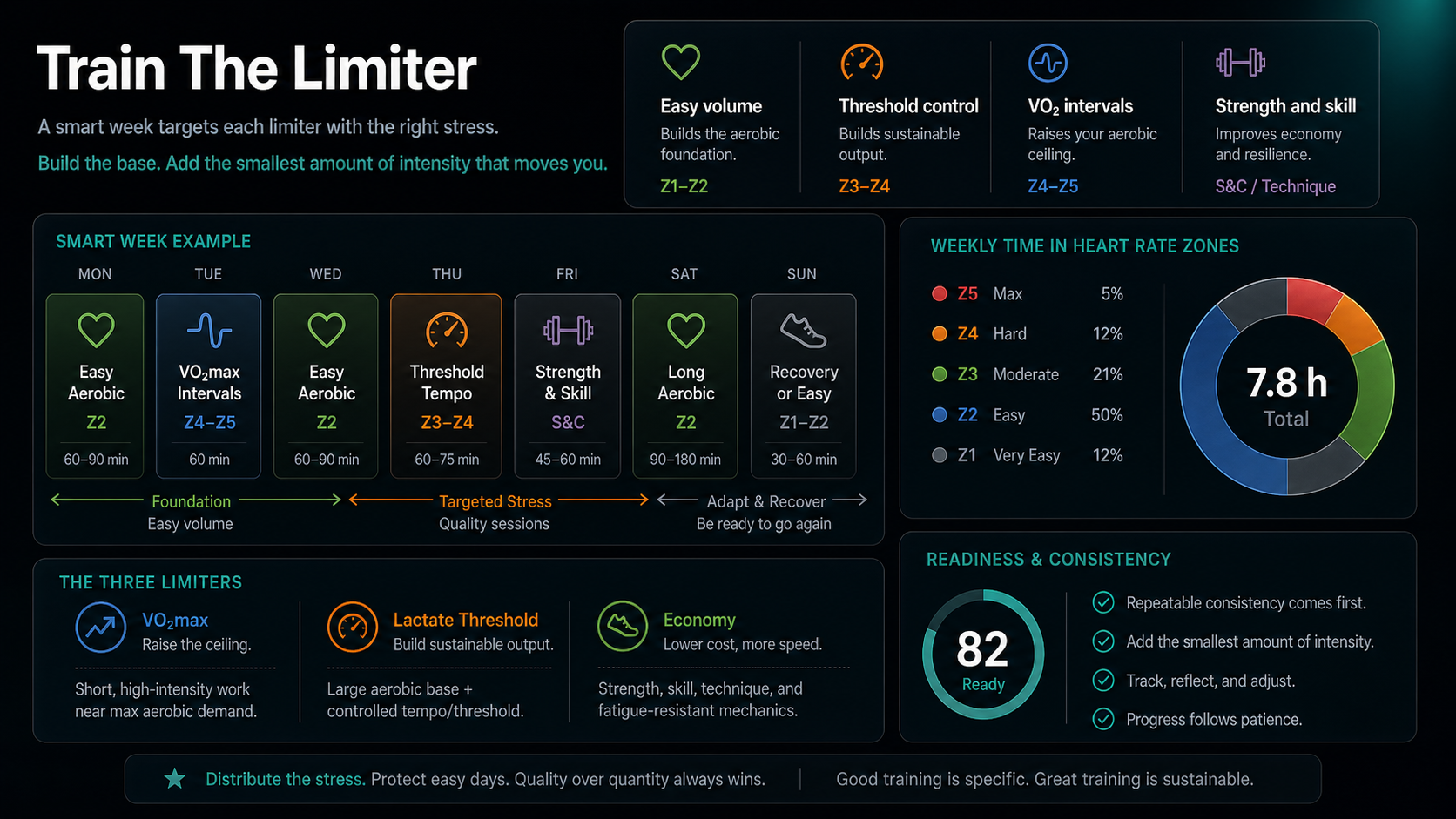
The best training plan usually combines four layers:
- Easy aerobic volume to build the base and support recovery.
- Threshold or tempo work to raise sustainable output.
- VO2 max or high-intensity work to raise the ceiling.
- Strength, skill, and relaxed speed to improve economy and resilience.
The blend changes by athlete, event, training age, and season.
Start With Enough Easy Volume
Easy volume is not a beginner-only tool. It supports capillary development, mitochondrial adaptations, fat oxidation, mechanical familiarity, autonomic balance, and recovery between harder sessions. It also gives you more practice moving efficiently without high stress.
Seiler's review of endurance training intensity distribution described successful athletes tending toward a large amount of low-intensity training plus a smaller amount of high-intensity work (International Journal of Sports Physiology and Performance). That should not be turned into a rigid rule for every recreational athlete, but it is a strong caution against making every workout moderately hard.
For many athletes, the first limiter is not a poor VO2 max session design. It is inconsistent aerobic volume, easy days that are too hard, and hard days that are too compromised.
Add Threshold Work For Sustainable Output
Threshold work is the bridge between easy volume and high-intensity intervals. It teaches you to hold strong output without constantly crossing into unsustainable stress. For runners, that might mean tempo runs, cruise intervals, or long progression runs. For cyclists, it might mean sweet spot, threshold intervals, or over-under sessions.
The right amount depends on your event and recovery. Too little threshold work can leave you unable to sustain pace. Too much can create chronic fatigue because threshold work is seductive: it feels productive, measurable, and controllable, but it still carries a cost.
Use threshold work when your limiter is sustainable pace or power. Avoid using it as the default solution for every problem.
Use VO2 Max Intervals As A Specific Stimulus
VO2 max intervals are useful when you need to raise the ceiling or prepare for high aerobic demands. They are especially relevant for shorter endurance races, hilly courses, race surges, and athletes whose threshold sits close to a modest ceiling.
The Milanovic meta-analysis supports high-intensity interval training as an effective tool for improving VO2 max (Sports Medicine), but that does not mean more is always better. The harder the session, the more it depends on recovery, fueling, and correct placement in the week.
Good signs that VO2 max work is helping:
- You can complete the reps without pace or power collapsing.
- Your breathing reaches very high aerobic demand without every rep becoming a sprint.
- You recover enough to keep easy days easy.
- Your race-specific benchmarks improve after several weeks.
Bad signs:
- You dread every hard day.
- Your easy heart rate climbs for the same pace.
- Your threshold sessions get worse.
- You need multiple days to feel normal after every interval workout.
Train Economy Without Forcing Form
Economy work should make movement smoother, stronger, and more resilient. It should not turn every run into a tense technique drill.
Useful economy tools include:
- Short relaxed strides after easy runs.
- Hill sprints with full recovery.
- Heavy or explosive strength work in low enough volume to support running or cycling.
- Plyometrics for appropriate athletes with adequate tissue tolerance.
- Sport-specific drills that improve coordination without fatigue.
- Gradual exposure to race pace or race posture.
The Balsalobre-Fernandez meta-analysis supports strength training as a way to improve running economy in trained runners (Journal of Strength and Conditioning Research). The key word is "support." Strength training should not create so much soreness that it ruins endurance training. Start small, progress gradually, and avoid placing heavy lower-body work right before key running sessions.
Protect Adaptation With Recovery
Training is the stimulus. Adaptation happens when the body recovers from the stimulus. This is not motivational language; it is a practical constraint. If you stack threshold work, VO2 max work, long runs, strength training, poor sleep, and under-fueling, you may create fatigue faster than fitness.
Recovery is also metric-specific. VO2 max sessions may need more neuromuscular and autonomic recovery. Threshold sessions may create lingering metabolic and muscular fatigue. Strength work may create delayed soreness that changes mechanics. Long sessions may create durability adaptations but also fueling and tissue demands.
If performance is stagnating, the missing ingredient may not be a more advanced workout. It may be making the current training absorbable.
Sample Training Priorities By Limiter
The following examples are not prescriptions. They are decision patterns. The right plan depends on injury history, training age, schedule, health, and event demands.
If VO2 Max Is The Limiter
Signs:
- You perform relatively better in long steady events than shorter hard events.
- You can hold a high percentage of your ceiling but lack top-end aerobic reserve.
- VO2-style intervals feel unfamiliar or underdeveloped.
- Your threshold pace or power is close to your short-race pace or power, leaving little headroom.
Training emphasis:
- Maintain easy aerobic volume.
- Add one VO2 max session weekly or every 10 days for 4 to 8 weeks.
- Keep threshold work light or moderate during the VO2-focused block.
- Use hills or intervals that bring breathing near maximal aerobic demand.
- Watch recovery closely.
Example week for a runner:
- Monday: Rest or very easy run.
- Tuesday: VO2 max intervals, such as 5 x 3 minutes hard with 3 minutes easy.
- Wednesday: Easy run.
- Thursday: Easy run plus strides.
- Friday: Strength training or rest.
- Saturday: Long easy run.
- Sunday: Short recovery run.
If Lactate Threshold Is The Limiter
Signs:
- You can run or ride fast briefly but fade in sustained efforts.
- Your race pace drops sharply after 20 to 40 minutes.
- You struggle to settle into controlled discomfort.
- Your heart rate or breathing climbs quickly at paces that should be sustainable.
Training emphasis:
- Keep easy days genuinely easy.
- Add threshold intervals or tempo progressions.
- Build total time near threshold gradually.
- Use long aerobic work to support the threshold.
- Limit all-out high-intensity work during the focused block.
Example week for a cyclist:
- Monday: Rest.
- Tuesday: 3 x 12 minutes at controlled threshold with 5 minutes easy.
- Wednesday: Easy spin.
- Thursday: Endurance ride with short cadence or skill work.
- Friday: Easy or rest.
- Saturday: Long endurance ride.
- Sunday: Tempo progression or group ride kept under control.
If Economy Is The Limiter
Signs:
- Lab or watch fitness looks strong, but race pace is underwhelming.
- You fatigue mechanically before you fatigue aerobically.
- You overstride, tense up, or lose rhythm late.
- You improve quickly when using better shoes, smoother terrain, or better technique cues.
Training emphasis:
- Maintain consistent aerobic volume.
- Add short strides or relaxed fast running.
- Add strength training twice per week in low-to-moderate volume.
- Use hills for force and posture.
- Avoid forced form changes during fatigue.
Example week:
- Monday: Easy run plus mobility.
- Tuesday: Threshold or tempo work.
- Wednesday: Easy run plus strength.
- Thursday: Easy run with 6 x 15-second relaxed strides.
- Friday: Rest.
- Saturday: Long easy run.
- Sunday: Short hill sprints with full recovery, or easy recovery depending on fatigue.
If Durability Is The Limiter
Signs:
- You test well when fresh but fade badly late.
- Heart-rate drift is high during steady long sessions.
- Mechanics fall apart after a certain duration.
- Fueling, heat, or muscle damage limits performance more than breathing.
Training emphasis:
- Build long-session volume gradually.
- Practice fueling during long workouts.
- Use steady aerobic work to reduce drift.
- Add strength work for tissue resilience.
- Include race-specific workouts only after the base is strong enough.
Durability is often the missing link between lab fitness and race performance. It is less glamorous than VO2 max, but it is often what athletes actually feel on race day.
Common Mistakes
Mistake 1: Treating VO2 Max As The Goal
VO2 max is a useful marker, not the finish line. If your VO2 max rises but your threshold, economy, and durability do not improve, race performance may barely change. If your VO2 max stays stable but your threshold pace improves and your heart-rate drift falls, you may be meaningfully fitter.
Use VO2 max to understand ceiling. Do not use it as your only definition of progress.
Mistake 2: Racing Every Threshold Workout
Threshold training should be repeatable. If you turn every threshold session into a time trial, you change the stimulus and increase recovery cost. You may also drift into the middle trap: too hard to recover easily, too soft to create high-quality VO2 max work, and too frequent to absorb.
Controlled threshold work should leave you feeling like you could do a little more. That restraint is not weakness. It is how you repeat the stimulus over weeks.
Mistake 3: Forcing Economy Changes Too Quickly
Running economy is multifactorial. Changing foot strike, cadence, stride length, or posture abruptly can create new stress. Some athletes become less economical when they overthink form because they add tension.
Improve economy with small inputs: strides, hills, strength, relaxed practice, and consistency. Let your body learn under low threat before asking it to hold new mechanics under race fatigue.
Mistake 4: Comparing Numbers Across Sports
A treadmill VO2 max and cycling VO2 max may differ. A runner's threshold heart rate may not match cycling threshold heart rate. Economy in running is not the same as efficiency on the bike. Even within running, trail, treadmill, road, heat, shoes, and surface can shift the numbers.
Compare like with like. Repeat tests in the same mode and similar conditions.
Mistake 5: Ignoring Measurement Error
Every test has error. A two-point change in estimated VO2 max may be noise. A threshold heart-rate estimate may shift because of heat. A field test may improve because pacing improved. A running-economy benchmark may look worse because you tested after a heavy strength session.
Good training decisions come from converging evidence: workouts, races, subjective feel, recovery, heart-rate trends, and repeatable benchmarks.
How To Use This In A Training Log
A training log should help you connect physiology to decisions. It should not just store numbers.
For VO2 max, track whether peak aerobic workouts are improving. Are you completing more time near high aerobic demand? Are short races or hard climbs improving? Are watch estimates aligned with field performance?
For lactate threshold, track controlled sustained efforts. Are tempo intervals becoming faster at similar heart rate? Is threshold power rising? Can you finish progression runs without late collapse? Are you keeping easy days easy enough to support threshold work?
For economy, track pace or power at fixed effort in similar conditions. Is easy pace improving at the same heart rate? Is heart-rate drift lower on long runs? Are you finishing workouts with smoother mechanics? Are strength and strides helping without adding soreness?
For durability, track what happens late. Many athletes look fit in the first half of a workout and reveal the real limiter in the second half. If heart rate climbs while pace falls, if cadence changes, if fueling fails, or if soreness accumulates early, that is useful information.
The value of the log is pattern recognition. One workout asks a question. A month of consistent notes starts to answer it.
Conclusion
VO2 max, lactate threshold, and economy are not competing explanations. They are three parts of the same endurance-performance system.
VO2 max is the ceiling: how large your aerobic engine can be. Lactate threshold is the sustainable fraction: how much of that engine you can use for meaningful time. Economy is the cost: how much speed or power you get for the oxygen and energy you spend. The best endurance performance comes from combining all three, then preserving them under fatigue, heat, terrain, and race pressure.
The practical move is to stop chasing the most famous number and start identifying the limiter. If your ceiling is low, build aerobic capacity and use VO2 max work carefully. If your sustainable output is weak, develop threshold with controlled training. If your movement is expensive, improve economy with strength, skill, and relaxed specificity. If your numbers are good but you fade late, train durability.
A good training plan does not worship one metric. It builds the whole system, measures enough to stay honest, and adjusts before fatigue turns into stagnation.
Related