

Data Diagnostics
Why Is My Heart Rate High on an Easy Run?
A high heart rate on an easy run usually means the internal cost of the run is higher than expected. Learn the common causes, what to check first, when to slow down, and when to treat it as a medical or recovery warning sign.

Introduction
If your heart rate is high on an easy run, it usually means the internal cost of the run is higher than expected. The pace may look easy, but your body may be working harder because of heat, dehydration, fatigue, stress, poor sleep, hills, illness, inaccurate zones, or a bad sensor reading.
That does not mean every high-heart-rate easy run is dangerous. Heart rate is supposed to respond to the whole situation, not just pace. A run that felt easy last week can produce a higher heart rate today if the weather changed, you slept poorly, you are carrying fatigue, or you started too fast.
The useful question is not "Why is my watch annoying me?" It is "What changed between the planned external load and my body's internal response?" External load is what you did: pace, distance, duration, route, elevation, and surface. Internal load is how your body responded: heart rate, breathing, perceived effort, and fatigue. A consensus statement on athlete load monitoring makes this distinction directly, separating external work from internal physiological response (Bourdon et al., 2017).
This article explains the most common reasons heart rate runs high on easy runs, how to decide whether it matters, what to do during the run, and when the pattern should push you toward rest, zone retesting, or medical advice.
The Short Answer
A high heart rate on an easy run usually means one of four things.
First, the run is not actually easy. You may have started too fast, chased a pace target, run hills too hard, or followed a group that pulled you above easy effort.
Second, the environment increased the cost. Heat, humidity, dehydration, wind, poor footing, and direct sun can raise heart rate at the same pace. Heart-rate monitoring is useful, but it is affected by environmental conditions, hydration status, exercise duration, and individual response (Achten and Jeukendrup, 2003).
Third, your recovery state changed. Poor sleep, accumulated training load, work stress, low energy intake, a hard workout earlier in the week, or a developing illness can make easy pace feel harder and push heart rate upward.
Fourth, the number may be wrong. Wrist optical sensors can misread heart rate, especially early in a run, in cold weather, with loose fit, or when cadence lock occurs. A study of commercially available heart-rate monitors in athletes found that accuracy varied across devices and conditions (Pasadyn et al., 2019).
The first step is simple: compare the heart-rate number with breathing and perceived effort. If heart rate is high but you can speak easily, feel relaxed, and the sensor looks suspicious, check the device. If heart rate is high and the run feels harder than easy, slow down or walk until breathing settles.
How High Is High?
"High" is personal. A heart rate that is high for one runner may be normal for another runner of the same age, pace, or race time. The more useful comparison is not your friend's easy heart rate. It is your own baseline on similar easy runs.
Start with the pattern you already know. If most easy runs on a flat route in mild weather sit around 135 to 145 beats per minute, and today the same effort is 155 to 165, something changed. If your usual easy heart rate is already 155, that number may not be unusual for you. Context matters more than a universal cutoff.
Look at three comparisons:
- Same route, similar weather, similar pace
- Same perceived effort, similar duration
- Same place in the training week
If heart rate is 5 beats higher than normal but the run feels relaxed, it may just be normal variation. If it is 10 to 20 beats higher than usual, or it rises quickly despite slower pace, the signal is stronger. If it is high and the run feels wrong, treat the feel seriously.
Also separate early heart rate from late heart rate. A high first mile can come from stress, caffeine, sensor error, or starting too fast. A late rise after 40 to 60 minutes points more toward heat, dehydration, cardiac drift, or durability. The average heart rate alone can hide that difference.
The best training log note is simple: "HR high for route and effort" or "HR high but breathing easy; sensor questionable." Those short notes make the data useful later.
First, Make Sure The Heart-Rate Reading Is Real
Before interpreting a high heart rate as fatigue or poor fitness, confirm that the reading is believable.
Wrist optical heart-rate sensors can work well for many steady runs, but they are not perfect. Poor contact, cold skin, darker sleeves interfering with placement, arm swing, vibration, or a loose watch can all produce bad data. A common error is cadence lock, where the watch appears to track running cadence rather than actual pulse. The file may show a sudden jump to a suspiciously steady number that matches steps per minute more closely than effort.
A chest strap is usually a better choice when heart-rate accuracy matters, but it can also misread if the strap is dry, loose, old, or has a weak battery. If the number seems wrong, stop briefly and check your pulse manually for 15 seconds. You do not need lab precision; you only need to know whether the watch is roughly describing reality.
Use these checks:
- Did heart rate jump suddenly while effort did not change?
- Is the number close to cadence?
- Did the reading start unusually high in the first few minutes?
- Does it disagree with breathing and perceived effort?
- Has the same sensor behaved strangely before?
If the answer is yes, fix the measurement before changing the training plan. Tighten the watch, warm your wrist, wet the chest strap electrodes, replace the battery, or compare the next run with another device.
Heart Rate Measures Internal Load, Not Pace
Runners often expect heart rate to match pace. That is understandable, but it is too simple. Pace is external output. Heart rate is part of the internal response to that output.
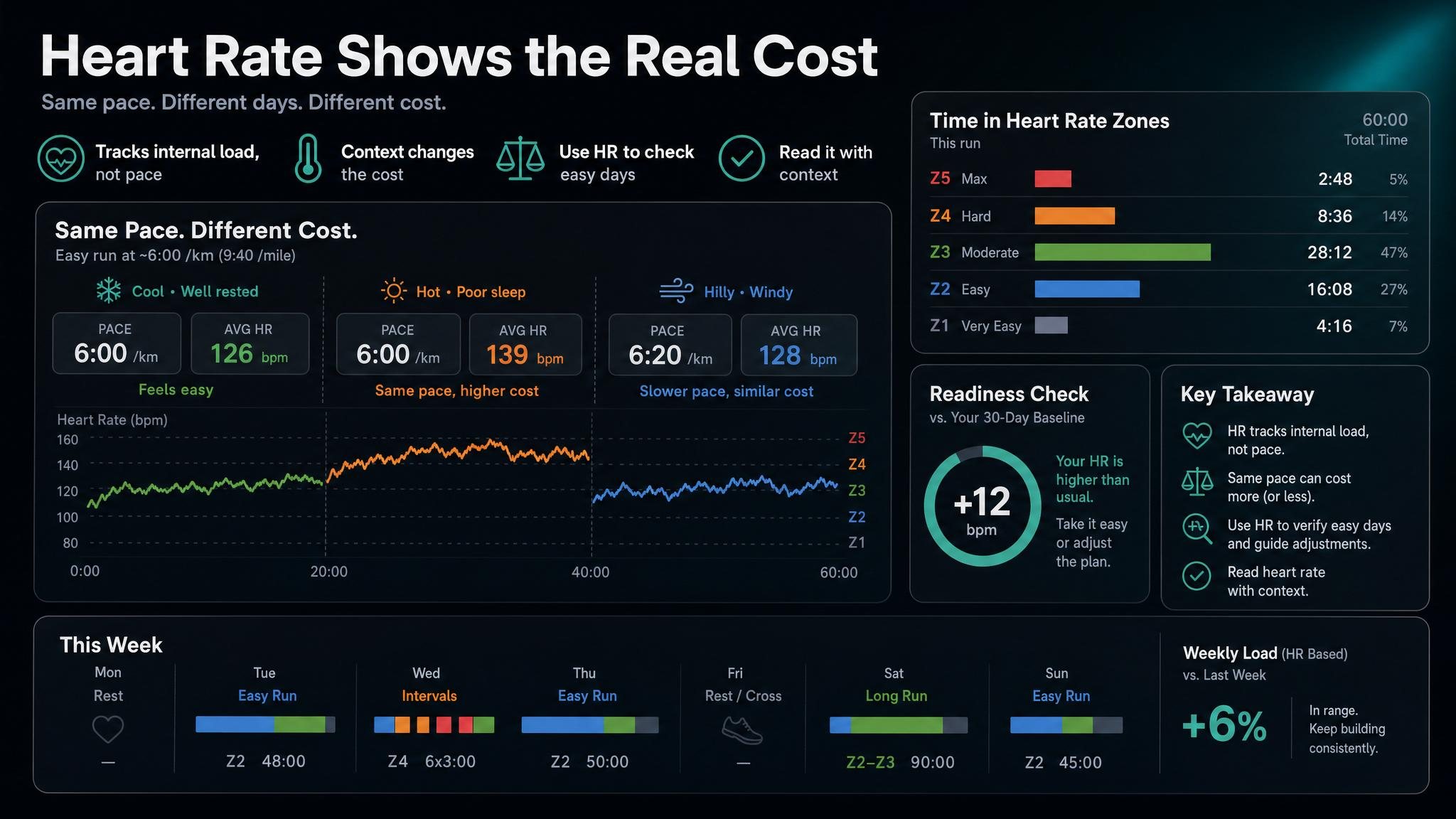
The same pace can produce different heart rates on different days. A 6:00/km or 9:40/mile easy run might be comfortable in cool weather after a rest day, but feel moderate in heat after poor sleep. The pace did not change. The cost changed.
This is why heart rate is useful on easy days. It catches the mismatch between what the plan says and what your body is absorbing. If pace is normal but heart rate is 10 to 15 beats higher than usual, the run may not be as easy as it looks. If heart rate is normal but pace is slower, the route or conditions may be harder. If both heart rate and effort are high, the session is no longer easy.
Researchers have long treated heart rate as a practical training tool with limitations. Achten and Jeukendrup describe heart rate as useful for monitoring intensity, while warning that it is affected by many non-pace factors (Achten and Jeukendrup, 2003). The practical takeaway is not to ignore heart rate. It is to read it with context.
Cause 1: You Started Too Fast
The most common running-specific reason is simple: the first 10 to 15 minutes were too fast.
Many runners start at the pace they hope to average. The problem is that the cardiovascular system needs time to settle. Breathing, muscle temperature, blood flow, and rhythm all change during the opening minutes. If you begin at your "normal" easy pace before your body is ready, heart rate may climb quickly and stay high for the rest of the run.
This is especially common when the route starts uphill, when you run straight from a stressful workday, or when you compare the first mile to a past run. Easy runs often need a boring first mile. The opening pace should feel almost too slow, especially if the goal is low-intensity aerobic work.
If your heart rate is high early but stabilizes after you slow down, the solution is not complicated. Start easier next time. Give yourself permission to run the first 10 minutes by breathing, not pace. If you use zones, stay below the top of your easy zone until the run feels settled.
Cause 2: Heat, Humidity, And Dehydration Raised The Cost
Heat is one of the clearest reasons heart rate rises on easy runs. When you run in warm or humid conditions, your body has to send blood to working muscles and to the skin for cooling. That competition can increase cardiovascular strain, even when pace stays the same.
Hydration matters too. The American College of Sports Medicine position stand on exercise and fluid replacement describes how fluid deficits can strain thermoregulation and cardiovascular function during exercise (ACSM, 2007). In controlled exercise research, Gonzalez-Alonso, Mora-Rodriguez, and Coyle showed that environment and hydration interact to affect stroke volume during exercise (Gonzalez-Alonso et al., 2000).
You do not need to memorize the physiology to use the signal. If the day is hotter, more humid, sunnier, or windless compared with your usual run, expect easy pace to slow down. If you force the same pace, heart rate may climb into a moderate zone even though the workout was labeled easy.
The CDC also warns that heat can make people sick and advises knowing when to seek care for overheating symptoms (CDC Heat and Health). For runners, that means taking heat seriously. Dizziness, confusion, chills in heat, nausea, unusual weakness, or stopping sweating in hot conditions are not training signals to push through.
For easy runs in heat, adjust before the run goes wrong. Run earlier, choose shade, reduce pace, shorten the session, carry fluid when appropriate, and avoid comparing hot-weather heart rate with cool-weather files.
Cause 3: You Are Carrying Fatigue
If your easy-run heart rate is high after a hard workout, a long run, a strength session, poor sleep, travel, or a stressful week, fatigue is a strong possibility.
Fatigue changes the relationship between pace and internal load. The same external work can feel more expensive because the body is not fully recovered. Heart rate may rise earlier, breathing may feel less relaxed, and pace may feel awkward even though it is normally easy.
Halson's review on monitoring training load emphasizes that fatigue is best understood through multiple signals, not a single number (Halson, 2014). Subjective measures are especially valuable. A systematic review by Saw, Main, and Gastin found that self-reported measures often reflected training response better than many commonly used objective measures (Saw et al., 2015).
That matters because a runner can be tempted to dismiss poor sleep, soreness, and low motivation as soft data. They are not soft if they repeatedly predict a high heart rate and poor run quality.
When high heart rate appears with heavy legs, low motivation, elevated morning heart rate, irritability, unusual soreness, or a drop in performance, treat the run as feedback. Slow down, shorten it, or replace it with walking or rest. You are not losing fitness by making one easy day easier. You are protecting the work you want to absorb.
Cause 4: Stress, Caffeine, Fueling, Or Illness Changed The Baseline
Sometimes heart rate is high before the run truly starts. Stress, anxiety, caffeine, poor fueling, alcohol the night before, certain medications, allergies, fever, or a developing infection can raise resting or exercise heart rate.
This is why the warm-up matters. If your heart rate is already higher than usual while getting dressed, walking to the start, or jogging the first few minutes, the run is beginning from a different baseline. Trying to hit normal easy pace may be unrealistic.
Illness is the one to respect most. If your easy heart rate is unusually high and you also have fever, body aches, chest symptoms, unusual shortness of breath, or a sense that something is off, the right workout may be no workout. Training through an infection can turn a small problem into a larger interruption.
Overreaching and overtraining are not diagnosed from one easy run, but persistent high heart rate, poor performance, mood changes, sleep disruption, and fatigue should not be ignored. The European College of Sport Science and American College of Sports Medicine consensus statement frames training maladaptation as a spectrum related to imbalance between stress and recovery (Meeusen et al., 2013).
The practical rule: if high heart rate is paired with feeling unwell, make the easy run easier or stop. Fitness is not built by forcing low-quality work through a body that is asking for recovery.
Cause 5: The Route Was Not As Easy As The Pace Looked
Average pace can hide a hard route. Rolling hills, wind, trail surfaces, heat radiating from pavement, repeated turns, traffic stops, and uneven footing can all make an easy run more expensive.
Hills are the classic example. If you hold flat-ground pace uphill, effort rises immediately. Heart rate may lag at first, then climb and stay elevated. By the time the route flattens, the easy run has already become moderate.
Wind can do the same. So can snow, mud, sand, technical trail, or running with a stroller. The pace file may look unimpressive, but the body experienced more work. This is another external-load versus internal-load mismatch.
The fix is not to avoid all difficult routes. It is to stop using normal easy pace as the only target. On hills, shorten stride and let pace slow. In wind, run by breathing. On trails, use effort rather than road pace. If the run is meant to be easy, the route should not force repeated surges that turn it into a workout.
Cause 6: Cardiac Drift Turned Easy Into Moderate
Sometimes the run starts easy and becomes expensive later. That pattern is often called cardiac drift: heart rate rises over time even when pace stays similar.
Some drift is normal during prolonged exercise. Body temperature rises, fluid balance changes, muscles fatigue, and the cardiovascular system continues adjusting. The important question is how much drift occurs and how it feels.
If heart rate rises slightly near the end while breathing stays relaxed, the run may still be fine. If heart rate climbs into a moderate zone and perceived effort rises too, the run is no longer easy. The solution is to slow down before the drift becomes large, shorten the run, choose cooler conditions, or build duration more gradually.
This is where easy-run discipline matters. If you wait until heart rate is already high, the correction comes late. If you know your heart rate tends to drift after 35 minutes, start the run easier, take a short walk break before the climb, or cap the run at a duration you can currently complete at low stress.
Cause 7: Your Easy Zones May Be Set Wrong
If every easy run looks high by heart rate, even when breathing is relaxed, your zones may be wrong.
Many apps set zones from age-predicted max heart rate. That is a rough population estimate, not a precise individual prescription. If your actual max heart rate, lactate threshold heart rate, or easy threshold differs from the app's assumption, your watch may label normal aerobic running as too hard.
The reverse can also happen. Your watch may call a run Zone 2 even though breathing and effort are clearly moderate. That is why zones should be checked against field experience.
Ask:
- Can I speak in complete sentences near the top of my easy zone?
- Does this heart rate match what I feel on several similar runs?
- Did a recent race, threshold test, or lab test support these zones?
- Are my running zones copied from cycling or another sport?
- Did my zones change after detraining, illness, heat acclimation, or a fitness jump?
If zones do not match reality, retest or adjust them. A threshold-based field test or lab test can be more useful than a generic formula. Until then, use breathing and perceived effort to keep easy runs easy.
When A High Heart Rate Needs Medical Attention
Most high-heart-rate easy runs are training or context problems. Some are not.
Stop the run and seek appropriate medical advice if the high heart rate comes with chest pain, unusual shortness of breath, faintness, loss of consciousness, severe dizziness, confusion, or a feeling that your heartbeat is irregular in a new or worrying way. MedlinePlus advises contacting a health care provider when pulse intensity or rate increases suddenly and does not go away, especially with symptoms such as chest pain, shortness of breath, feeling faint, or loss of consciousness (MedlinePlus).
Also be cautious if your heart rate stays unusually high after you stop and rest, if this is a new pattern with no clear training explanation, or if you already have a heart condition. Training articles can help you interpret common patterns, but they cannot diagnose chest symptoms, arrhythmias, infection, anemia, thyroid problems, medication effects, or other medical causes.
The practical split is simple. A high number during a hot, hilly, slightly too-fast run is usually a training signal. A sudden unexplained high heart rate with concerning symptoms is a health signal. Treat those differently.
What To Do During The Run
When heart rate is high on an easy run, make a decision based on both the number and the feel.
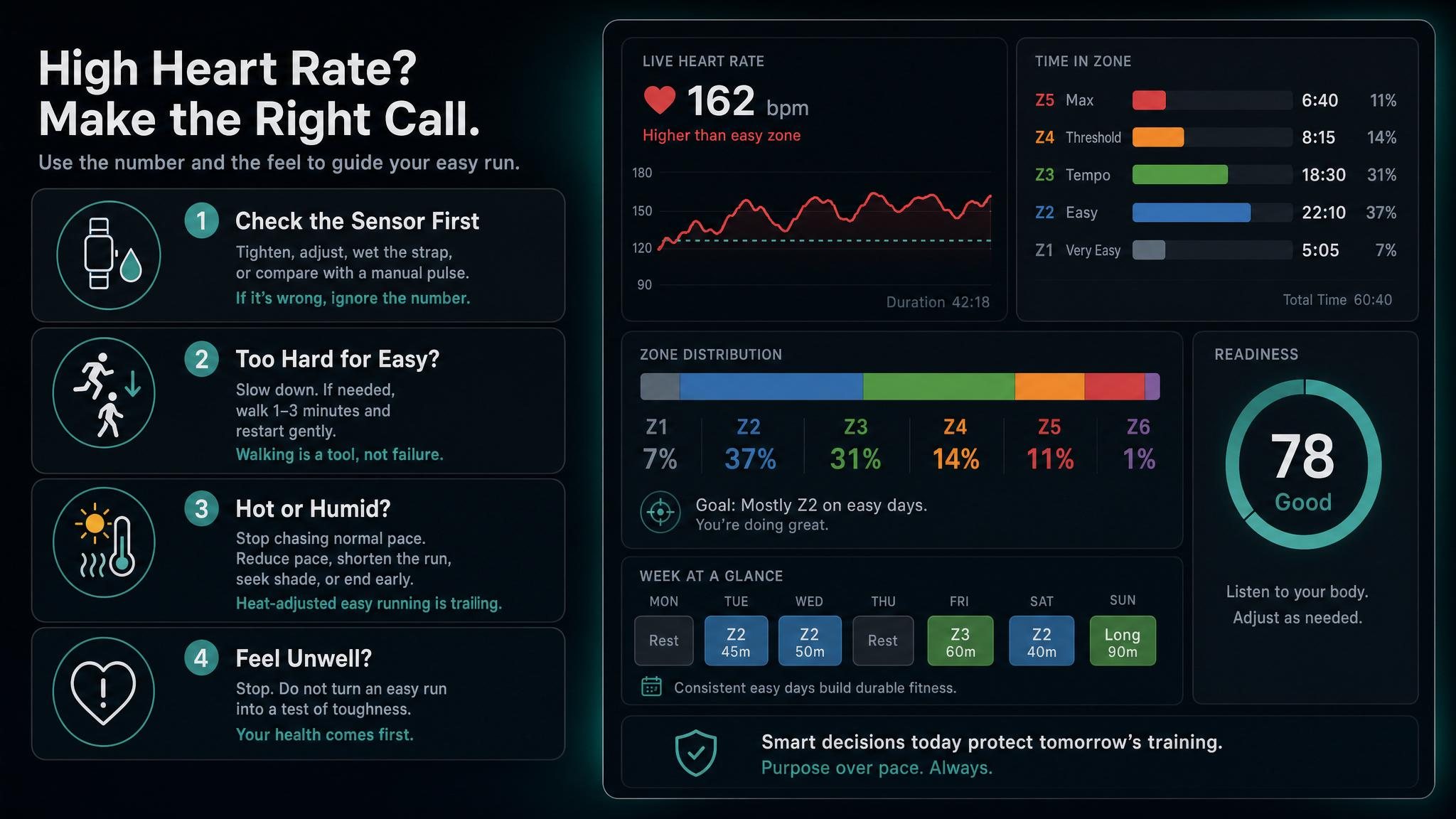
If heart rate is high but effort is genuinely easy, first check the sensor. Tighten the watch, adjust the strap, wet the chest strap, or stop briefly and compare with a manual pulse. If the sensor is wrong, do not let a bad number ruin the run.
If heart rate is high and breathing is harder than easy, slow down. If slowing down is not enough, walk for one to three minutes and restart gently. Walking is not failure. It is a tool that keeps the session aligned with its purpose.
If the day is hot or humid, stop chasing normal pace. Reduce pace, shorten the run, seek shade, or end the session early if symptoms suggest overheating. Heat-adjusted easy running is still training.
If heart rate is high and you feel unwell, stop. Do not turn an easy run into a test of toughness. The cost of missing one easy run is tiny compared with the cost of extending illness or ignoring a medical warning.
What To Change In The Next Week
If this happened once, make a note and move on. One high-heart-rate easy run after heat, poor sleep, or a stressful day does not require a new training philosophy.
If it happens repeatedly, adjust the week.
Start with the easy days. Make them easier than you think they need to be. Run the first 10 minutes slowly, cap heart rate conservatively, and allow walk breaks on hills. Your goal is not to prove that a pace is easy. Your goal is to create low-stress aerobic work.
Next, protect the hard days. If easy runs keep turning moderate, your quality sessions may suffer because you are never fully fresh. Move the next hard workout if the trend is paired with fatigue, poor sleep, or low motivation.
Then review your recent load. Did weekly volume jump? Did you add intensity, hills, strength training, or a long run at the same time? Did you stack stress outside training? If the answer is yes, reduce one variable rather than blaming fitness.
Finally, retest zones if the pattern continues despite easier pacing and normal recovery. A high heart rate may be a real warning, but it may also be a bad zone model. Good training decisions need a reasonably accurate map.
How To Review The Pattern
Do not judge the pattern from one file. Use three to six similar easy runs.
Track the basics: route, weather, sleep, soreness, stress, caffeine or alcohol, perceived effort, average heart rate, pace, time in zones, and whether heart rate was high early or drifted late. The notes do not need to be long. A few words are enough.
Look for clusters.
If high heart rate appears mainly in heat, adjust for weather. If it appears after hard sessions, review recovery. If it appears on hills, adjust route or pace. If it appears only with one device, check the sensor. If it appears across all easy runs with worse performance and poor mood, reduce load and consider whether illness or deeper fatigue is involved.
This kind of review is more useful than asking whether one number was "good" or "bad." Heart rate becomes valuable when it is connected to context.
Conclusion
A high heart rate on an easy run means the run is costing more than expected. The cause might be pacing, heat, dehydration, fatigue, stress, illness, terrain, cardiac drift, inaccurate zones, or sensor error.
The best response is not panic and not denial. Check whether the reading is real. Compare heart rate with breathing and perceived effort. Slow down if the run no longer feels easy. Respect heat and illness. Review the pattern across several runs before changing the plan.
Easy running should support the rest of training. When heart rate is high, it is giving you information about the day you are actually having, not the day you planned on paper. Use that information early, and your easy runs will do their real job: build aerobic fitness without quietly adding stress you did not intend.

Our editorial approach & AI disclosure
We use AI to help research, organize, and draft some articles. Every article is reviewed by a human editor and aims to reflect current evidence-based training practices and scientific literature.
Read our editorial policy