

Data Diagnostics
What Does It Mean If Your Weekly Zone 2 Time Is Going Down?
Weekly Zone 2 time going down can mean less aerobic volume, more intensity creep, recovery stress, or simply changed zone settings. Learn how to read the trend and recalculate a realistic Zone 2 target.

Introduction
If your weekly Zone 2 time is going down, it usually means one of four things: you are training less overall, your easy-training share has dropped, more time is shifting into Zone 1 or Zone 3, or your zones and conditions are changing how workouts are classified. A single lower week is not automatically a problem. A repeated drop is worth investigating because Zone 2 is often the easiest way to protect aerobic volume without adding much stress.
Zone 2 is not magic, and it is not identical across every five-zone model. In practical training logs, it usually means conversational aerobic work below a major threshold. That overlaps with public-health moderate aerobic guidance, but endurance athletes often use it more specifically as base-building work that should feel repeatable. The American College of Sports Medicine's exercise guidance describes moderate-intensity aerobic exercise and the common weekly range of 150 minutes or more for adults (Medicine & Science in Sports & Exercise). For endurance training, the question is narrower: are you still getting enough low-stress aerobic time to support the rest of the week?
The useful move is not to panic at the number. First decide what actually went down.
First Decide What Went Down
Weekly Zone 2 minutes can fall even when fitness is improving. For example, a beginner who adds strength training, rest days, or short intervals may record fewer Zone 2 minutes for a week without losing aerobic capacity. A runner returning from illness may intentionally cut volume. A cyclist may swap one long easy ride for a shorter threshold workout. In all three cases, lower Zone 2 time is a planning change, not necessarily a warning sign.
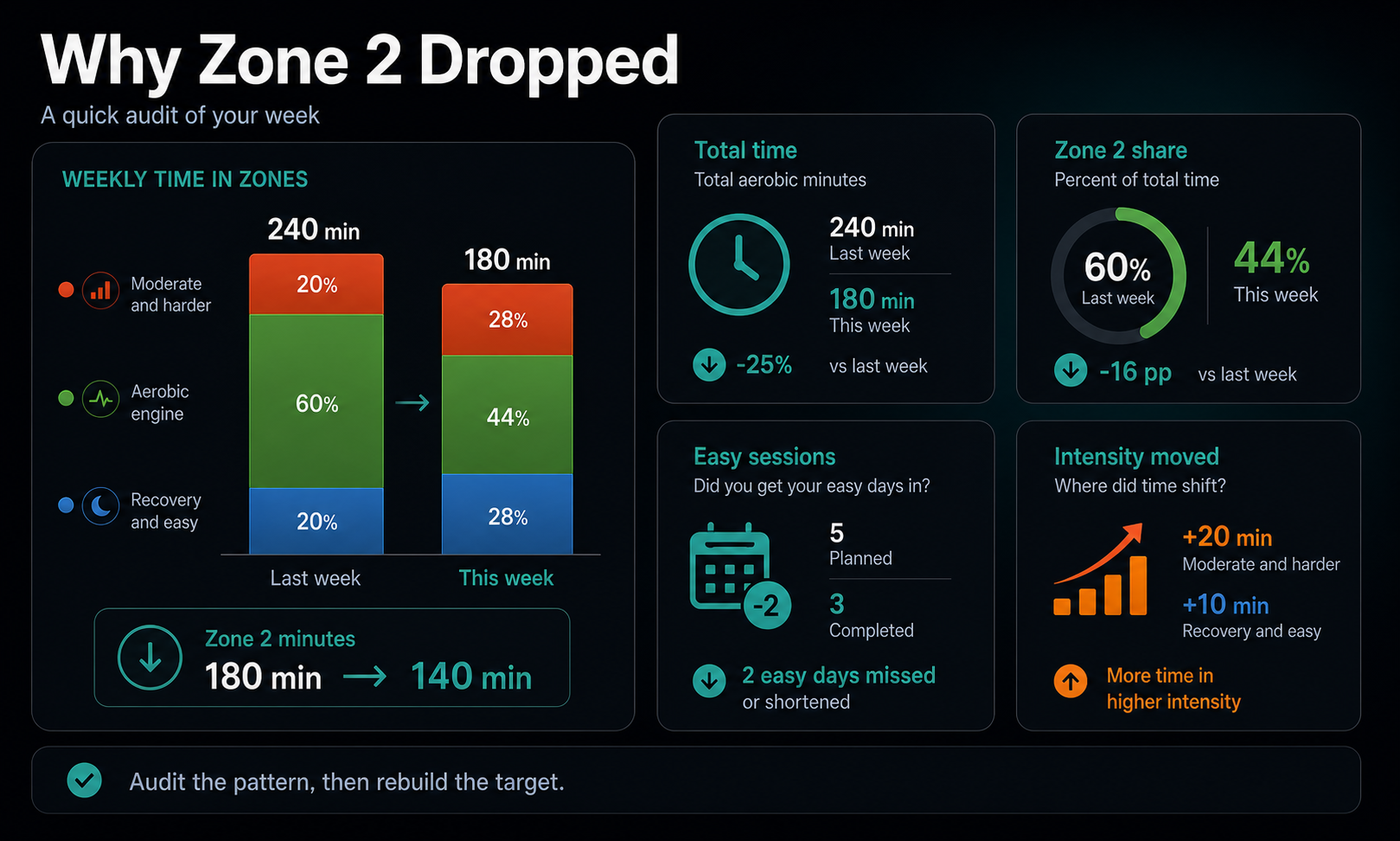
Start by comparing four numbers: total aerobic minutes, Zone 2 minutes, Zone 2 share, and time in Zones 3-5. A drop from 180 to 140 Zone 2 minutes means something different if the whole week dropped from 240 to 180 minutes than if total time stayed at 240 but more of it moved into Zone 3. The first pattern is lower volume. The second pattern is intensity creep.
Also check whether Zone 1 increased. If Zone 2 went down because you replaced easy endurance sessions with recovery walks, mobility, very easy spins, or low heart-rate movement after a hard block, that may be exactly what your body needed. If Zone 2 went down while Zone 3 rose, you may be turning easy days into moderate days.
Use The Zone 2 Calculator To Rebuild The Target
Once you know the pattern, recalculate the week instead of guessing. The Zone 2 calculator below turns total weekly aerobic time, target Zone 2 share, session count, and easy pace into weekly Zone 2 minutes, minutes per session, and estimated mileage. You can also open the standalone Zone 2 Training Volume Calculator when you want to plan outside this article.
Use the output as planning math, not a command. If you have 240 weekly aerobic minutes and want 75% easy Zone 2 work, the target is 180 Zone 2 minutes. If your real week only allows 180 total minutes, the same 75% share becomes 135 minutes. That is not failure. It is a smaller week.
The calculator is especially useful when your schedule changes. If you move from five aerobic sessions to three, you may need longer easy sessions to preserve Zone 2 time. If that would make each session too long for your current durability, reduce the target and build back gradually.
Common Reasons Zone 2 Time Drops
The simplest reason is missed or shortened sessions. Zone 2 usually depends on time more than intensity. Removing a 60-minute easy run or ride can erase more Zone 2 time than slightly changing the pace of every other session.
The next reason is intensity drift. Research on endurance training intensity distribution repeatedly points to the value of organizing a large share of training below the first threshold, with harder work placed deliberately. Seiler's review of endurance training distribution describes how successful endurance athletes often keep most training low intensity rather than spending every day in the middle (International Journal of Sports Physiology and Performance). Esteve-Lanao, Foster, Seiler, and Lucia also linked training intensity distribution with endurance performance in trained runners, using a model that separated low, moderate, and high-intensity work (Journal of Strength and Conditioning Research). Those studies do not prove every athlete needs the same ratio, but they support the practical idea that the easy portion of the week matters.
A third reason is recovery. If you are carrying fatigue, heart rate may not behave normally, pace may drop, or you may choose shorter sessions. Halson's review on training-load monitoring emphasizes that fatigue is best interpreted with multiple signals, not one metric alone (Sports Medicine). Lower Zone 2 time paired with poor sleep, heavy legs, worse mood, elevated resting heart rate, or unusually high perceived effort is different from lower Zone 2 time during a planned deload.
Zone settings can also create false trends. If you changed your max heart rate, heart-rate reserve, threshold, sport profile, watch, or app settings, the same workout may be classified differently. If your Zone 2 range moved down, sessions that used to count as Zone 2 may now appear in Zone 3. If the range moved up, the reverse can happen.
Finally, conditions can change the classification. Heat, hills, terrain, caffeine, dehydration, and cardiac drift can push heart rate out of the intended range. Coyle and Gonzalez-Alonso reviewed cardiovascular drift during prolonged exercise, where heart rate can rise over time during longer efforts even when external output is steady (Exercise and Sport Sciences Reviews). A long run that begins in Zone 2 and finishes above it may still be aerobically useful, but it will reduce recorded Zone 2 minutes.
When A Drop Is Not A Problem
Lower Zone 2 time is probably fine when it is intentional. Deload weeks, taper weeks, travel weeks, and return-from-illness weeks should often show less total aerobic work. If the goal was recovery, lower Zone 2 minutes are not a mistake.
It is also fine when the lower number is caused by better intensity separation. Suppose last month every workout was moderate, and this month you added one true interval day plus two very easy recovery days. Your Zone 2 minutes might dip while the week becomes more purposeful. The goal is not to maximize Zone 2 at all costs; it is to make your training match the adaptation you want.
Lower Zone 2 time can even appear during fitness gains. As you become more efficient, the same route may require a lower heart rate and spend more time in Zone 1. Or, if your zones were recalibrated upward after a field test, previous Zone 2 sessions might now sit below the new range. That does not mean aerobic fitness disappeared. It means the measurement context changed.
The drop deserves attention when it repeats for several weeks without a clear reason, especially if total aerobic time is falling, hard intensity is rising, or recovery markers are worsening.
When It Can Hurt Your Aerobic Base
Zone 2 time matters most when it is the main way you accumulate low-stress endurance volume. If it trends down for weeks while nothing replaces it, your aerobic base may stop progressing. In the short term, missing one or two weeks is usually manageable. In longer reductions or cessation of training, detraining research shows that endurance adaptations can decline. Mujika and Padilla reviewed cardiorespiratory and metabolic characteristics of detraining in humans (Medicine & Science in Sports & Exercise), and a more recent review of endurance athletes reported that full training cessation can reduce VO2max and other endurance-related adaptations (Frontiers in Physiology).
That does not mean every lower week causes fitness loss. It means the trend matters. A one-week drop after a race may be recovery. A four-to-eight-week decline in easy aerobic minutes, paired with no other endurance stimulus, is more likely to show up as reduced durability, higher heart rate at familiar paces, or a harder feeling during long sessions.
The most common mistake is replacing Zone 2 with Zone 3 without noticing. Zone 3 can be valuable tempo work, but it is more expensive than easy aerobic training. If Zone 2 goes down because every easy session is turning moderate, you may lose the low-stress volume that makes hard sessions productive.
How To Respond
If total weekly aerobic time went down, rebuild the schedule before changing zones. Add back one easy session, extend one short easy session by 10 to 20 minutes, or preserve a weekly long easy session. Keep the increase modest enough that the next week still feels repeatable.
If Zone 2 share went down because intensity moved up, slow the first 10 minutes of easy sessions and use a heart-rate ceiling. The talk test is a simple check: the CDC describes moderate intensity as a level where you can talk but not sing, while vigorous work makes speaking more difficult (CDC). For many easy aerobic sessions, you should be able to speak in full sentences.
If Zone 2 went down because recovery is poor, do not force the number immediately. Keep sessions short and easy for a few days, then rebuild. The target is durable consistency, not one heroic week.
If the number changed after editing zones, compare workouts by pace, power, route, perceived effort, and breathing, not only the color-coded chart. Zone labels are useful, but they are only useful when the underlying thresholds are credible.
Finally, use a rolling view. Compare three or four weeks rather than one week. Ask whether Zone 2 time is moving down because of an intentional training phase, a temporary life constraint, a measurement change, or a pattern that needs correction.
Conclusion
Weekly Zone 2 time going down is a signal, not a diagnosis. It may mean you trained less, recovered intentionally, shifted intensity upward, changed zone settings, or ran into conditions that moved heart rate out of range.
The best response is to audit the whole week: total aerobic minutes, Zone 2 share, missed easy sessions, and time in higher zones. Then use the Zone 2 calculator to rebuild a target that fits your current schedule and recovery. Protect enough easy aerobic work to support your goals, but do not treat every lower week as a setback.

Our editorial approach & AI disclosure
We use AI to help research, organize, and draft some articles. Every article is reviewed by a human editor and aims to reflect current evidence-based training practices and scientific literature.
Read our editorial policy