


What Should You Track in a Training Log?
A useful training log connects what you did, how hard it was, how your body responded, and what happened next. Learn the key metrics runners and cyclists should track without drowning in data.
Jun 20, 202615 min read

Introduction
A good training log should answer four questions: what did you do, how hard was it, how did your body respond, and what happened next?
That sounds simple, but many athletes either track too little or track too much. Too little, and the log becomes a calendar of completed workouts with no explanation. Too much, and the log becomes a data swamp that feels impressive but rarely changes decisions. The useful middle is a log that connects training input, internal response, recovery context, and outcomes.
For a runner, that might mean duration, distance, pace, elevation, heart rate zones, perceived effort, soreness, sleep, surface, shoes, and a short note about how the session felt. For a cyclist, it might mean duration, power, heart rate, terrain, cadence, time in zones, fuel intake, perceived effort, sleep, pain, and whether the ride matched the plan.
The goal is not perfect measurement. The goal is better pattern recognition. If easy runs feel harder after poor sleep, your log should show it. If knee pain appears after rapid mileage jumps, your log should reveal the trend. If threshold workouts improve after easier recovery days, your log should make that obvious.
Research and coaching practice both point in the same direction: training is not just the external work performed. It is also the athlete's response to that work. A consensus statement on training-load monitoring defines load in ways that include both external load, such as distance or power, and internal load, such as heart rate or perceived exertion (Bourdon et al., 2017). Impellizzeri, Marcora, and Coutts later emphasized that external and internal load answer different questions and should not be treated as interchangeable (Impellizzeri et al., 2019).
That distinction is the foundation of a useful training log. Track what you did. Track how hard it was for you. Track the context that shaped the response. Then review the trends.
The Short Answer: Track Four Things
A useful training log should connect four categories:
- Session basics: sport, duration, distance, route, elevation, surface, conditions, equipment, and workout type.
- Intensity and load: pace or power, heart rate, time in zones, interval structure, session RPE, and weekly training load.
- Recovery and context: sleep, soreness, mood, fatigue, illness, fueling, hydration, heat, travel, work stress, and menstrual-cycle notes where relevant.
- Outcomes: performance notes, pain, missed sessions, personal bests, whether the workout matched the plan, and what you would change next time.
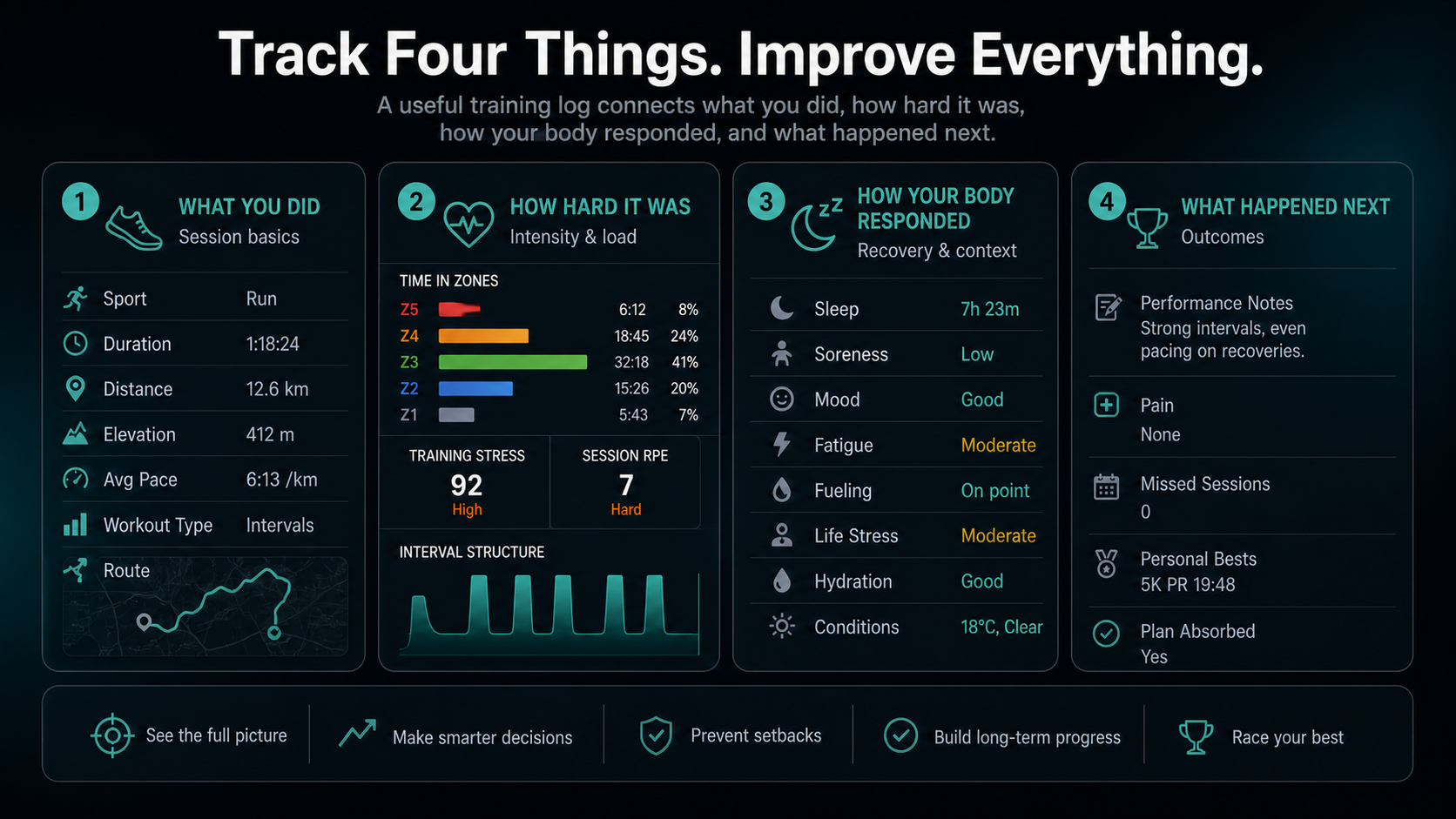
You do not need to fill every field every day. The core idea is to track enough information to explain your training, not just count it.
If you only record distance, you know how far you went. If you also record intensity, sleep, soreness, and notes, you can start to understand why one 8-mile run felt smooth and another felt unusually hard. That is where the log becomes a coaching tool.
Why A Training Log Works
A training log works because adaptation is personal. Two athletes can complete the same workout and experience different stress. One may absorb it easily. The other may need two recovery days. The workout on paper is identical, but the training effect is not.
This is why sports science separates external load from internal load. External load is the work performed: miles, kilometers, minutes, elevation, speed, watts, reps, or weight lifted. Internal load is the body's response: heart rate, breathing, perceived exertion, fatigue, soreness, mood, and recovery state. Halson's review on training-load monitoring argues that understanding fatigue requires looking at both the work completed and the athlete's response to it (Halson, 2014).
A log also gives memory some structure. Athletes are good at remembering dramatic workouts and recent frustrations, but poor at accurately reconstructing six weeks of ordinary training. A log turns vague impressions into evidence. You can see whether you truly increased volume gradually, whether your easy days stayed easy, whether sleep declined before a bad week, or whether pain appeared only after specific terrain or shoes.
The best log is not the one with the most fields. It is the one you actually use and review. If a field never changes a decision, it may not deserve daily attention. If a simple note helps you prevent repeated mistakes, it is worth keeping.
Track The Session Basics First
Start with the facts of the session. These are the details that let you reconstruct what happened without relying on memory.
For most endurance athletes, the session basics are:
- Sport or activity type.
- Date and start time.
- Duration.
- Distance, if relevant.
- Route or location.
- Elevation gain.
- Terrain or surface.
- Weather, heat, wind, or altitude when meaningful.
- Workout type: easy, long, recovery, intervals, tempo, threshold, hills, race, strength, mobility, or cross-training.
- Equipment: shoes, bike, tires, insoles, pack, poles, or other gear when it could affect the session.
Duration is often the most stable base metric because it works across sports and terrain. Ten miles on flat roads is not the same stress as ten miles on technical trails. A 90-minute endurance ride into a headwind is different from the same route on a calm day. Distance matters, but duration gives context.
For runners, distance and surface are especially useful. Concrete, track, treadmill, gravel, grass, and trails create different mechanical loads. Shoes also matter. If a tendon or joint gets irritated, a shoe and surface history can help identify patterns.
For cyclists, route, elevation, bike setup, and conditions can explain a lot. The same average speed can mean very different things depending on wind, climbing, group dynamics, tire choice, and road surface. Power helps, but context still matters.
Keep the basics objective. This part of the log should describe what happened before you interpret it.
Track Intensity, Not Just Volume
Volume tells you how much you trained. Intensity tells you what kind of stress you created.
Two 60-minute sessions can produce very different effects. One may be an easy aerobic run. Another may include VO2 max intervals. One ride may stay in Zone 2. Another may include repeated climbs above threshold. If the log only records duration and distance, those sessions look too similar.
Useful intensity fields include:
- Average and max heart rate.
- Time in heart rate zones.
- Pace or speed distribution.
- Power, normalized power, or intensity factor for cyclists with power meters.
- Time in power zones.
- Interval details: number of reps, duration, recovery, target, and actual execution.
- Session RPE, usually a 1-10 rating of how hard the whole session felt.
- Notes on whether easy work truly felt easy.
Session RPE is valuable because it is simple and portable. Foster and colleagues described a practical method of monitoring training by multiplying session duration by a rating of perceived exertion, creating a session-load estimate that can be used across different activities (Foster et al., 2001). It is not perfect, but it captures something devices can miss: how hard the work felt to the athlete.
Heart rate and power are also useful, but they answer different questions. Power tells a cyclist what they produced. Heart rate shows part of the physiological response. Pace shows running output, but heat, hills, fatigue, surface, and wind can change what that pace costs. RPE adds the athlete's perception of the whole session.
The most useful logs combine these signals. If power is normal but heart rate is unusually high, you may be dealing with heat, dehydration, stress, or fatigue. If pace is slower but RPE is low on a hilly trail, the workout may be exactly right. If easy sessions require higher RPE for several days, it may be time to reduce load.
Track Recovery And Readiness
Training does not happen in isolation. Sleep, soreness, stress, illness, and fueling all change how a session lands.
This is where many athletes underuse their logs. They record the workout but skip the context. Then they wonder why a normal week suddenly felt hard. Often the answer is not hidden in the workout. It is hidden around the workout.
Useful recovery and readiness fields include:
- Sleep duration.
- Sleep quality.
- Resting heart rate or heart rate variability, if measured consistently.
- Soreness.
- Mood.
- Fatigue.
- Stress.
- Illness symptoms.
- Appetite.
- Menstrual-cycle notes where relevant.
- Muscle tightness or mobility issues.
- Motivation to train.
Subjective measures deserve serious attention. A systematic review by Saw, Main, and Gastin found that subjective self-reported measures often reflected changes in athlete well-being at least as well as, and sometimes better than, commonly used objective measures (Saw et al., 2016). That does not mean devices are useless. It means your own consistent self-report is not fluff.
Keep these ratings simple. A 1-5 scale for sleep quality, soreness, fatigue, mood, and stress is enough for most athletes. The value comes from consistency, not precision. You are looking for trends: three poor sleep nights before a failed workout, rising soreness during a mileage build, low mood during a heavy work week, or better long-run recovery after better fueling.
Recovery also includes deliberate actions. Note when you took a rest day, did mobility, used easy cross-training, ate more carbohydrate before a long session, or moved a hard workout because of life stress. These notes help you learn which adjustments actually work.
Track Pain, Niggles, And Injury Clues
Pain tracking should be boring, consistent, and honest.
Do not wait until something is a clear injury before writing it down. A small ache that appears once may not matter. A small ache that appears every time weekly volume jumps is useful information. A calf that feels tight only after track workouts may be telling you something about speed, surface, shoes, or warmup.
Use a simple pain scale:
- 0: no pain.
- 1-2: mild awareness, does not change movement.
- 3-4: noticeable, changes confidence or mechanics.
- 5 or higher: significant enough to stop, modify, or seek professional help.
Add location and behavior. "Left Achilles, 2/10, stiff first 10 minutes, gone after warmup" is much more useful than "Achilles sore." Note whether pain improved, worsened, shifted, or returned later.
Training-load research does not support the idea that all hard training is dangerous. The better point is that sudden changes and poorly managed load can raise risk. Gabbett's training-injury prevention paper argues that athletes need enough preparation for sport demands, but that workload spikes and poor load management are problems (Gabbett, 2016). Your log helps you see whether pain follows a manageable pattern or a risky jump.
Pain notes are also useful when you talk to a clinician or coach. Instead of saying, "It has been bothering me for a while," you can show when it started, what made it worse, what reduced it, and how training changed around it.
Track Fueling, Hydration, And Conditions
Not every athlete needs a detailed nutrition log. But endurance athletes should track fueling when it affects performance, recovery, or consistency.
For everyday sessions, a short note is enough: under-fueled, normal breakfast, good carbs, poor hydration, late dinner, heavy meal, caffeine, or heat. For long runs, long rides, races, and key workouts, be more specific. Record what you ate before, carbohydrate intake during the session, fluid intake, sodium if relevant, and how your stomach felt.
This is especially important for athletes preparing for long events. A marathon, gravel race, sportive, ultramarathon, or long triathlon is not just a fitness test. It is also a fueling and pacing test. If you do not track what you practiced, you cannot confidently repeat it.
Conditions matter too. Heat, humidity, altitude, wind, cold, and poor footing can change the cost of the same pace or power. Charest and Grandner's review on sleep and athletic performance highlights that sleep is intertwined with training, recovery, and performance, which is one reason context matters when interpreting sessions (Charest and Grandner, 2020). The same principle applies broadly: a workout never happens in a vacuum.
Good log notes might be:
- "Hot and humid, HR 8-10 bpm higher than usual."
- "Under-fueled, felt empty after 50 minutes."
- "Took 60 g carbs per hour, no stomach issues."
- "Poor sleep after travel, kept workout easy."
- "Strong headwind, power steady, speed irrelevant."
These notes prevent misinterpretation. Without context, you may think fitness dropped. With context, you may see that the session was reasonable for the conditions.
Track Whether The Workout Matched The Plan
A training log should show the gap between planned training and completed training.
This does not need to become a guilt system. The point is not to punish missed sessions. The point is to understand reality. If the plan says five runs per week but you complete three, the plan may be too ambitious for the current season of life. If the plan says easy but the log shows repeated moderate efforts, recovery may be compromised. If hard workouts are often moved because of fatigue, the weekly structure may need adjustment.
Useful completion fields include:
- Completed as planned.
- Modified.
- Skipped.
- Replaced with cross-training.
- Stopped early.
- Felt too easy, appropriate, or too hard.
- Reason for change.
The reason matters. "Skipped because lazy" is rarely useful. "Skipped because child sick and slept four hours" is actionable. "Stopped early because hamstring tightened" is actionable. "Reduced intervals because heat was high and HR drifted" is actionable.
Over time, these notes reveal whether the plan fits the athlete. A realistic plan that gets completed consistently usually beats an impressive plan that collapses every third week.
Track Outcomes, Not Just Inputs
Training logs become powerful when they connect inputs to outcomes.
Inputs are what you did: 45 miles, 8 hours, two workouts, one long run, three Zone 2 rides. Outcomes are what happened: threshold pace improved, easy heart rate stabilized, long-run recovery improved, pain increased, race result met expectations, or motivation dropped.
Useful outcome markers include:
- Personal bests.
- Race results.
- Benchmark workout results.
- Easy pace or power at a given heart rate.
- Heart rate drift on steady aerobic sessions.
- Ability to complete long sessions without unusual fatigue.
- Recovery time after hard workouts.
- Pain-free consistency.
- Missed sessions.
- Confidence and motivation.
Do not test outcomes constantly. A log is not a daily exam. But periodic benchmarks can be helpful when they are placed thoughtfully. For example, a runner might compare the same aerobic route every few weeks at similar effort. A cyclist might repeat a steady sub-threshold climb. A marathoner might track how controlled marathon-pace blocks feel during long runs.
The key is to interpret outcomes alongside context. A poor workout after travel and poor sleep is not the same as a poor workout during a normal week. A personal best after a taper does not mean every week should look like race week. The log helps you avoid these false conclusions.
The Best Training Logs Show Trends
A single workout can be interesting, but the real value of a training log is the pattern across days and weeks.
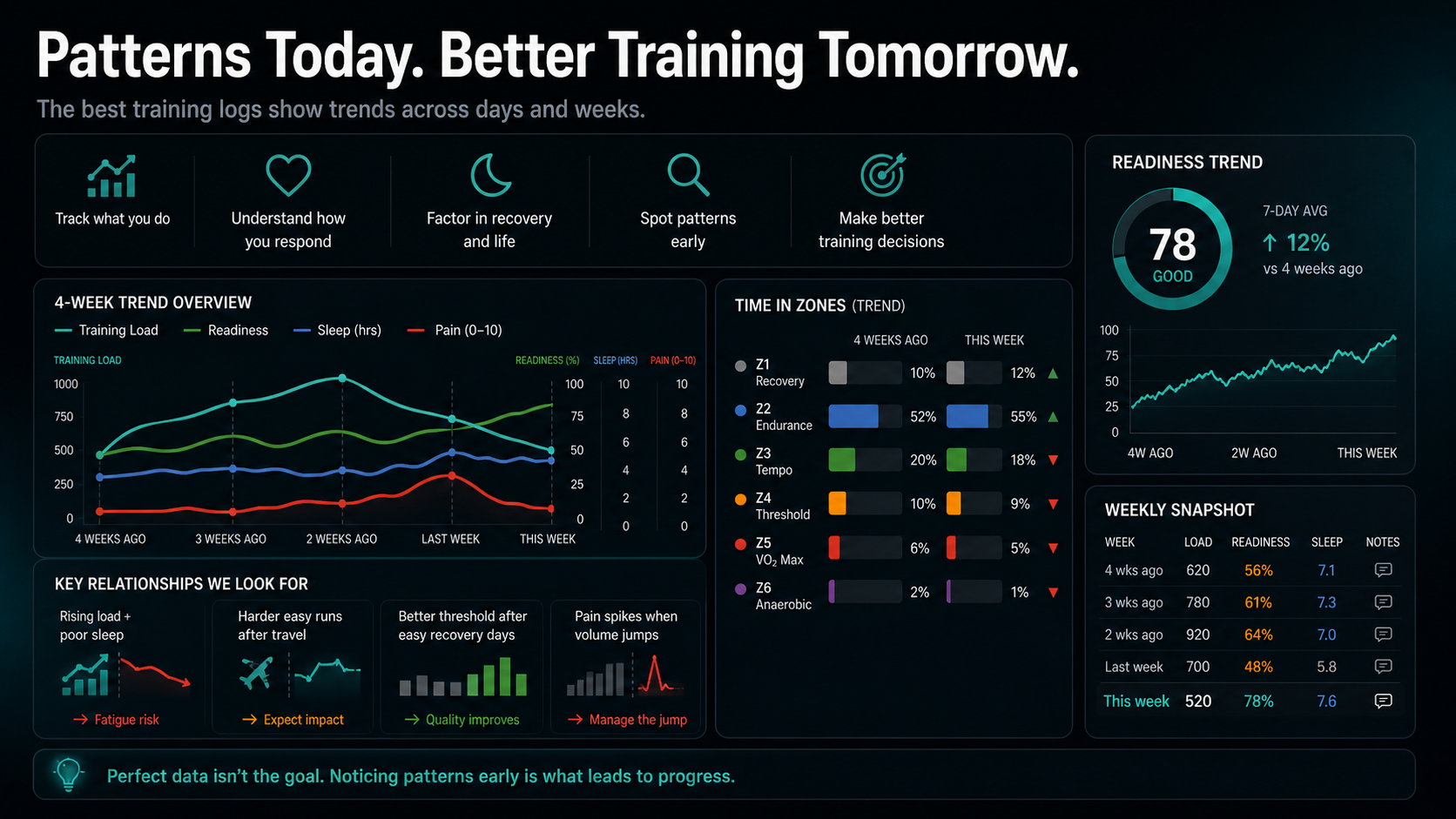
Look for relationships such as:
- Rising load plus poor sleep.
- Harder easy sessions after travel.
- Better threshold workouts after true recovery days.
- Pain that appears when weekly volume jumps.
- Higher heart rate in heat despite normal pace.
- Mood and motivation dropping during heavy blocks.
- Better long-run recovery after improved fueling.
Kellmann and colleagues' recovery consensus statement emphasizes that recovery is multidimensional and should be considered alongside training stress rather than treated as a separate afterthought (Kellmann et al., 2018). A log is where those dimensions meet. Training load, sleep, soreness, stress, notes, and outcomes become more useful together than separately.
Weekly review is usually enough. Daily data can be noisy. One bad night of sleep, one unusually high heart rate, or one flat run may not mean much. But a week of rising fatigue, reduced mood, poor sleep, and harder easy sessions is a pattern.
Set a regular review rhythm. At the end of each week, ask:
- What was the total training load?
- How much was easy, moderate, and hard?
- Did the week match the plan?
- Did recovery markers improve, decline, or stay stable?
- Did any pain trend appear?
- What should change next week?
This is where the training log changes behavior. It tells you whether to progress, repeat, deload, adjust intensity, protect sleep, fuel better, or ask for help.
What Beginners Should Track
Beginners should track fewer things, not more.
If you are new to consistent endurance training, start with:
- Date.
- Sport.
- Duration.
- Distance, if relevant.
- Workout type.
- Easy, moderate, or hard rating.
- Short note.
- Pain or soreness.
That is enough to learn consistency, spot overuse patterns, and avoid turning every session into a performance judgment. Beginners often get overwhelmed when they try to track advanced metrics before they have stable habits.
The most important beginner question is simple: can you repeat the training next week? If the answer is yes, the load may be appropriate. If the answer is no, the log should help explain why.
Once the routine is stable, add heart rate zones, sleep quality, and simple session RPE. Add more only when it helps you make decisions.
What Intermediate And Advanced Athletes Should Track
Intermediate and advanced athletes can benefit from more detail because their training has more moving parts.
A serious runner may track weekly mileage, vertical gain, long-run duration, time in heart rate zones, threshold work, interval volume, shoes, surface, strength training, soreness, sleep, and workout notes. A serious cyclist may track total hours, power-zone distribution, kilojoules, training stress, cadence, climbing, heart rate, fueling, bike setup, and subjective fatigue.
The extra detail should serve decisions:
- Are easy days easy enough?
- Is intensity distribution matching the phase?
- Is load rising too quickly?
- Are hard days followed by enough recovery?
- Is strength work supporting training or adding fatigue?
- Are shoes, terrain, or equipment linked to pain?
- Are benchmark sessions improving without excessive cost?
Advanced athletes should also track what they deliberately choose not to do. Skipping a workout because the body needs recovery is not a failure. It is a decision. Recording that decision helps separate smart adjustment from random inconsistency.
What Not To Track Every Day
Not every metric deserves daily attention.
Avoid tracking data that creates anxiety but does not change decisions. Avoid fields you cannot measure consistently. Avoid pretending that a single readiness score knows more than the full context. Avoid chasing precision in metrics that are noisy.
You probably do not need daily body weight unless there is a clear health, performance, or clinical reason. You probably do not need to rank every workout against all previous workouts. You probably do not need to write long essays after routine easy days. You probably do not need five different fatigue scores if one consistent score works.
More data is not always better. More useful data is better.
The best test for a field is this: will this help me make a better training decision later? If yes, keep it. If no, remove it or make it optional.
A Simple Training Log Template
Here is a practical template most runners and cyclists can adapt:
| Field | What To Record |
|---|---|
| Session | Sport, duration, distance, route, elevation, workout type |
| Intensity | Pace or power, heart rate zones, interval details, session RPE |
| Context | Sleep, stress, soreness, mood, weather, travel, fueling |
| Body signals | Pain location, pain score, tightness, illness symptoms |
| Outcome | Completed, modified, skipped, performance note, what to adjust |
For a normal easy session, one short entry might be enough:
Easy run, 45 min, flat road, Z2. RPE 3/10. Slept 7h, legs normal, no pain. Felt smooth.
For a key workout, add more:
Threshold run, 3 x 10 min, 2 min easy recovery. Averaged target pace, HR rose slightly in final rep. RPE 7/10. Warm day. Slept 6h. Calves tight but no pain. Next time start a little more controlled.
For a long ride:
Endurance ride, 3h 20m, rolling route, 1,450 m climbing. Mostly Z2, two climbs near tempo. Took 75 g carbs per hour, stomach good. RPE 5/10. Good energy, mild neck tightness late.
The note does not need to be poetic. It needs to be useful to your future self.
Conclusion
The best training log is not the most complicated one. It is the one that helps you make better training decisions.
Track what you did, how hard it was, how your body responded, and what happened next. For most endurance athletes, that means session basics, intensity and load, recovery context, pain or injury clues, fueling notes for key sessions, completion status, and outcomes.
Use devices where they help. Use subjective notes where they reveal context. Review trends weekly. Keep the log simple enough to maintain and detailed enough to explain your training.
A useful log should help you answer the question that matters most: what should I do next?