

Recovery & Readiness
How Should Endurance Athletes Track Recovery?
Endurance athletes should track recovery as a trend, not a single readiness score. Learn which subjective and objective signals matter, how to review them weekly, and how to adjust training.

Introduction
Endurance athletes should track recovery with a small set of repeatable signals, then interpret those signals as trends against training load. The useful question is not "What is my readiness score today?" The useful question is "How is my body responding to the work I am asking it to absorb?"
That distinction matters. A watch can estimate sleep, resting heart rate, heart rate variability, and daily readiness. A training log can show volume, intensity, pace, power, elevation, and session RPE. Your body adds other information: soreness, mood, appetite, motivation, stress, pain, and whether an easy run or ride actually feels easy. None of those signals is perfect on its own. Together, they can show whether training stress is becoming fitness, accumulating fatigue, or drifting toward a problem.
Recovery is not passive downtime. It is part of the training process. The 2018 Recovery and Performance in Sport consensus statement frames recovery as an active component of performance that depends on the balance between stress, restoration, and the athlete's individual context. For endurance athletes, that means tracking recovery should be simple enough to do consistently, but broad enough to include both training and life stress.
This guide explains what to track daily, what to track from workouts, how to use device metrics without letting them dominate the plan, and how to review recovery each week so it leads to a better training decision.
The Short Answer: Track Recovery As A Trend
Endurance athletes should track recovery as a trend, not as one daily verdict.
Use a small set of repeatable signals: sleep, fatigue, soreness, mood, motivation, pain, session RPE, easy-session feel, and one or two device metrics such as resting heart rate or HRV if you measure them consistently. Then compare those signals with recent training load. If load is rising and recovery is stable, you may be absorbing the work. If load is rising and recovery is falling, the next block may need less volume, less intensity, or more spacing between hard sessions.
That trend-based approach fits the evidence better than chasing one metric. In a systematic review, Saw, Main, and Gastin reported that subjective self-reported measures were often more sensitive and consistent than commonly used objective measures for monitoring an athlete's training response (BJSM, 2016). That does not mean device data is useless. It means your recovery system should not ignore simple daily self-report just because it looks less technical.
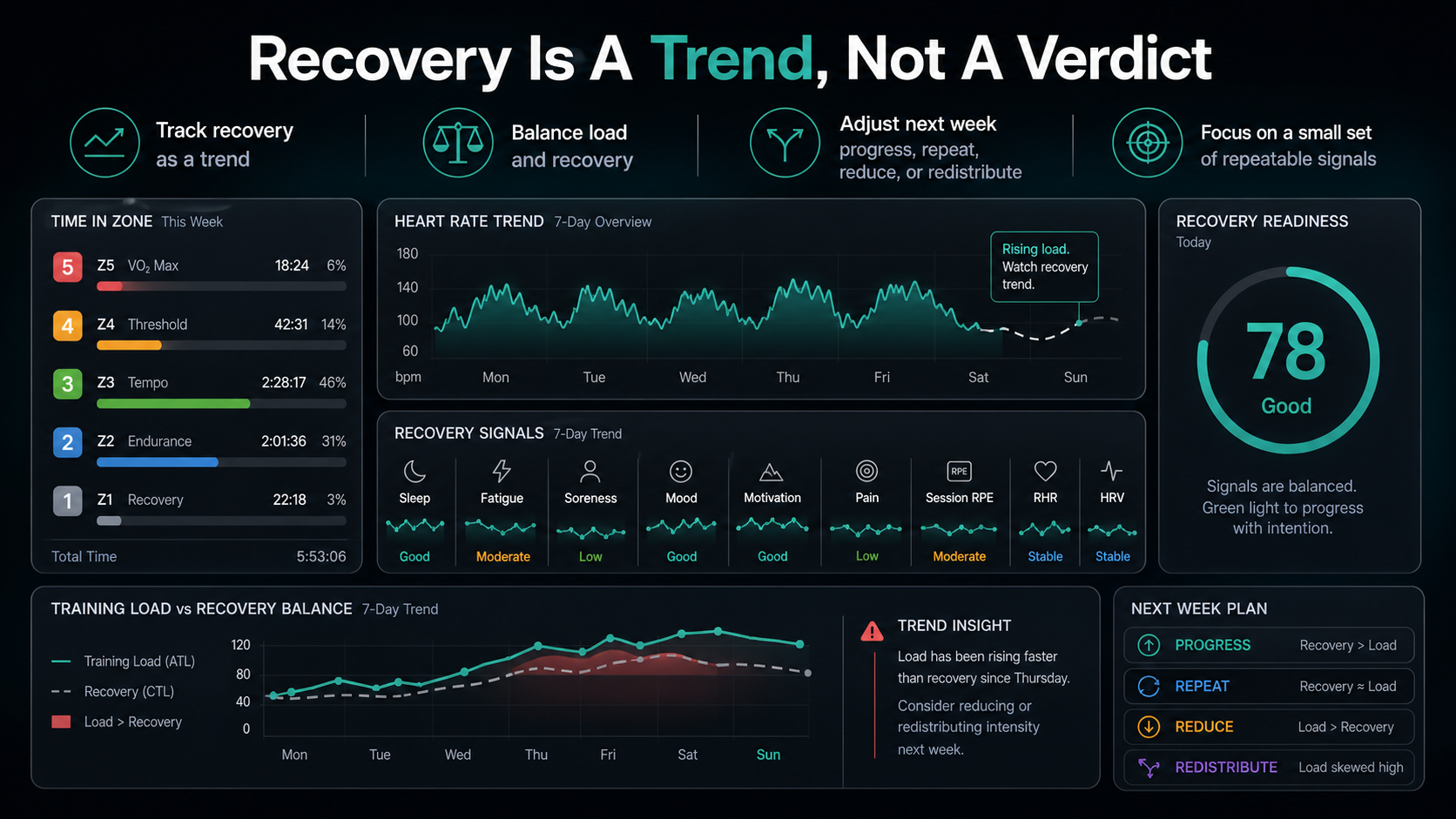
A good recovery log should answer three questions:
- What stress did I apply?
- How did I respond?
- What should change next?
The first question comes from training load: duration, intensity, frequency, terrain, heat, elevation, strength work, and racing. The second comes from the body: sleep, fatigue, soreness, mood, motivation, pain, resting HR, HRV, and how normal workouts feel. The third is the coaching decision: progress, hold, repeat, reduce, or redistribute intensity.
The best system is the one you will actually maintain. For most athletes, that means a 30-second daily check-in plus a 10-minute weekly review.
Why Recovery Tracking Matters
Training improves endurance only when stress and recovery are matched well enough for adaptation. Too little stress and the body has no reason to change. Too much stress without enough recovery and the athlete may accumulate fatigue faster than fitness. The point of recovery tracking is to see that mismatch early, before it becomes a missed week, a forced break, or a pattern of poor workouts.
Training load research separates the work performed from the body's response to that work. A 2017 consensus statement on monitoring athlete training loads describes load monitoring as a way to understand the relationship between training, competition, fatigue, adaptation, and injury or illness risk. Impellizzeri, Marcora, and Coutts later emphasized the distinction between external load, such as distance or power, and internal load, the athlete's physiological and psychological response (International Journal of Sports Physiology and Performance, 2019).
Recovery tracking sits on the internal-response side of that relationship. Two athletes can complete the same week on paper and respond very differently. One may be sleeping well, hitting normal paces at normal effort, and feeling ready for the next block. Another may show rising fatigue, unusually high perceived effort, poor mood, and a dull pain that changes their stride. The external load is similar. The recovery status is not.
Halson's review on monitoring training load to understand fatigue makes the practical point that monitoring is useful because fatigue is multifactorial. It can reflect training, sleep, nutrition, travel, heat, illness, psychological stress, and competition demands. That is why a good recovery system includes both training context and non-training context. If you only track mileage, you may miss stress. If you only track sleep score, you may miss load.
Recovery tracking is also not a promise that every dip can be prevented. Endurance training requires fatigue. During a productive block, you may feel heavy for a day or two. After a race, your metrics may be off. During a training camp, soreness may be expected. The goal is not to keep every recovery signal green. The goal is to distinguish planned, temporary fatigue from a pattern that suggests poor absorption.
What To Track Daily
Daily tracking should be fast. If the checklist takes too long, athletes either stop doing it or start overthinking it. Use a 1 to 5 scale, a few yes/no fields, and optional notes only when something meaningful happened.
Start with sleep. Track sleep duration and sleep quality separately if possible. Duration is the rough amount of time available for recovery. Quality captures whether that time was useful. Fullagar and colleagues reviewed evidence on sleep and athletic performance, noting that sleep loss can affect exercise performance and physiological or cognitive responses. Consumer sleep staging is not perfect, but consistent sleep timing, short sleep, and poor perceived sleep are still useful recovery context.
Track fatigue next. Use a simple prompt: "How tired do I feel before training?" This should be separate from sleep because an athlete can sleep eight hours and still feel flat after a hard block, travel day, illness, or stressful work period.
Track muscle soreness. General soreness is normal after hard sessions, hills, strength training, or racing. The useful pattern is whether soreness is resolving, spreading, or changing movement. Soreness that improves during an easy warm-up is different from pain that worsens, alters mechanics, or persists at rest.
Track mood and stress. Subjective measures matter because the nervous system does not separate training stress from the rest of life. A demanding work week, poor sleep from parenting, exams, travel, or emotional stress can reduce the amount of training you can absorb. The Saw review supports the practical value of self-reported measures such as mood, stress, fatigue, and soreness for monitoring training response (BJSM, 2016).
Track motivation. A low-motivation day is not automatically a red flag. Everyone has them. But a trend of low motivation, irritability, heavy legs, and poor sleep alongside rising load deserves attention.
Track pain or niggles as a separate field, not hidden inside soreness. Use simple categories: none, mild, moderate, severe, or "changes movement." If pain changes your gait, pedaling mechanics, or willingness to load a limb, it should influence the next decision even when your readiness score looks good.
Many athletes should also track menstrual cycle phase and symptoms, allergy flare-ups, illness symptoms, heat exposure, fueling issues, and alcohol intake when relevant. Do not add every field forever. Add fields that explain recurring patterns in your own training.
What To Track From Workouts
Recovery is not only measured before training. Workouts reveal how the body is responding under load.
The simplest workout metric is session RPE: how hard the whole session felt, usually on a 0 to 10 scale. Foster and colleagues popularized session RPE as a practical way to quantify training load by multiplying session duration by perceived intensity (Journal of Strength and Conditioning Research, 2001). Even if you do not calculate a formal score, recording RPE helps you see when normal sessions start feeling unusually hard.
For endurance athletes, the phrase "easy felt easy" is valuable. If Zone 2 runs, rides, or swims begin to feel like moderate work, recovery may be lagging. That does not mean every easy session must feel effortless. Heat, hills, wind, dehydration, poor fueling, and life stress all matter. But if easy sessions are repeatedly drifting upward in effort, the plan may need adjustment.
Track the relationship between pace or power and heart rate. If the same easy pace produces a higher-than-normal heart rate, or if the same power feels unusually hard, note it. Heart rate drift during steady aerobic sessions can also help reveal aerobic durability and fatigue, but interpret it in context. Heat, dehydration, caffeine, altitude, cardiac drift, and measurement error can all affect heart rate.
Track whether key sessions are completed as intended. This does not mean forcing every interval at all costs. It means noticing the pattern. One failed workout is information. Repeated failures, shortened sessions, or needing unusually long recoveries after normal workouts are stronger signals.
Finally, record the recovery cost of hard sessions. Two threshold sessions can have similar pace or power but very different after-effects. If one workout leaves you functional the next day and another disrupts sleep, appetite, mood, and easy pace for three days, the second workout is more costly for you even if it looks impressive.
How To Use Device Metrics Without Letting Them Run The Plan
Objective metrics can help, especially when they are measured consistently. They become less helpful when athletes treat them as commands.
Resting heart rate is a simple signal. A higher-than-normal resting heart rate may reflect fatigue, stress, dehydration, illness, heat, alcohol, poor sleep, or a hard prior session. The key phrase is "higher than normal." Compare against your own baseline, measured in the same conditions. Do not compare your resting heart rate with another athlete's.
Heart rate variability, or HRV, can be useful for some endurance athletes because it reflects autonomic nervous system regulation. Plews and colleagues discussed HRV as a monitoring tool for training adaptation in endurance athletes (Sports Medicine, 2013). Buchheit's review on monitoring training status with heart-rate measures also highlights that HR-based monitoring can be informative, but interpretation is not always straightforward.
The practical rule is consistency. Measure HRV at the same time, in the same posture, with the same device, and look at rolling trends. A single low HRV reading should not automatically cancel training. A multi-day drop combined with poor sleep, high soreness, low mood, elevated resting HR, and poor workout feel is more meaningful.
Sleep scores can be useful, but do not confuse precision with accuracy. Wearables may estimate sleep duration reasonably for many users, but sleep stages and recovery scores are modeled estimates. Your subjective sleep quality still matters. If a device says you slept well but you were awake half the night with stress, believe the context.
Daily readiness scores are best treated as summaries, not verdicts. They often combine sleep, HRV, resting heart rate, recent load, and proprietary weighting. The score can help you notice a trend, but it cannot know the full training goal, the importance of the next workout, the history of a pain issue, or whether you are intentionally carrying fatigue during a planned block.
Use device metrics as a second opinion. If your subjective check-in, training log, and device trend all point in the same direction, confidence goes up. If they disagree, slow down and interpret. A green device score with sharp pain is not a green light. A poor score after one bad night does not automatically mean the week is ruined.
How To Review Recovery Weekly
A weekly recovery review should connect four things: planned load, completed load, recovery response, and the next training decision.
Start with planned load. What did the week intend to do? Build aerobic volume, touch threshold, add VO2 max work, absorb a race, return from illness, or unload after a block? Recovery cannot be judged without knowing the purpose of the week.
Then compare completed load. Did you actually complete the planned work? Look at duration, intensity distribution, long-session load, strength training, racing, elevation, terrain, and heat. A week can have the same total hours but a very different recovery cost if intensity is crowded into too many days.
Next, review recovery response. Look at daily fatigue, soreness, mood, stress, sleep, motivation, resting HR, HRV, pain, and how easy sessions felt. Do not average everything into one bland number too quickly. The pattern matters.
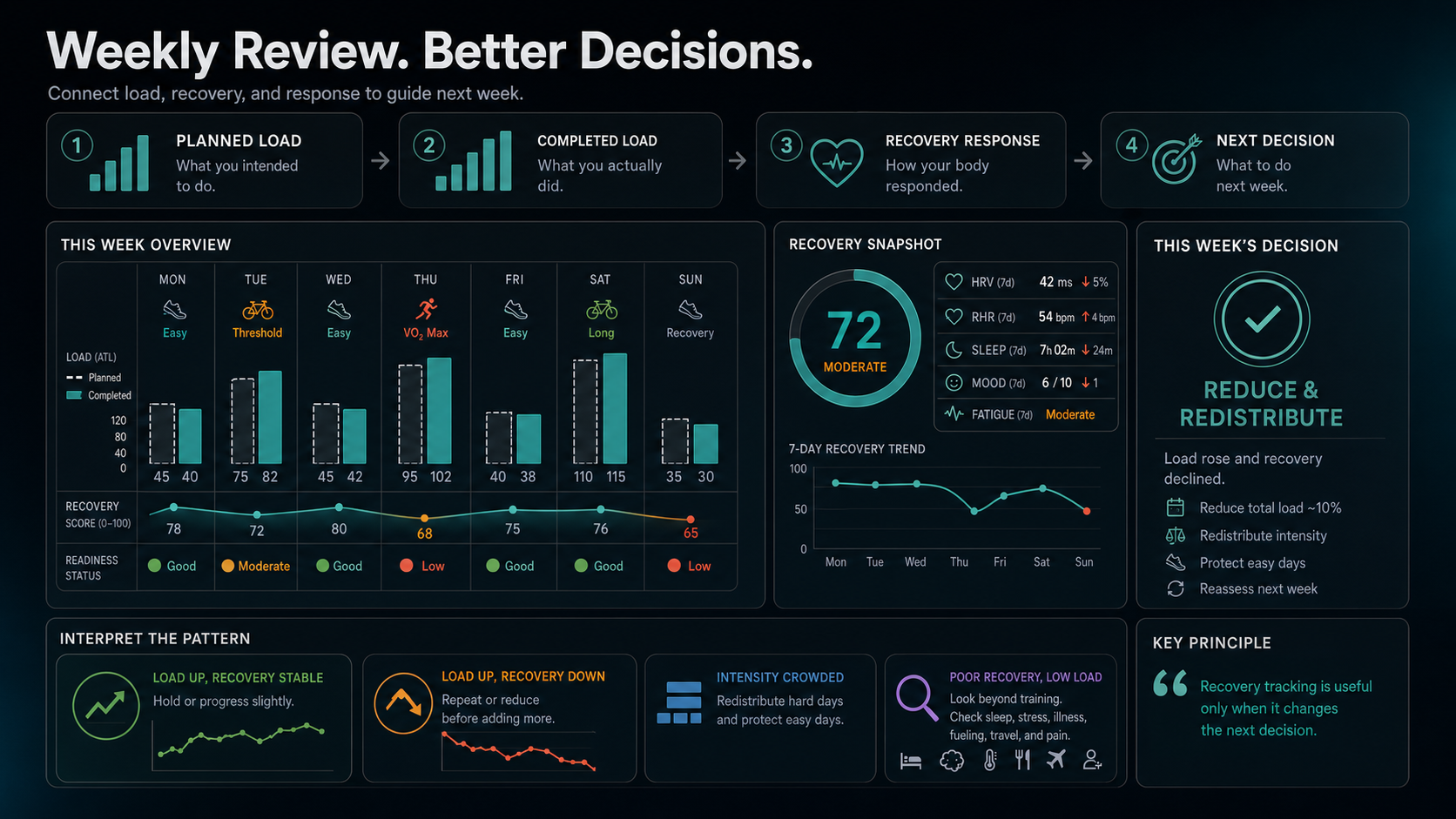
Use the review to make a decision:
| Weekly pattern | Likely interpretation | Next decision |
|---|---|---|
| Load rose and recovery stayed stable | You may be absorbing the block | Hold or progress slightly |
| Load rose and recovery declined | Stress may be outpacing recovery | Repeat the week, reduce load, or add spacing |
| Load was normal but easy days felt hard | Intensity or life stress may be too high | Protect easy days and remove extra hard efforts |
| Load was low but recovery stayed poor | Something beyond training may be driving fatigue | Check sleep, stress, illness, fueling, travel, or pain |
| Device score was good but pain worsened | Recovery score missed a local tissue issue | Modify training and address the pain |
| Device score was poor but you felt normal | One metric may be noisy | Watch the trend and keep the session flexible |
This review should not become a courtroom argument with your watch. It should be a coaching conversation with yourself. What did the plan ask for? What did the body show? What is the smallest useful adjustment?
The overtraining consensus statement by Meeusen and colleagues describes overtraining syndrome as complex and difficult to diagnose, with performance decline and persistent fatigue among the concerns (Medicine and Science in Sports and Exercise, 2013). Most athletes are not diagnosing overtraining each week. They are trying to notice early when the plan is becoming too expensive. Weekly recovery review helps you act before the signs become dramatic.
Common Recovery Tracking Mistakes
The first mistake is tracking too much. A crowded dashboard can feel serious, but it often creates noise. If you record 25 fields and never use them to change training, the system is not helping. Start with the smallest useful set.
The second mistake is trusting a single readiness score blindly. Readiness scores can be useful summaries, but they are not context-aware coaching decisions. They do not fully understand your race calendar, pain history, training age, fueling, motivation, or life constraints.
The third mistake is ignoring subjective data. Many endurance athletes treat feelings as soft and device data as hard. That is backwards for many recovery decisions. Subjective data is not perfect, but it often captures the integrated response to training and life stress.
The fourth mistake is changing the plan after every single bad signal. Recovery tracking should create better decisions, not daily panic. If one metric is off but everything else looks normal, keep the workout flexible. If several signals are off for several days, act.
The fifth mistake is comparing recovery metrics across athletes. HRV, resting heart rate, sleep needs, soreness patterns, and RPE are individual. Your baseline is the comparison that matters.
The sixth mistake is only tracking recovery when training is already going badly. The useful baseline comes from normal weeks. If you only start tracking during a crisis, you have less context for interpreting what changed.
A Simple Recovery Tracking Template
Use this daily check-in. It should take less than 30 seconds:
- Sleep duration: hours
- Sleep quality: 1 to 5
- Fatigue: 1 to 5
- Soreness: 1 to 5
- Mood or stress: 1 to 5
- Motivation: 1 to 5
- Pain or niggle: none, mild, moderate, severe, changes movement
- Resting HR or HRV: optional, only if measured consistently
- Training note: one sentence if something unusual happened
After each workout, add:
- Session RPE: 0 to 10
- Duration
- Main intensity
- Easy felt easy: yes, no, or mixed
- Completed as planned: yes, adjusted, or no
- Recovery cost next day: low, moderate, or high
Then use this weekly review:
- What was the goal of the week?
- What load did I actually complete?
- Did fatigue, soreness, mood, sleep, pain, RPE, resting HR, or HRV trend worse?
- Did easy training feel easy?
- Did key sessions improve, hold, or fall apart?
- What non-training stress affected recovery?
- Should next week progress, hold, repeat, reduce, or redistribute intensity?
For many athletes, the best adjustment is not a full rest week. It is often smaller: move the hard session by one day, shorten the long run, remove extra tempo from an easy ride, keep the same volume instead of increasing it, or replace intensity with aerobic work until recovery stabilizes.
Recovery tracking becomes powerful when it protects consistency. The athlete who notices fatigue early can usually adjust slightly and keep training. The athlete who ignores the trend may need a much larger correction later.
Conclusion
Endurance athletes should track recovery with a simple trend system: subjective daily check-ins, a few consistent objective metrics, workout response, and a weekly review that leads to a training decision.
Do not let recovery tracking become a search for perfect certainty. Sleep, soreness, fatigue, mood, pain, session RPE, resting heart rate, HRV, and workout feel all have limitations. Their value comes from being recorded consistently and interpreted together.
If the trend says you are absorbing the work, keep building carefully. If the trend says recovery is slipping, adjust before the plan forces you to stop. Recovery tracking is not separate from training. It is how you decide whether the next dose of training is the right one.

Our editorial approach & AI disclosure
We use AI to help research, organize, and draft some articles. Every article is reviewed by a human editor and aims to reflect current evidence-based training practices and scientific literature.
Read our editorial policy