

Aerobic Base
How Do You Know If Your Base Training Is Working?
Base training is working when easy efforts become more efficient, long sessions drift less, recovery improves, and your weekly training becomes more repeatable. Learn which signals matter and which ones mislead.

Introduction
You know base training is working when easy endurance work becomes more efficient and more repeatable. The same easy effort produces slightly better pace or power, heart rate rises less during steady sessions, recovery between workouts improves, and your weekly training becomes more consistent without needing extra willpower.
The key is to look for a cluster of signals. No single metric proves that your aerobic base is improving. A lower heart rate can mean better fitness, but it can also mean cool weather, fatigue, caffeine changes, sensor error, or a route with less climbing. A faster easy pace can mean better fitness, but it can also mean you are pushing too hard and quietly turning base training into moderate training.
Base training is working when output, internal load, recovery, and consistency move in the right direction together. That matters because endurance performance is not one physical trait. A major review by Jones and Carter describes aerobic fitness through interacting parameters such as VO2max, lactate or ventilatory threshold, exercise economy, and oxygen uptake kinetics Jones and Carter, 2000. Base training should make that whole system more durable, not just improve one watch score.
This guide explains the signals worth tracking, the signals that often mislead athletes, and what to adjust if your base phase is not producing the progress you expected.
The short answer: look for a cluster of signals
Base training is probably working if several of these are true over a few weeks:
- Your heart rate is lower at the same easy pace or power.
- Your pace or power is higher at the same easy heart rate.
- Long steady sessions show less heart-rate drift.
- Easy sessions leave less soreness and fatigue.
- You can complete more consistent weeks.
- Your perceived effort is calmer at the same output.
- You can add light intensity without destabilizing the week.
The pattern matters more than any one data point. One good workout is not proof. One bad workout is not failure. Use similar sessions, similar terrain, similar weather, and a time window of at least three to six weeks.
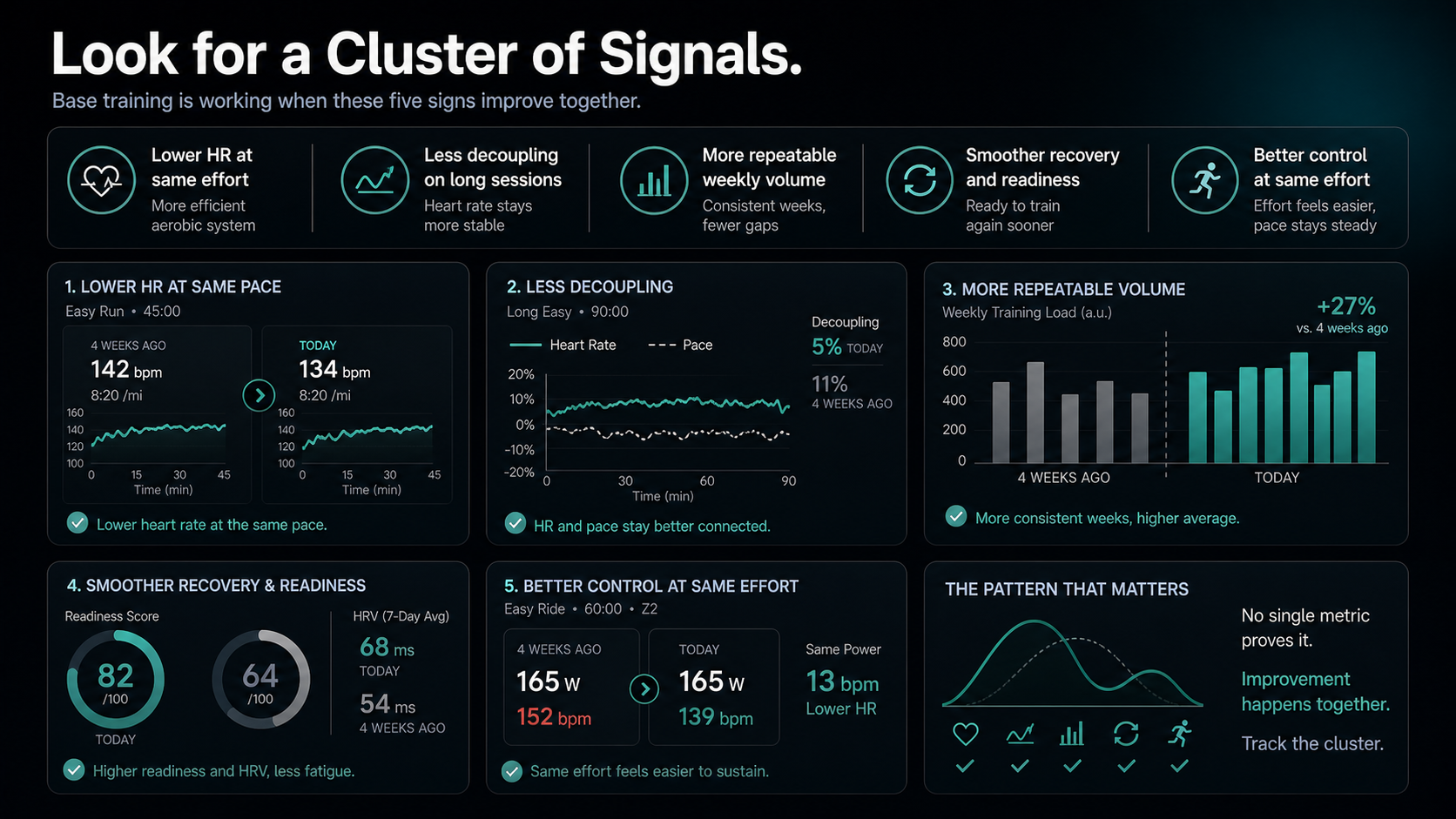
Signal 1: lower heart rate at the same pace or power
The clearest field sign is improved efficiency: you can do the same external work with a lower internal cost. For a runner, that may mean your usual easy route averages the same pace at a lower heart rate. For a cyclist, it may mean the same endurance power requires fewer beats per minute. For a hiker, it may mean you climb the same grade with steadier breathing.
This signal fits the basic physiology of endurance adaptation. Training improves oxygen delivery and muscle metabolic regulation, which can let athletes sustain a given output more comfortably Jones and Carter, 2000. It also fits the goal of base training: not to make every easy session faster, but to make easy work cheaper.
To track it well, compare like with like. Use the same route or indoor setup. Ignore days with unusual heat, wind, poor sleep, dehydration, illness, or high life stress. Look at rolling averages rather than one workout.
A good sign:
- Four weeks ago: 45 minutes at 8:30 per mile, average heart rate 145.
- Today: 45 minutes at 8:30 per mile, average heart rate 137, similar weather and effort.
That does not mean every run should now be faster. It means the aerobic cost of a familiar workload may be dropping.
Signal 2: less heart-rate drift on long steady sessions
Heart-rate drift, often called aerobic decoupling, is when heart rate rises during a steady session even though pace or power stays similar. Some drift is normal, especially as duration, heat, dehydration, and fatigue accumulate. But if your base improves, the same long aerobic effort should often become more stable.
Cardiovascular drift is a known response during prolonged moderate exercise. Coyle and Gonzalez-Alonso describe it as a progressive fall in stroke volume accompanied largely by a rise in heart rate after sustained exercise Coyle and Gonzalez-Alonso, 2001. Wingo, Ganio, and Cureton also note that drift has implications for exercise prescription, especially in heat stress Wingo et al., 2012.
In practical terms, if you run or ride steady for 75 to 120 minutes and your heart rate climbs sharply while output stays flat, the session may be too long, too hot, under-fueled, too hard, or simply beyond your current durability. If the same session shows less drift after several weeks of base work, that is a strong sign your endurance is becoming more durable.
Do not chase a perfect zero-drift workout. Instead, ask whether the trend is improving under similar conditions.
Signal 3: your easy days actually feel easy
Base training is not working well if every easy session requires negotiation. You should not need to hype yourself up for routine aerobic work. A working base phase usually makes ordinary sessions feel calmer, more rhythmic, and less costly.
Perceived effort matters because heart rate and pace do not tell the whole story. Buchheit's review on heart-rate measures argues that heart-rate data should be interpreted with training context and combined with logs, questionnaires, and practical performance tests rather than used alone Buchheit, 2014. In other words, your notes about effort, mood, soreness, and readiness are not soft data. They are part of the signal.
Useful notes are simple:
- "Felt controlled after 10-minute warm-up."
- "Same route, less breathing strain."
- "Legs heavy despite low HR."
- "Easy pace drifted into moderate effort."
- "Recovered quickly next morning."
Over time, those notes reveal whether the base block is creating capacity or only fatigue.
Signal 4: you recover faster from routine aerobic work
A good base phase should make normal aerobic work easier to absorb. You may still feel tired after a longer week, but ordinary easy sessions should not leave you sore, flat, or irritable for days.
Recovery is one reason base training works: it lets you repeat enough low-cost sessions to accumulate adaptation. If your weekly plan keeps collapsing after routine workouts, the stimulus may be too high, your easy intensity may be too hard, or your recovery habits may be limiting adaptation.
Watch for these positive signs:
- You wake up ready to train after easy days.
- Soreness fades faster after long aerobic sessions.
- You can keep strength work in the week without feeling overloaded.
- You do not need extra rest after every longer session.
- Appetite, sleep, and mood remain stable as volume increases.
Heart-rate variability can help some athletes monitor adaptation, but it should be used carefully. Plews and colleagues reviewed HRV monitoring in elite endurance athletes and found that interpretation is not always straightforward; athletes need longitudinal context and individual patterns Plews et al., 2013. If your HRV, resting heart rate, and subjective readiness all improve together, that is useful. If one metric moves alone, treat it as a prompt to look closer, not a verdict.
Signal 5: weekly volume becomes more repeatable
The most underrated sign of base fitness is consistency. If your base training is working, you can complete more normal weeks with fewer forced gaps.
That does not mean you should always add volume. It means the volume you already do becomes more stable. The long run stops wrecking the next two days. The easy ride stops turning into a hidden race. The Monday session after a weekend long workout becomes possible again.
Endurance training is built through repeated exposure. Seiler's review of endurance training intensity distribution notes that successful endurance athletes often organize a large proportion of sessions at low intensity, with smaller amounts of harder work added deliberately Seiler, 2010. For everyday athletes, the practical lesson is not to copy elite volume. It is to make most training repeatable enough that the week can compound.
Track this with simple questions:
- Did you complete the planned easy sessions?
- Did the long session compromise the rest of the week?
- Did intensity leak into days that were supposed to be easy?
- Did soreness or fatigue force unplanned rest?
- Did your weekly minutes rise without a matching rise in strain?
If the answers improve over time, your base is probably doing its job.
Signal 6: thresholds and benchmark workouts move in the right direction
Some athletes can test more formally. If you use lactate testing, ventilatory testing, field tests, or repeatable submaximal benchmarks, base training may show up as a rightward shift: you can produce more pace or power before the same physiological breakpoint.
Lactate-threshold concepts are not perfectly simple, but they are useful when interpreted carefully. Faude, Kindermann, and Meyer reviewed lactate-threshold methods and describe threshold measures as important for assessing endurance capacity and prescribing intensity, while also noting terminology and measurement complexity Faude et al., 2009.
You do not need a lab to use the idea. A field benchmark can be enough:
- Warm up the same way.
- Hold a controlled aerobic heart-rate cap for 30 to 45 minutes.
- Record pace or power, average heart rate, perceived effort, and drift.
- Repeat every four to six weeks under similar conditions.
If pace or power improves at the same cap and perceived effort stays controlled, the base is likely improving. If the output improves but effort jumps, you may be testing harder rather than getting fitter.
Signals that do not prove base training is working
Some signs feel satisfying but are weak evidence.
A faster easy pace does not prove progress if your heart rate and perceived effort also rose. You may simply be training harder.
A lower heart rate does not prove progress if you feel flat, unmotivated, or unusually heavy. Sometimes fatigue suppresses heart rate.
A higher watch VO2max estimate can be encouraging, but it is not the base itself. Treat it as a derived estimate, not a training diagnosis.
Weight loss does not prove base fitness. It may help some athletes in some contexts, but it can also reflect under-fueling.
Sweating more, feeling destroyed, or earning a bigger calorie number does not prove aerobic development. Base training should often feel almost too controlled.
The safest interpretation is always contextual: output, internal load, perceived effort, recovery, and consistency should tell the same general story.
What if your base training is not working?
If the signals are not improving after several weeks, start with intensity. Many athletes fail base blocks by making easy days moderately hard. The session feels productive, but the week becomes harder to repeat.
Next, look at volume. If you increased duration too quickly, your aerobic system may be fine while your legs, connective tissue, sleep, or motivation are not. Hold volume steady until the same week feels easier.
Then check consistency. Two big sessions followed by five inactive days rarely build the same base as several repeatable aerobic touchpoints.
Also check fueling and recovery. Under-fueled base training can look disciplined for a while, then show up as poor sleep, heavy legs, low mood, stalled progress, and cravings.
Finally, check whether your benchmark is fair. Comparing a cool flat morning to a hot hilly afternoon tells you more about conditions than fitness.
If you need a simple reset, use this for two weeks:
- Keep all aerobic sessions conversational.
- Shorten the long session slightly.
- Remove moderate "almost tempo" work.
- Keep notes on sleep, soreness, and motivation.
- Repeat one familiar aerobic benchmark.
If you feel better and the numbers stabilize, the issue was probably not lack of fitness. It was load management.
How often should you check progress?
Check trends weekly, but judge progress monthly. Weekly review helps you catch obvious problems. Monthly review gives the data enough time to breathe.
For most athletes, a useful review includes:
- One repeatable easy benchmark.
- One long-session drift check.
- Weekly volume and missed sessions.
- Subjective recovery notes.
- Any change in resting heart rate or HRV, if you track them.
Do not test hard every week to prove the base is working. That can turn a base block into a test block. Base progress is often quiet: calmer breathing, steadier heart rate, better recovery, and fewer gaps in the log.
A simple weekly review template
Use the same review questions every week. Consistency makes the answers more useful than a complicated dashboard you only check when training feels good.
Start with the week as a whole. Did you complete the planned aerobic sessions? Did you miss sessions because of normal life, or because the training load was too much? If the same type of workout keeps causing missed days, that is a training signal.
Next, review your easy sessions. Pick one or two comparable workouts and ask whether the relationship between pace or power, heart rate, and perceived effort is improving. You are not looking for perfection. You are looking for a gradual shift: the same easy work feels calmer, or the same heart-rate range produces a little more output without extra strain.
Then check the long session. Did heart rate drift less than usual? Did breathing and form stay controlled late in the workout? Did you recover well enough to resume normal training within a day or two? If the long session keeps disrupting the week, your base is not failing; your progression may simply be ahead of your current durability.
Finally, review recovery. Look at sleep, soreness, mood, appetite, resting heart rate, HRV if you track it, and motivation. Buchheit's review is useful here because it argues for interpreting heart-rate measures in training context rather than treating them as standalone answers Buchheit, 2014. Your training log should connect numbers with how the work felt.
Try this five-line review:
- Efficiency: Same output, lower cost?
- Drift: Long session more stable?
- Recovery: Ready sooner?
- Consistency: Fewer missed sessions?
- Control: Easy days stayed easy?
If three or more are improving, the base block is probably moving in the right direction.
How to choose a good benchmark workout
A benchmark should be repeatable, submaximal, and boring. If it requires a huge effort, it is a fitness test, not a base check.
For runners, a good benchmark might be 30 to 45 minutes on a familiar flat route at a fixed heart-rate cap. For cyclists, it might be 45 to 60 minutes at a steady endurance power indoors. For hikers, it might be a familiar climb at conversational effort. For rowers or skiers, it might be a steady aerobic session on the same machine or route.
Keep the warm-up consistent. Keep the intensity controlled. Record the same fields each time: duration, average heart rate, pace or power, perceived effort, drift, notes on conditions, and how you felt the next day.
Avoid comparing benchmarks when conditions are wildly different. Heat, wind, hills, altitude, poor sleep, dehydration, and stress can all change the result. A benchmark is only useful when it is boring enough to repeat honestly.
The best sign is not one heroic improvement. It is a boring benchmark that gradually becomes easier to complete.
Conclusion
Base training is working when the same aerobic work costs less and your training week becomes easier to repeat. Look for lower heart rate at the same output, less drift on long steady sessions, calmer perceived effort, better recovery, more consistent weekly volume, and benchmark improvements that do not require forcing the pace.
The strongest evidence is a cluster. One metric can mislead you. Several improving signals, repeated across similar sessions, are much harder to fake.
Track the pattern, keep easy work truly easy, and judge progress over weeks rather than days. A good base does not just make you faster once. It makes endurance training more sustainable.

Our editorial approach & AI disclosure
We use AI to help research, organize, and draft some articles. Every article is reviewed by a human editor and aims to reflect current evidence-based training practices and scientific literature.
Read our editorial policy