

Aerobic Base
What Is Aerobic Base Training?
Aerobic base training is the controlled, repeatable endurance work that builds durability below your first threshold. Learn what it is, how it works, and how to use it without turning every session into a slow grind.

Introduction
Aerobic base training is the controlled endurance work that makes your body better at producing energy with oxygen, clearing and using lactate, and repeating training day after day without excessive fatigue. It usually means doing a large share of your running, cycling, hiking, rowing, skiing, or other endurance training at an intensity below your first lactate or ventilatory threshold.
That definition is more useful than the common shorthand "just go slow." Base training is not slow for its own sake. It is training that is easy enough to accumulate consistently and specific enough to improve the systems that support endurance performance: oxygen delivery, mitochondrial function, metabolic control, movement economy, and fatigue resistance.
The idea is old, but it keeps coming back because endurance athletes keep running into the same problem. Hard training is powerful, but expensive. If every session is moderately hard, you get stress without enough repeatability. If every session is very easy but never progresses, you get activity without enough development. Aerobic base training sits in the middle of that decision: it gives you a way to build a bigger engine before asking that engine to work harder.
For most athletes, the practical answer is simple: make most endurance sessions conversational, controlled, and repeatable, then add harder work deliberately. That approach is consistent with research showing that endurance performance depends on several interacting qualities, including VO2max, lactate or ventilatory thresholds, economy, and oxygen uptake kinetics, not one magic workout type. A review by Jones and Carter describes endurance training as improving the body's ability to deliver oxygen and regulate muscle metabolism, which lets athletes last longer at the same pace or sustain a faster pace for the same duration Jones and Carter, 2000.
This guide explains what aerobic base training is, where it sits in heart-rate zones, how it works physiologically, how much to do, and how to avoid the common mistake of turning base work into endless gray-zone fatigue.
Aerobic base training in one sentence
Aerobic base training means accumulating most of your endurance work at an intensity you can repeat often: usually below your first lactate or ventilatory threshold, where breathing is controlled, lactate production and clearance stay close to balance, and fatigue is low enough that you can train again tomorrow.
In practical terms, this is the work many athletes call easy running, easy riding, zone 2, low aerobic, or conversational pace. The exact label matters less than the behavior: the session should feel controlled, sustainable, and boring enough that you finish with more training capacity rather than less.
The first threshold is the useful dividing line. Below it, you are still working, but your body can rely heavily on oxidative metabolism. Above it, the session may still be aerobic, but stress rises faster and recovery cost increases. Lactate-threshold research has used many definitions, but a major review by Faude, Kindermann, and Meyer describes the first rise in blood lactate above baseline and the higher maximal lactate steady state as meaningful landmarks for endurance testing and training prescription Faude et al., 2009.
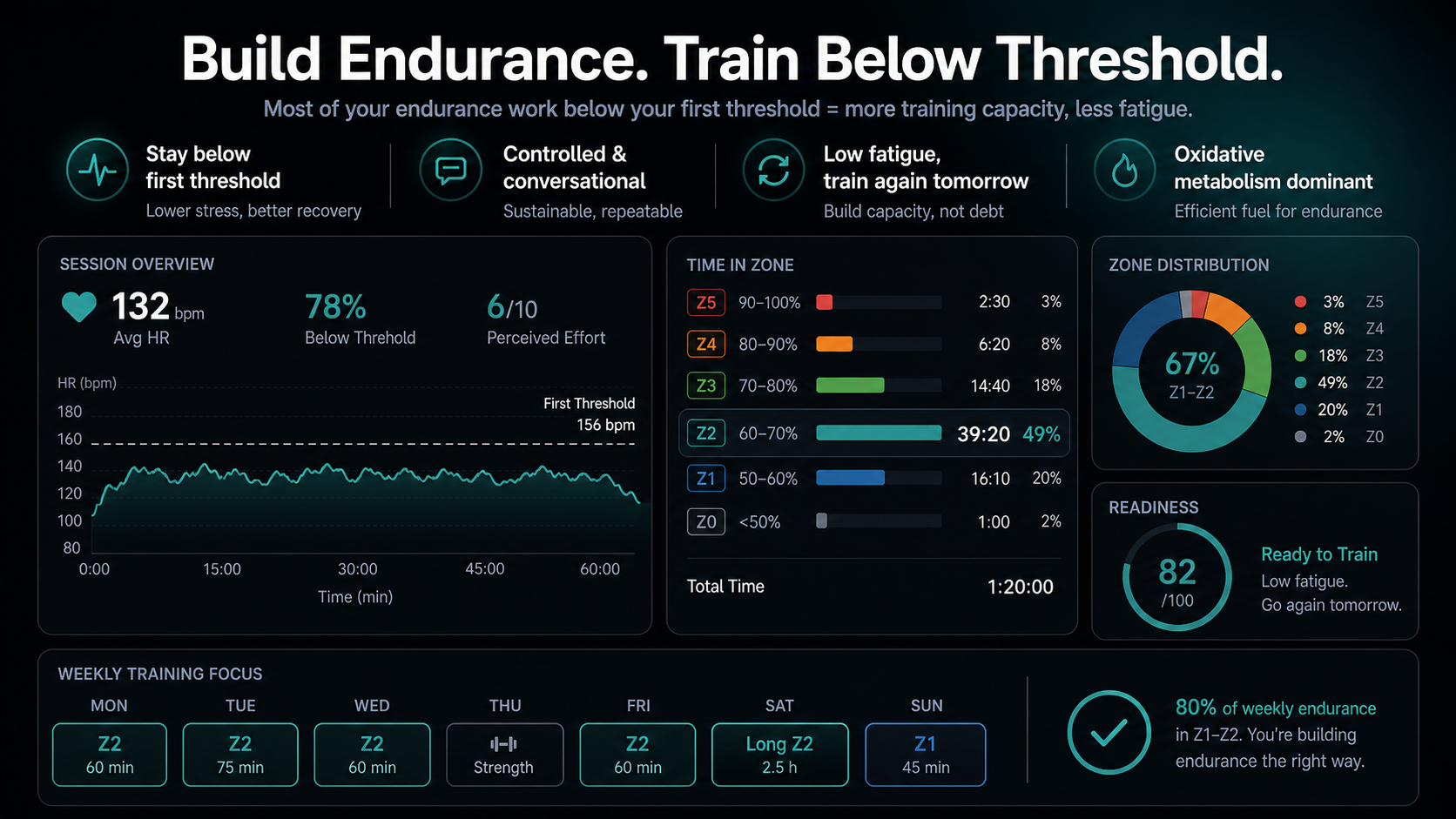
If you use a five-zone model, aerobic base training often lands mostly in zones 1 and 2. If you use a three-zone threshold model, it is mostly zone 1: below the first threshold. If you use only feel, it is the pace where you can speak in full sentences, keep your stride or pedal stroke relaxed, and avoid the creeping sense that you are racing your own workout.
Why it is called a base
The word "base" can sound vague, but the concept is concrete. A base is the training capacity underneath your harder workouts and your goal event. It is the reason you can handle a long run, recover from intervals, ride longer without fading, or climb at a steady pace without breathing like you are at the finish line.
Base training improves durability in two ways. First, it gives you more low-cost volume. That matters because endurance adaptations are strongly tied to repeated exposure. Second, it lets you practice the exact skill of staying efficient when the effort is not dramatic. Many races and long events are decided not by one heroic surge, but by how little you deteriorate after one, two, three, or five hours.
Physiologists usually describe endurance performance through interacting determinants rather than one single "aerobic base" variable. Jones and Carter highlight VO2max, exercise economy, lactate or ventilatory threshold, and oxygen uptake kinetics as key parameters Jones and Carter, 2000. Base training supports several of these at once. It may not maximize every determinant by itself, but it creates the background fitness that makes more specific training possible.
That is why experienced endurance athletes rarely treat base training as only an off-season phase. They may emphasize it more in a base block, but controlled aerobic work usually remains a large part of training year-round.
What happens in your body during base training?
Aerobic base training is not easy because nothing is happening. It is easy because the stress is distributed across systems that can handle a lot of repetition.
At the muscle level, endurance exercise stimulates remodeling that improves the way muscle uses oxygen and fuel. Egan and Zierath describe exercise training as triggering metabolic and molecular remodeling in skeletal muscle through many signaling pathways Egan and Zierath, 2013. One classic foundation for this idea comes from Holloszy's work showing that exercise training increased mitochondrial oxygen uptake and respiratory enzyme activity in skeletal muscle Holloszy, 1967.
You do not need to memorize the molecular pathways to train well. The practical takeaway is that repeated aerobic work teaches muscle to do more with oxygen. Over time, that can support better endurance at a given heart rate, less drift during longer sessions, and a higher sustainable pace or power before breathing and lactate accumulation become limiting.
Base training also changes how your body manages fuel. At lower intensities, a trained endurance athlete can generally rely more on fat oxidation while still using carbohydrate as needed. In a study comparing professional endurance athletes, moderately active people, and people with metabolic syndrome, San-Millan and Brooks found that higher fat oxidation during incremental exercise was associated with lower blood lactate across their study groups San-Millan and Brooks, 2018. That does not mean the goal is to burn only fat or avoid carbohydrate. It means a well-developed aerobic system gives you more metabolic flexibility.
Lactate is often misunderstood here. Base training is not good because it avoids a toxic waste product. Lactate is an important fuel and signaling molecule. Brooks summarizes modern lactate biology by explaining that lactate is produced under aerobic conditions and used continuously by cells and tissues Brooks, 2020. The problem in training is not lactate itself. The problem is spending too much time at intensities where lactate production, breathing stress, muscle tension, and nervous-system cost rise faster than your ability to recover.
That is the central logic of base work: enough stress to improve aerobic machinery, low enough cost to repeat.
Aerobic base vs. zone 2 vs. easy training
These terms overlap, but they are not identical.
Aerobic base training is the broad training goal. It describes a phase or emphasis: building the low-to-moderate intensity endurance foundation that supports later training.
Zone 2 is an intensity label. In many five-zone heart-rate systems, zone 2 is the upper easy or low aerobic range. In some threshold-based systems, however, the same physiological area may be called zone 1 because the system uses only three zones: below the first threshold, between thresholds, and above the second threshold. This is why arguments about zone names often create more heat than clarity.
Easy training is a subjective label. It usually means low perceived effort, but it can drift. A session may feel easy for 20 minutes and become moderate by 60 minutes. A pace may feel easy when you are fresh and become too costly when you are sleep deprived, dehydrated, or training in heat.
For practical training, anchor the concept to physiology and behavior:
- You can talk in full sentences.
- Breathing is controlled, not forced.
- The effort feels repeatable tomorrow.
- Heart rate stays stable after warming up, with limited drift.
- Pace or power may be slower than your ego prefers.
- You finish feeling like you did work, not like you survived a test.
If your watch says zone 2 but you are breathing hard, pressing the pace, and needing a rest day after every session, the label is not helping. If your watch says zone 1 but the session is long, repeatable, and building durability, it may be doing exactly what you need.
Where aerobic base training sits in your zones
The cleanest way to place aerobic base training is by thresholds.
The first threshold is the point where exercise begins to move from very steady aerobic work toward a more demanding middle intensity. In a lab, it may be estimated from blood lactate or ventilatory markers during a graded exercise test. The American Heart Association's scientific statement on cardiopulmonary exercise testing describes CPET as a way to measure integrated cardiovascular, pulmonary, and muscular responses to exercise Balady et al., 2010. For athletes, those ventilatory markers can help separate easier aerobic work from more stressful domains.
In the field, most people do not need a lab test to start. You can triangulate intensity with heart rate, breathing, pace or power, and perceived exertion.
A simple hierarchy works well:
- Use a threshold-tested zone model if you have recent, sport-specific testing.
- Use a conservative heart-rate range if your zones are estimated.
- Use the talk test and perceived effort to keep the session honest.
- Adjust for heat, hills, fatigue, altitude, dehydration, and terrain.
For many recreational athletes, base work happens around a 3 to 4 out of 10 effort. It is not a shuffle, and it is not tempo. Cyclists may feel steady pressure on the pedals but no burning legs. Runners may feel rhythm and lightness, not strain. Hikers may climb with purposeful breathing but without needing frequent stops.
The danger zone is the middle. It feels productive because you are working. It is not so hard that you fear it, but not so easy that you recover quickly. If too many sessions land there, you may get tired without getting the full benefit of either easy volume or high-quality intensity.
Why so many endurance athletes train mostly easy
One reason aerobic base training became central in endurance culture is that many successful athletes do a lot of low-intensity work. In a study of nationally competitive junior cross-country skiers, Seiler and Kjerland found that roughly three-quarters of endurance training was performed in the lowest intensity zone when classified by heart rate or session RPE Seiler and Kjerland, 2006. In a later review, Seiler summarized descriptive studies of competitive endurance athletes as often converging on a pattern where about 80% of sessions are low intensity, with a smaller share dominated by high-intensity work Seiler, 2010.
That does not mean every athlete should copy an elite 80/20 plan. Elite athletes train many hours, have years of adaptation, and may count intensity by sessions rather than minutes. A recreational athlete running four hours per week should not blindly mimic the distribution of a skier training 15 to 25 hours per week.
Still, the pattern teaches an important principle: low-intensity training is not filler. It is the only intensity range most athletes can repeat often enough to build large amounts of endurance without breaking down.
Research comparing training intensity distributions also suggests that the mix matters. In a nine-week study of well-trained endurance athletes, Stoggl and Sperlich reported that polarized training produced greater improvements in several key endurance variables than threshold, high-intensity, or high-volume-only approaches Stoggl and Sperlich, 2014. That study does not prove that polarized training is always best for every athlete. It does support the practical concern that too much threshold-like work can crowd out better combinations of easy volume and targeted intensity.
The base-training lesson is not "never train hard." It is "earn your hard training with enough easy work to absorb it."
What aerobic base training improves
Aerobic base training can improve many outcomes, but the most important benefits are practical.
First, it improves repeatability. The best endurance plan is not the one that looks hardest on paper. It is the one you can execute for enough weeks to adapt. Base sessions should leave you able to train again soon.
Second, it improves durability. Durability means your physiology and mechanics hold together as duration accumulates. In a race, this shows up as less slowing at the same effort. In training, it shows up as lower cardiac drift, steadier pace, fewer late-session spikes in perceived effort, and less soreness from routine volume.
Third, it raises the floor under harder sessions. A runner with a stronger aerobic base may recover better between intervals. A cyclist may arrive at threshold work with less background fatigue. A hiker may climb longer before the legs feel heavy.
Fourth, it gives you more room to progress. If your easy pace becomes faster at the same heart rate, or your long ride becomes less draining at the same power, you have expanded your usable training range. That does not happen every week, and it can be hidden by weather or fatigue, but over months it is one of the clearest signs that base work is doing its job.
Fifth, it supports health and general fitness. The American College of Sports Medicine recommends regular cardiorespiratory training for most adults and notes that exercise programs should be modified according to health status, goals, and individual responses ACSM Position Stand, 2011. Performance base training is not identical to public-health exercise guidance, but they share the same basic truth: consistent aerobic work is a core pillar of fitness.
How much aerobic base training should you do?
The right amount depends on your training history, recovery capacity, goals, and available time. A new endurance athlete may build a base with three or four controlled sessions per week. A recreational runner or cyclist may keep most weekly minutes easy and reserve one or two sessions for faster work. A high-volume athlete may still use the same principle, but with longer sessions and more careful monitoring.
A useful planning rule is simple: make the easy work easy enough that it does not steal quality from the hard work. The weekly pattern should leave room for one long easy session, several repeatable aerobic sessions, and only as much moderate or high intensity as you can absorb.
Base training is not a permanent ban on intensity. It is a way to earn the right to use intensity well.
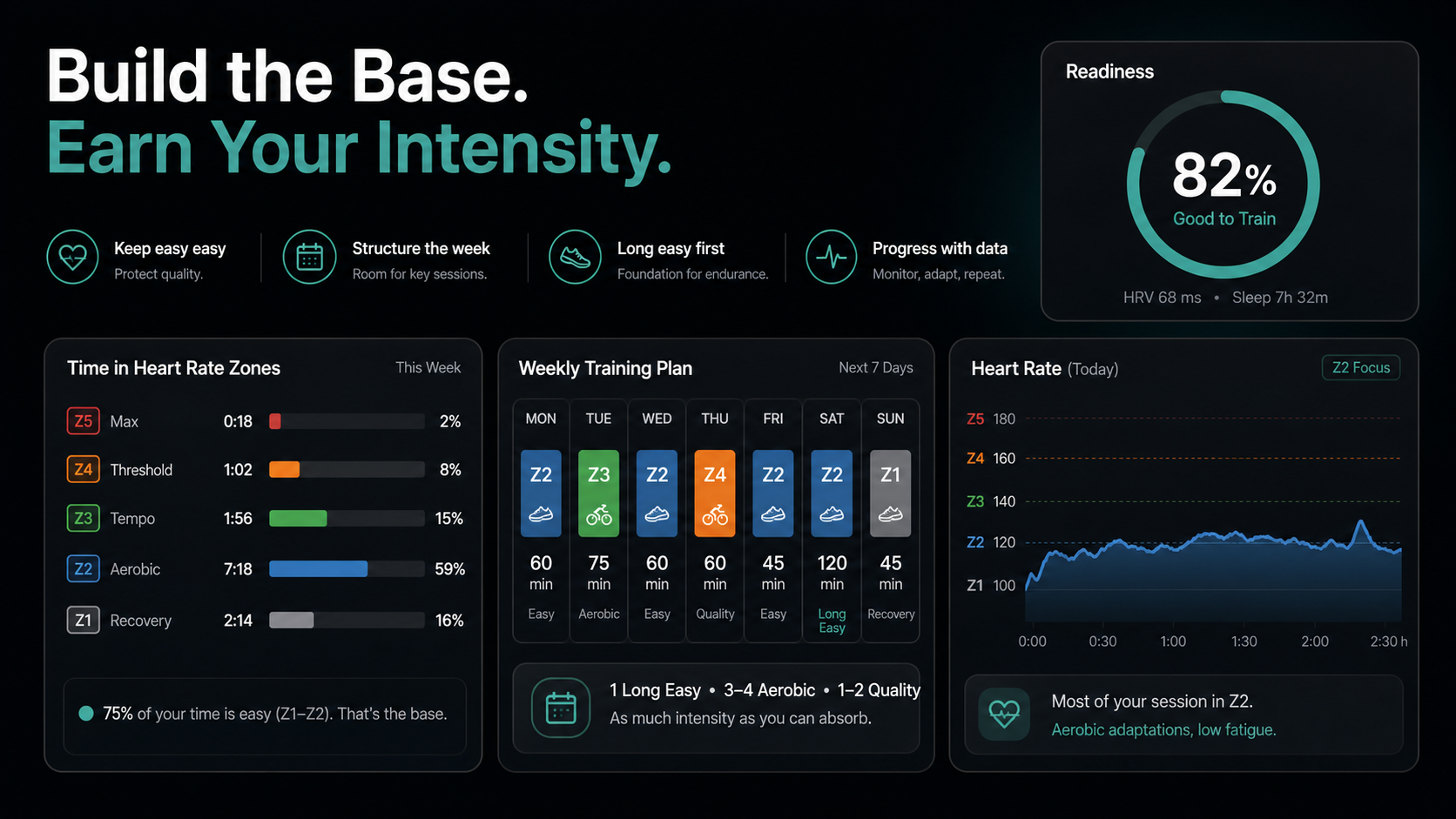
Here are practical starting points.
If you are new or returning after a long break, start with frequency. Three short aerobic sessions per week are better than one ambitious long session that makes you sore for days. Keep the sessions short enough that you could have done a little more.
If you already train consistently, build duration gradually. Add minutes to existing easy sessions before adding more intensity. A common pattern is one longer aerobic session, two or three shorter aerobic sessions, and one light dose of strides, hills, or intervals if you are ready.
If you are training for a long event, extend the long session carefully. The long run, ride, hike, or ski is often the most specific base workout, but it should not consume so much recovery that the rest of the week collapses.
If you are time limited, do not panic. You may not build the same base as a high-volume athlete, but you can still benefit from keeping most work controlled and adding intensity precisely. With only three sessions per week, your distribution may look less "elite" and more pragmatic: one longer easy session, one easy aerobic session, and one quality session.
A simple base-training week
A base week should look almost too simple.
For a runner training four days per week, it might be:
- Day 1: 35 to 45 minutes easy.
- Day 2: Rest or strength.
- Day 3: 40 to 55 minutes easy with 4 to 6 relaxed strides.
- Day 4: Rest or cross-training.
- Day 5: 30 to 45 minutes easy.
- Day 6: 60 to 90 minutes easy long run.
- Day 7: Rest or very easy recovery.
For a cyclist training five days per week, it might be:
- Day 1: 45 to 60 minutes easy spin.
- Day 2: 75 minutes aerobic endurance.
- Day 3: Rest or strength.
- Day 4: 60 minutes easy with a few short cadence drills.
- Day 5: Rest or very easy spin.
- Day 6: 2 to 3 hours aerobic endurance.
- Day 7: 60 to 90 minutes easy.
For a hiker or mountain athlete, base training may include brisk walking, easy uphill hiking, stair work, and loaded walking. The principle is the same: control breathing, keep the effort repeatable, and progress duration before intensity.
The exact schedule matters less than the pattern. You are trying to stack weeks. A good base week leaves you tired in a normal way, not flattened.
How long should a base phase last?
Many athletes use base blocks of 6 to 12 weeks, but the best length depends on your starting point and event calendar. A beginner may spend several months simply learning to train consistently. An experienced athlete may emphasize base for a shorter block before adding race-specific intensity. A year-round athlete may keep base training present in every phase.
Use progress markers instead of calendar obsession.
Good signs include:
- You can complete more weekly minutes without extra soreness.
- Easy pace or power improves at the same heart rate.
- Heart rate drifts less during longer aerobic sessions.
- You recover faster after routine workouts.
- You can add light intensity without losing control of the week.
- Your long session feels less intimidating.
Poor signs include:
- Easy sessions keep turning moderate.
- Resting fatigue rises for more than a few days.
- Sleep, mood, or motivation deteriorate.
- Your easy pace slows while heart rate rises.
- You need more recovery from workouts that used to be routine.
Base training should create capacity. If it only creates fatigue, either the intensity is too high, the volume is too high, life stress is too high, or your recovery habits are not supporting the plan.
How to set your aerobic base intensity
There are four practical ways to set base intensity. The best option is the one you can use consistently.
Use thresholds if you have them
If you have recent lactate or cardiopulmonary testing, use the first threshold as your ceiling for most base work. This is especially helpful for athletes whose heart-rate formulas are inaccurate.
Threshold testing is not perfect. Faude and colleagues found many lactate-threshold concepts in the literature and noted ongoing debate about terminology and interpretation Faude et al., 2009. Still, an individually measured threshold is usually more useful than a generic percentage of max heart rate.
Use heart rate conservatively
Heart rate is useful because it reflects internal load, but it lags behind effort and changes with conditions. Heat, caffeine, dehydration, poor sleep, stress, altitude, and cardiac drift can all push heart rate higher. Cold weather, fatigue, and some medications can change it too.
For base training, treat heart rate as a guardrail, not a command. If your target range says you can go faster but your breathing says no, listen to breathing. If your heart rate climbs steadily during a long easy session while pace stays constant, slow down or shorten the session.
Use the talk test
The talk test is blunt but useful. During base work, you should be able to speak in full sentences. You may not want to hold a podcast interview on a climb, but you should not be limited to one-word answers.
This works because ventilatory changes are closely tied to intensity domains. The AHA CPET statement describes how exercise testing can evaluate ventilatory and gas-exchange responses during incremental exercise Balady et al., 2010. You are using a field version of the same idea: breathing tells you when the effort has changed.
Use pace or power carefully
Pace and power are external outputs. They are useful for tracking progress, but dangerous when used as ego targets. A pace that is aerobic on a cool flat day may be too hard in heat or hills. A cycling power target that is easy when fresh may become costly after a hard week.
Use pace or power to observe, not force. The goal of base training is not to prove that you can hold a number. The goal is to build the system that makes better numbers sustainable later.
Should base training include intensity?
Usually, yes, but the amount depends on the athlete and the phase.
A pure base phase with no intensity can be useful for beginners, return-to-training periods, injury comeback phases, or athletes who have been doing too much moderate work. But many athletes benefit from small touches of speed even during base training.
For runners, that might mean short relaxed strides after an easy run. For cyclists, it might mean cadence drills or brief neuromuscular spin-ups. For hikers, it might mean a few short hill surges with full recovery. These are not workouts that create deep fatigue. They preserve coordination, movement quality, and comfort at faster rhythms.
The bigger question is when to add structured threshold or VO2max work. Once your weekly volume is stable and easy sessions are truly easy, one quality session per week can fit well. As the event approaches, the plan can become more specific.
This is where base training and polarized or pyramidal training connect. Seiler's review suggests successful endurance athletes often combine a large amount of low-intensity work with a smaller amount of high-intensity work Seiler, 2010. Stoggl and Sperlich's intervention also suggests that well-trained athletes may respond well when hard work is included without letting threshold-like training dominate Stoggl and Sperlich, 2014.
The practical formula: keep the base big enough that the intensity works, and keep the intensity small enough that the base stays repeatable.
Common aerobic base training mistakes
The first mistake is going too hard. This is the classic gray-zone trap. You feel good, the pace creeps, and the run becomes a tempo workout with no warm-up, no purpose, and no recovery plan. Do that often enough and your easy days disappear.
The second mistake is going so easy that the session loses purpose. Recovery sessions can be very easy, but base training should still be training. If you are always far below a useful aerobic stimulus, you may maintain activity without building much capacity. The fix is not to force every session upward. The fix is to separate recovery days from aerobic development days.
The third mistake is adding volume too quickly. Aerobic systems may tolerate more work before your connective tissues, bones, and muscles are ready. Runners need to be especially careful because impact load rises with duration. Cyclists may tolerate more hours, but they can still accumulate fatigue through posture, muscle tension, and fueling errors.
The fourth mistake is under-fueling. Because base work is often associated with fat oxidation, some athletes assume it should be done depleted. That can backfire. You do not need to turn every easy session into a carbohydrate-heavy event, but routinely under-fueling can reduce training quality, increase stress, and make later sessions worse. Base training is about adaptation, not proving you can suffer on empty.
The fifth mistake is ignoring strength and mobility. A bigger aerobic engine does not help much if your body cannot tolerate the work. Strength training, mobility, and basic tissue capacity support the consistency that base training requires.
The sixth mistake is expecting every metric to improve immediately. Base training often works slowly. You may see heart-rate drift improve before pace improves. You may feel more stable before your watch gives you a better fitness score. Give the process enough weeks to show up.
How to know whether your aerobic base is improving
You do not need a lab to see progress. Track repeatable field signals.
One useful marker is aerobic decoupling, often called heart-rate drift. On a steady long session, compare the first half to the second half. If pace or power stays similar but heart rate rises sharply, endurance durability may be limited or conditions may be stressing you. If drift decreases over time under similar conditions, your base may be improving.
Another marker is easy pace or power at the same heart rate. If you can run faster at 140 beats per minute than you could two months ago, that is useful progress. It is not perfect because terrain, weather, fatigue, and device accuracy matter, but trends over time are informative.
A third marker is recovery. If a 60-minute easy run used to leave your legs heavy and now feels routine, your base is improving even if the pace has not changed much.
A fourth marker is long-session stability. You can finish long aerobic sessions without a late collapse in form, breathing, or mood. That is not glamorous, but it is a major endurance skill.
A fifth marker is readiness for intensity. If you add a harder workout and it no longer wrecks the week, your base is doing its support job.
Be careful with isolated data points. A single hot day can make your aerobic base look worse. A rested day with cool weather can make it look better. Use trends across similar sessions.
Who benefits most from aerobic base training?
Beginners benefit because they need consistency more than complexity. The fastest path is usually not aggressive intervals. It is learning to train regularly without making every session a recovery problem.
Intermediate athletes benefit because they often live in the moderate zone. They are fit enough to push, but not disciplined enough to keep easy days easy. Aerobic base training gives them a way to increase volume and recover better.
Advanced athletes benefit because high performance requires a lot of specific work, and specific work requires support. The stronger the base, the more precisely an athlete can use threshold work, VO2max intervals, race-pace sessions, and long event-specific workouts.
Masters athletes may benefit because recovery cost rises with age, life stress, and training history. Controlled aerobic work allows high consistency without needing every session to be heroic.
Time-limited athletes benefit too, but they need a realistic version. If you only train three hours per week, you probably need some intensity at certain points. But even then, making the easy work genuinely easy can improve the quality of the limited hard work you do.
When aerobic base training is not enough
Base training is foundational, not complete. If your goal is to race faster, climb harder, improve sprint power, run a faster 5K, or hold threshold power in a time trial, easy aerobic work alone will eventually leave gaps.
You may need threshold training to raise sustainable race effort. You may need VO2max intervals to improve high-end aerobic power. You may need hills, strides, sprints, or strength work to improve neuromuscular qualities. You may need race-pace practice to learn fueling, pacing, and mechanics under specific stress.
Midgley, McNaughton, and Jones reviewed training recommendations for long-distance running and argued that direct scientific evidence is limited for prescribing exact methods to trained runners, partly because studies differ in design, training status, and control of background training Midgley et al., 2007. That is a useful caution. No single article, coach, or watch metric can prescribe the perfect plan for every athlete.
The right lesson is balance. Aerobic base training is necessary for most endurance goals, but not sufficient for all of them. Build the base, then add specificity.
Frequently asked questions
Is aerobic base training the same as zone 2 training?
Not exactly. Zone 2 is an intensity zone. Aerobic base training is a training emphasis. Many base sessions happen in zone 2, but depending on your zone model, sport, and fatigue, some base work may be in zone 1 or near the top of zone 2. The goal is controlled aerobic development below the point where fatigue cost rises sharply.
Can I do aerobic base training every day?
Some experienced athletes can do low-intensity aerobic work most days, but that does not mean everyone should. Beginners often need rest days between sessions. Runners need to respect impact. Cyclists and hikers may tolerate more frequency but still need recovery. Daily base work is only useful if it stays repeatable.
How slow should base training feel?
It should feel controlled, not embarrassingly slow for its own sake. Early in a base phase, many athletes need to slow down more than expected. Over time, the same heart rate or effort may produce better pace or power. That is the point.
Can I lift weights during base training?
Yes. Strength training can support durability, especially for runners and older athletes. Keep it consistent and avoid suddenly adding heavy lifting volume that compromises your aerobic sessions. During a base phase, strength work should support the plan, not compete with it.
Should I do fasted base training?
Not by default. Some athletes use occasional low-carbohydrate or fasted sessions strategically, but it is easy to overuse. If fasted training makes you sluggish, irritable, under-recovered, or unable to complete the week, it is not helping. Most athletes should fuel enough to train consistently.
How do I stop easy days from becoming too hard?
Use a ceiling. That ceiling can be heart rate, breathing, RPE, or power. Start easier than you think for the first 10 to 15 minutes. On hills, shorten stride or shift gears instead of fighting the grade. If the session has no quality objective, do not chase pace.
How long until I notice results?
Some changes, like better control of easy effort, can happen within a few weeks. Deeper changes in durability and aerobic output usually need months. Look for trends: lower heart rate at the same pace, less drift, better recovery, and longer sessions feeling routine.
Conclusion
Aerobic base training is the disciplined work of building endurance capacity below the intensity where fatigue rises quickly. It is usually conversational, repeatable, and mostly below the first lactate or ventilatory threshold. It improves the systems that let you train more consistently, recover better, and make harder workouts more effective later.
The mistake is treating base training as either magic or meaningless. It is neither. It is a practical way to organize the largest share of endurance work so that your body can adapt without constantly paying the cost of moderate-hard effort.
For most athletes, the best starting point is simple: keep most sessions easy enough to repeat, extend duration gradually, track how your body responds, and add intensity only when it improves the week rather than destabilizing it. That is how aerobic base training becomes more than slow miles. It becomes the foundation for durable fitness.

Our editorial approach & AI disclosure
We use AI to help research, organize, and draft some articles. Every article is reviewed by a human editor and aims to reflect current evidence-based training practices and scientific literature.
Read our editorial policy