


Acute vs Chronic Training Load
Acute training load is recent stress, while chronic training load is the baseline you have built over several weeks. Learn how to compare them, what the acute:chronic workload ratio can and cannot tell you, and how to use load trends in weekly training reviews.
Jun 22, 202614 min read

Introduction
Acute training load is your recent training stress. Chronic training load is the baseline you have built over several weeks. The useful question is not which one is more important. The useful question is whether your current training stress fits the capacity you have recently developed.
That comparison matters because the same week can mean different things in different contexts. A 10-hour training week may be normal for an athlete who has averaged 8 to 10 hours for months. The same 10-hour week may be a major spike for someone returning from illness, injury, travel, or a long break. A hard interval session may be productive when it sits on top of consistent training. It may be too costly when it lands after several low-load weeks.
This is the idea behind acute vs chronic training load and the acute:chronic workload ratio, often shortened to ACWR. In simple terms, ACWR compares recent load with longer-term load. It tries to answer: is this week's stress close to the load I am prepared for, or is it a sudden jump?
The idea is useful, but it is easy to overuse. Training-load monitoring can help athletes understand both the work performed and the body's response to that work, as described in the training-load consensus statement by Bourdon and colleagues (Bourdon et al., 2017). But load metrics are not magic. Impellizzeri, Marcora, and Coutts emphasize that external load and internal load are different concepts and should not be treated as interchangeable (Impellizzeri et al., 2019).
That distinction is the foundation of this article. Acute and chronic load are not just spreadsheet numbers. They are a way to compare current stress, recent preparation, and recovery response.
Acute vs Chronic Training Load: The Short Answer
Acute training load is the load from your recent training. In many tools and research papers, it is often modeled as the last 7 days or the current week.
Chronic training load is your longer baseline. In many models, it is often the last 3 to 6 weeks, with 28 days commonly used in acute:chronic workload ratio examples.
The acute:chronic workload ratio compares the two:
acute load / chronic load = acute:chronic workload ratioIf your acute load is 600 arbitrary units and your chronic load is 500, the ratio is 1.2. Your recent load is 20 percent above your longer baseline.
If your acute load is 800 and your chronic load is 400, the ratio is 2.0. Your recent load is double your longer baseline.
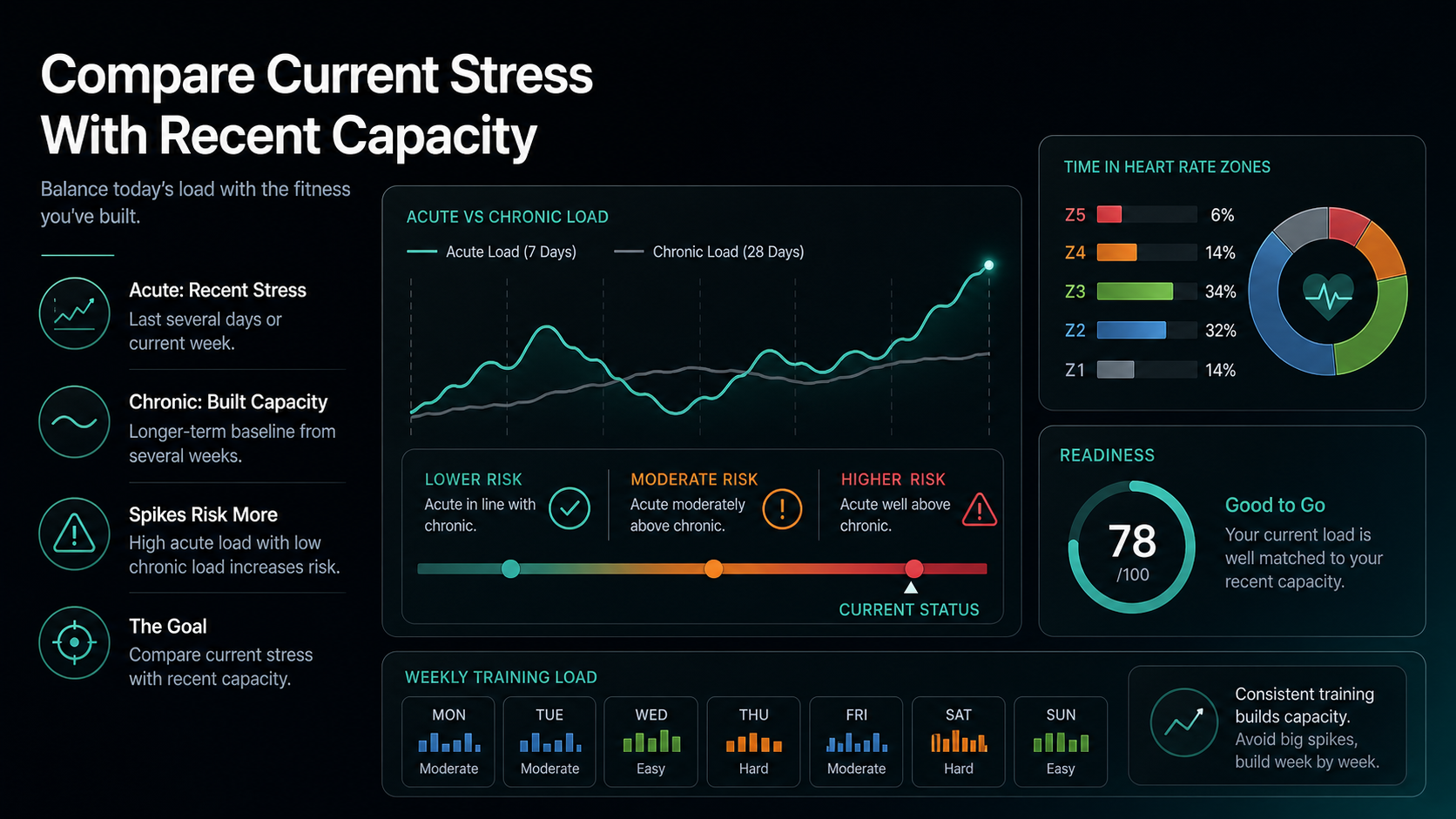
The practical takeaway is simple: compare current stress with recent capacity. A hard week after steady training is different from the same hard week after low training. A sudden jump deserves attention, especially if recovery signals are poor.
But do not treat ACWR as a guarantee of safety or injury. It is better used as a trend lens than as a prediction machine.
What Counts As Training Load?
Training load can be measured in different ways, and the metric you choose changes what acute and chronic load mean.
External load is the work performed. For runners, that may be mileage, duration, elevation, pace, interval volume, or time in zones. For cyclists, it may be duration, power, kilojoules, climbing, time in power zones, or high-intensity efforts. External load answers, "What did I do?"
Internal load is how the body responded. It can include heart rate, perceived exertion, session RPE, soreness, fatigue, mood, sleep, resting heart rate, and heart rate variability. Internal load answers, "What did it cost me?"
This matters because an acute spike in external load is not always the same as an acute spike in internal load. A 90-minute easy run in cool weather may be routine. The same run in heat, after poor sleep, with poor fueling, may create a much higher internal load. Halson's review on training-load monitoring makes this point clearly: understanding fatigue requires looking at the load and the athlete's response (Halson, 2014).
For everyday endurance athletes, the best starting load metrics are usually simple:
- Weekly training time.
- Weekly distance, if relevant.
- Time in training zones.
- Session RPE load.
- Hard-session count.
- Long-session duration.
- Recovery markers.
Session RPE load is especially useful because it works across sports. You rate the whole session from 1 to 10, then multiply by duration in minutes. Foster and colleagues described this practical approach to monitoring exercise training (Foster et al., 2001). A 60-minute easy session rated 3 gives 180 units. A 60-minute hard session rated 8 gives 480 units.
That does not make session RPE perfect. It makes it usable. The best load metric is the one you can record consistently and interpret honestly.
How The Acute:Chronic Workload Ratio Works
The classic ACWR idea compares short-term load with longer-term load.
In a simple rolling-average model:
- Acute load might be the last 7 days.
- Chronic load might be the average of the last 28 days.
- The ratio compares the two.
For example:
| Athlete | Acute Load | Chronic Load | Ratio | Practical Meaning |
|---|---|---|---|---|
| A | 500 | 500 | 1.0 | Current load matches baseline |
| B | 650 | 500 | 1.3 | Current load is above baseline |
| C | 900 | 450 | 2.0 | Current load is a major spike |
| D | 300 | 600 | 0.5 | Current load is far below baseline |
This is intuitive. If recent stress is much higher than your baseline, you may be asking the body to handle more than it has recently practiced. If recent stress is far lower than your baseline, you may be deloading, tapering, ill, injured, traveling, or losing training rhythm.
Early ACWR studies helped popularize this way of thinking. Hulin and colleagues reported that the acute:chronic workload ratio was associated with injury risk in elite rugby league players and that higher chronic workload may be protective in some contexts (Hulin et al., 2016). Gabbett's training-injury prevention paper also argued that athletes need sufficient training to tolerate sport demands, while poorly managed spikes can be problematic (Gabbett, 2016).
The most useful idea from that work is not a universal number. It is the tension between preparedness and spike. A well-built chronic load can represent capacity. A sudden acute jump can represent stress that may be harder to absorb.
Why Chronic Load Can Be Protective
Chronic load is often misunderstood. It is not just fatigue. It can also represent preparation.
If you have trained consistently for several weeks or months, your tissues, energy systems, coordination, fueling habits, and recovery routines have had time to adapt. That does not make you invincible, but it changes what a given session means. A long run, hard ride, or demanding hike is usually easier to tolerate when it fits a pattern you have gradually built.
This is why low training followed by a sudden big week can feel rough. The issue is not simply that the week was hard. The issue is that the hard week arrived without enough recent preparation underneath it.
For a runner, this can look like:
- Jumping from 20 miles per week to 35.
- Adding hill repeats after several flat easy weeks.
- Racing hard after a low-volume month.
- Returning from injury and adding both long-run distance and intervals.
For a cyclist, it can look like:
- Doubling weekly hours because the weather improved.
- Turning one group ride into three.
- Adding threshold intervals after weeks of easy riding.
- Doing a long climbing weekend after mostly flat training.
The chronic-load idea reminds you that capacity is built, not declared. If you want to handle a bigger acute load, build the baseline first.
Why Acute Spikes Can Be Costly
An acute spike is a short-term jump in load. It can come from volume, intensity, terrain, mechanical stress, heat, or life stress.
The obvious spike is adding too much volume. But many spikes are less visible. A runner may keep weekly mileage the same while adding hills, strides, and a faster long-run finish. A cyclist may keep weekly hours stable while adding more high-intensity surges. The training log shows a normal week, but the body experiences a harder week.
Acute spikes can also be internal. Suppose your external load is normal, but sleep is poor, work stress is high, and heart rate is elevated on easy days. Your body may be responding as if the week is much harder than planned. That is why internal load should sit next to external load in the review.
The International Olympic Committee consensus statement on load in sport and injury risk notes that load can influence injury risk, but the relationship is complex and depends on the athlete, sport, tissue, and context (Soligard et al., 2016). This is the right level of confidence for everyday athletes: spikes matter, but they are not the only thing that matters.
A spike deserves more attention when it combines several stressors:
- Higher total volume.
- More high-intensity time.
- More downhill, sprinting, climbing, or technical terrain.
- Poor sleep.
- Low fueling.
- Heat or altitude.
- Pain or unusual soreness.
- Returning from illness or injury.
The more of these you stack together, the more conservative your next decision should be.
The Evidence Is Useful, But Not Settled
The acute:chronic workload ratio became popular because it gave coaches a simple way to discuss workload spikes and preparation. But the evidence is not as simple as the chart often looks.
A systematic review by Griffin and colleagues examined the association between ACWR and injury in team sports (Griffin et al., 2020). The review reflects both the interest in ACWR and the difficulty of applying one workload model across different sports, injuries, data sources, and calculation methods.
Methodological critiques have also been important. Wang and colleagues reviewed lessons from ACWR research and highlighted problems with using the ratio too casually for activity and injury analysis (Wang et al., 2020). Other work has discussed issues such as mathematical coupling, where the acute load can be included inside the chronic load and create statistical complications. Lolli and colleagues argued that conventional acute-to-chronic workload ratio calculations can create spurious correlations through mathematical coupling (Lolli et al., 2019).
Calculation method matters too. Murray and colleagues compared rolling averages with exponentially weighted moving averages, reporting that the exponentially weighted model was more sensitive in their elite Australian football sample (Murray et al., 2017). That does not mean every athlete needs an advanced model. It means the ratio is not one universal object. How you calculate it changes what it says.
A more recent systematic review and meta-analysis on ACWR and sports injury risk shows that the topic is still being evaluated across sports and study designs (Qin et al., 2025). For practical coaching, the cautious interpretation is best: ACWR can help flag workload changes, but it should not be treated as a stand-alone injury predictor.
Use the concept. Be skeptical of false precision.
Common Mistakes With Acute And Chronic Load
The first mistake is treating a single ratio as a pass-fail test. A ratio near 1.0 does not prove you are safe. A high ratio does not prove you will get injured. It tells you that current load and recent baseline deserve a closer look.
The second mistake is ignoring what load metric was used. A ratio based on weekly distance may miss intensity. A ratio based on heart rate may miss downhill running or sprint mechanics. A ratio based on power may miss poor sleep, heat, or soreness. The metric defines the meaning.
The third mistake is comparing your ratio with someone else's. Chronic load is personal. A training spike for one athlete may be normal for another. A low ratio for one athlete may be a deliberate taper, while for another it may reflect missed sessions and declining consistency.
The fourth mistake is increasing chronic load too aggressively because chronic load seems protective. Chronic load is only useful when it is built gradually enough to be absorbed. You do not create capacity by forcing a big number.
The fifth mistake is forgetting that low acute load can also matter. A very low week may be a planned recovery week, which is useful. But several low weeks followed by an ambitious return can create a spike later. Detours, travel, illness, and missed weeks all change what the next hard week means.
The sixth mistake is ignoring body response. If acute load is high and you feel good, you still need recovery. If acute load looks normal but your internal response is unusually high, the week may still need adjustment.
How To Use Acute And Chronic Load In A Weekly Review
A weekly review should turn the load trend into one decision.
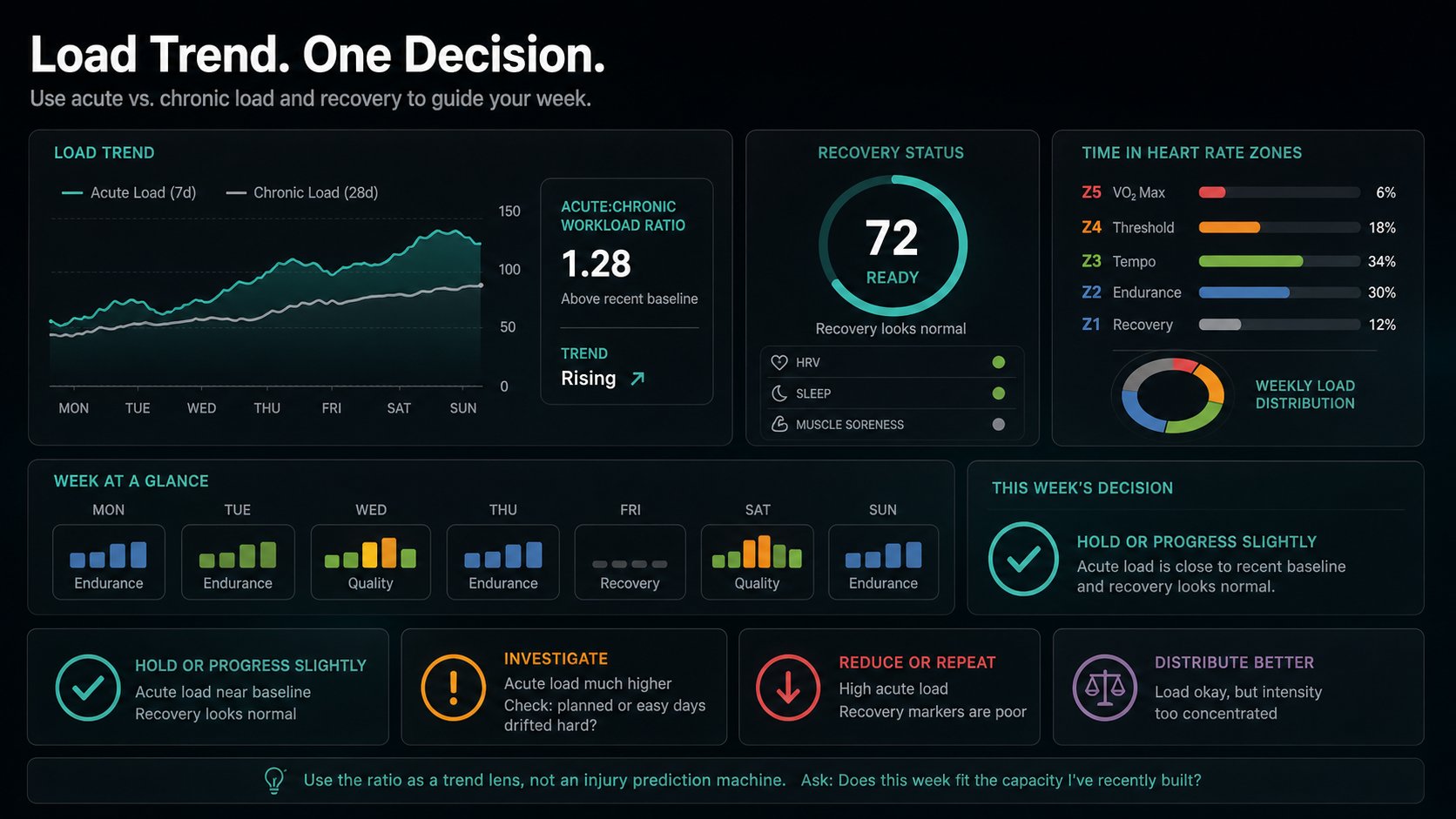
Start with the purpose of the week. Was this supposed to be a base week, build week, recovery week, taper, race week, or return-to-training week? A high acute load may be expected during a planned build. A low acute load may be expected during a deload. The number only makes sense against the plan.
Then compare acute load with chronic load. Ask:
- Is this week close to my recent baseline?
- Is it moderately above baseline?
- Is it a major spike?
- Is it far below baseline?
- Did the change come from volume, intensity, terrain, or life stress?
Next, compare the load trend with recovery:
- Did easy sessions feel easy?
- Did soreness resolve between sessions?
- Did sleep stay stable?
- Did mood and motivation hold?
- Did heart rate behave normally?
- Did pain appear or increase?
Then make one decision:
| Pattern | Next Decision |
|---|---|
| Acute load near baseline, recovery normal | Hold or progress slightly |
| Acute load above baseline, recovery normal | Keep the next increase small |
| Acute load well above baseline | Add recovery or reduce the next week |
| Acute load high, recovery poor | Reduce, repeat, or deload |
| Acute load low by design | Resume gradually after recovery |
| Acute load low because training was missed | Rebuild before hard sessions |
| Load okay, intensity crowded | Redistribute intensity and protect easy days |
This is where the concept becomes useful. You do not need the ratio to tell you your future. You need it to make next week less random.
Practical Examples
Example 1: the steady build.
A runner has averaged 30 miles per week for the last month. This week is 33 miles with one familiar threshold session and normal recovery. Acute load is slightly above chronic load, but the increase is controlled. The next decision may be to hold or progress slightly.
Example 2: the hidden spike.
A cyclist keeps weekly hours at 7, which looks normal. But two easy rides become group rides with repeated surges, and the weekend ride includes long climbs above threshold. The duration-based acute load looks stable, but intensity load has spiked. The next week should protect easy days.
Example 3: the return-from-break problem.
An athlete averages 2 hours per week during a busy month, then jumps to 6 hours when life calms down. The 6-hour week may not seem extreme in isolation, but it is high relative to recent chronic load. The safer move is to rebuild for a few weeks before adding intensity.
Example 4: the productive high-load week.
A trained athlete completes a planned training camp. Acute load is high, but chronic load has been built for months, fueling is good, sleep is prioritized, and the next week is easier. This is not the same as an impulsive spike. The context changes the meaning.
Example 5: the ratio looks fine but the body disagrees.
A runner's ratio sits near baseline, but easy pace feels unusually hard, resting heart rate is elevated, and soreness is lingering. The number is not alarming, but the internal response is. The next decision should be conservative.
A Simple Rule Set For Runners And Cyclists
Use acute and chronic load as a weekly conversation with your training log.
For runners:
- Build mileage gradually enough that easy days still feel easy.
- Watch changes in long-run distance, hills, surface, and speed work.
- Treat downhill, sprinting, and trail terrain as load, not just scenery.
- Be careful when returning from low-volume weeks.
- Add intensity only when the easy baseline is stable.
For cyclists:
- Track hours, power, climbing, and hard surges separately.
- Do not let group rides disguise intensity spikes.
- Watch high-intensity time even when weekly hours look normal.
- Treat big climbing weekends as load spikes if you have not prepared for them.
- Use heart rate and RPE to catch heat, fatigue, or under-fueling.
For both:
- Compare this week with the last 3 to 6 weeks.
- Review external load and internal response.
- Avoid stacking volume, intensity, heat, poor sleep, and life stress.
- After a spike, make the next week easier or more controlled.
- After a break, rebuild before chasing old numbers.
If you want one practical sentence, use this: the harder this week is compared with your recent baseline, the more recovery evidence you need before progressing again.
Continue the Training Load Review
- Start with the practical definition of training load
- Decide whether you need a deload or a race taper
- Review the full week before reacting to one hard session
- Explore the Training Load guide hub
Conclusion
Acute training load is recent stress. Chronic training load is the baseline you have built over several weeks. Comparing them helps you see whether a week fits your recent preparation or represents a meaningful jump.
The acute:chronic workload ratio is one way to express that comparison, but it should not be treated as a stand-alone injury prediction tool. The research is useful, but the details are debated, and calculation choices matter.
For endurance athletes, the practical value is simpler than the math. Use acute and chronic load to notice spikes, respect low-preparation periods, protect recovery, and make better weekly decisions. Compare what you did, how hard it was, how your body responded, and whether next week should progress, repeat, reduce, or redistribute intensity.
The goal is not the perfect ratio. The goal is training that builds capacity without letting short-term stress outrun recovery.
Acute and Chronic Load at a Glance
| Question | Acute load | Chronic load |
|---|---|---|
| What does it represent? | Recent training stress, often summarized over about a week | The training base accumulated across several weeks |
| What changes it quickly? | A hard race, training camp, missed week, or sudden volume increase | Repeated weeks of consistent training or detraining |
| What is it useful for? | Seeing what the current week is costing | Understanding the recent workload context |
| What can it not prove? | Whether one session will cause injury | Whether an athlete is protected from injury |
The acute-to-chronic ratio compresses these two histories into one number. That can make a change easy to notice, but it does not create a universal safe zone. Methodological critiques have found fundamental problems with using ACWR to prescribe training or predict injury (Impellizzeri and colleagues). Use the ratio as a prompt to inspect the actual weeks: session type, progression, symptoms, recovery, and the athlete’s training history.
If acute load rises, ask why before reacting. A planned overload followed by recovery is different from several accidental moderate days, and a low ratio caused by missed training is different from a well-executed deload. Start with what training load represents, then use the trend to make a specific weekly decision.